Teacher Portal:
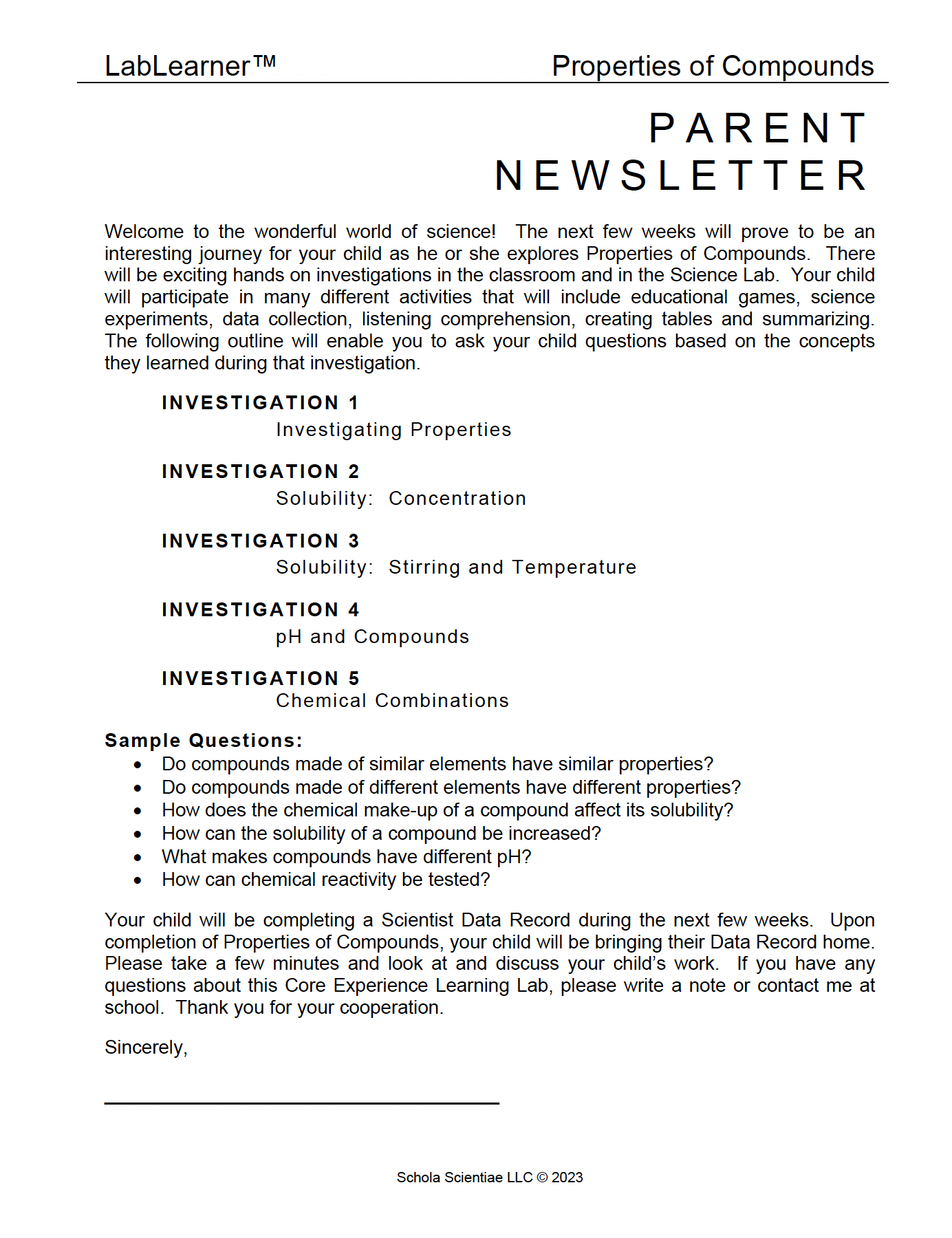
Properties of Compounds
Properties of Compounds: Investigation 1 - Investigating Properties
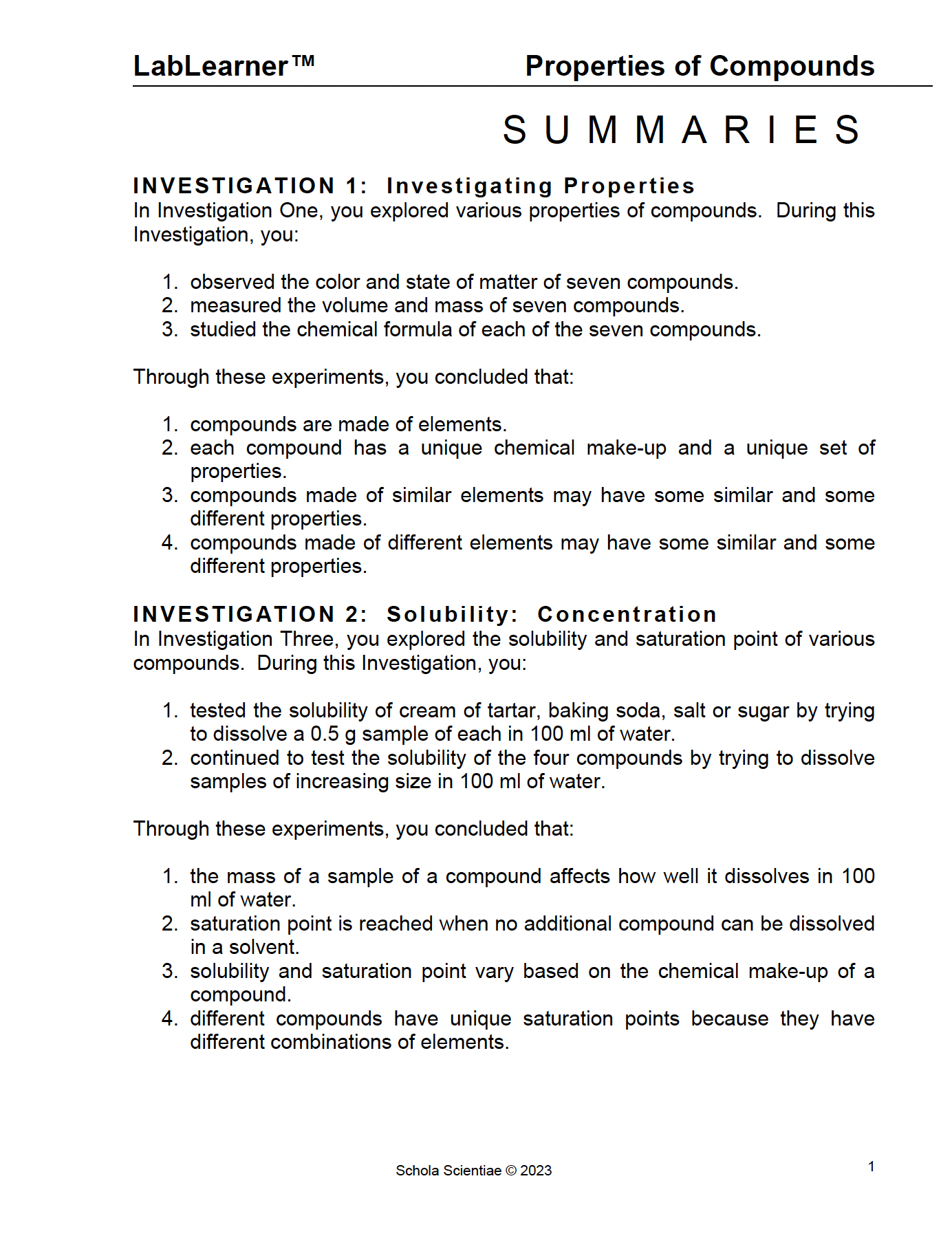
Investigation One introduces students to the concept of compounds. Through observation and experimentation, students will learn the difference between qualitative and quantitative properties. Students will use volumetric equipment and the triple beam balance to obtain measurements of the compounds. Students will discover that although compounds can share similar properties, they each have a unique set of properties that define them.
Properties of Compounds: Investigation 2 - Solubility: Concentration
In Investigation Two, students will continue their study of the properties of compounds through experimentation. Students will perform simple tests to determine whether or not a compound is soluble in water. Students will continue exploring solubility by determining the saturation point of each compound. Their observations will enable them to realize that compounds that contain the same or different elements each have a different solubility and that solubility is determined by the unique combination of elements that compose a compound.
Properties of Compounds: Investigation 3 - Solubility: Stirring and Temperature
During Investigation Three, students will determine how the solubility of compounds can be increased. While performing simple tests, students will determine the effect that stirring and the temperature of a solvent have on the solubility of a compound. Through their experiments, students will conclude that although solubility and saturation point are unique to each compound, most compounds respond similarly to changes in stirring and temperature. In the final experiment in this Investigation, students will test whether the increase in solubility seen with increases in stirring and temperature occurs at all concentrations of a solute in a solvent.
Properties of Compounds: Investigation 4 - pH and Compounds
Investigation Four introduces students to the concept of pH. Through observation and experimentation, students will determine that pH is a quantitative property of all compounds. Students will discover that in order to test the pH of a solid, the solid must first be made in a solution. Students will also learn that the pH of a compound depends upon the unique combination of elements in that compound.
Properties of Compounds: Investigation 5 - Chemical Combinations
In Investigation Five, students will have an opportunity to investigate the chemical reactivity of compounds by combining two compounds, as well as, compounds and various substances. Students will observe the each combination to determine whether or not signs of chemical change are exhibited. By observation and experimentation, students will come to the understanding that the unique combinations of elements of compounds determine how they will react with other compounds and substances.
Properties of Compounds: Investigation 6 - Performance Assessment
Investigation Six consists of a performance assessment designed to evaluate students’ understanding of the science concepts addressed in the first five Investigations of the CELL. During this exploration, students will use the knowledge they have gained about solubility, saturation point, pH, and chemical reactivity to determine the identity of a solution that is made of an unknown solute and unknown solvent.