
Teacher Portal:
Properties of Compounds
Investigation 3
Investigation Two: Solubility-Stirring and Temperature
In Investigation One, students began their examination of the properties of compounds by comparing the qualitative and quantitative properties of compounds based on their chemical structure. Students discovered that compounds made of different elements can have properties that were the same. In addition, students discovered that compounds composed of the same elements can have different properties.
 Students continued their investigation of the effects of chemical structure on the properties of compounds by exploring how the composition affects solubility in Investigation Two. Students also discovered that compounds which are soluble have an upper limit of solubility called a saturation point. In Investigation Three, students will continue their exploration of the property of solubility by exploring how solubility can be affected by temperature and stirring.
The solubility of a compound is affected by the temperature of the solvent. In general, as the temperature of a solvent increases the amount of solute that can dissolve in that solvent increases. It then follows that, in general, as the temperature of a solvent decreases, the amount of solute that can dissolve in that solvent also decreases. This explains why it is easier to dissolve sugar in a cup of hot coffee than a glass of iced tea.
Kinetic Energy (Stirring and Temperature)
Increasing the temperature of a solution and stirring a solution both increase the rate of solubility as well as affecting the amount of solute that will dissolve. The rate of solubility is the speed at which a solute dissolves in a liquid. Many people have experienced that stirring a solution vigorously results in a solid dissolving more quickly than if the solution is stirred slowly. A solid will also dissolve more rapidly in a hot liquid than a cold liquid. The rate of solubility is expressed in units of mass per unit of time. Thus, both stirring and increased temperature allow more solute to be dissolved in a solvent and the solute dissolves more quickly as compared to instances in which a solute is not stirred or is in a colder solvent.
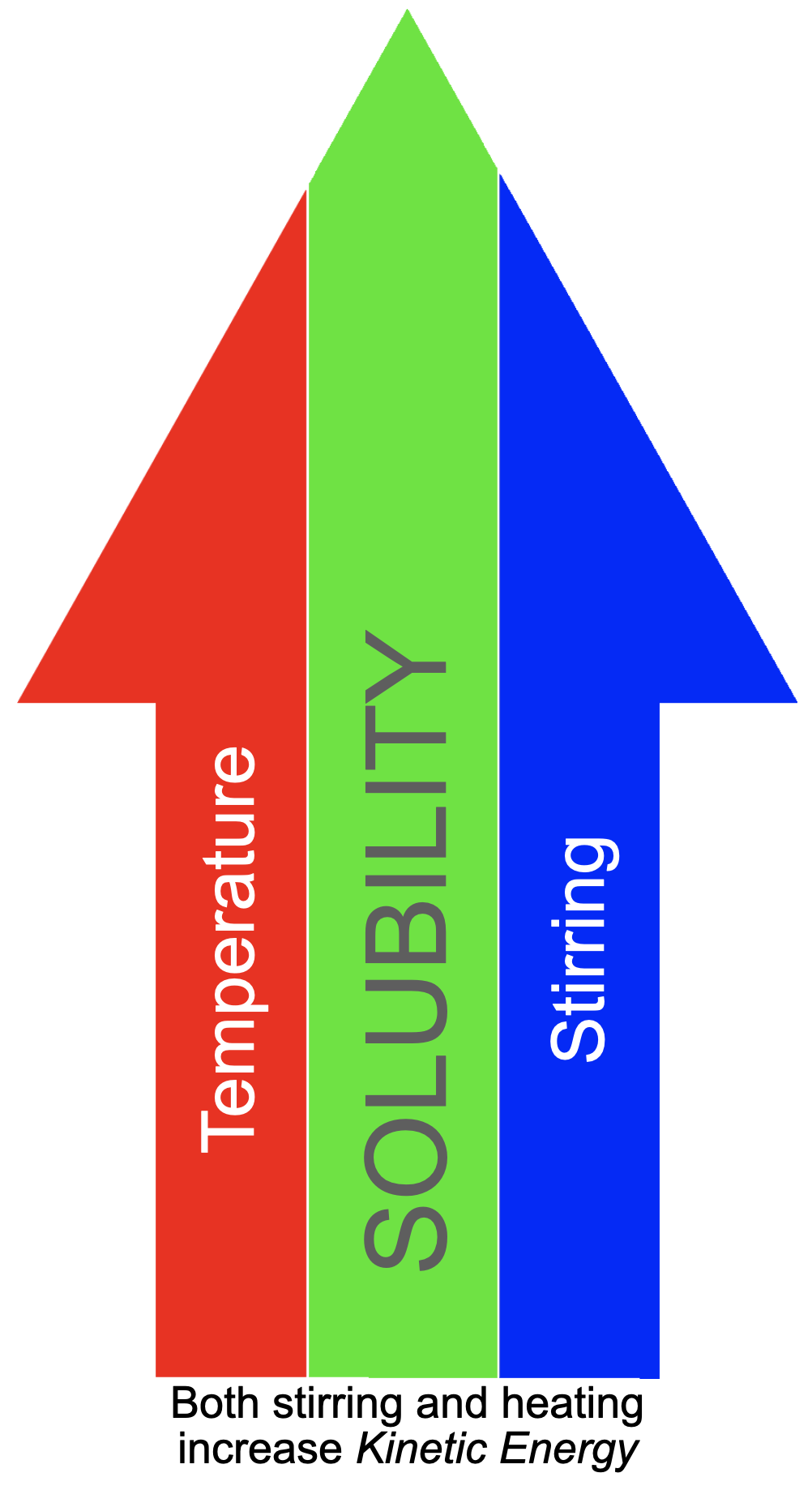 Why do you think that stirring and heat increase solubility? The answer has to do with kinetic energy. Recall that kinetic energy is the energy of movement. Stirring increases kinetic energy, as does heat. For solute compound molecules (sugar molecules, for example) to dissolve and become soluble in a solvent (water, for example), the water and sugar molecules must collide with each other. Anything that increases collisions between solute and solvent molecules will increase solubility.
Increased kinetic energy will cause both the solute and solvent molecules to increase the speed at which they move and the frequency that they collide. Both stirring and temperature are forms of kinetic energy. Stirring increases the kinetic energy of the solute/solvent interaction. Temperature is thermal energy, which is a form of kinetic energy. Heated molecules move faster and with more energy than cooler molecules.
In Investigation One, we discussed how increasing the temperature of a compound speeds up its molecules and can even cause a phase transition, either from solid to liquid or liquid to gas. Reexamine that graphic and notice how much more kinetic energy of movement occurs as water is heated from ice to liquid to gas.
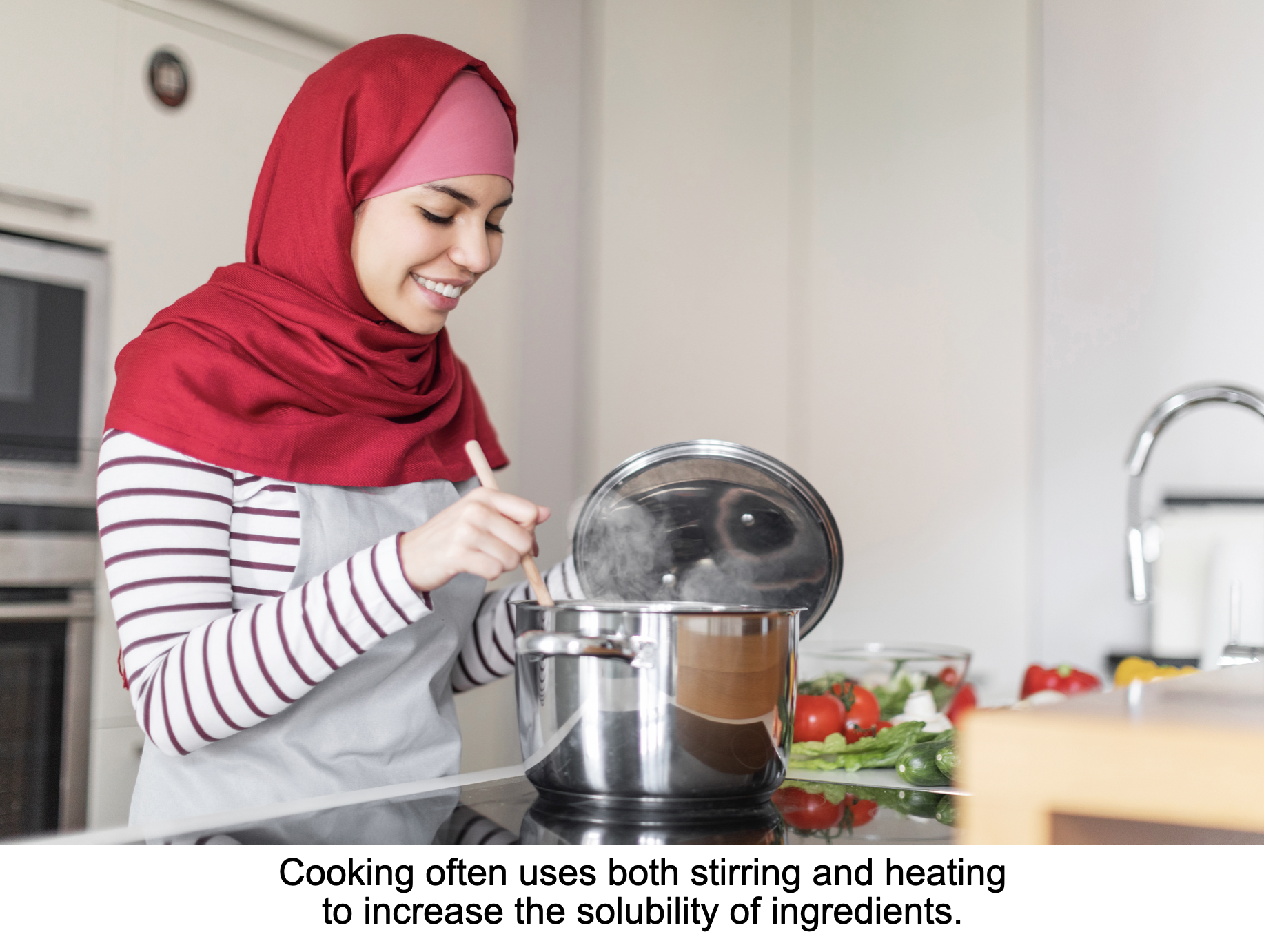
In this Investigation, students will explore how temperature and stirring affect the solubility of different compounds. Students will also examine how temperature and stirring affect the rate of solubility of the different compounds. In addition, students will compare how the elemental composition of compounds affects their response to stirring and temperature.
Properties of Compounds: Investigation 3 - Mathematics Concepts
Prelab
- quantitative properties
- comparing (non)measurable characteristics
- mass in grams
- volume in mL
- concentration
- greater than/less than/equal to
- counting whole numbers
- ratio
- decimals
- fractions
- rate
- (in)direct relationships
- time in minutes
- data table
Lab
- rate
- volume in mL
- temperature in Celsius
- mass in g
- time in minutes
- data table
Postlab
- quantitative properties
- greater than/less than/equal to
- volume in mL
- temperature in Celsius
- rate
- ratio
- data table
- data analysis
- comparing (non)measurable characteristics
- time in minutes
Properties of Compounds: Investigation 3 - Procedural Tools

Properties of Compounds: Investigation 3 - Cognitive Tools

Properties of Compounds:
Investigation 3 Quiz

