
Teacher Portal:
Properties of Compounds
Investigation 1
Investigation One: Investigating Properties
All substances on Earth are composed of matter, defined as anything that occupies space and has mass. Matter commonly exists in three physical states: solid, liquid, and gas. The states of matter are distinguished by their physical structure (see illustration below).
Solids are identified by their ability to hold a definite shape (notice how the ice cubes maintain their shape until they melt and become liquid). As a result, they have a definite volume. Also, the molecules within a solid more relatively slowly.
Liquids also have a definite volume but cannot hold a shape without a container (notice how the spilled water below loses the shape of the container once it leaves the cup). This explains why salt crystals will remain in a pile on a table unless disturbed, but an equivalent volume of water will spread into a thin film on the same table.
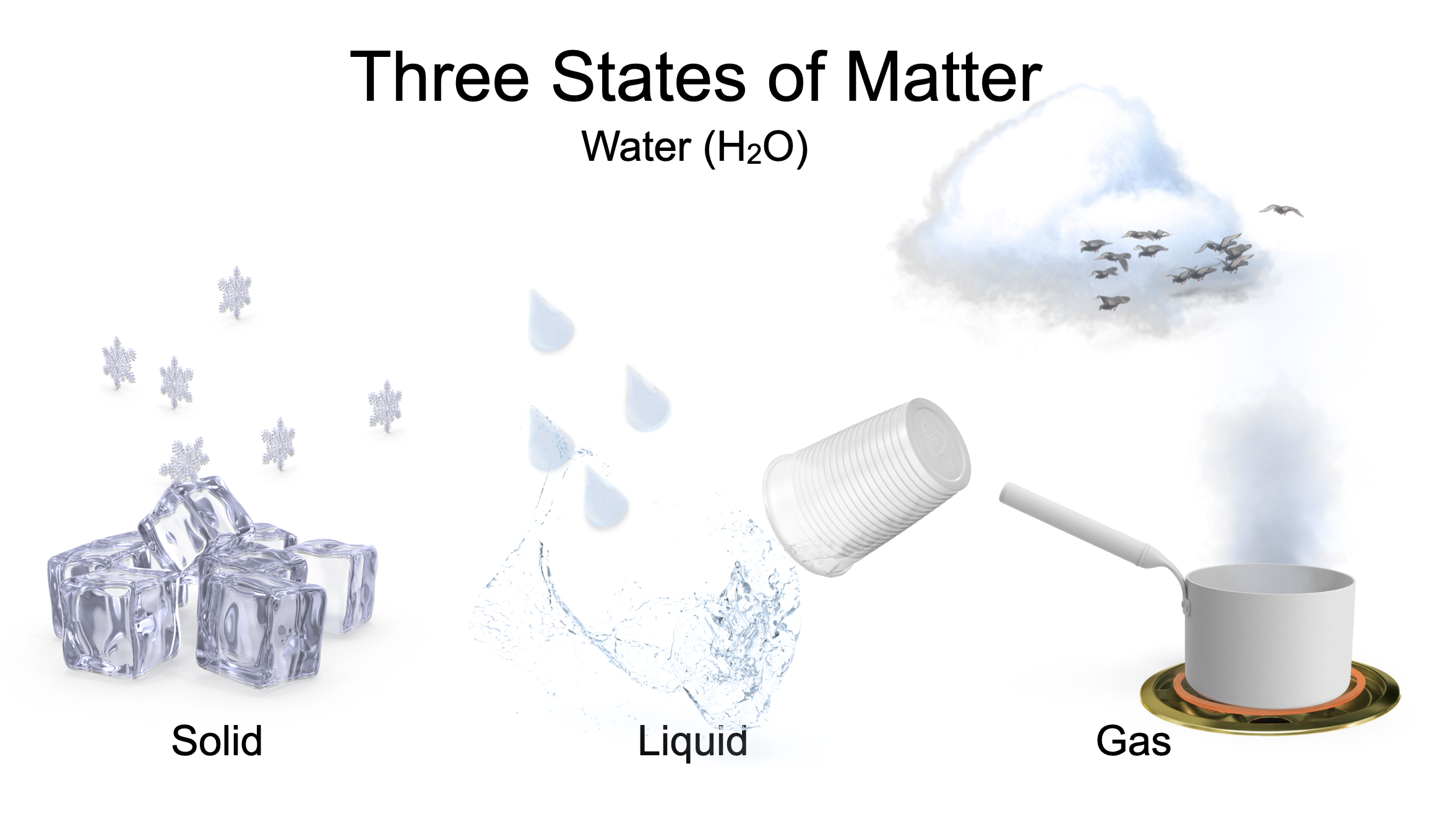
As with solids and liquids, gases have mass. However, their volume is defined solely by the volume of their container, as gas molecules will expand to fill the available space. The water vapor or gas in the above illustration leaves the boiling pot of liquid water and will spread to fill the room. Clouds are areas of water vapor (gas) that collect after water evaporates from the Earth’s surface.
Temperature (kinetic energy) is the major factor in determining the state and properties of a compound under normal conditions. As the kinetic energy and temperature increase, the molecules within a substance move faster. For example, there is very little movement of water molecules in solid ice (see below).
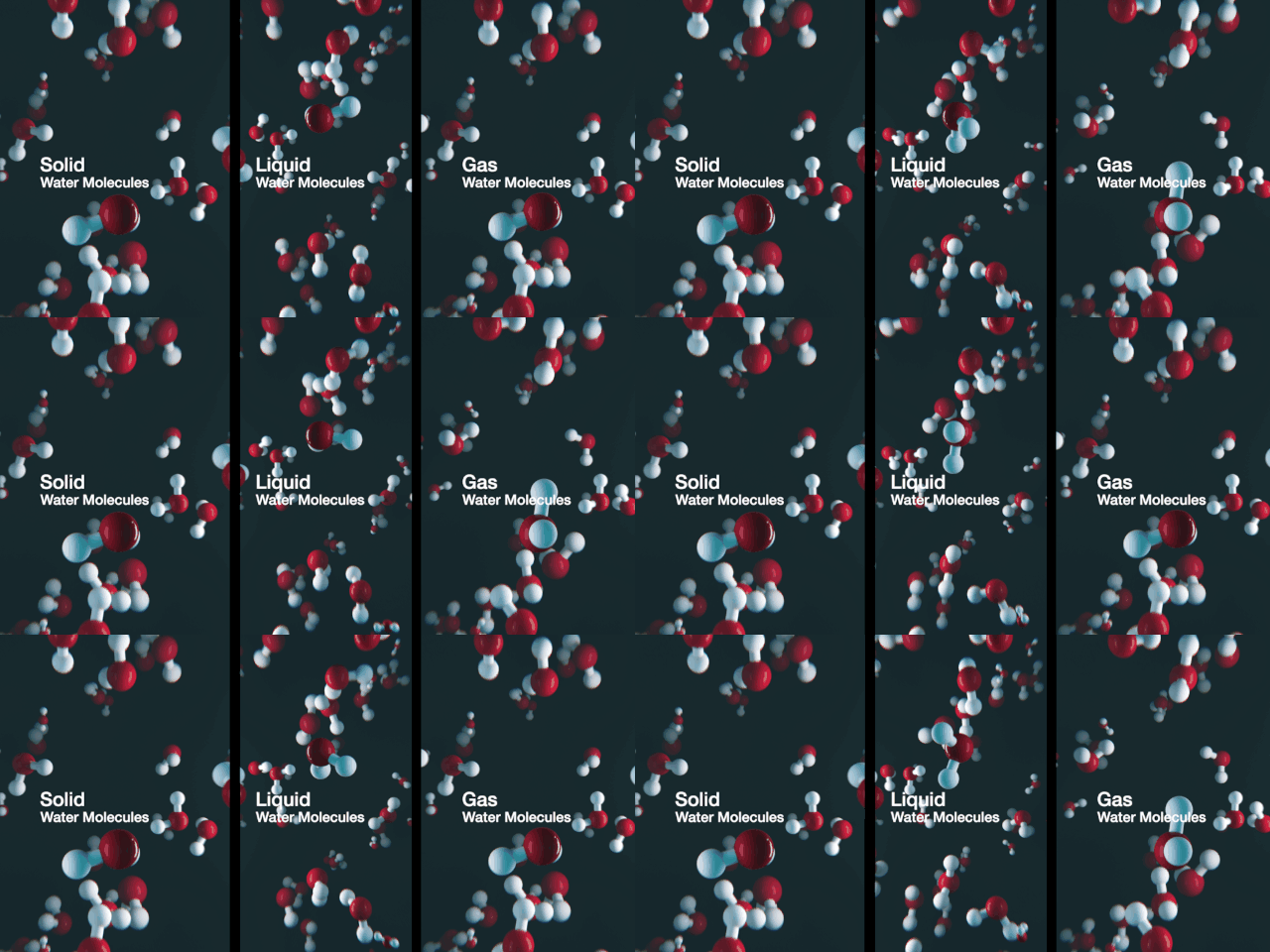
Simulated Speed of Water (H2O) Molecules in Ice, Liquid, and Gas Phase
However, with increased temperature, the water molecules in ice speed up, and the ice transitions (changes, melts) into a liquid. Additional heat further increases the movement of the water molecules until they separate from the liquid, forming the gas phase of water – steam.
The Periodic Table of Elements
In its simplest form, matter is made up of elements. Elements cannot be broken down into smaller components through chemical reaction. Elements can be combined with one 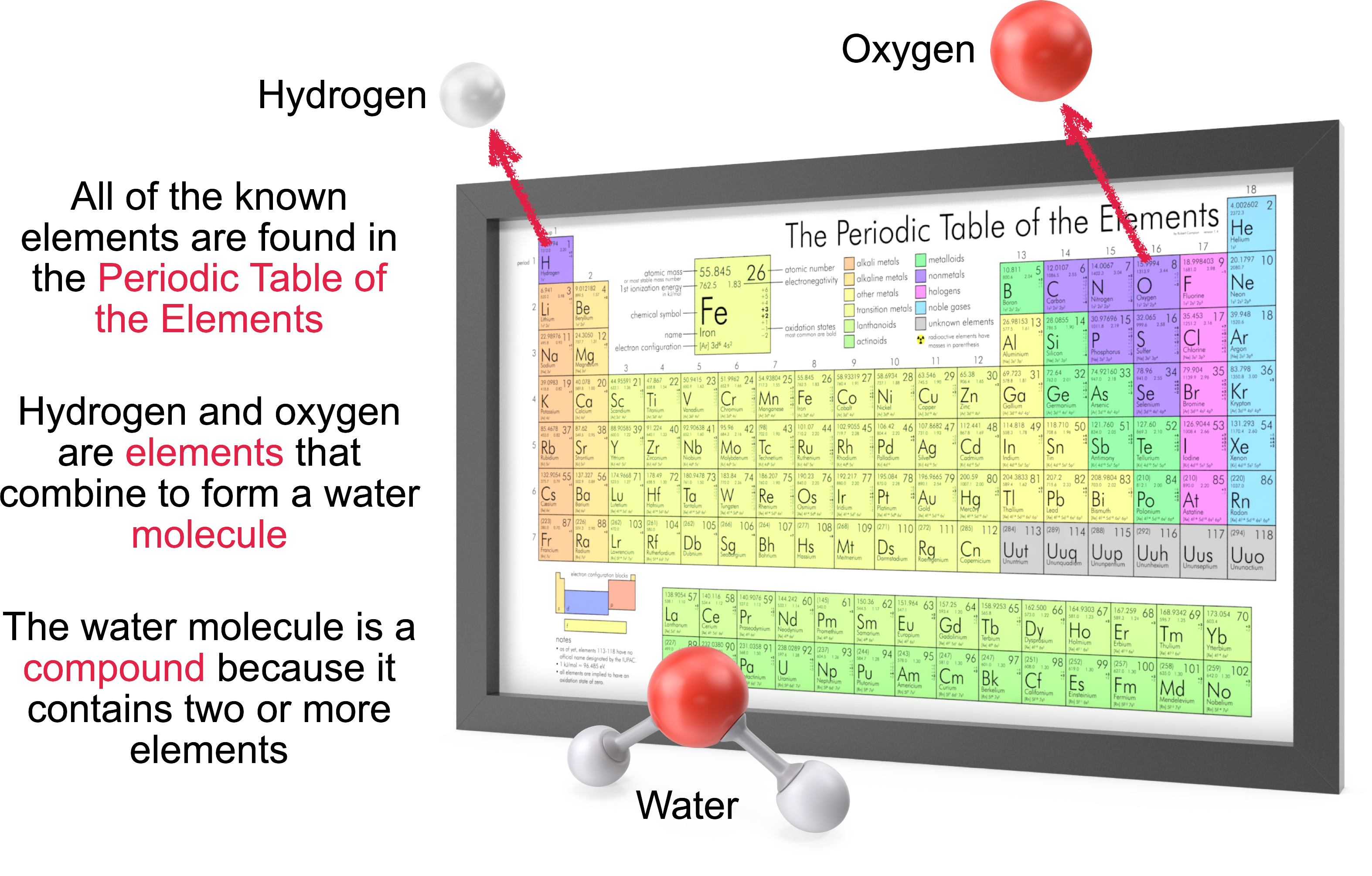 another to form compounds. Compounds, like all matter, have both qualitative and chemical properties. Scientists can use these properties to identify and classify compounds. In this CELL, students will explore properties of matter that are unique to compounds.
The elements in compounds are always present in the same ratios. These ratios are indicated by their chemical formulas. For example, the chemical formula for water is H2O. This means that there are two atoms of hydrogen for every atom of oxygen. The composition of matter and compounds in this CELL is described as consisting of different types of “particles”.
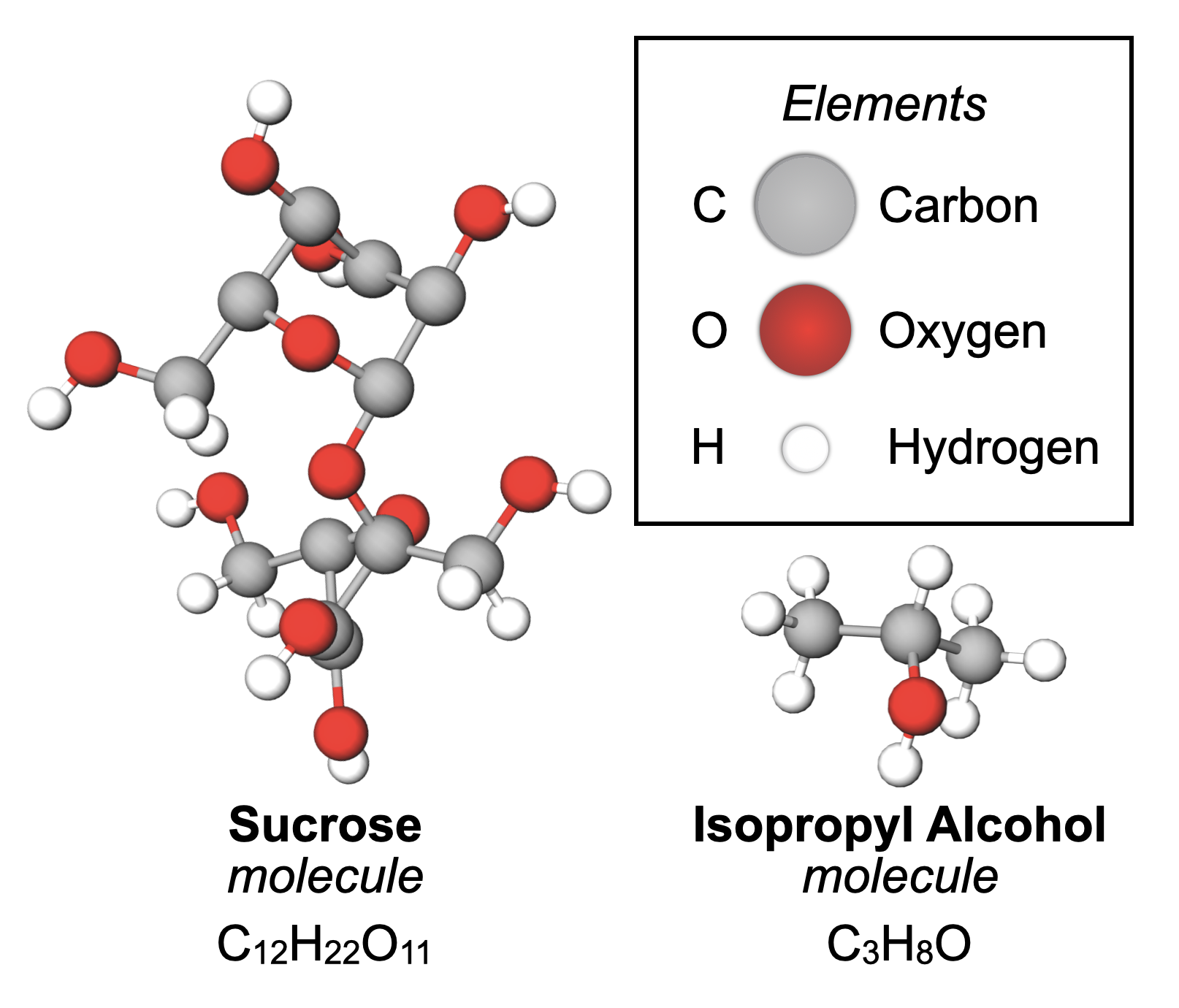 A compound’s identity is determined by the ratio of the elements of which it is composed. Many compounds may contain the same elements. However, the ratios of the elements in each compound are different. For example, table sugar (sucrose) and rubbing or isopropyl alcohol are both composed of carbon, hydrogen, and oxygen. However, the chemical formula for sugar is C12H22O11, while the chemical formula for isopropyl alcohol is C3H8O. The three elements are present in different ratios in each compound, and this difference in ratios is what gives the two compounds their very distinctive differences.
Qualitative and Quantitative Properties
Investigation One introduces students to qualitative and quantitative properties of different compounds. Qualitative properties are those properties which can be observed but cannot be measured. These include color, shape, texture, and odor. For example, salt (sodium chloride) is a white, crystalline substance. “White” and “crystalline” refer to the qualitative properties of color and shape. Table sugar (sucrose) is also a white, crystalline substance. Both salt and sugar are compounds and have identical qualitative properties. This illustrates an important concept: compounds may not be distinguished from one another solely on the basis of their qualitative properties. Scientists generally look beyond a compound’s qualitative properties to its quantitative properties in order to be able to identify it.
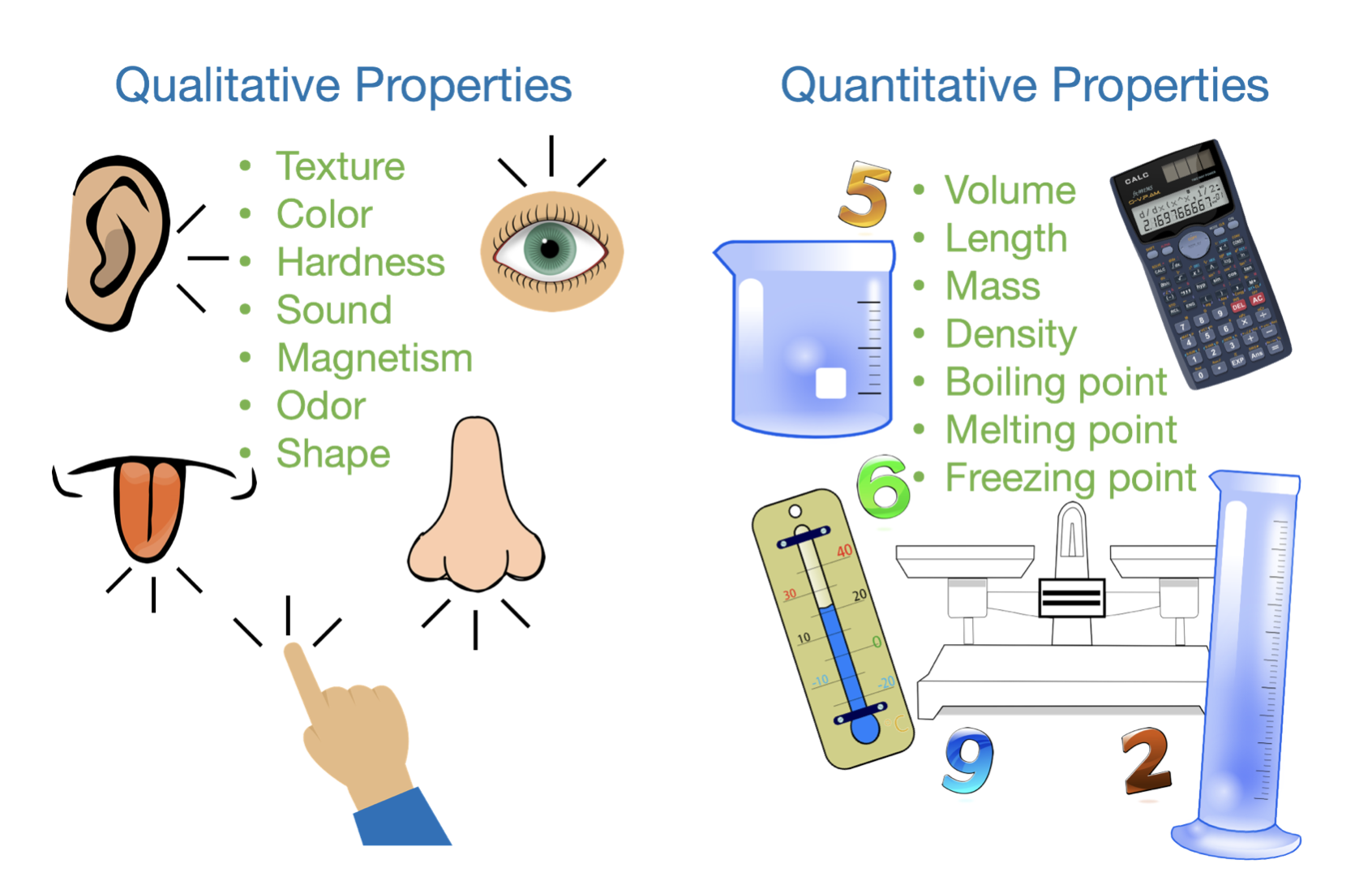
Quantitative properties are those properties which can be measured or quantified. Investigation One provides students with an opportunity to explore two quantitative properties: mass and volume. Mass and volume are examples of properties that can be measured directly. The mass and volume of a substance are dependent upon the size of the sample of the substance.
Investigation One provides students the opportunity to compare different solid and liquid compounds on the basis of their qualitative and quantitative properties. Students will also examine how compounds made of the same elements can have different properties, while compounds made of different elements can have similar properties. During this Investigation, students will also be introduced to the Periodic Table of the Elements as they explore compounds in terms of their chemical formulas.
Properties of Compounds: Investigation 1 - Mathematics Concepts
Prelab
- classifying
- comparing (non)measurable characteristics
- (in)direct relationships
- temperature
- speed
- quantitative properties
Lab
- comparing (non)measurable characteristics
- classifying
- volume in mL
- mass in g
- quantitative properties
- data table
- subtraction
- addition
Postlab
- classifying
- comparing (non)measurable characteristics
- volume in mL
- quantitative properties
- mass in g
- data table
- counting whole numbers
Properties of Compounds: Investigation 1 - Procedural Tools

Properties of Compounds: Investigation 1 - Cognitive Tools

Properties of Compounds:
Investigation 1 Quiz

