
Teacher Portal:
Properties of Compounds
Investigation 2
Investigation Two: Solubility and Concentration
Investigation One introduced students to the difference between qualitative and quantitative properties of matter. Students compared different liquid and solid compounds to determine whether compounds made of different elements and compounds made of the same elements had the same or different qualitative and quantitative properties. Students discovered that compounds made of the same elements can have different properties, and compounds made of different elements can have the same properties. In Investigation Two, students will continue their study of the properties of compounds by beginning an examination of the property of solubility.
Solutes, Solvents, Solutions, and Saturation
Solubility is the ability of a solute to dissolve in a solvent. In chemistry, this may include solids dissolving in solids or liquids, and liquids dissolving in gases, and gases dissolving in other gases. However, during this CELL, students will limit their exploration of solubility to that of solids dissolving in liquids.
A liquid which contains a dissolved solid is called a solution. A solute is the component in the solution which dissolves or is present in the smallest amount. A solvent is the component of a solution which does not change state or is present in the greatest amount.
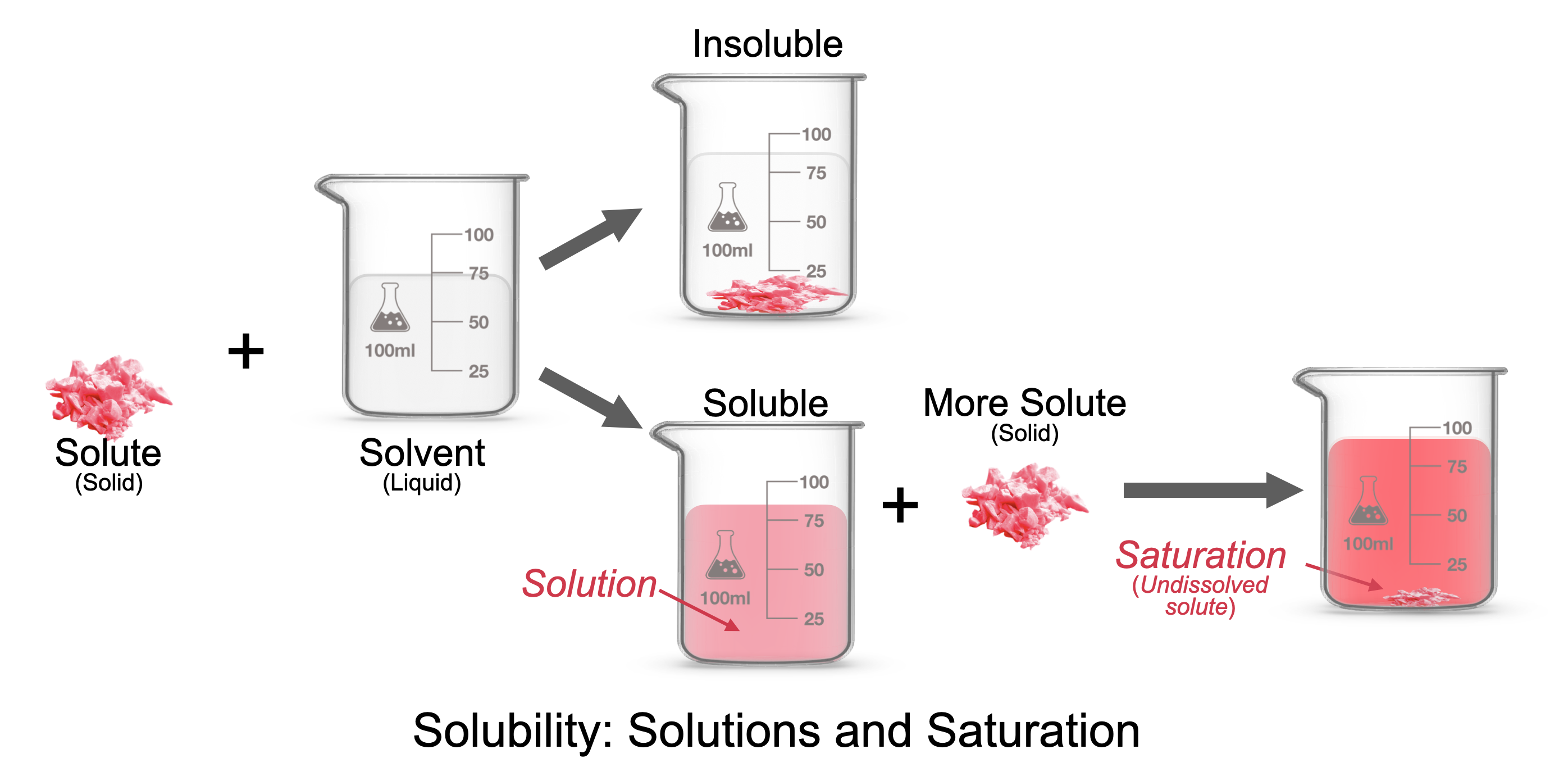
Compounds may be soluble in one liquid and be insoluble in another. Some compounds are not soluble at all. The level at which no more solute will dissolve at a given temperature in a solvent is referred to as the saturation point of that solute. At this point, no further solute will dissolve into solution. We say the solution is now saturated. As you will see, the ability of a compound to dissolve is determined by its chemical structure.
Concentration
The ratio of solute to solvent is expressed in terms of concentration, and is often represented as grams per milliliter. When concentration is represented as a percentage, such as a 10% solution, the concentration is interpreted as grams per 100 ml. Therefore, a 10% solution has 10 g of solute (solid) for every 100 ml of (solvent) solution.
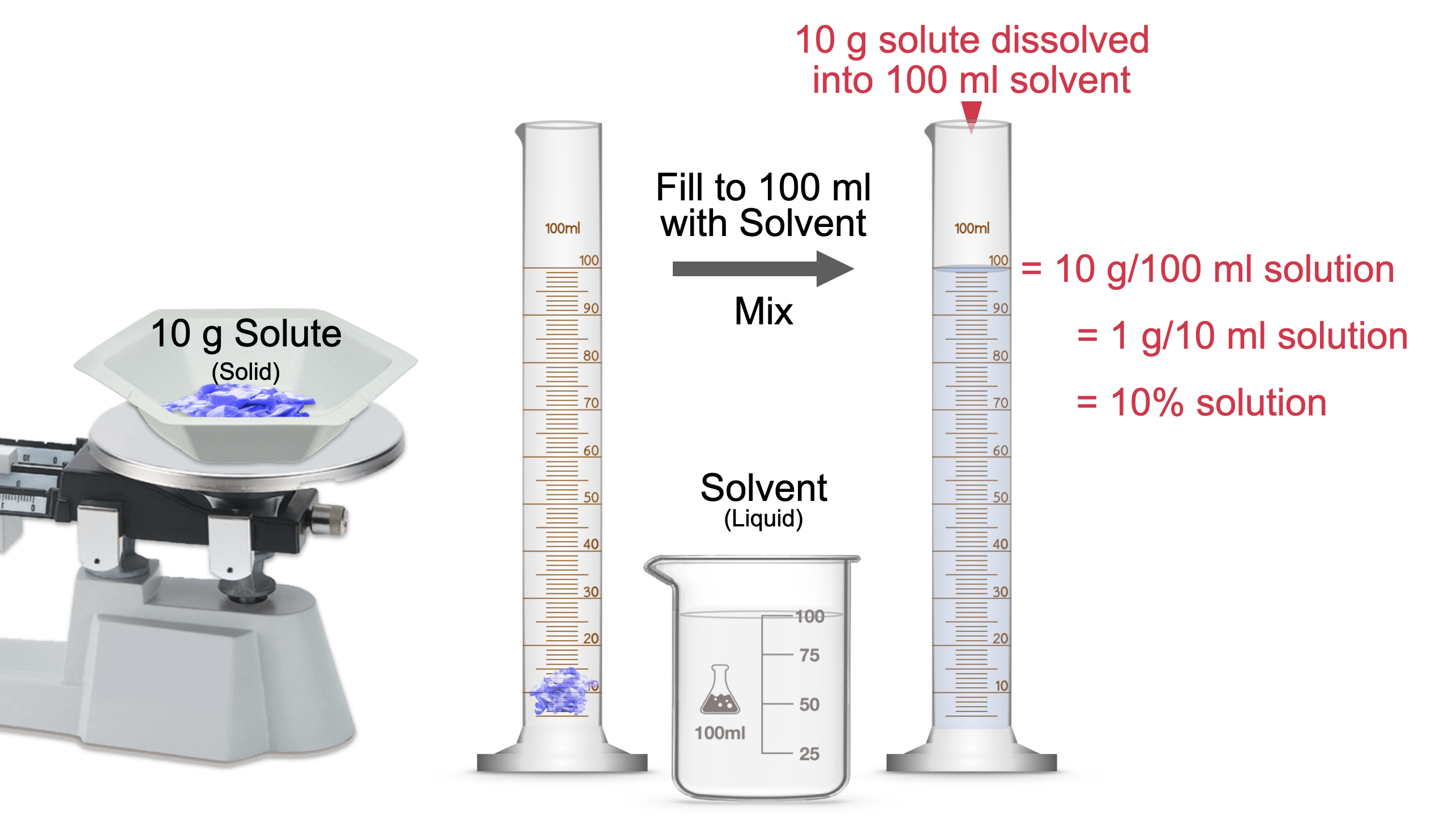
Labels on chemical solutions may indicate that the solution is a certain percentage weight/volume. This indicates that the solution was made by combining a solid (solute) and a liquid. If a label indicates percentage volume/volume, then the solution has been made by 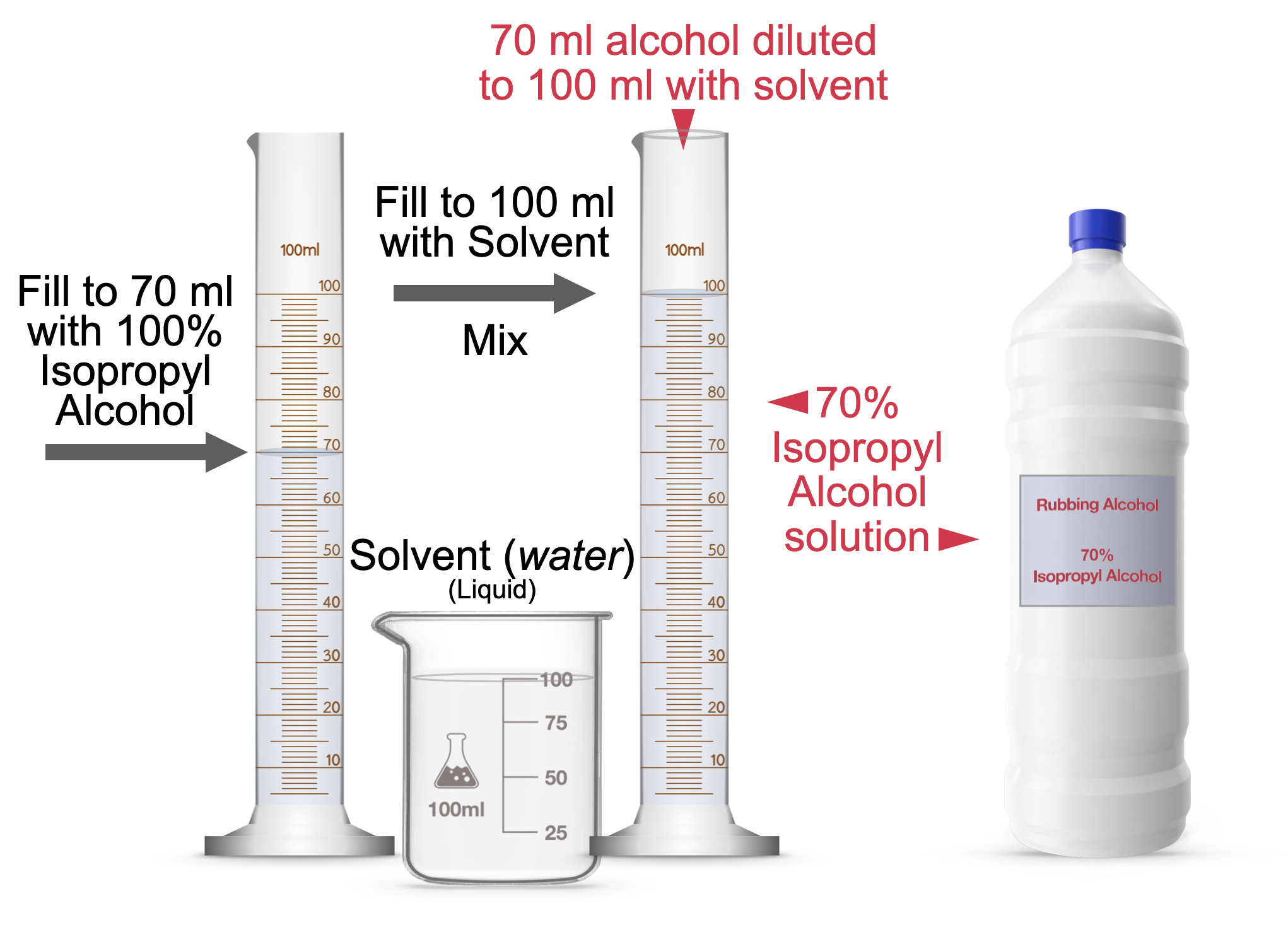 combining two liquids. An example of a percentage volume/volume is 70% isopropyl alcohol. This means that for every 100 ml of the alcohol solution, 70 ml is isopropyl alcohol.
In Investigation Two, students will examine the solubility of different compounds. Students will also compare solubility on the basis of composition by comparing compounds with the same and different elements. During their experiments, students will also determine the saturation point of different compounds by preparing solutions of increasing concentrations until they become saturated with solute. As with many other properties of compounds, students will find that the solubility and saturation point of a compound in a solvent is the result of the unique combination of the elements of which it is composed.
Properties of Compounds: Investigation 2 - Mathematics Concepts
Prelab
- quantitative properties
- comparing (non)measurable characteristics
- mass in grams
- volume in mL
- concentration
- greater than/less than/equal to
- counting whole numbers
Lab
- comparing (non)measurable characteristics
- volume in mL
- mass in g
- data table
- concentration
- addition
- subtraction
Postlab
- mass in g
- greater than/less than/equal to
- volume in mL
- comparing (non)measurable characteristics
- concentration
- (in)direct relationships
- data table
- bar graph
- data analysis
Properties of Compounds: Investigation 2 - Procedural Tools

Properties of Compounds: Investigation 2 - Cognitive Tools

Properties of Compounds:
Investigation 2 Quiz

