Teacher Portal:
Work and Simple Machines
Work and Simple Machines: Investigation 1 - Exploring Forces
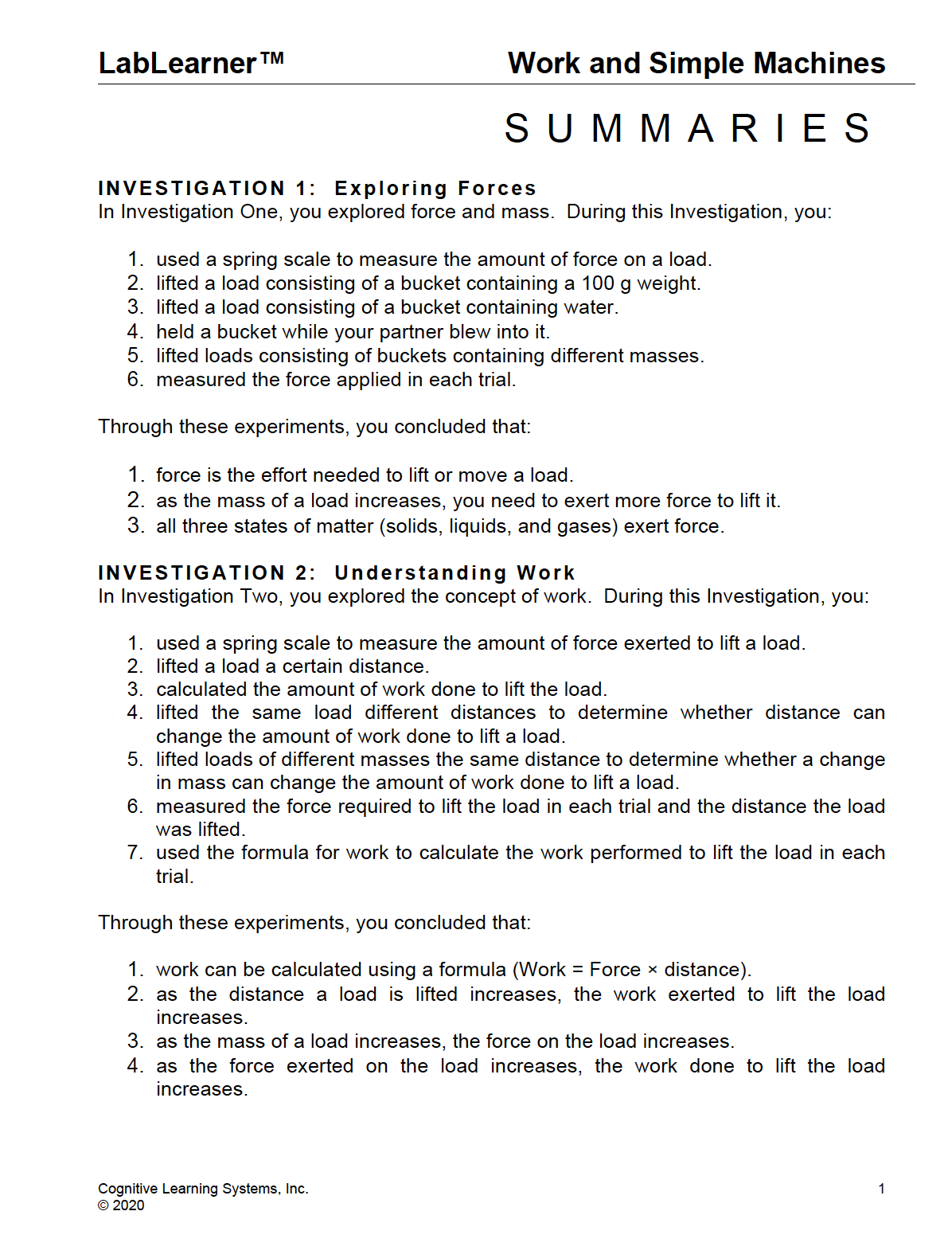
In Investigation One, students will explore the concept of force as the effort needed to lift or move a load. Students will investigate the force exerted by solids, liquids, and gases and will vary the mass of the load in order to determine the relationship between mass and force exerted to lift a load.
Work and Simple Machines: Investigation 2 - Understanding Work
Investigation Two guides students to explore the concept of work. Students perform several trials in which they vary the mass of the load and the distance each load is lifted, discovering the relationship between force, distance, and work. To further investigate this relationship, students use the formula Work = Force × distance to calculate work.
Work and Simple Machines: Investigation 3 - Simple Machines: The Pulley
During Investigation Three, students will begin their exploration of simple machines by investigating the pulley. Students will calculate and compare the work done when performing a task with and without a pulley, varying the mass of the load and the distance the load is lifted. This Investigation guides students toward concluding that the pulley makes work feel easier by changing the direction force is applied to a load, even though the amount of work done remains the same.
Work and Simple Machines: Investigation 4 - Simple Machines: The Lever
Investigation Four introduces students to a second simple machine, the lever. Students will explore the use of the lever by varying the location on the lever at which the effort is applied and by varying the position of the fulcrum. Through this Investigation, students will discover that by varying the location of the effort or by varying the location of the fulcrum, the force required to lift the load changes. However, students will also find that when using a lever, a change in the force required is accompanied by an inverse change in the distance over which the force is exerted so that the work done to perform a certain task does not increase or decrease.
Work and Simple Machines: Investigation 5 - The Inclined Plane
In Investigation Five, students will be introduced to a third simple machine, the inclined plane. Students will explore the relationship between the effort needed to move a load over inclined planes that are the same in height but differ in their steepness. By performing several experiments focused on this relationship, students will discover that, because the inclined planes are the same height, as the steepness of the inclined plane increases, the length over which an object moves decreases, and the force to move a load increases. In addition, students will find that when comparing the work done with inclined planes that have the same height but a different steepness the work remains the same due to an inverse relationship between effort to move the load and the distance over which the load is moved.
Work and Simple Machines: Investigation 6 - Performance Assessment
Investigation Six consists of a performance assessment designed to evaluate students’ understanding of the science concepts addressed in the first five Investigations of the CELL. During this exploration, students will design and implement the use of a simple machine.
Pre-Tests and Post-Tests
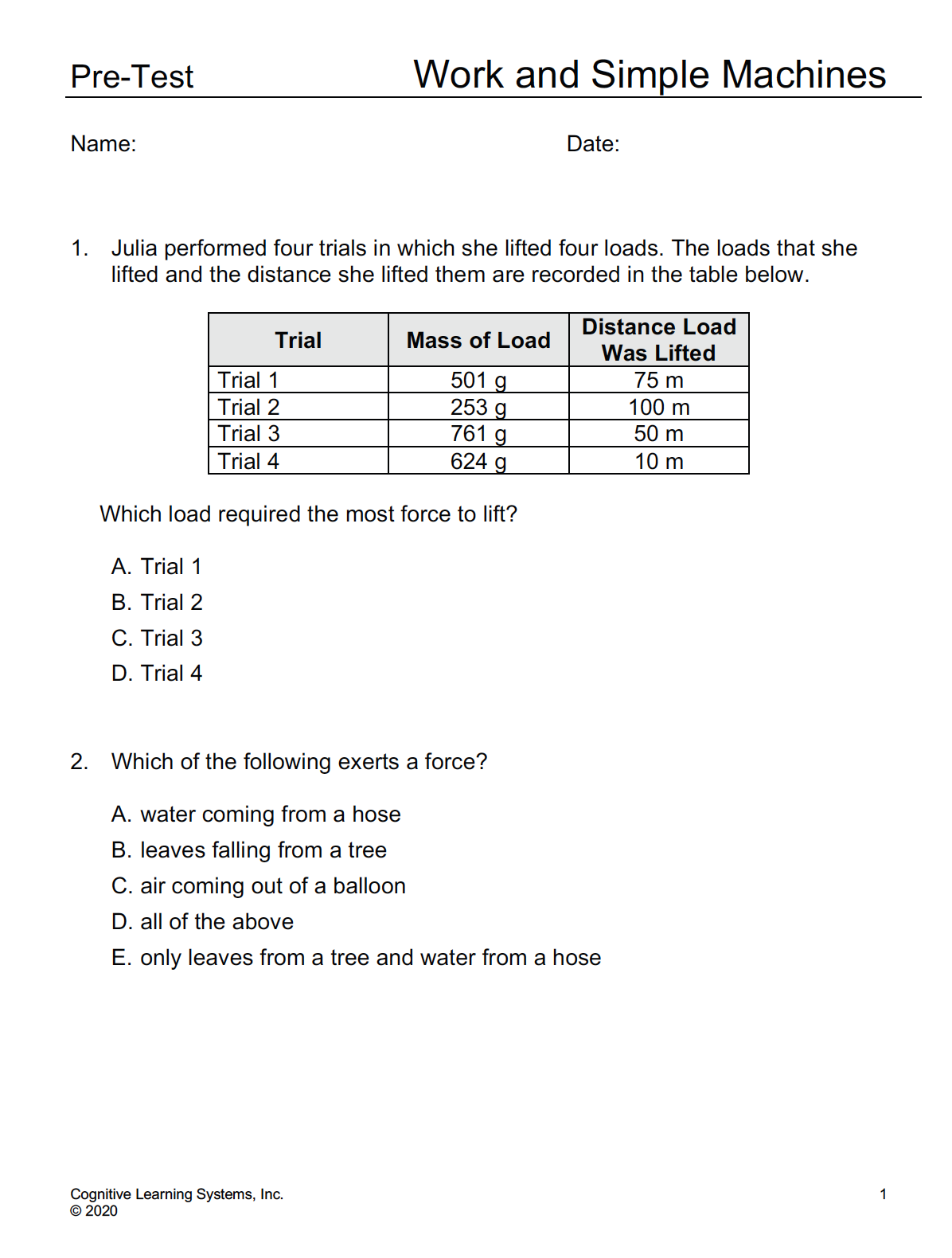
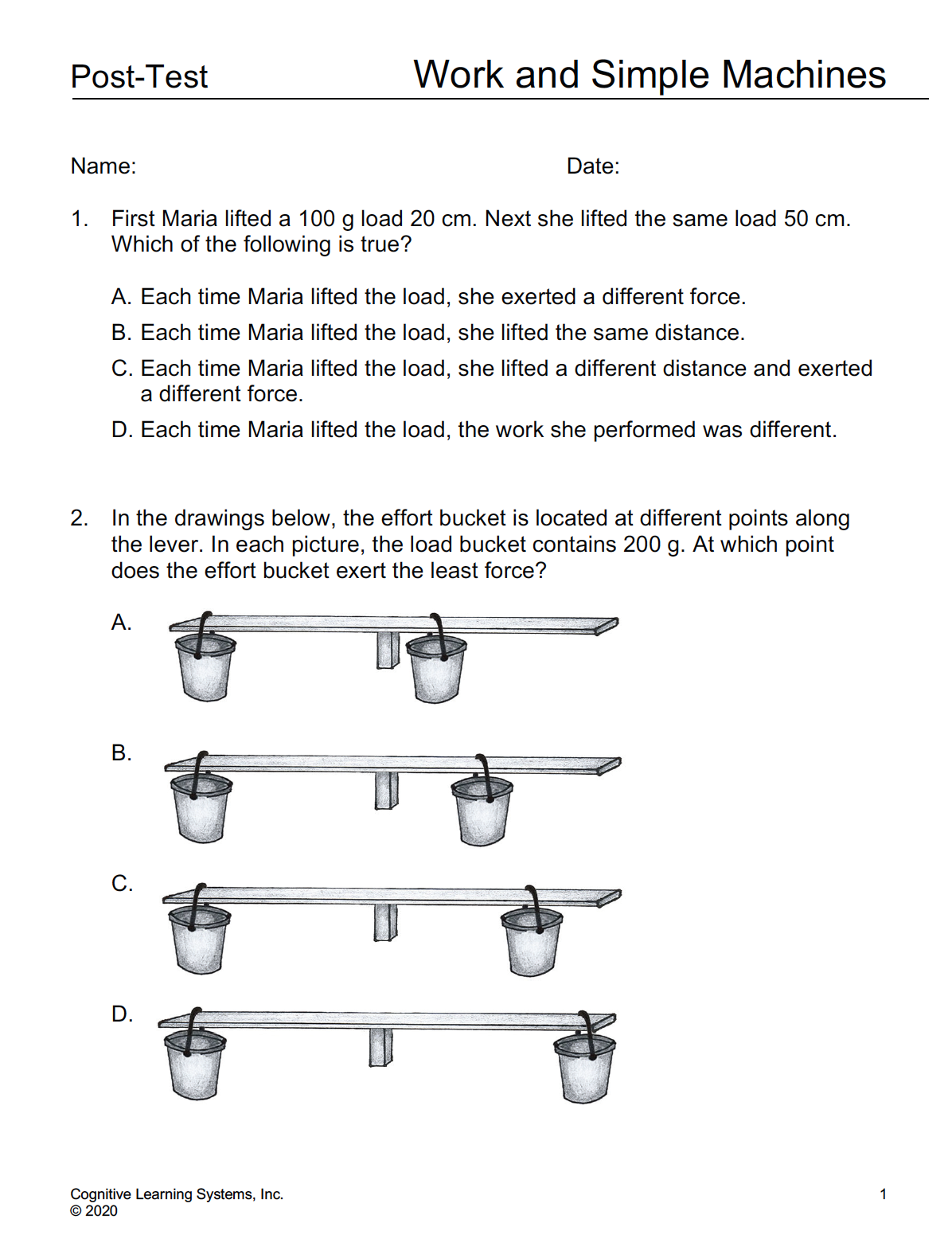
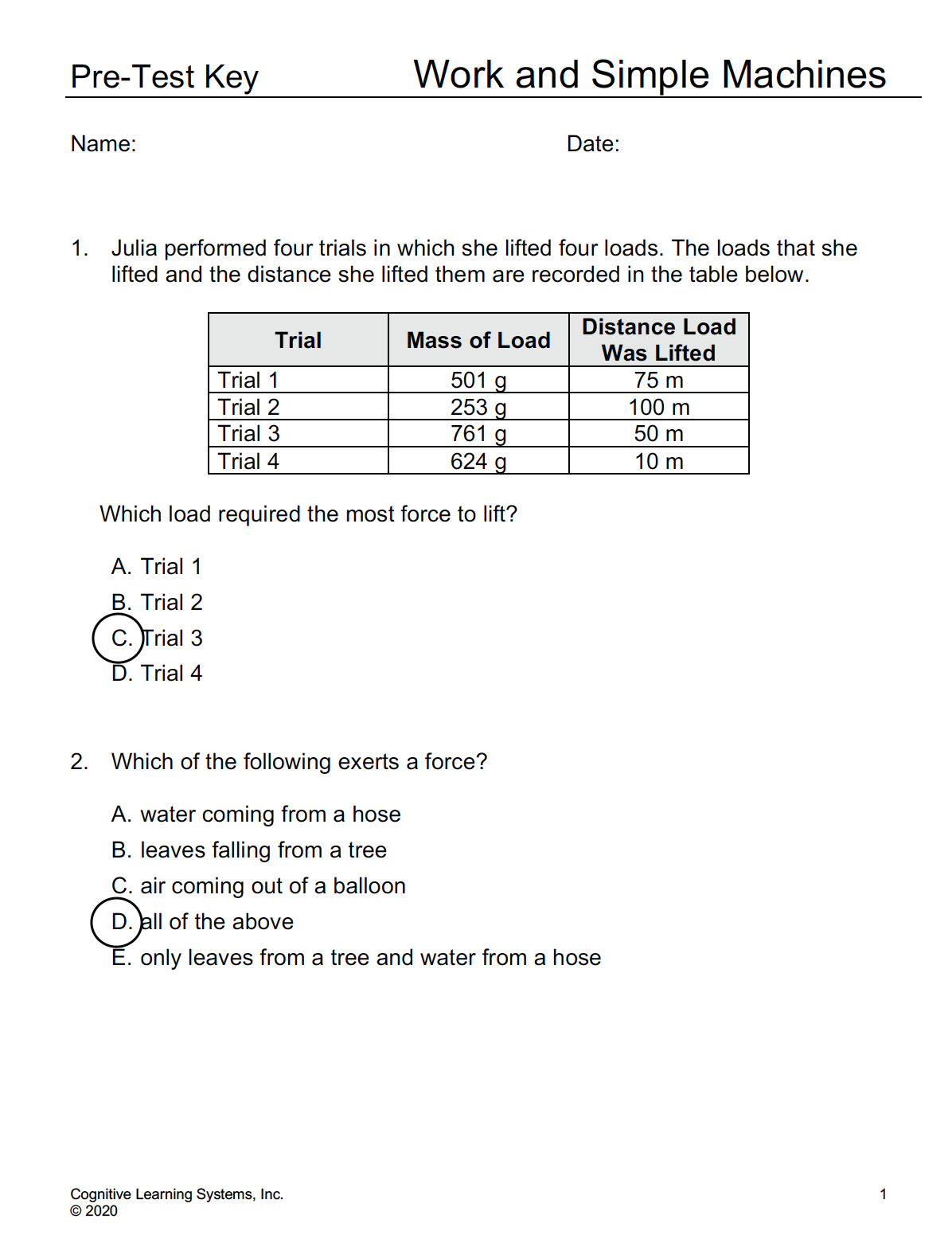
Pre-Test Key
Includes NGSS correlations
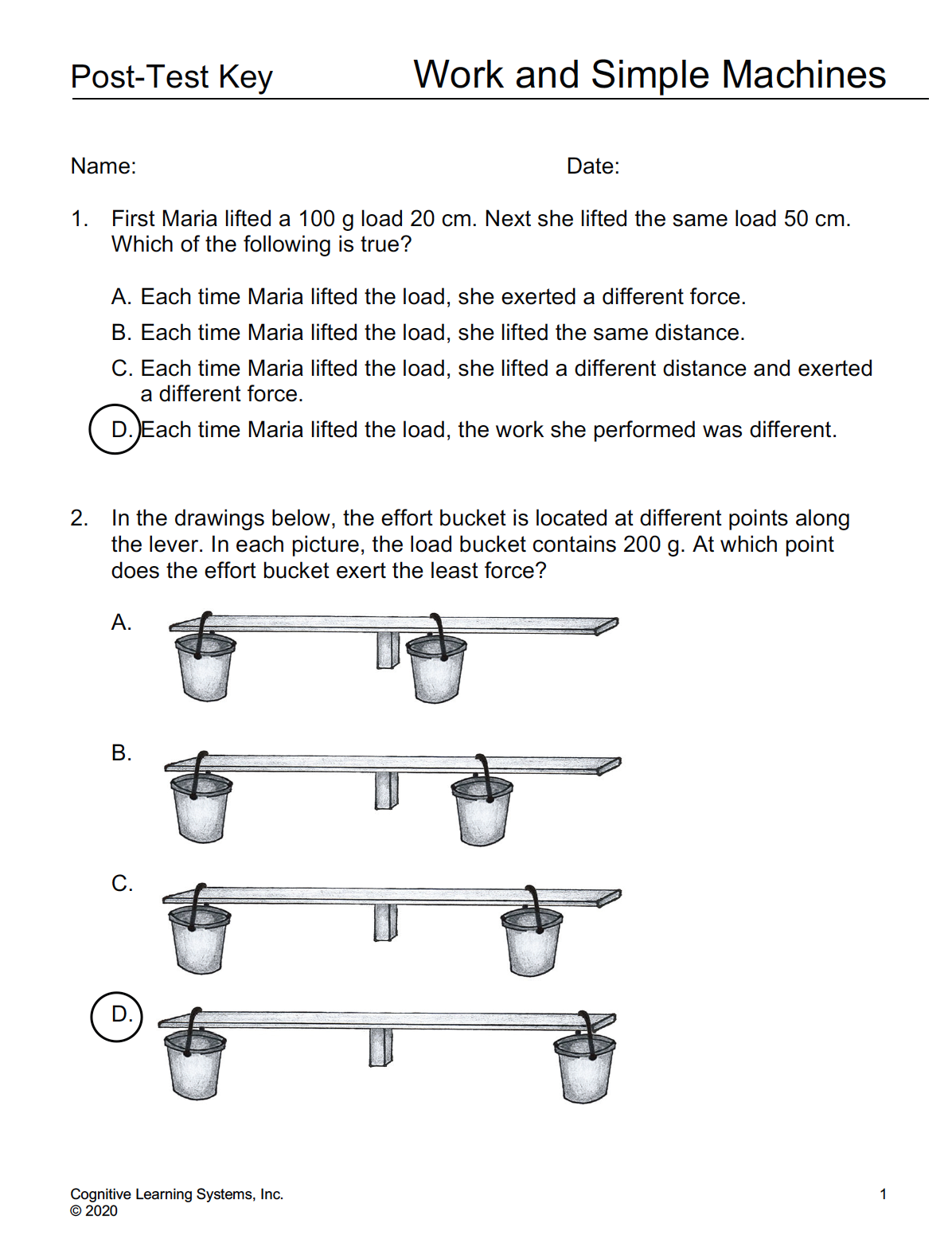
Post-Test Key
Includes NGSS correlations