
Teacher Portal:
Work and Simple Machines
Investigation 2
Work and Simple Machines Investigation-2: Understanding Work
During Investigation One, you explored the concept of force as the effort needed to lift or move a load. You discovered that solids, liquids, and gases exert a force and that increasing the mass of the load increases the amount of force needed to lift the load. Investigation Two draws on your observations of force and distance and guides you through an exploration of the concept of work.
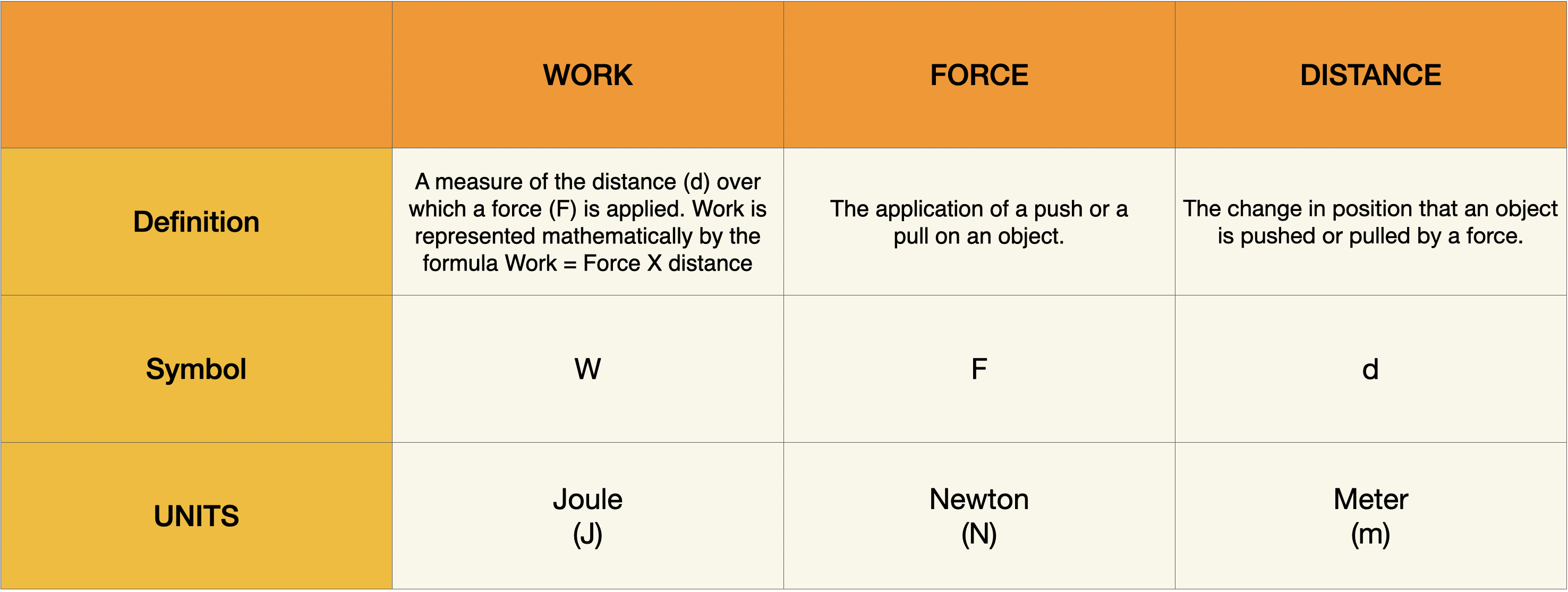
When a force is applied over a distance, work is performed. Work is done when lifting a backpack, sliding a box across the floor, and pulling a wagon. The relationship between force, distance, and work is expressed through the formula Work = Force X distance. The standard unit for force is Newtons, distance is meters, and work is joules or newton-meters:
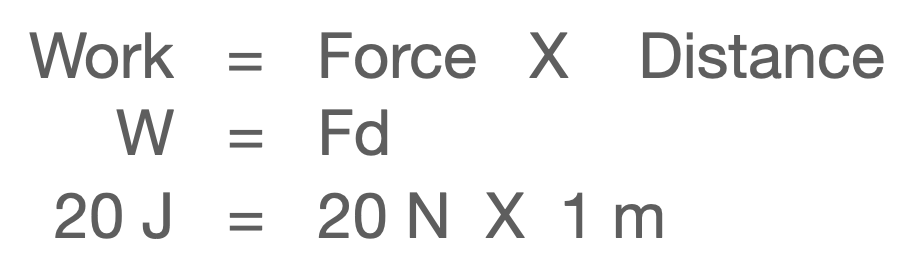
Studying the formula, we find that work varies based on the magnitude of the force applied and the distance over which it is applied. For example, if a woman applied a force of 20 Newtons to lift a box 1 meter, she performs 20 J of work.
If the woman takes some items out of the box, she may only need to apply 15 N of work to lift the box 1 meter, performing 15 J of work.

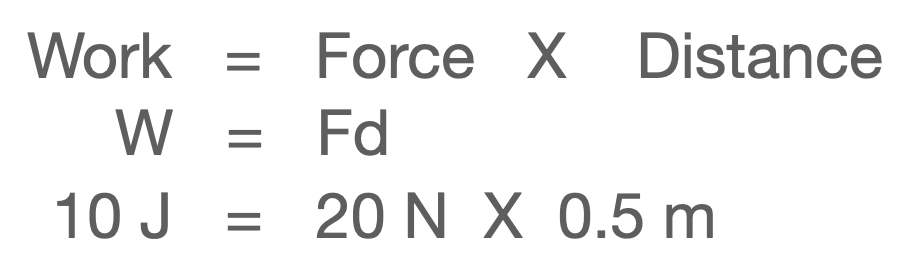
If the woman puts all of the items back in the box, she must again apply 20 N of force to lift the box. She now lifts it only 0.5 m, performing 10 J of work.
Thus, work is affected both by the force applied and the distance over which it is applied.
During this Investigation, you will perform several trials in which you vary the mass of the load and the distance each load is lifted, discovering the relationship between force, distance, and work. To further investigate this relationship, you will use the work formula.
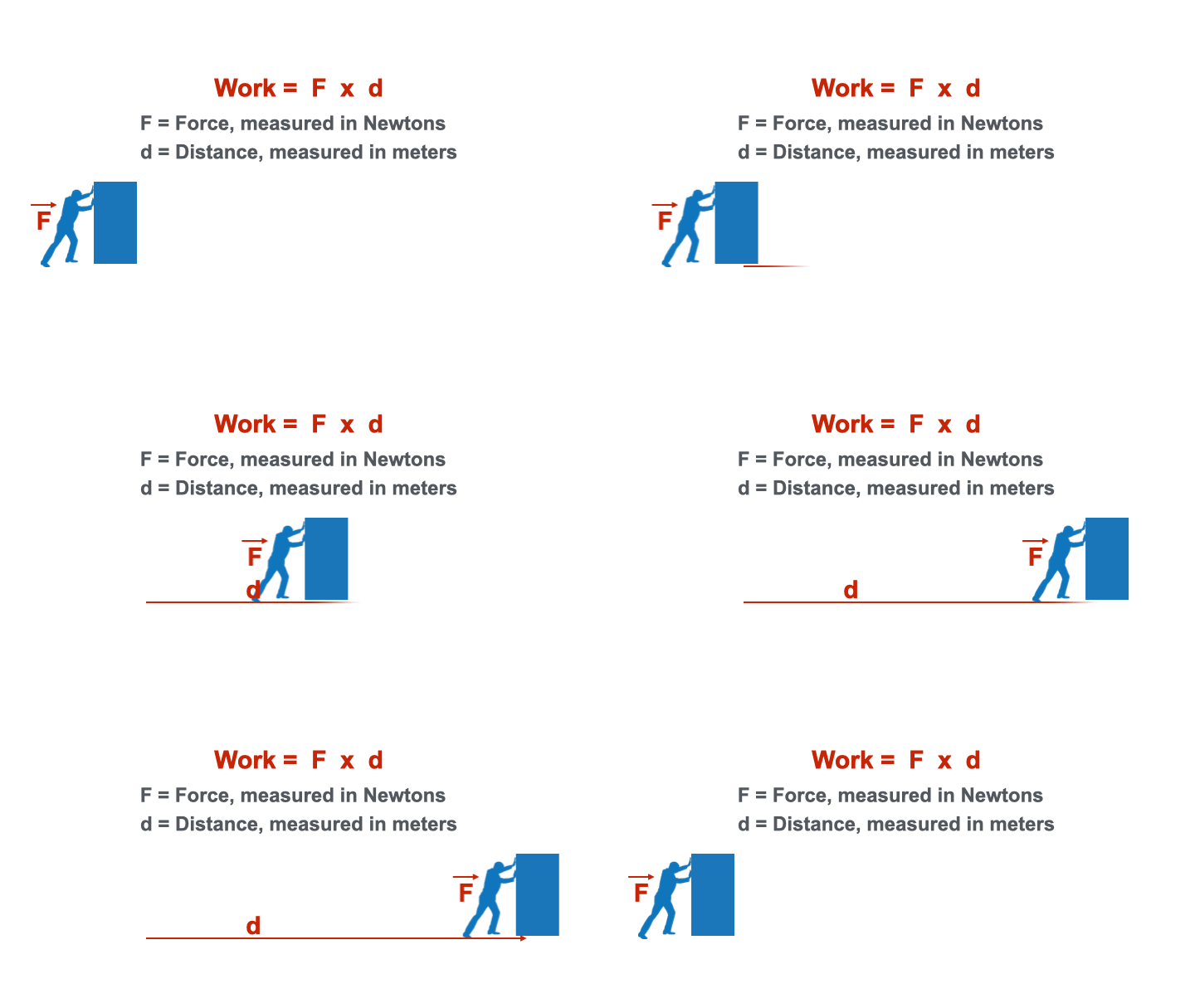
Finally, in addition to being able to calculate the Work involved in lifting an object, you will later see that the same work formula can be used to calculate the work performed when pushing or pulling an object.
Work and Simple Machines: Investigation 2 - Mathematics Concepts
Prelab
- multiplication
- factors/products
- force in Newtons
- distance in meters
- calculating Work in Joules
- problem-solving
- whole numbers
- decimals to the nearest tenth
- metric conversion
- greater than/less than/equal to
- fractions and decimal equivalent
- addition
Lab
- mass in grams
- force in Newtons
- decimals to the nearest tenth
- whole numbers
- distance in cm and meters
- metric conversion
- multiplication
- (in)direct relationships
- patterns
- data table
Postlab
- multiplication
- distance in cm and meters
- metric conversion
- greater than/less than/equal to
- patterns
- data table
- data analysis
- (in)direct relationships
- comparing (non)measurable characteristics
- variables/constants
- line graph
- skip counting by 0.2 and 0.5
Work and Simple Machines: Investigation 2 - Procedural Tools

Work and Simple Machines: Investigation 2 - Cognitive Tools

Work and Simple Machines:
Investigation 2 Quiz

