
Teacher Portal:
Work and Simple Machines
Investigation 3
Work and Simple Machines Investigation-3: The Pulley
In Investigations One and Two, you began an exploration of force and work. By varying the force of a load and the distance a force is applied to move the load, you investigated the relationship between force, distance, and work. During Investigations Three, Four, and Five, you will begin your exploration of simple machines in conjunction with these three factors.
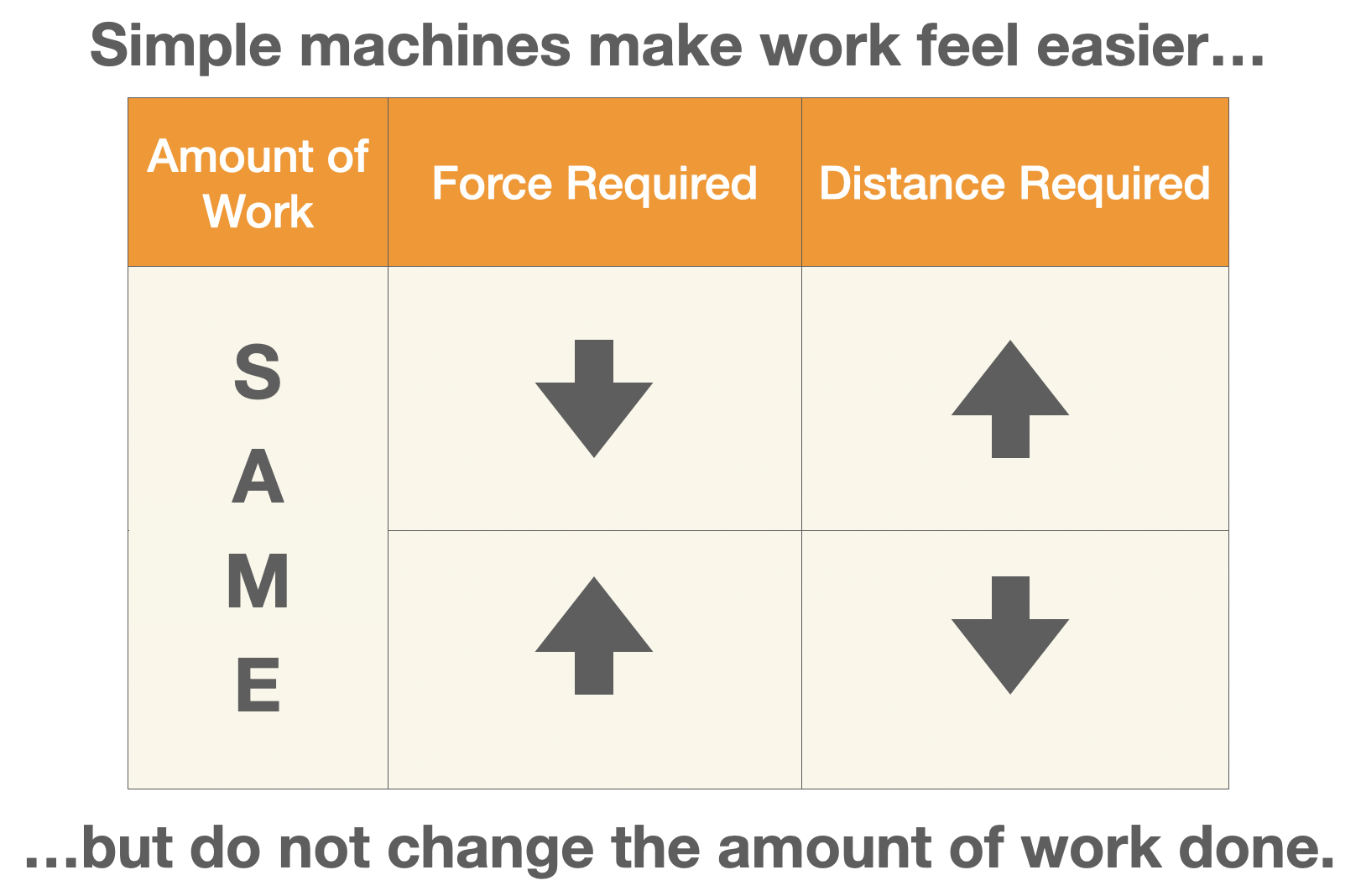 Simple machines make work feel easier by 1) changing the direction of the applied force, 2) decreasing the distance over which the force is applied, or 3) decreasing the force necessary to do work. However, simple machines do not change the amount of work that is done. When the force applied decreases, there is a simultaneous increase in the distance over which the force is applied. Likewise, a decrease in the distance over which the force is applied is accompanied by a simultaneous increase in the applied force. Thus, although the work feels easier because of a change in one variable, the work done remains the same because of an opposing change in the other variable. You will explore this relationship by investigating three simple machines: the pulley, the lever, and the inclined plane.
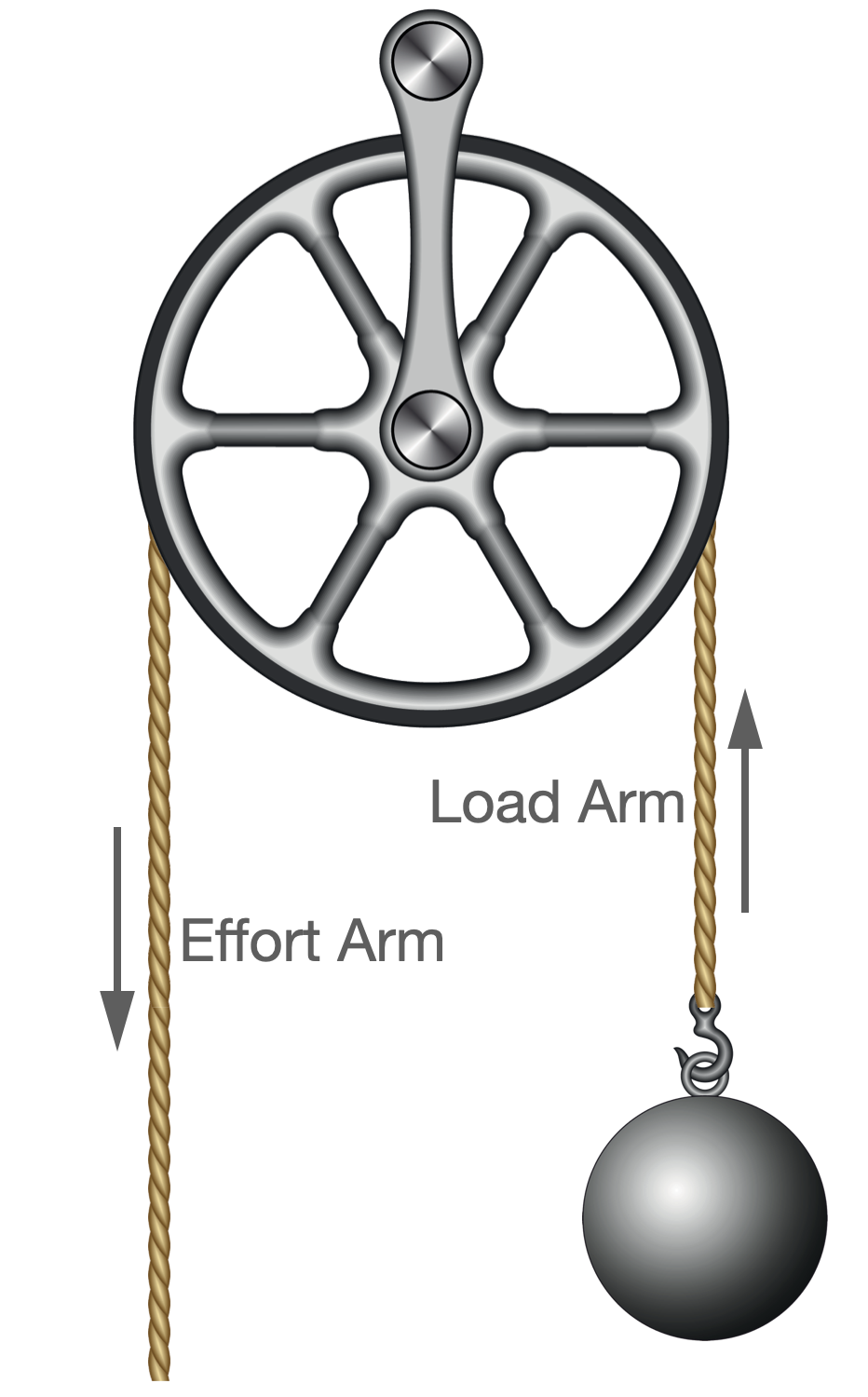 During Investigation Three, you will begin your exploration of simple machines by investigating the pulley. A pulley consists of a grooved wheel and a rope or cable which rests in the groove of the wheel. In a single fixed pulley, the axle of the wheel remains stationary as the cable moves and the wheel rotates. Although other types of pulleys such as a movable pulley and a compound pulley exist, in Investigation Three you will only utilize the single fixed pulley. Imagine a fixed pulley with a load attached to one end of the rope or cable. To lift the load, a force is applied to the end of the cable opposite the load. Thus, the pulley has a load arm, where the load is attached, and an effort arm, where the force is applied.
When lifting a load with and without a single fixed pulley, neither the force applied to lift nor the distance over which the force is applied varies. Both the force and the distance remain constant. However, single fixed pulleys make work feel easier by changing the direction of the applied force. Imagine a flag pole. To raise the flag without using a pulley, a person must stand on a ladder and lift up and fasten the flag. The implementation of a single fixed pulley allows the same person to stand on the ground and pull down on the effort arm rather than applying a force upward to lift the flag.
 Although the use of a single fixed pulley does not decrease the force applied or distance over which the force is applied, it offers an advantage by reversing the direction of the applied force. For example, automobile engines use a complex system of pulleys and belts to transfer force from one place in the engine to another.
During this Investigation, you will calculate and compare the work done when performing a task with and without a pulley, varying the mass of the load, and the distance the load is lifted. This Investigation will guide you toward concluding that the pulley makes work feel easier by changing the direction force is applied to a load, even though the amount of work done remains the same.
Work and Simple Machines: Investigation 3 - Mathematics Concepts
Prelab
- factors/products
- multiplication
- problem-solving
Lab
- mass in grams
- distance in cm and meters
- addition
- force in Newtons
- multiplication
- whole numbers
- decimals to the nearest tenth
- metric conversion
- greater than/less than/equal to
- data table
- variables/constants
Postlab
- greater than/less than/equal to
- multiplication
- metric conversion
- whole numbers
- decimals to the nearest tenth
- comparing (non)measurable characteristics
- patterns
- (in)direct relationships
- data table
- data analysis
Work and Simple Machines: Investigation 3 - Procedural Tools

Work and Simple Machines: Investigation 3 - Cognitive Tools

Work and Simple Machines:
Investigation 3 Quiz

