
Teacher Portal:
Work and Simple Machines
Investigation 1
Work and Simple Machines Investigation-1: Exploring Forces
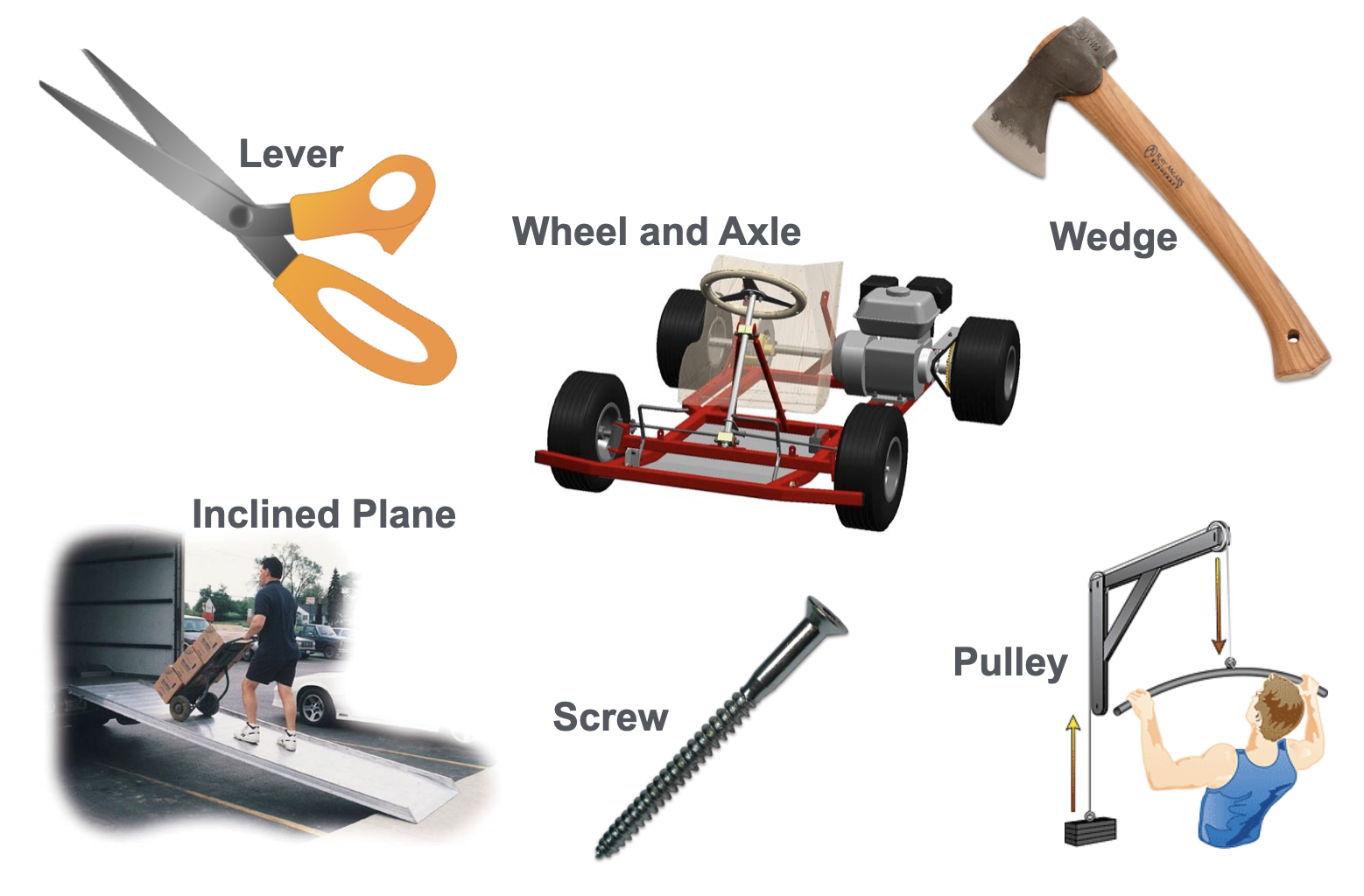 This CELL introduces the scientific concepts of force, work, and simple machines. You will explore how to measure the force required to move, or lift, a load and the work done when moving the load over a certain distance. You will apply the concepts of force and work to the use of simple machines in your everyday life and investigate the advantage of using simple machines such as the lever, the fixed pulley, and the inclined plane. There are six common simple machines shown in the illustration here – you will work with half of them in this Investigation.
Investigation One begins with an introduction to the concept of force, which is the effort of applying a push or pull to a body, object, or substance, called a load. Over the course of the Investigation, you will discover that a load can consist of solids, liquids, or gases and that regardless of its state  of matter, a load can exert a force and will require a force to be moved because it consists of matter, which has mass. As you explore the concept of force, you will be introduced to the spring scale, a new tool from the Procedural Toolbox that is used to measure the force exerted on a load as well as the force needed to lift a load. The experiments in Investigation One have been designed to provide you with multiple opportunities to use the spring scale and to increase your familiarity with the metric unit used to measure force, the newton (N).
During this Investigation, you will explore the relationship between force,  distance, and mass, in the form of solids, liquids, and gases, by changing the mass contained in a load and the distance over which a load is moved. When measuring distance, you will use the metric units of meters (m), and centimeters. By the end of the Investigation, you should discover that all three states of matter exert a force. You should also realize that the force exerted to move a load increases as the mass of a load increases. For example, a 400 g load will require 4 N of force to lift, whereas a 100 g load will require only 1 N of force to lift. In addition, you will discover that the force exerted to lift a load remains the same regardless of the distance the load is lifted. That is, the force needed to lift a load is independent of the distance the load is moved. Thus, the same force is exerted to move a load 10 meters or 40 meters.
Work and Simple Machines: Investigation 1 - Mathematics Concepts
Lab
- calibration
- whole numbers
- tenths
- decimals
- mass in grams
- addition
- distance in cm
- mass in grams
- force in Newtons
- direct/indirect relationships
- comparing (non)measurable characteristics
- greater than/less than/equal to
- patterns
PostLab
- comparing (non)measurable characteristics
- greater than/less than/equal to
- (in)direct relationships
- patterns
- mass in grams/kg
- data table
- data analysis
- distance in cm
- force in Newtons
Work and Simple Machines: Investigation 1 - Procedural Tools

Work and Simple Machines: Investigation 1 - Cognitive Tools

Work and Simple Machines:
Investigation 1 Quiz

