
Teacher Portal:
Work and Simple Machines
Investigation 4
Work and Simple Machines Investigation-4: The Lever
Investigation Three introduced students to the pulley, a simple machine that offers an advantage by reversing the direction of the applied force. Students found that the force applied, the distance over which it is applied, and the work performed when using a pulley are the same as when the load is lifted without a pulley.
During Investigation Four, students will discover a second simple machine, the lever. Like the pulley, the lever consists of a load arm and an effort arm. However, instead of the two arms being divided by a wheel and axle, a fulcrum separates the load arm from the effort arm in the lever (Figure 4.1).
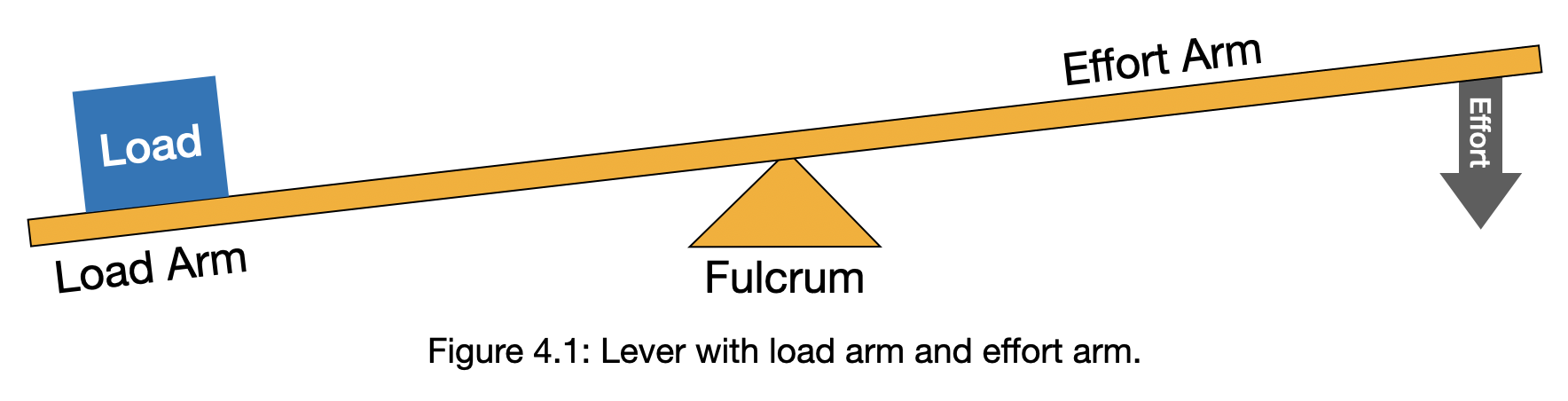
The placement of the fulcrum and the location of the effort affect the amount of force required to perform a task. When the fulcrum is placed in the middle of the lever, as shown in Figure 4.1, and force is applied on the effort arm to lift the load, the force required to lift the load is equal to the force required to lift the load without the lever. In other words, in this case, the advantage of the lever is the same as the advantage of the single fixed pulley—a reversal of the direction of the applied force.
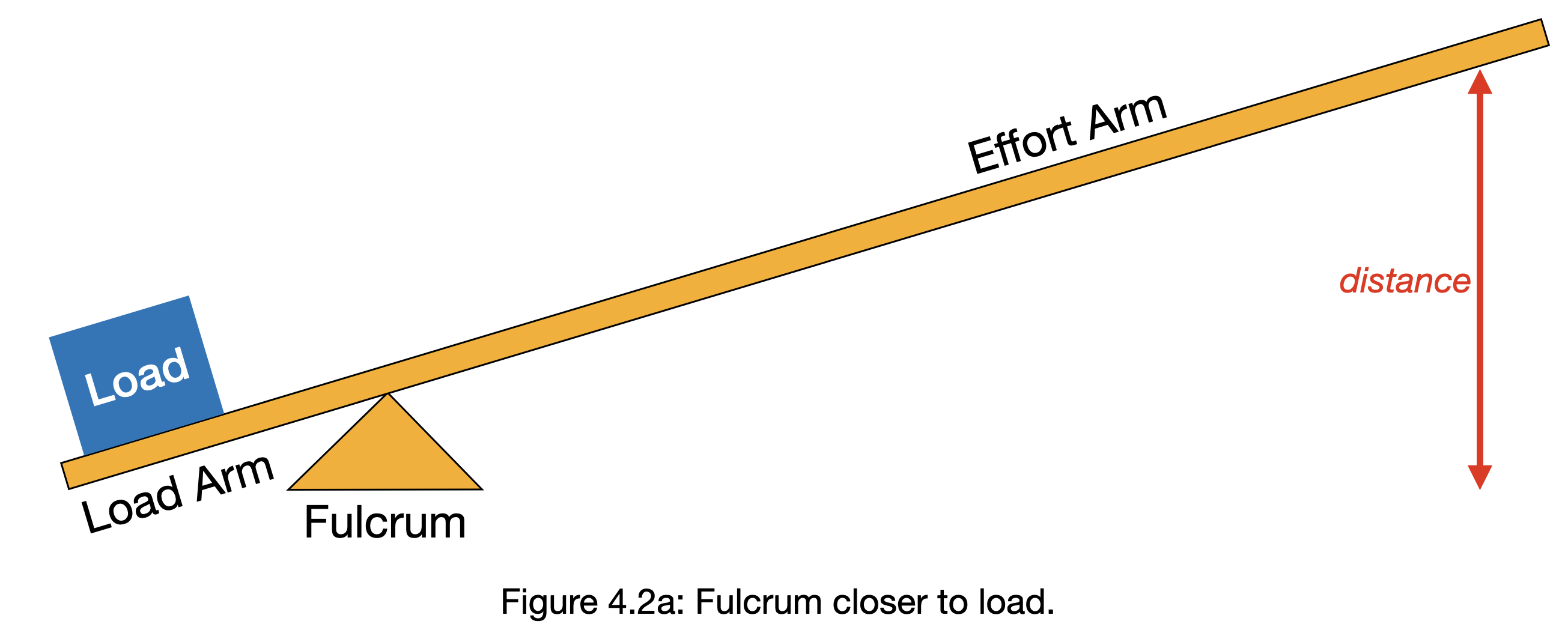
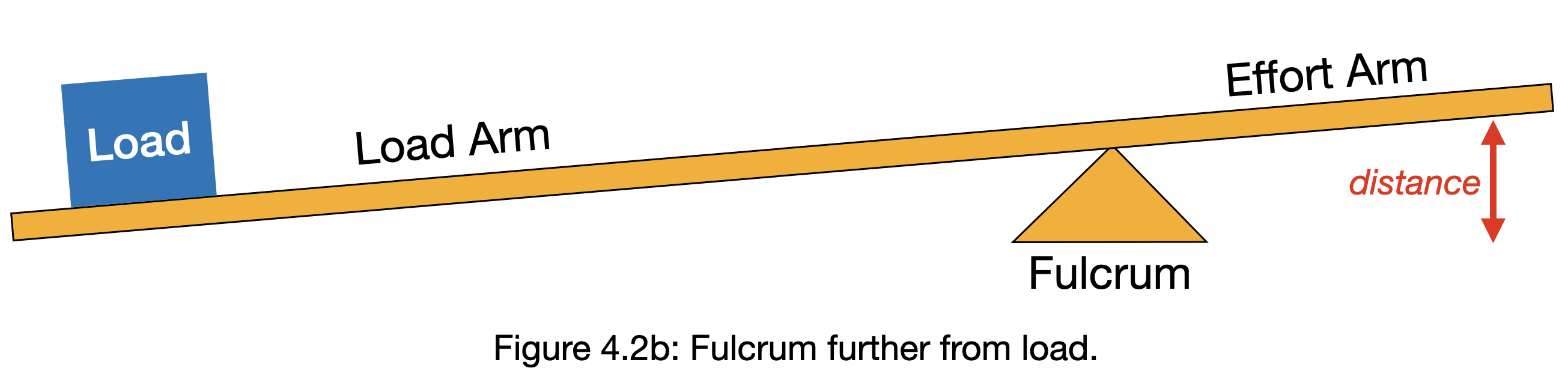
However, if the fulcrum is moved closer or farther from the load, the distance over which the force is applied and the magnitude of the force are altered. For instance, if the fulcrum is moved closer to the load, the distance over which the force is applied to lift the load increases, and the magnitude of the force decreases (Figure 4.2a). If the fulcrum is moved farther from the load, the distance over which the force is applied decreases, and the magnitude of the force increases (Figure 4.2b).
This relationship is described mathematically in the formula Work:
Work = Force x distance
or
W = fd
The cost to every decrease in force is an increase in distance, and the cost to every decrease in the distance is an increase in force.
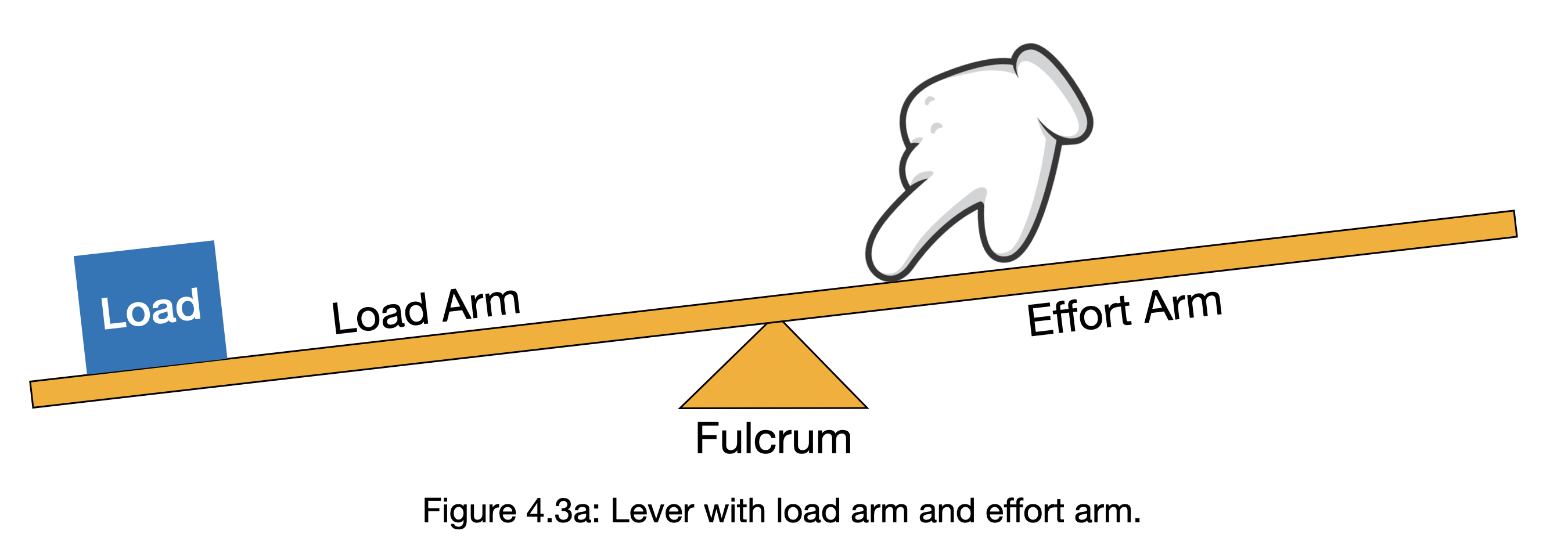
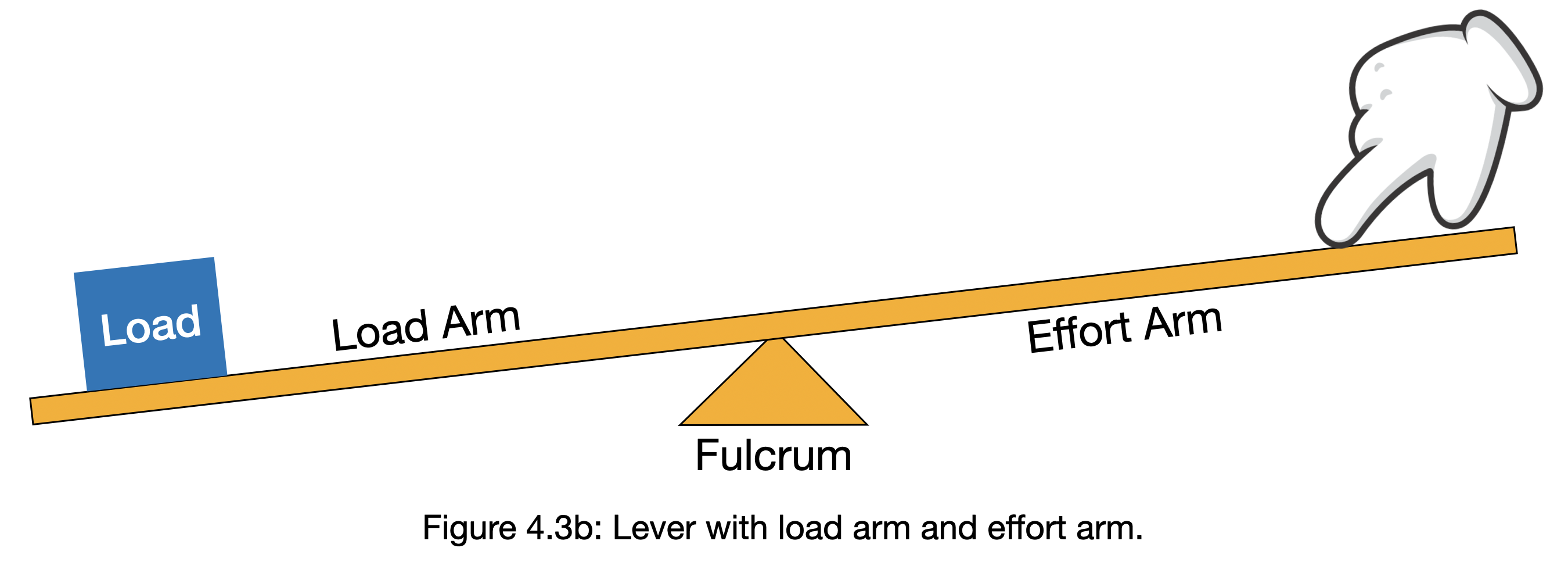
The same trend holds true when the fulcrum is in a fixed position and the location at which the effort is applied varies. The closer to the fulcrum that the force is applied, the greater the force and the shorter the distance over which the force is applied (Figure 4.3a). The farther from the fulcrum that the force is applied, the smaller the force and the greater the distance over which the force is applied (Figure 4.3b).
In Investigation Four, students will explore the use of the lever by varying the location on the lever at which the effort is applied and by varying the position of the fulcrum. Through this Investigation, students will discover that by varying the location of the effort or by varying the location of the fulcrum, the force required to lift the load changes.
However, students will also find that when using a lever, a change in the force required is accompanied by an inverse change in the distance over which the force is exerted so that the work done to perform a certain task remains the same regardless of where the effort is applied along the lever and regardless of whether the task is performed with or without the lever.
Work and Simple Machines: Investigation 4 - Mathematics Concepts
Prelab
- greater than/less than/equal to
- problem solving
Lab
- distance in cm
- mass in grams
- addition/subtraction
- whole numbers
- decimals to nearest tenth
- data table
- comparing (non)measurable characteristic
- place value (tenths, ones, tens, hundreds)
Postlab
- comparing (non)measurable characteristics
- (in)direct relationship
- patterns
- data table
- data analysis
- whole numbers
- decimals to nearest tenth
- place value (tenths, ones, tens, hundreds)
- multiplication
- distance in cm and meters
- metric conversion
- line graph
- skip counting by 0.5
- counting backward
Work and Simple Machines: Investigation 4 - Procedural Tools

Work and Simple Machines: Investigation 4 - Cognitive Tools

Work and Simple Machines:
Investigation 4 Quiz

