
Teacher Portal:
Work and Simple Machines
Investigation 5
Work and Simple Machines Investigation-5: The Inclined Plane
Thus far in this CELL, students have discussed and investigated force, distance, and work and have applied two simple machines in their experimentation – pulleys and levers. In Investigation Four, students explored the lever and found that although it does not alter the amount of work done to perform a task, the lever can affect both the force applied and the distance over which the force is applied when performing the task.
During Investigation Five, students will consider a third simple machine, the inclined plane. An inclined plane consists of a flat surface that connects two points of different heights. As with the pulley and the lever, effort must be applied in order to move a load on an inclined plane. Unlike the previous machines though, the effort is applied directly to the object being moved rather than to a part of the machine. A very common example of the use of an inclined plane in everyday life is the tailgate ramp used by many trucks.
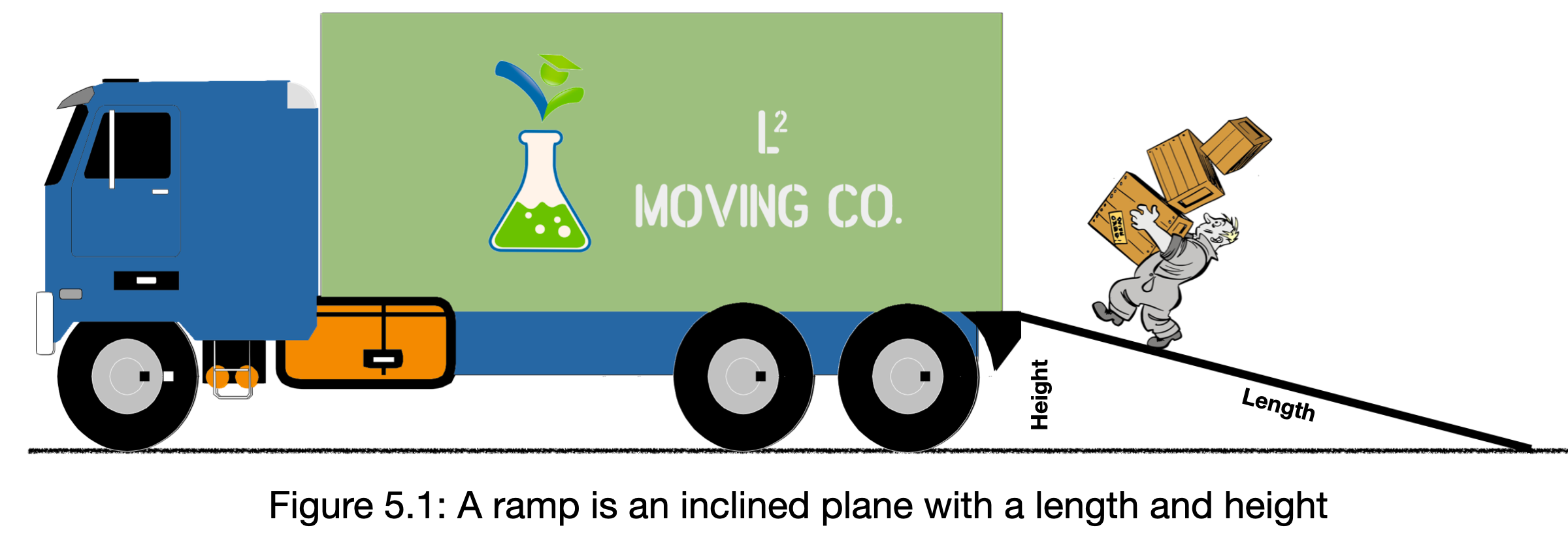
An inclined plane reduces the amount of effort needed to move an object to a certain height. The trade-off is that the distance that an object must travel along the inclined plane is greater than the vertical distance it is lifted vertically. In the above cartoon, the man could simply stand right next to the truck and lift the boxes straight up and put them directly into the back of the truck. However, lifting the heavy boxes to the height required would be extremely hard to do. On the other hand, look how far he has to walk carrying the boxes. That is the trade-off that an inclined plane requires.
In the diagram in Figure 5.2 below, when the inclined plane is not used, the force to lift the load is applied over a 5-meter distance (lifting it straight up). When the object is moved along the inclined plane, the effort is applied over a 25-meter distance. The end result is that both loads end at a position that is 5 meters above the ground. However, the force needed to lift the load is greater when the inclined plane is not used. The reason that less effort is used when pushing or pulling the load up the inclined plane is that the effort is exerted over a greater distance. In Investigation Five, students will compare the effort needed to lift an object to the same height both with and without an inclined plane. They will discover that the inclined plane reduces the effort needed to move the object.
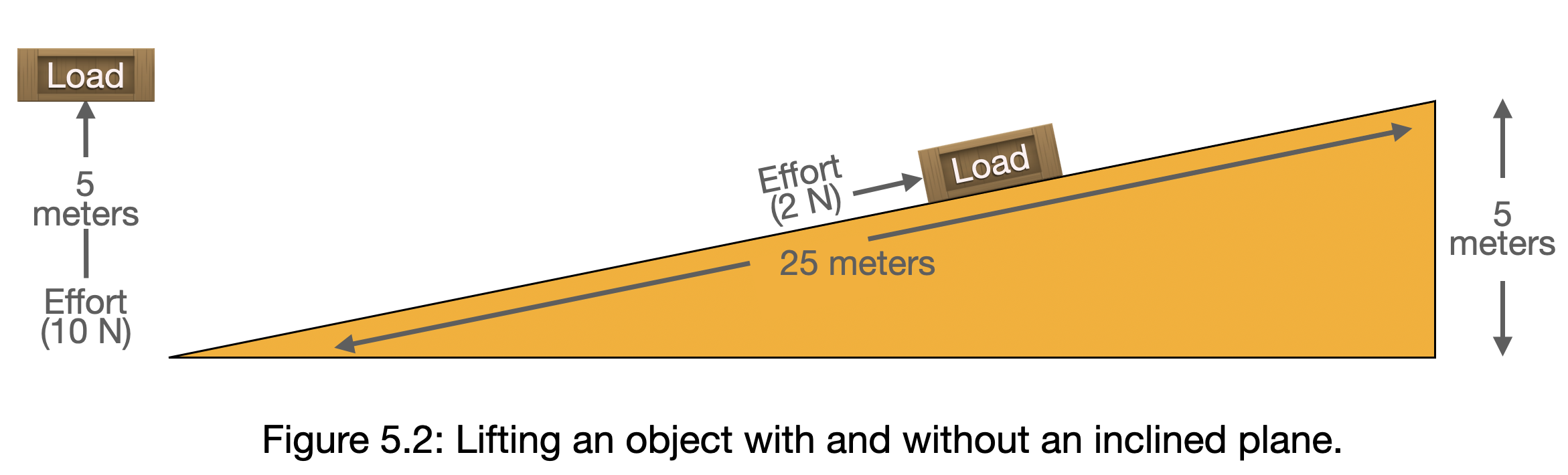
Similar to other simple machines, inclined planes do not decrease the work required to complete a task. The reason is that the decrease in effort results from an increase in the distance required to move an object. In the example above (Figure 5.2) the work done to move a load to the same height with and without an inclined plane should theoretically be the same because machines do not change the amount of work performed.
NOTE TO TEACHER ON FRICTION: In reality, if students were to calculate the work done from the experiments they perform with and without the inclined plane, they would find that the work done with the inclined plane would be greater than the work done without the inclined plane. This occurs because of the force of friction between the load and the surface of the inclined plane. The force needed to move the object up the inclined plane includes the effort needed to move the mass of the load but also the effort to overcome the force of friction between the load and the surface of the inclined plane. The effort applied along the inclined plane IS STILL LESS than the effort when lifting the load BUT not as low as would be predicted in the absence of friction. Therefore, even though more work takes place when using an inclined plane to lift an object, the task still feels easier than simply vertically lifting the load because of the decrease in the effort. It should be noted that because of complexities associated with discussing the role of friction in inclined planes, students are NOT asked to calculate the work done with and without the inclined plane in this Investigation. Students will address friction in much more detail in the LabLearner CELL, Earth’s Forces.
In addition to comparing the effort used to lift a load with and without the inclined plane, students will also investigate other factors that can affect how much effort must be applied to move a load. One of the factors that affect the amount of effort needed to move an object up an inclined plane is the relationship between the length of the inclined plane and the height the load is to be lifted.
Another way of describing this relationship is to refer to the steepness of an inclined plane. For example in Figure 5.3, below, the height of the inclined plane is the same – 5 meters. However, Inclined Plane A is steeper than Inclined Plane B. As a result, although the height of both inclined planes is the same, Inclined Plane A is shorter than Inclined Plane B (length of Inclined Plane A is less than the length of Inclined Plane B). When the effort used to pull an object up both inclined planes is compared, more effort is used in pulling the load up Inclined Plane A than Inclined Plane B. In other words, the steeper the inclined plane, the more effort is needed to move a load up the inclined plane.
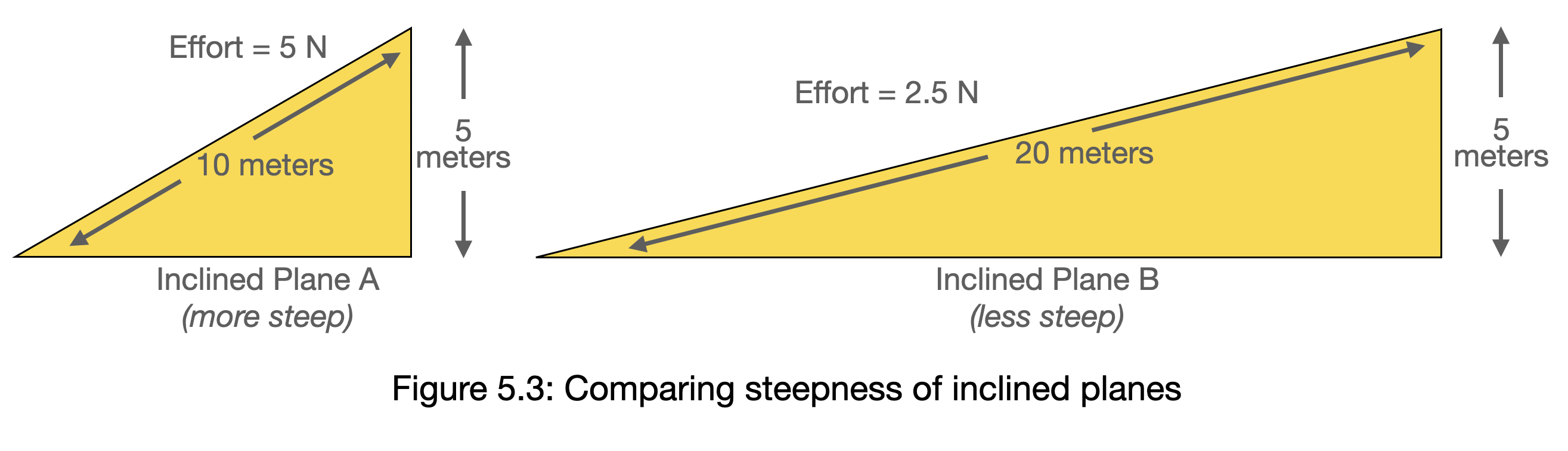
If the work performed when moving the object up both inclined planes in Figure 5.3 is compared, it will be the same. The reason is that for inclined planes of the same height, there is an inverse relationship between the distance a load is moved and the effort needed to move the load. In Figure 5.3, the object is ultimately  lifted to the same height off the ground, but the distance over which the force is applied is much smaller for Inclined Plane A as compared to Inclined Plane B. The longer the length of an inclined plane results in less effort to move the load along the inclined plane to the same height. It is, for this reason, driving up the side of a steep mountain requires switchbacks that reduce the steepness of the road but greatly add to the distance that must be traveled to get to the top.
Does this mean that work will be the same if any more steep and less steep inclined planes are compared? Figure 5.4 shows an example of a more steep and less steep inclined plane. In this case, the work will be different when moving an object up Inclined Plane C as compared to Inclined Plane D. To better understand why, think about the two factors that affect work: force and distance, W = Fd.
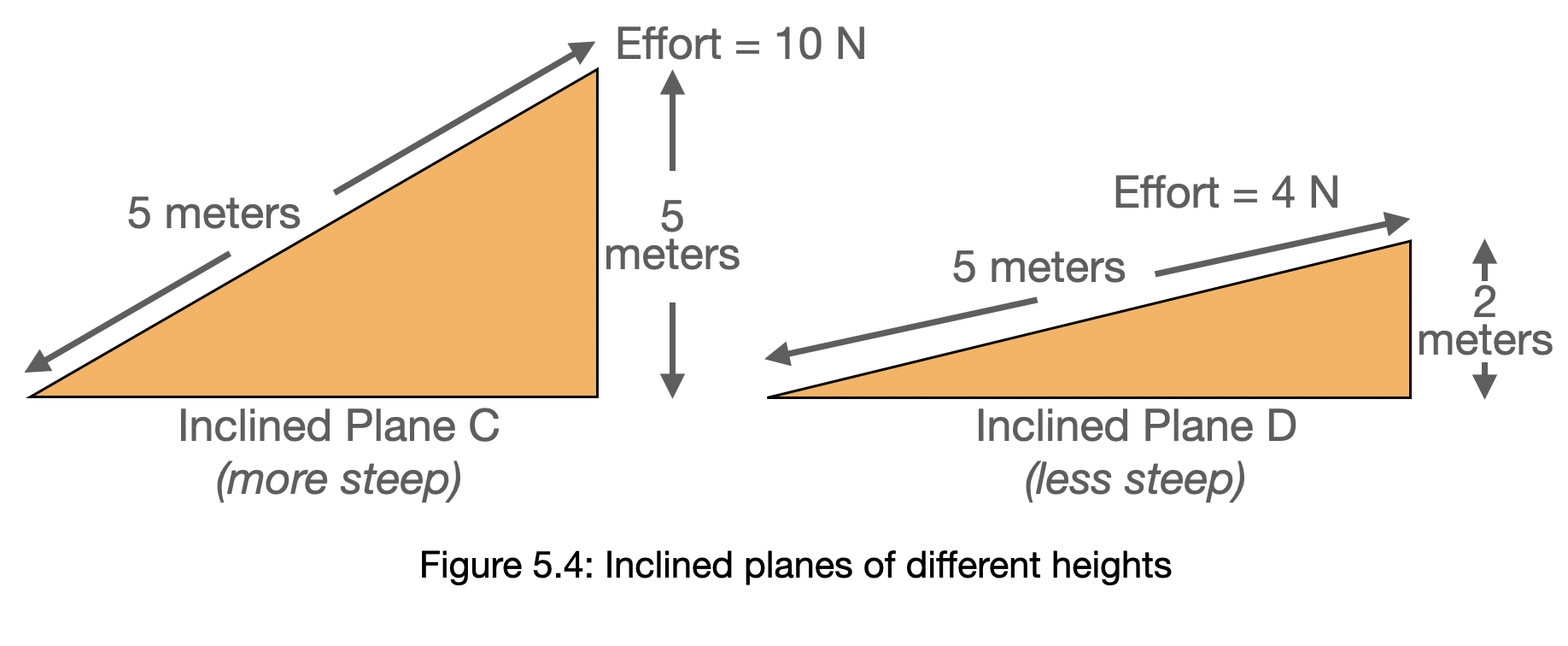
As discussed previously, as the steepness of an inclined plane increases, the effort needed to move a load increases. More effort will be used with Inclined Plane C than Inclined Plane D because Inclined Plane C is steeper. However, the length of the inclined planes is the SAME. This means that an object is pulled or pushed the same distance for both inclined planes. Thus more work is done when pulling a load up Inclined Plane C because a greater effort is applied over the same distance as in Inclined Plane D. Another way to think of this is that different amounts of work will be performed because the height of Inclined Planes C and D are different. In the end, the load will be lifted higher on Inclined Plane C than D. Thus, more work will have been performed. NOTE TO TEACHER: Although students will not explore the relationship described in Figure 5.4, this information has been provided in the event that such questions arise.
In Investigation Five, students will explore the relationship between the steepness of an inclined plane and the effort and work done when lifting a load. They will alter the steepness of the inclined plane by varying the length of the incline while keeping the height constant. Through this Investigation, students will discover that by increasing the length of an inclined plane and keeping the height constant, the steepness of the inclined plane decreases. As a result, the effort needed to move an object along the incline decreases, but the distance the object moves increases. Therefore students should conclude that for inclined planes of the same height, changes in the steepness (length of the incline) do not affect the amount of work required to move the object.
Work and Simple Machines: Investigation 5 - Mathematics Concepts
Prelab
- (in)direct relationship
- patterns
- distance in cm and meters
- comparing (non)measurable characteristics
Lab
- mass in grams
- addition/subtraction
- whole numbers
- decimals to nearest tenth
- distance in cm and meters
- multiplication
- metric conversion
- (in)direct relationships
- patterns
- greater than/less than/equal to
- data table
Postlab
- comparing (non)measurable characteristics
- greater than/less than/equal to
- (in)direct relationships
- patterns
- data analysis
- least to greatest
- line graph
- skip counting by 0.1
Work and Simple Machines: Investigation 5 - Procedural Tools

Work and Simple Machines: Investigation 5 - Cognitive Tools

Work and Simple Machines:
Investigation 5 Quiz

