
Teacher Portal:
Properties of Matter
Investigation 2
Investigation Two: Volume and Water
As the Investigations continue, students will begin to focus on specific properties of matter. This Investigation focuses on the property of volume. Volume is a physical property that can easily be observed and measured. It is defined as the amount of space that matter occupies. In the lab, volume is a measurement in milliliters (ml) and liters (l).
Metric Volume
People view metric volumes every day without realizing it. Every soda can, drink, or other liquid bought in the grocery store is labeled with a volume. In the United States today most of those labels include measurement in ounces and a metric measurement in liters. Yet many people are unfamiliar with how much a liter actually is.
Things That are Measured in Liters (L)
Liquid items are sold by volume and in the metric system that means liters (L) for some liquids and milliliters (ml) for others, depending on the amount. One of the most common liquid items sold by metric volume is gasoline. Let’s look at other items that are often measured in liters.
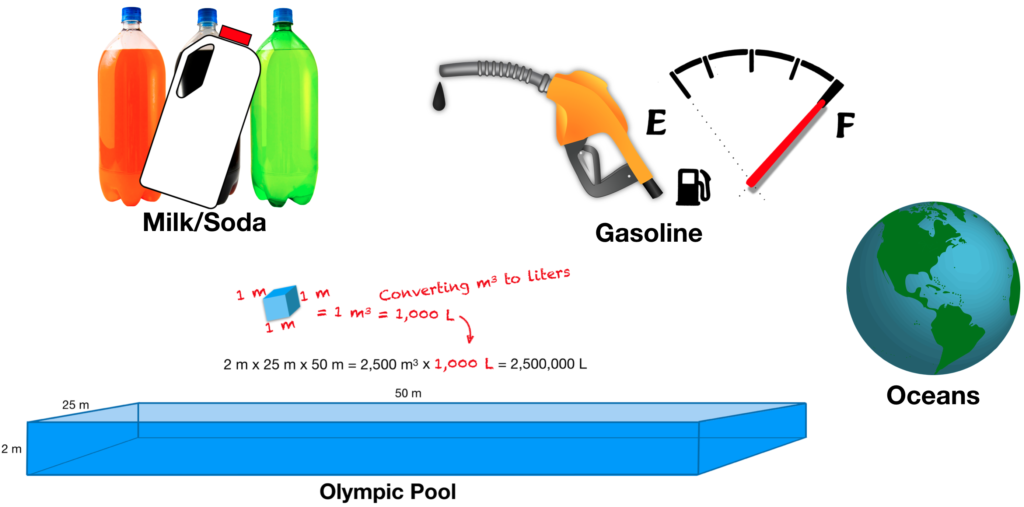
While gasoline and soda quickly come to mind when thinking of liters, some really large volumes may be recorded in liters as well. A typical Olympic pool, for example, has the measurement shown above. The volume of water in the pool is, of course, the depth (2 m) times the width (25 m) times the length (50 m). Multiplying three numbers together gives us a cubic measurement. In this case, we get cubic meters (m3). But how many liters are there in m3? The answer is 1,000 L. Therefore, we can easily convert cubic meters into liters simply by multiplying by 1,000. In the case of the pool shown above, the total number of liters is 2,500,000 L.
The world’s oceans contain around 97 percent of all the liquid water on our planet. Can you imagine a larger volume than that! What is the volume of all of the Earth’s oceans combined? While this number can only be estimated, it turns out to be a truly enormous number: that is
1,350,000,000,000 L
In English, that volume is read as one trillion, three hundred and fifty billion liters! While this conversion from cubic meters (m3) to liters is possible, extremely large volumes, like the volume of the Oceans’ waters would normally be reported in cubic meters (m3) or more likely in km3 (cubic kilometers). In these terms, the Oceans volume is around 1,350,000,000 cubic kilometers (km3). That’s still a huge number!
Things That are Measured in milliliters (ml)
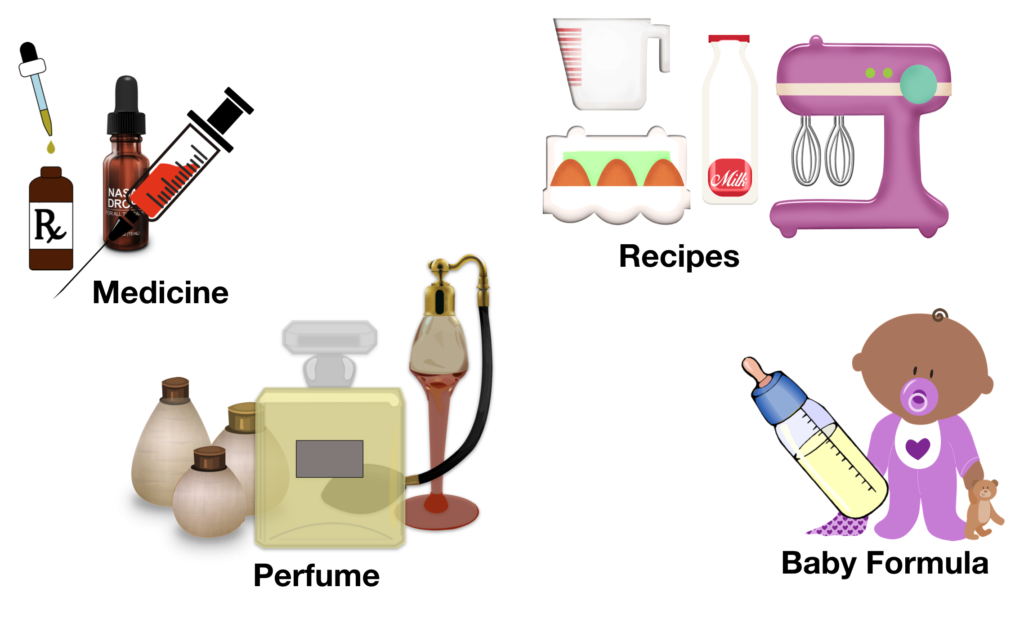
Milliliters (ml) are 1,000 times smaller than a liter. Therefore, it is often more convenient to report volumes less than a liter in milliliters. Nonetheless, keep in mind that any time you report a number in milliliters, it is also a decimal fraction of a liter. Thus, 500 ml is also 0.5 L and 750 ml is also 0.75 L. Sometimes you will see fractions of liters like this, particularly at the grocery store.
The following are the types of things that would commonly be reported in milliliters:
Determining Volume in Lab
There are several methods by which volume can be found. The following are three examples of finding volume: Measurement with Volumetric Equipment, Mathematical Equations, and Volume Displacement.
1. Measurement with Volumetric Equipment: The volume of liquids or powdered solids can be measured with volumetric equipment such as a graduated cylinder. After pouring the liquid into the cylinder, the volume can simply be read off the graduations on the cylinder.
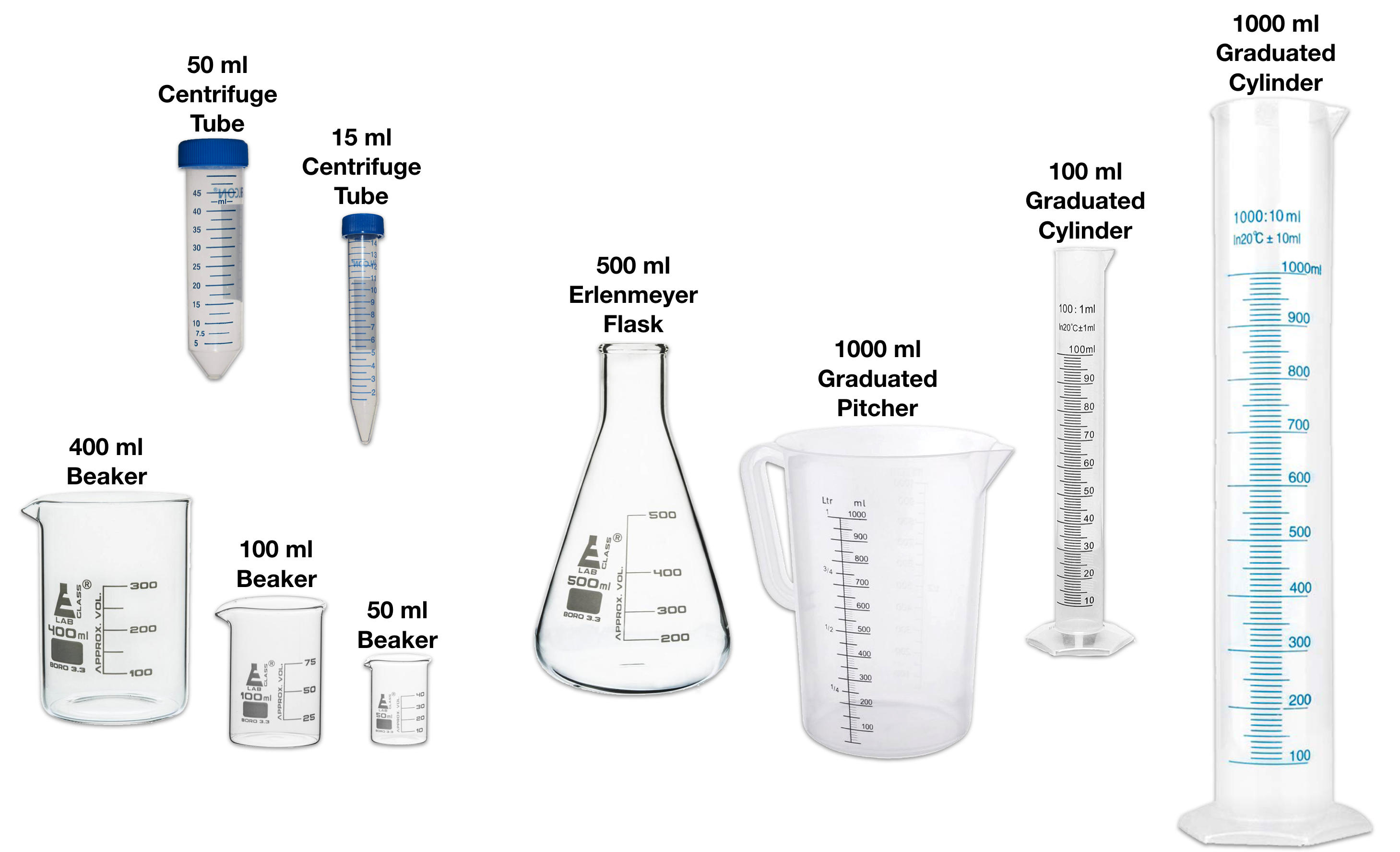
With all of these different volumetric containers, your first question may well be, “which container do I use for measuring volumes?”. In general, while beakers and Erlenmeyer flasks have graduation markers on them, we don’t use them for accurately measuring volume. These pieces of equipment are used for mixing or heating solutions. The volume markings only give approximate readings and there is quite a large volume difference between the markings.
As a rule, the finer or the more graduation marks on a piece of volumetric equipment, the greater its accuracy. Notice, for example, that the individual marks on your 1000 ml graduated cylinder represent steps of 10 ml (above). Therefore, any volume between these 10 ml marks can only be estimated. On the other hand, if you examine your 100 ml graduated cylinder (above), you will see that the individual marks on it represent only 1 ml. Therefore, you can get better accuracy with the 100 ml graduated cylinder than the 1,000 ml (1 liter or 1 L) graduated cylinder.
2. Mathematical Equations:
If the object that you want to determine the volume of is a regular geometric shape, you can often use a mathematical equation to do so. Below, we go through this process for a cube, rectangular prism, sphere, and cylinder.
Note to Teacher: The following discussion of determining the volume of a cube, rectangular prism, sphere, and cylinder are NOT included in the Student Portal as the detail may be too complex depending on the mathematics curriculum. However, should you wish to share this information with your students as a class discussion, we have included them at the bottom of this page as clickable images that you may present to your entire class.
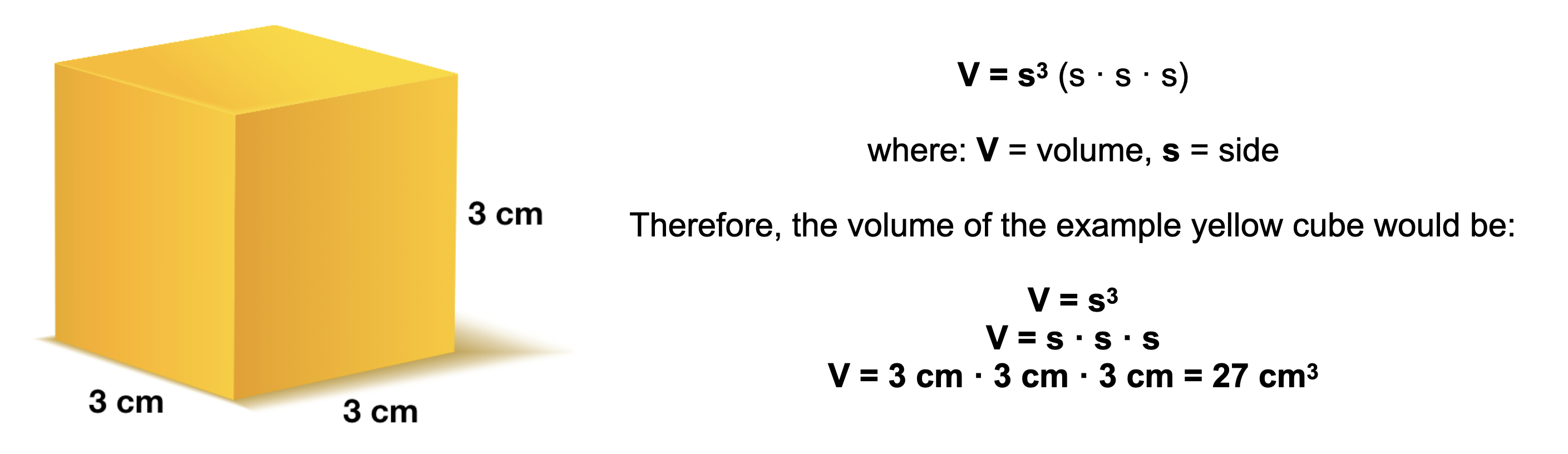
Cube
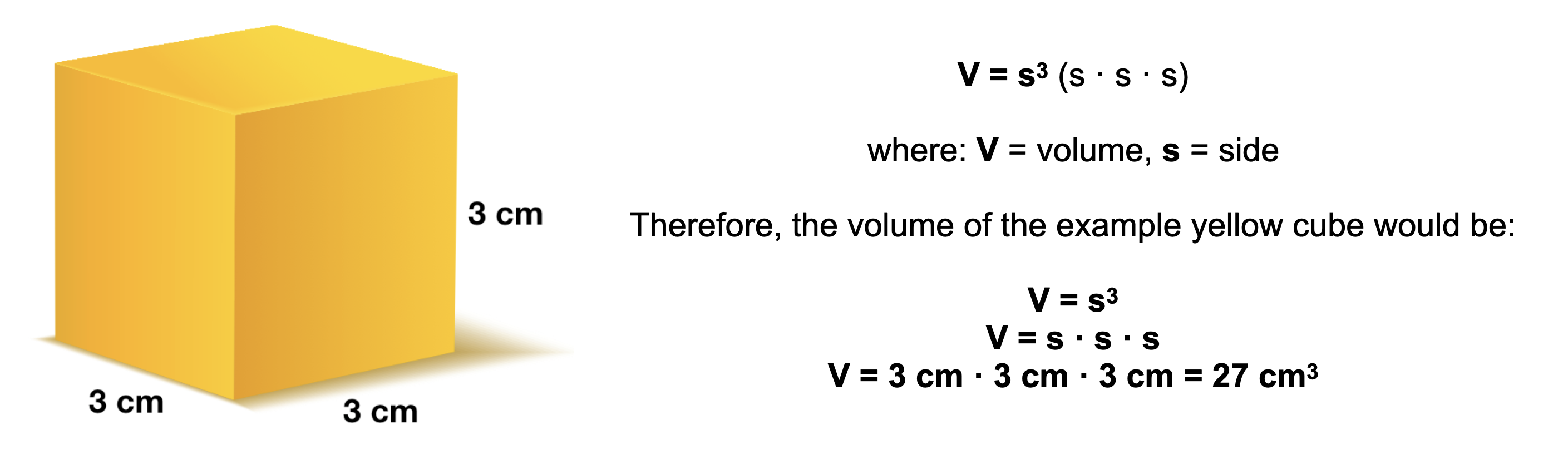
There is a special kind of shape in which all three dimensions (length, width, and height) are the same. Such a shape is called a cube. Use this formula for the volume of a cube:
Rectangular Prism
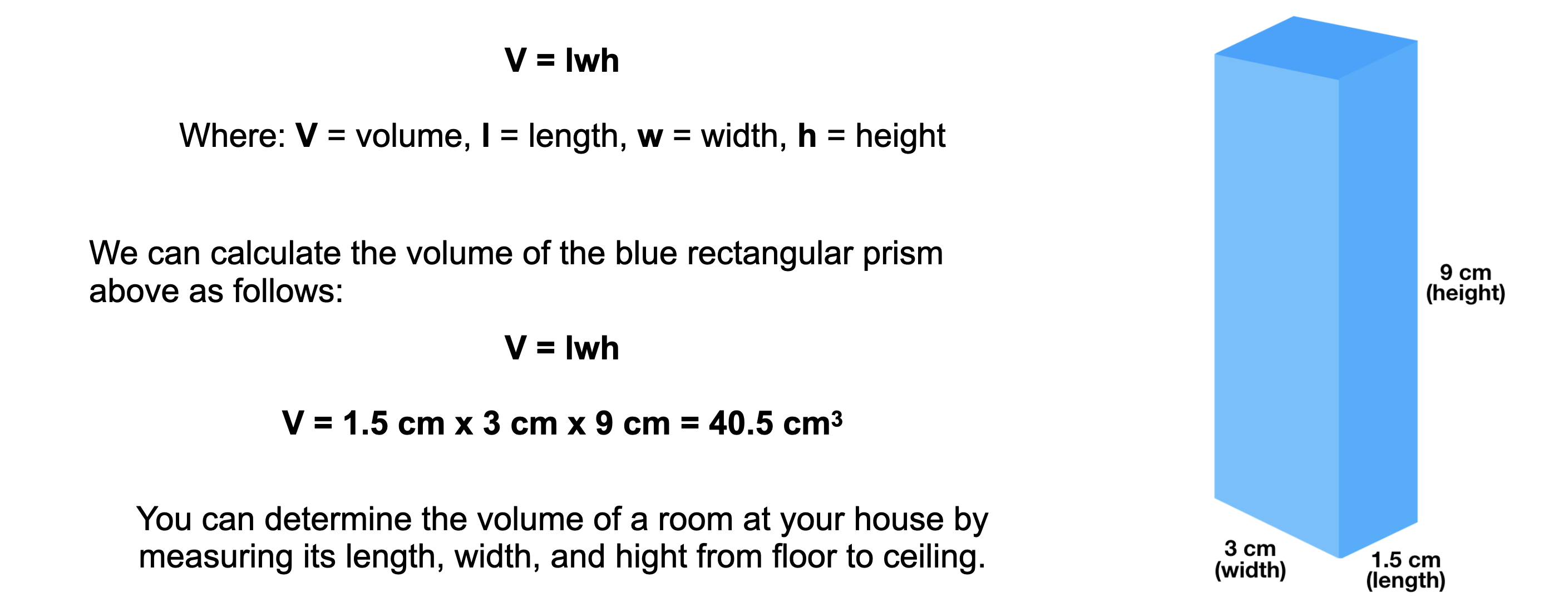
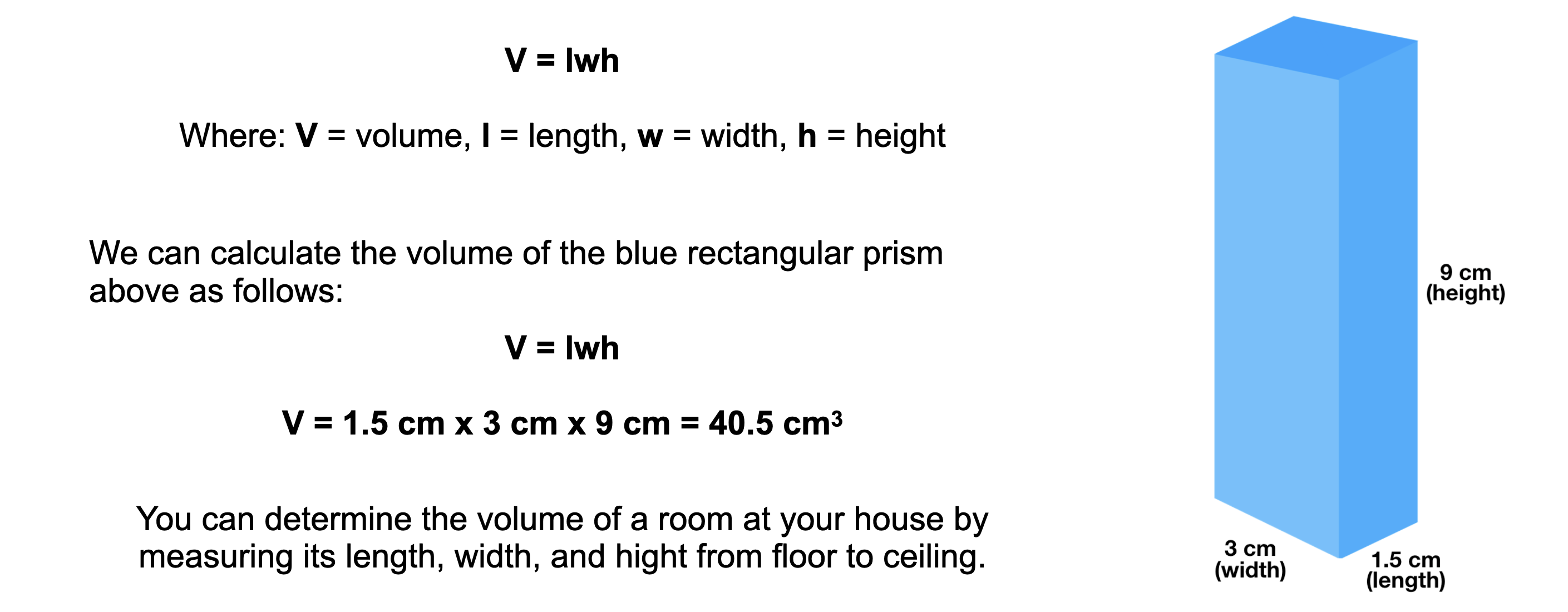
You can think of a rectangular prism as a three-dimensional rectangle. It has three dimensions: length, width, and height. The volume of a rectangular prism is equal to its length (l) times its width (w) times its height (h). Use this formula:
Sphere
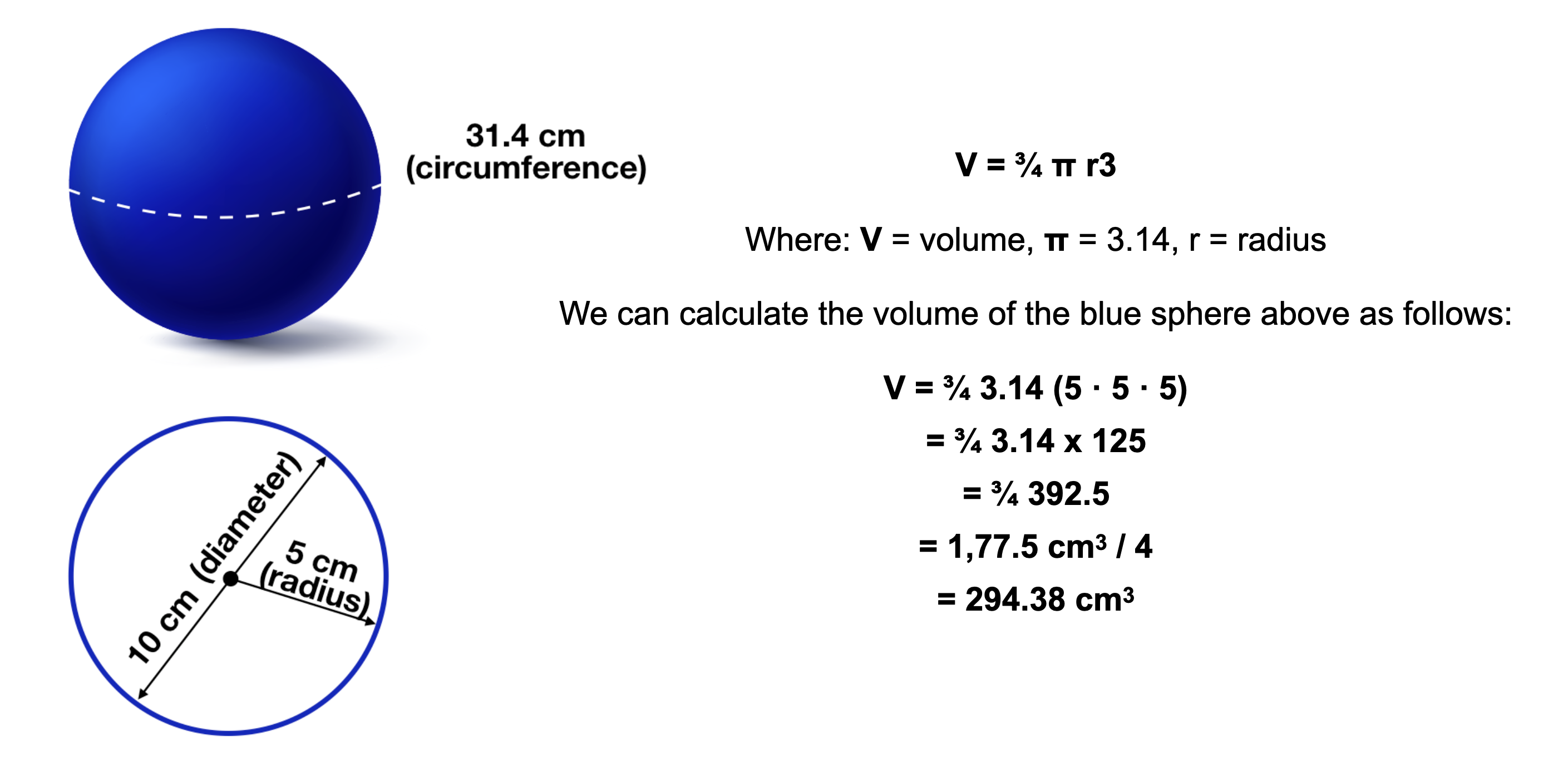
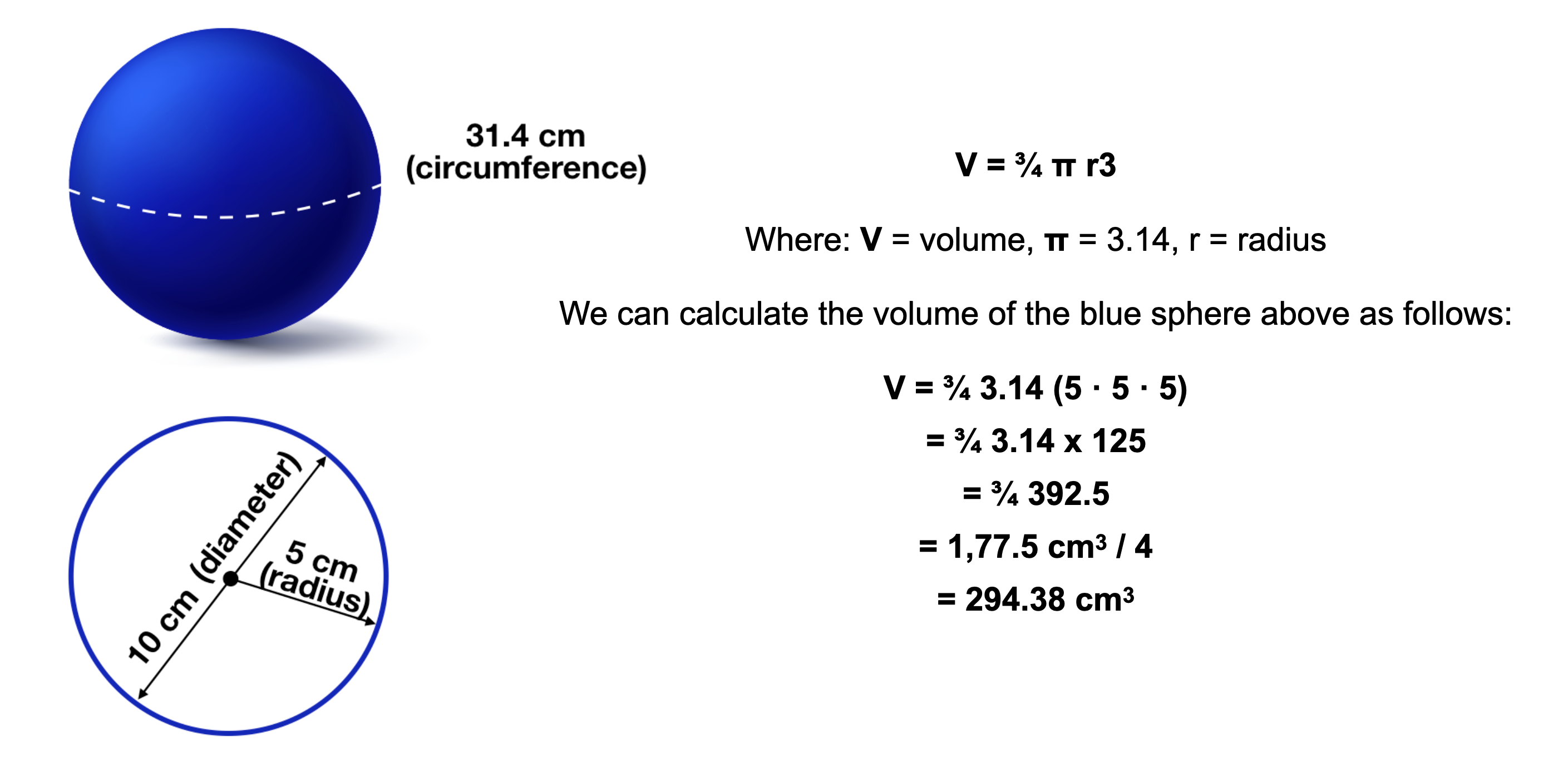
You can think of a sphere as a three-dimensional volume based on a circle. We don’t talk about the height, width, or length of a sphere but rather refer to its circumference, diameter, or radius. Use this formula to calculate the volume of a sphere:
Cylinder
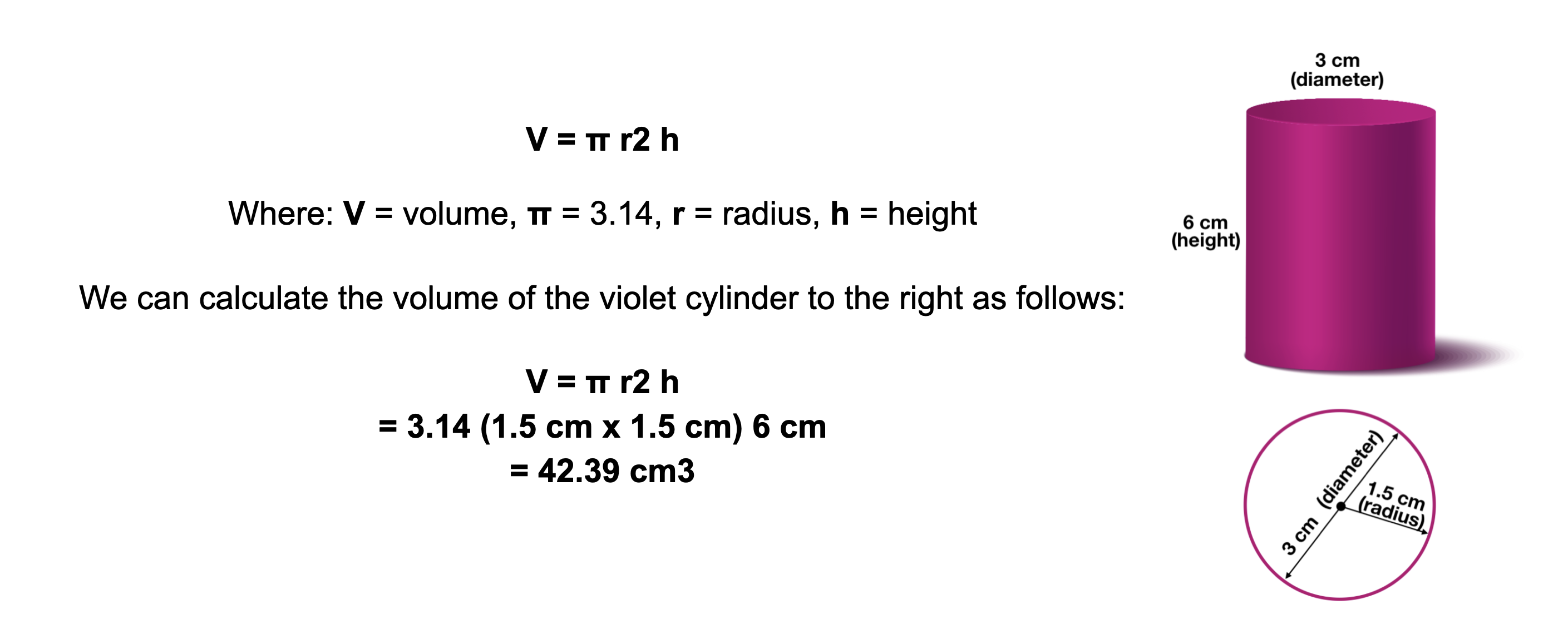
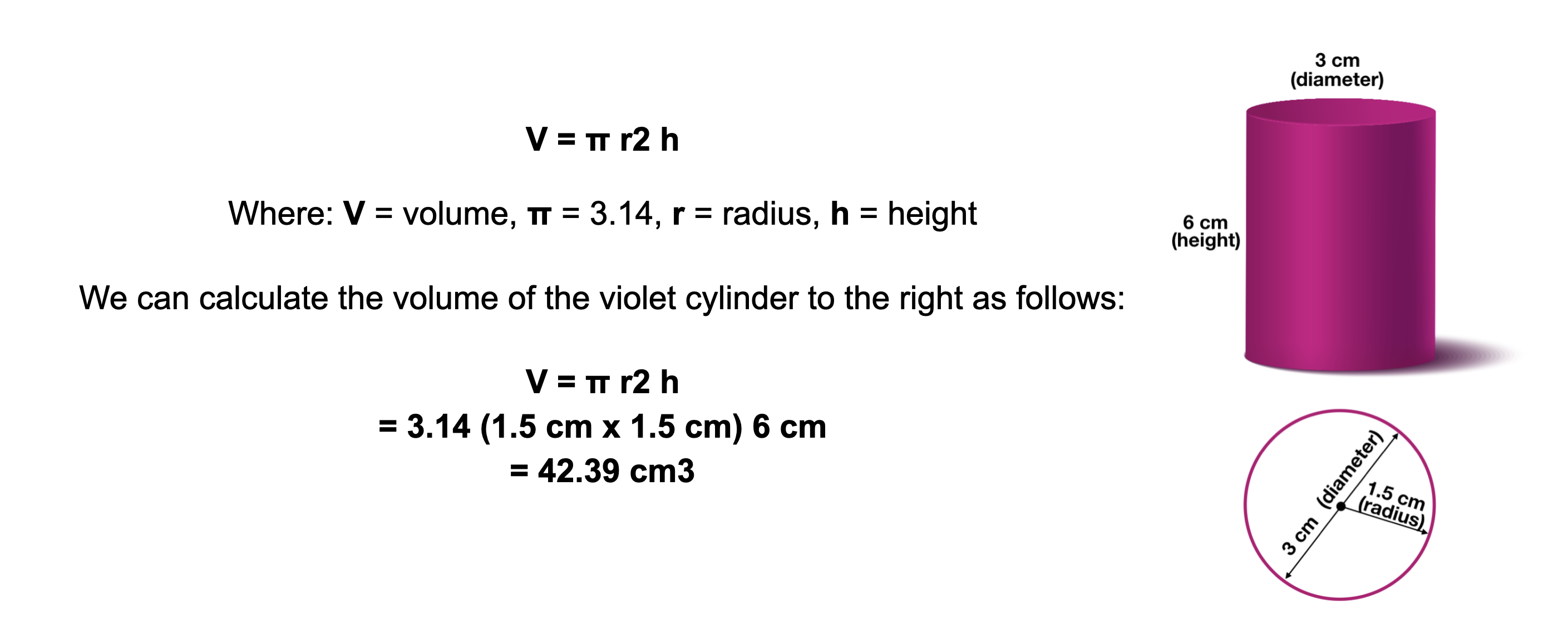
Finally, finding the volume of a cylinder requires two measurements, its height and its radius. Use this formula:
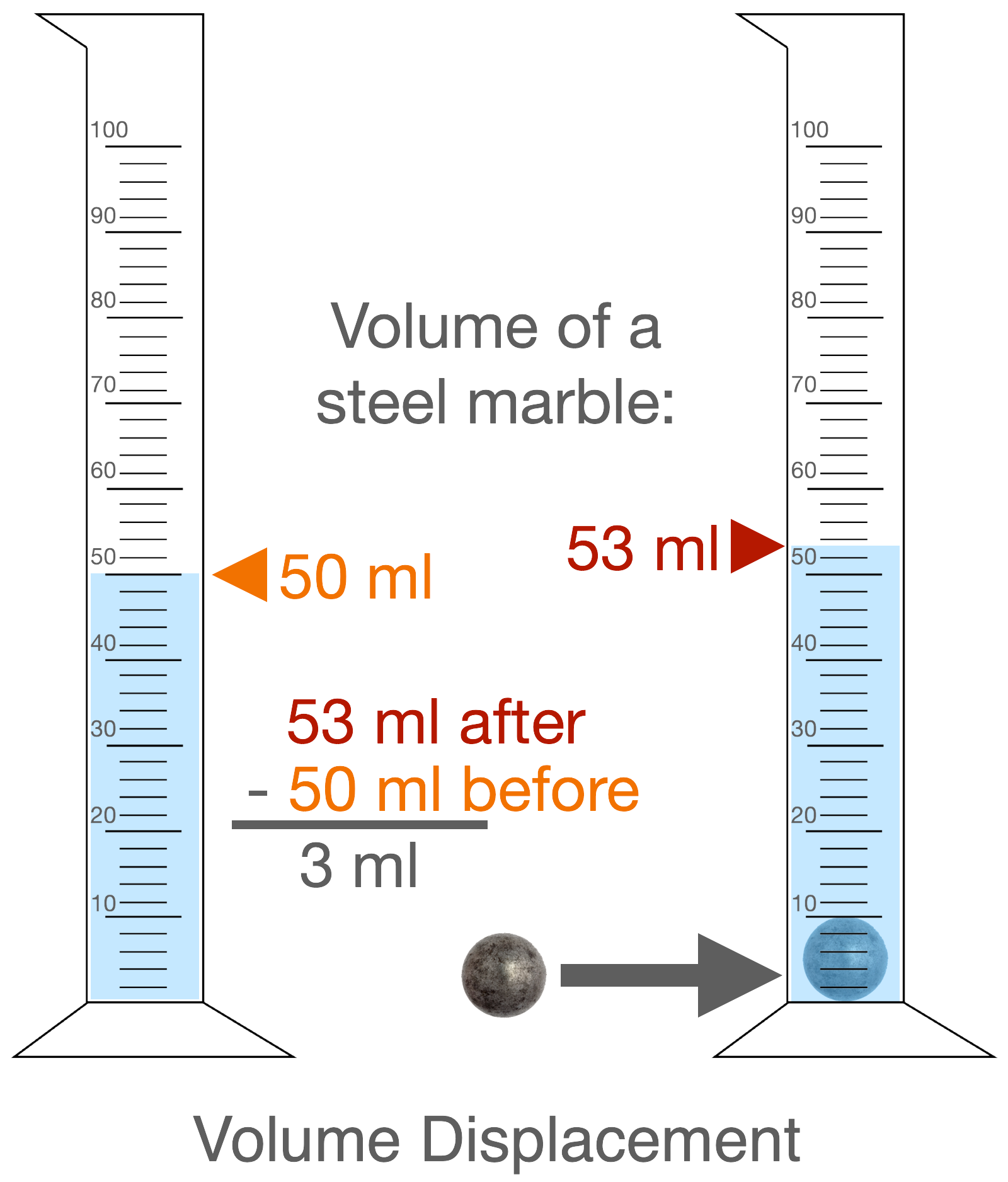 3. Volume Displacement: To find the volume of an object through volume displacement, you must start with a certain volume of liquid such as 50 ml of water. Place the object into the liquid and observe the total amount of water. For example, a small steel marble displaces the water to 53 ml. The volume of the object, in this case, the steel marble, can be calculated by subtracting the original volume from the total volume that now includes the object. In this example, the rock is 53ml – 50ml or 3ml. It is also important to note that 1ml is equal to 1 cubic centimeter (cm3).
The volume of Different States of Matter
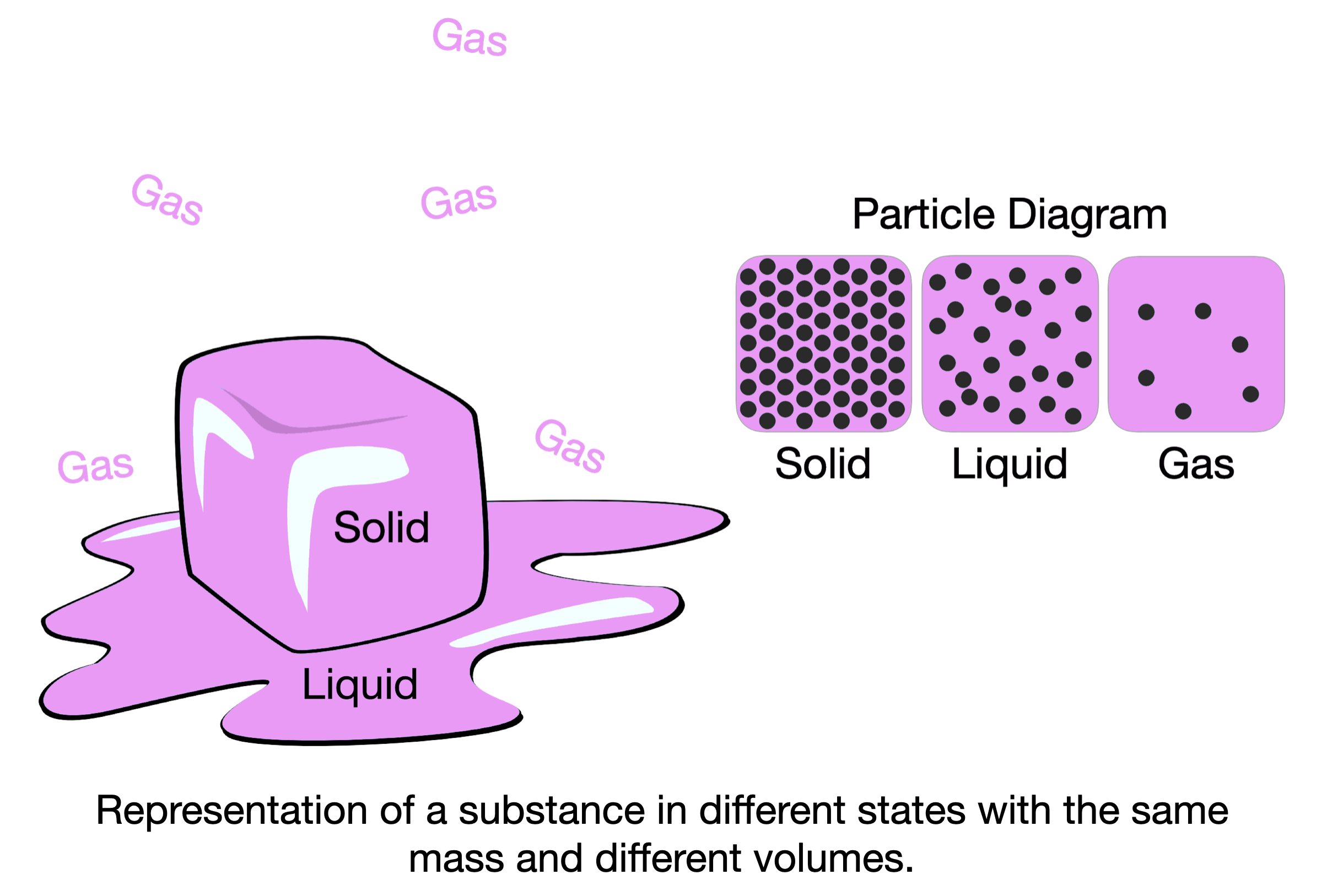
Most substances expand as they melt and evaporate. In the same way, they contract as they condense and freeze. The expansion and contraction that occurs as a substance changes state affect the volume of the substance. If you have a solid and liquid with the same amount of molecules (same mass), the volumes will be different. The volume of the solid will be less than the volume of the liquid because the molecules in the liquid are more spread out and have more kinetic energy. The volume of a gas will be even larger than the volume of the liquid because the molecules of the gas have even more kinetic energy.
In This Investigation
In this Investigation, students will explore volume through prediction and testing. They will learn that an estimation is a form of prediction involving an amount or quantity.
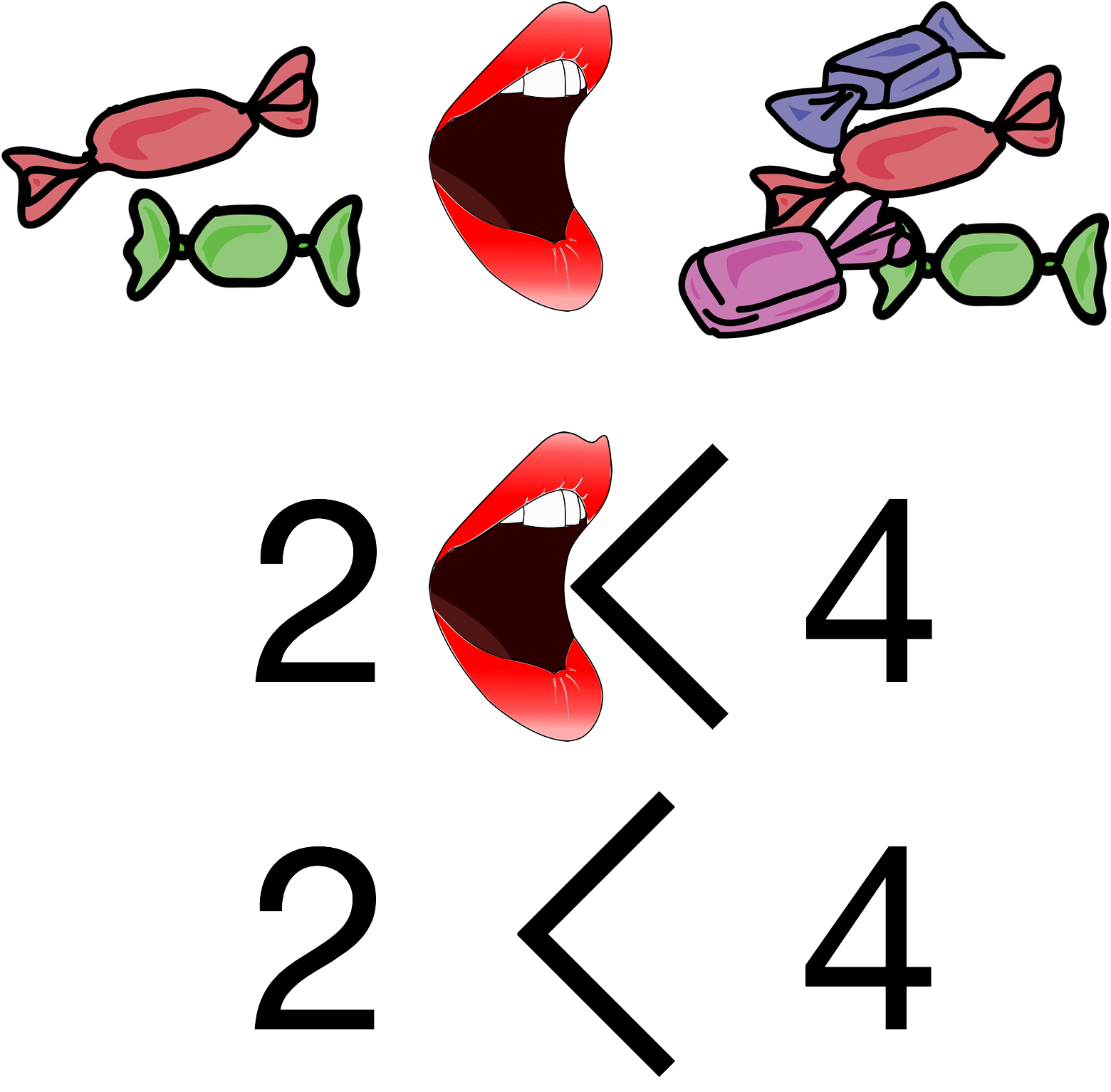 Students will also compare volumes in this Investigation using the mathematical symbols greater than (>), less than (<), and equal to (=). Many students understand = but get confused when using > and <. One way to remember which side of the symbol gets the larger number is to think of the symbol as a hungry mouth. The mouth always wants to eat the most food it can get, so the open side of the symbol is turned toward the larger number.
Students will perform experiments to measure the volume of water in Investigation Two. Students will compare the volume of different containers. Students will also observe how different objects in the water can affect the total volume in a container. Finally, students will calculate the volume of objects in the water.
Properties of Matter: Investigation 2 - Mathematics Concepts
Prelab
• classifying groups
• greater than/less than/equal to
• whole numbers
• estimation
• geometry
• volume in mL
• place value (ones, tens, hundreds)
• bar graph
• least to greatest
Lab
• whole numbers
• volume in mL
• place value (ones, tens, hundreds, thousands)
• estimation
• multiplication
• geometry
• manipulatives
Postlab
• volume in mL
• estimation
• multiplication/division
• place value (ones, tens, hundreds, thousands)
• bar graph
• subtraction
• comparison
• greater than/less than/equal to
• estimation
• common trends/relationships
Properties of Matter: Investigation 2 - Procedural Tools

Properties of Matter: Investigation 2 - Cognitive Tools

Properties of Matter:
Investigation 2 Quiz

