Teacher Portal:
Properties of Matter
Investigation 2 – PreLab
 PRINT IT
Use your browser to download a printable PDF as help during the slide presentation and to make additional notes. In your browser, go to File > Print and then choose to save as PDF.
MINDSET
This Investigation is designed to:
- reinforce student understanding of the concept of properties.
- increase student understanding of the volume of liquids and solids.
- provide students with the opportunity to measure volume.
- provide students with the opportunity to compare volumes of different objects
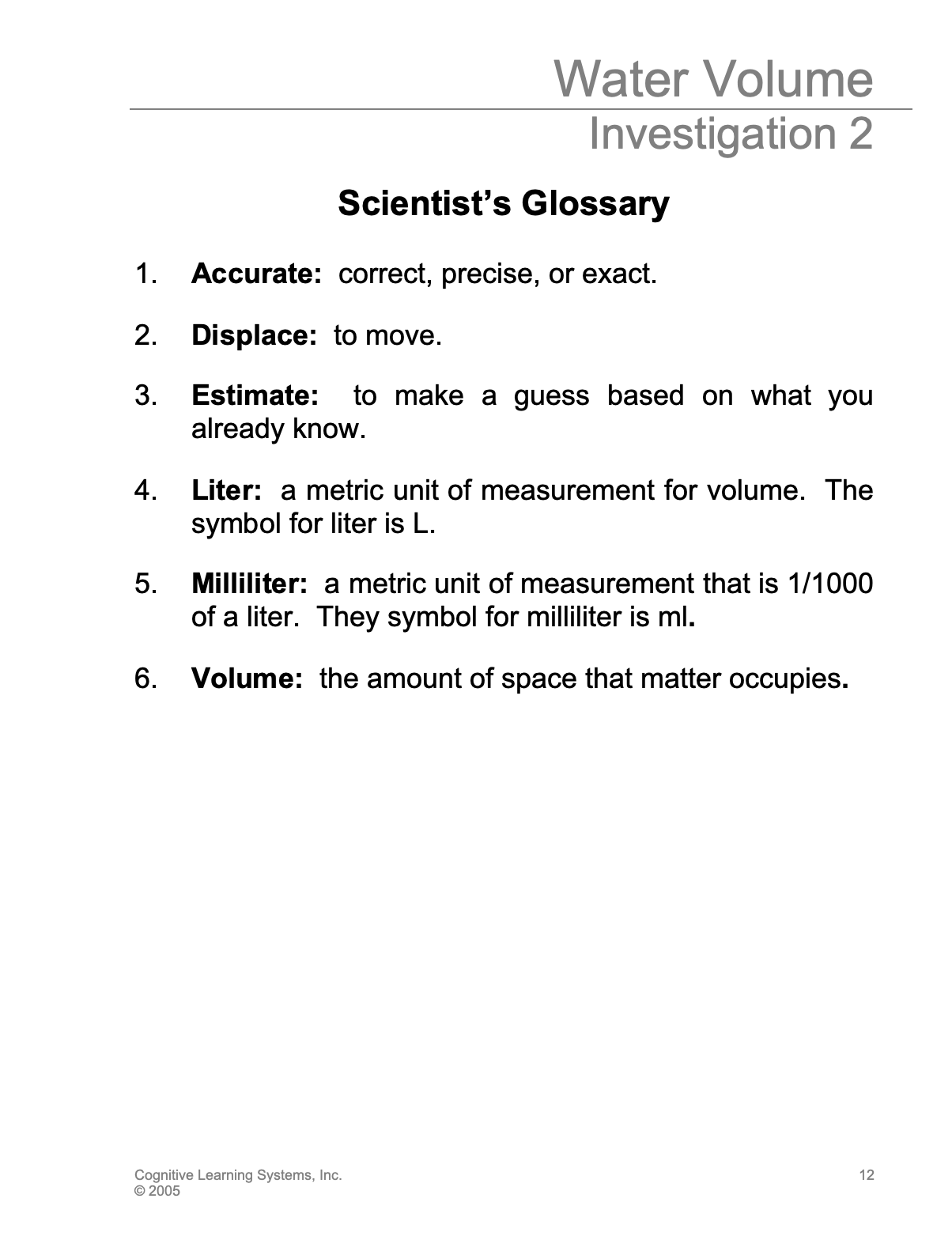
SCIENTIST’S GLOSSARY
1. Accurate: correct, precise, or exact.
2. Displace: to move.
3. Estimate: to make a guess based on what you already know.
4. Liter: a metric unit of measurement for volume. The symbol for liter is L.
5. Milliliter: a metric unit of measurement that is 1/1000 of a liter. The symbol for milliliter is ml.
6. Volume: the amount of space that matter occupies.
BE PREPARED
Watch the Investigation 2 Teacher Video and Student Video below to prepare for the PreLab.
SET FOR SUCCESS
- Tell students that they will continue their exploration of the Properties of Matter CELL.
- In this Investigation, students will focus on the volume of water.
- Ask students to share the kinds of things they might learn in these Investigations.
Begin the PreLab Concept Slides to start students on their learning journey. Then watch the Pre-Lab Student Video afterward as a class.
NAVIGATE IT
Once the slide presentation is launched
- use your left and right arrows to advance or go back in the slide presentation, and
- hover your mouse over the left edge of the presentation to get a view of the thumbnails for all the slides so that you can quickly move anywhere in the presentation.
- Click HERE to launch the slide presentation for the CELL.
SHARE IT
SLIDE VPROP2-pre-1
This is the second Investigation of the LabLearner CELL Exploring Density. In it, students will focus on measuring the volume of water.
______________________________________________
SLIDE VPROP2-pre-2
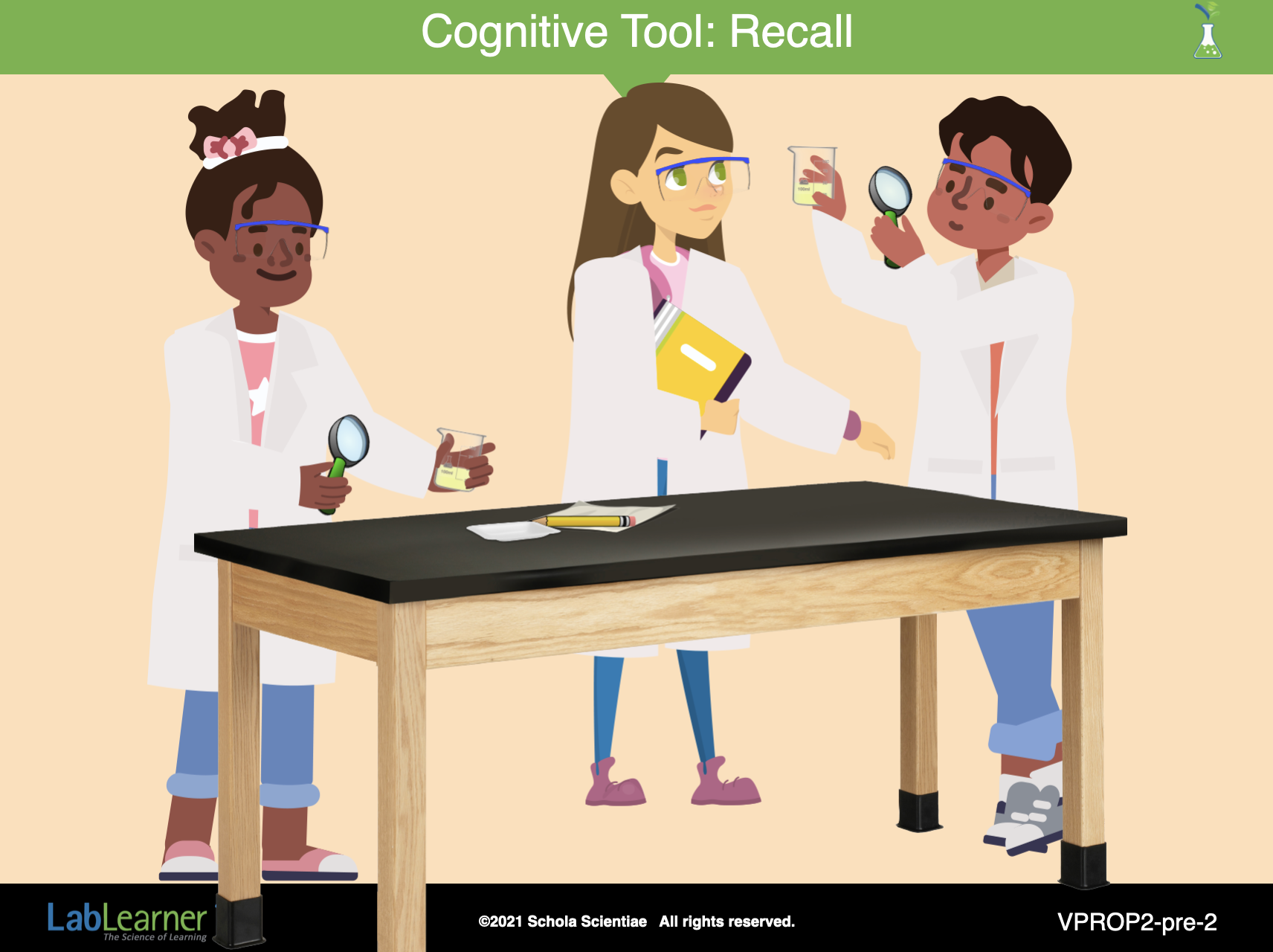
A. Use the following questions in order to prompt discussion of Investigation 1.
1. Ask students: What type of matter did we explore in Investigation 1? Students should indicate they observed water.
2. Ask students: What were the states of matter that were observed in Investigation 1? Ice, Water, and Water Vapor.
3. Ask students: How much water did we use in the lab? Students should indicate that they do not know how much water they used.
4. Ask students: How could we have found out how much water we used? Students should indicate they could have measured the water with a beaker, graduated cylinder, or other volumetric equipment.
5. Inform students that they will be estimating and measuring with water in Investigation 2.
______________________________________________
SLIDE VPROP2-pre-3
B. Review terms and symbols with students.
1. Refer students to their Scientist’s Glossary.
a. Ask a volunteer to read the definition of Volume to the class.
“Volume: the amount of space that matter occupies.”
b. Tell students they will be investigating the volume of water in the lab.
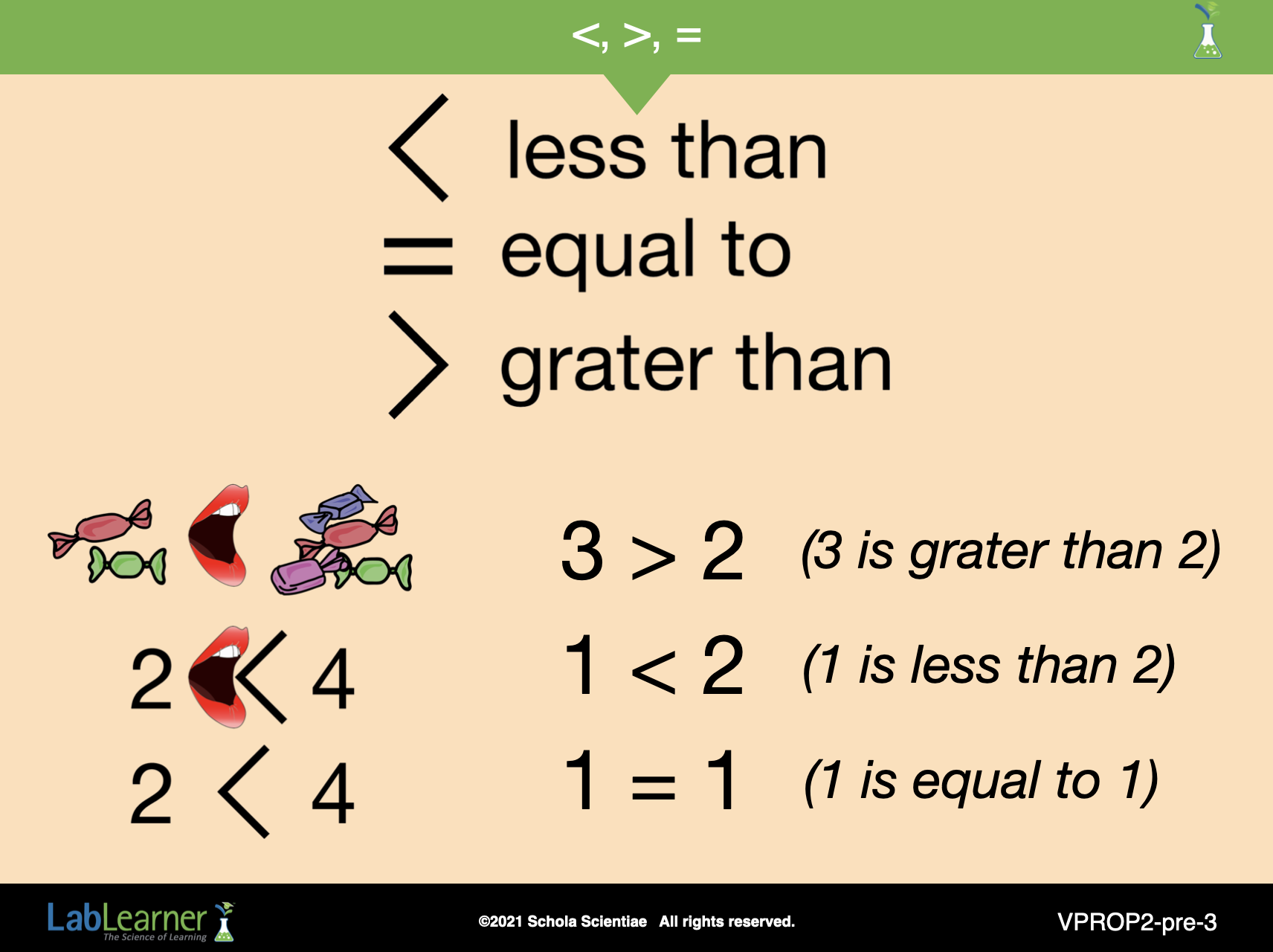
2. Review the symbols >, <, and =.
Tell students that one way to remember which side of the symbol gets the larger number is to think of the symbol as a hungry mouth. The mouth always wants to eat the most food it can get, so the open side of the symbol is turned toward the larger number.
a. Show the class the > symbol.
b. Remind students that the number that is greater goes on the left side of this symbol.
c. Show the class the < symbol.
d. Remind students that the number that is less goes on the left side of this symbol.
e. Show the class the = symbol.
f. Remind students that the numbers should be the same on both sides of this symbol.
______________________________________________
SLIDE VPROP2-pre-4
C. Complete an activity with the class to reinforce the concepts of <, >, and =.
1. Divide the class into two or more large groups.
2. Instruct the students to pick one student as the spokesperson for the group.
3. Instruct students that they will be dividing the members of their group according to what sign you hold up.
4. Perform a sample item with the students.
a. Hold up the > paper.
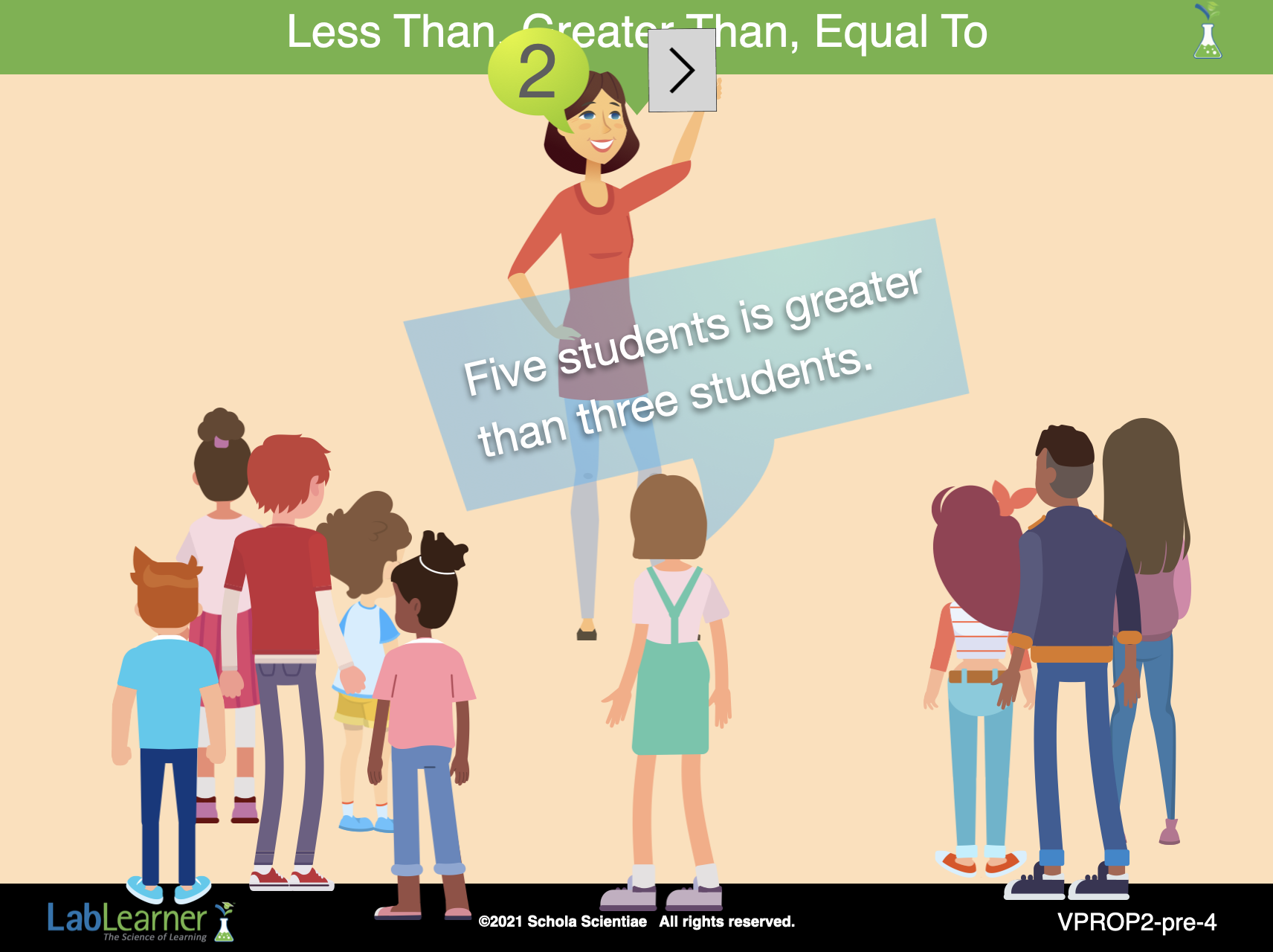
b. Tell students: I will say “Two” and hold up this sign for greater than. Then you will divide your group members so that there are two more students on the left side of the spokesperson than the right side. For example, you may have five people on the left and three on the right because five is two greater than three. After you get into your arrangement, I will ask the spokesperson to tell me, ‘Five students is greater than three students.’
5. Play the game with students.
a. Tell students Three and hold up the less than sign.
b. Allow students 30 seconds to 1 minute to arrange their groups.
c. Have each spokesperson tell you a less than sentence such as 2 is less than 5.
d. Direct students to choose a new spokesperson for the next round.
e. Repeat steps a.-c. using >,<, and = two times each.
-
-
- Show equals
- Say One and show greater than
- Show equals
- Say Three and show greater than
- Say One and show less than
-
______________________________________________
SLIDE VPROP2-pre-5
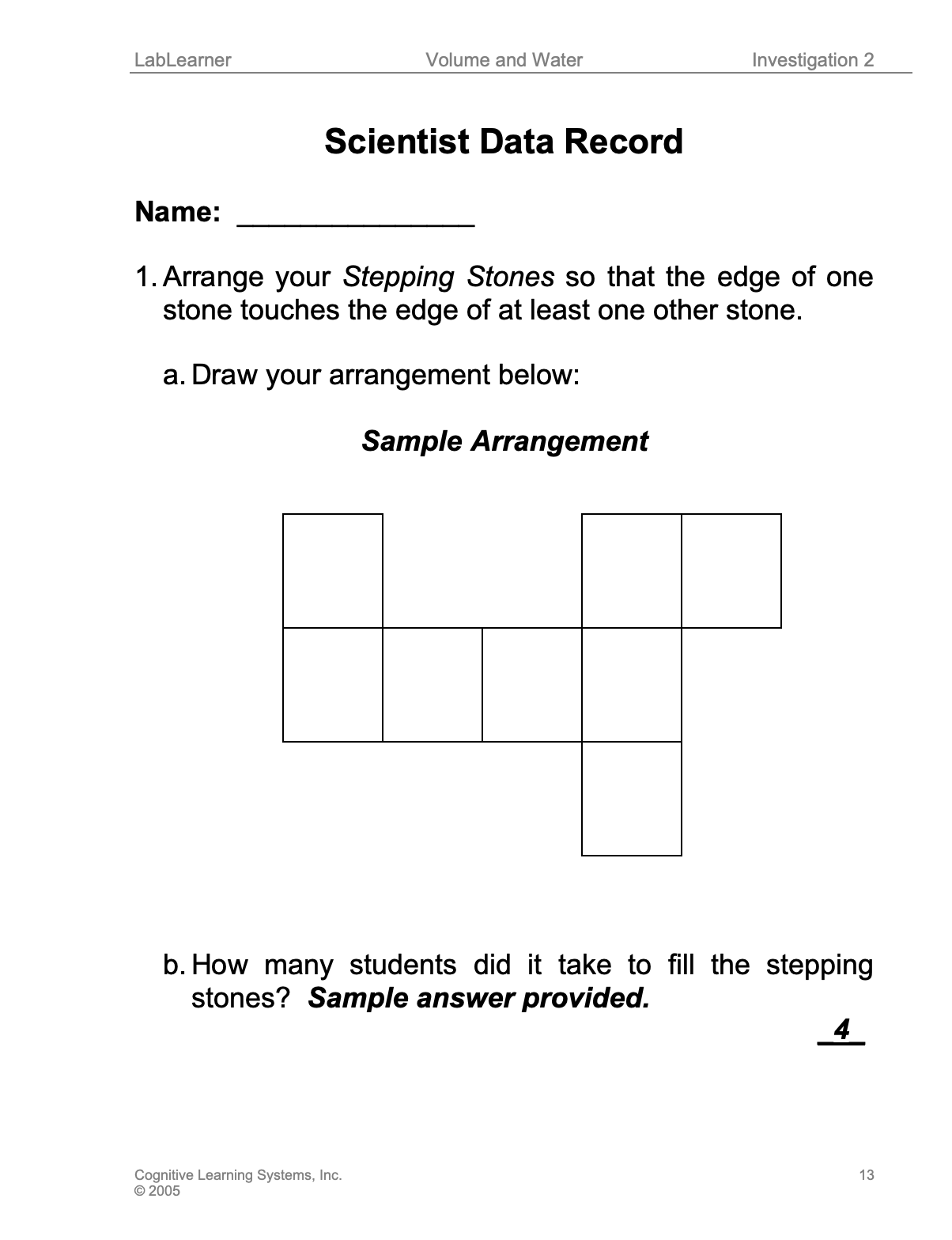
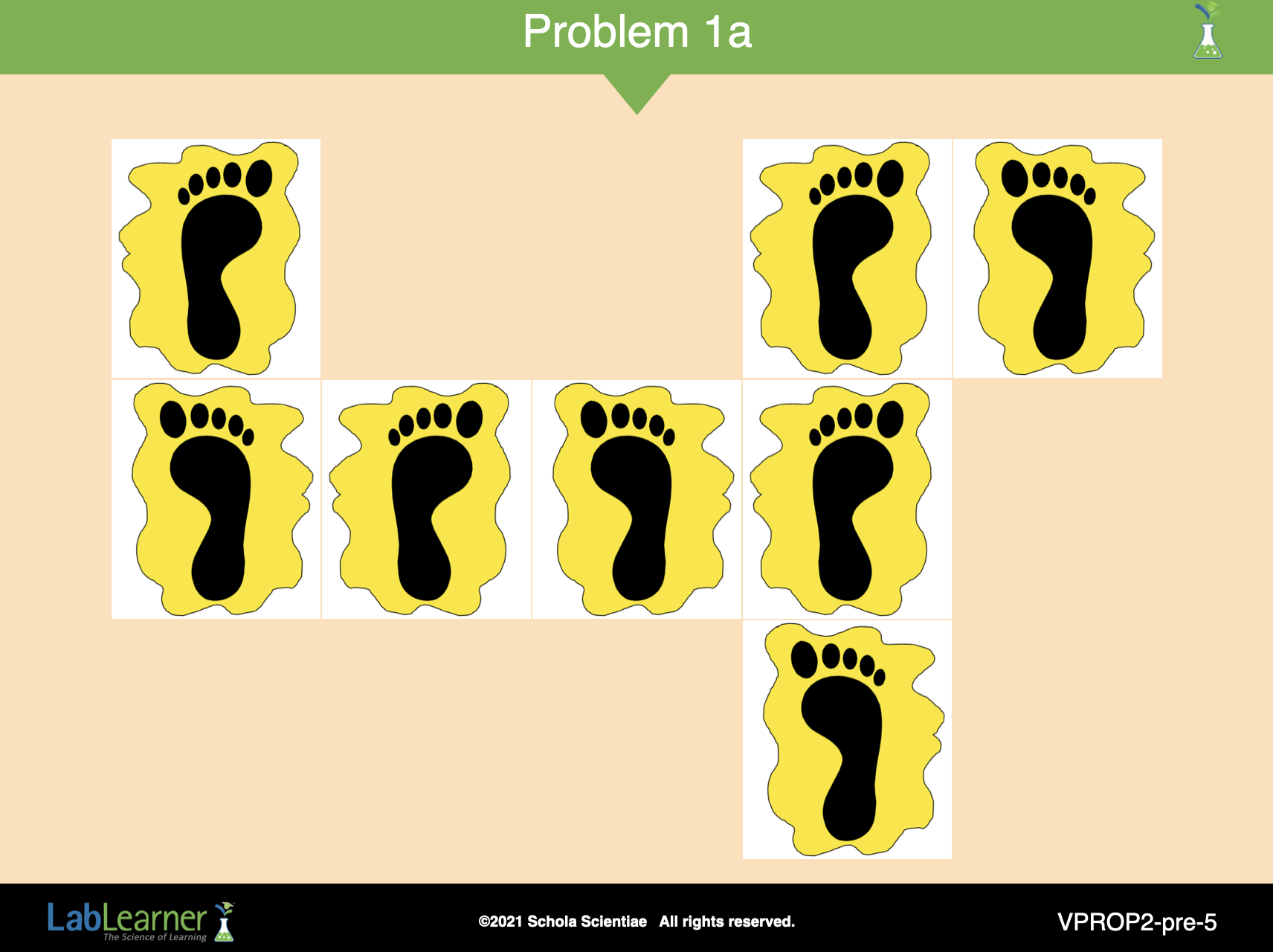
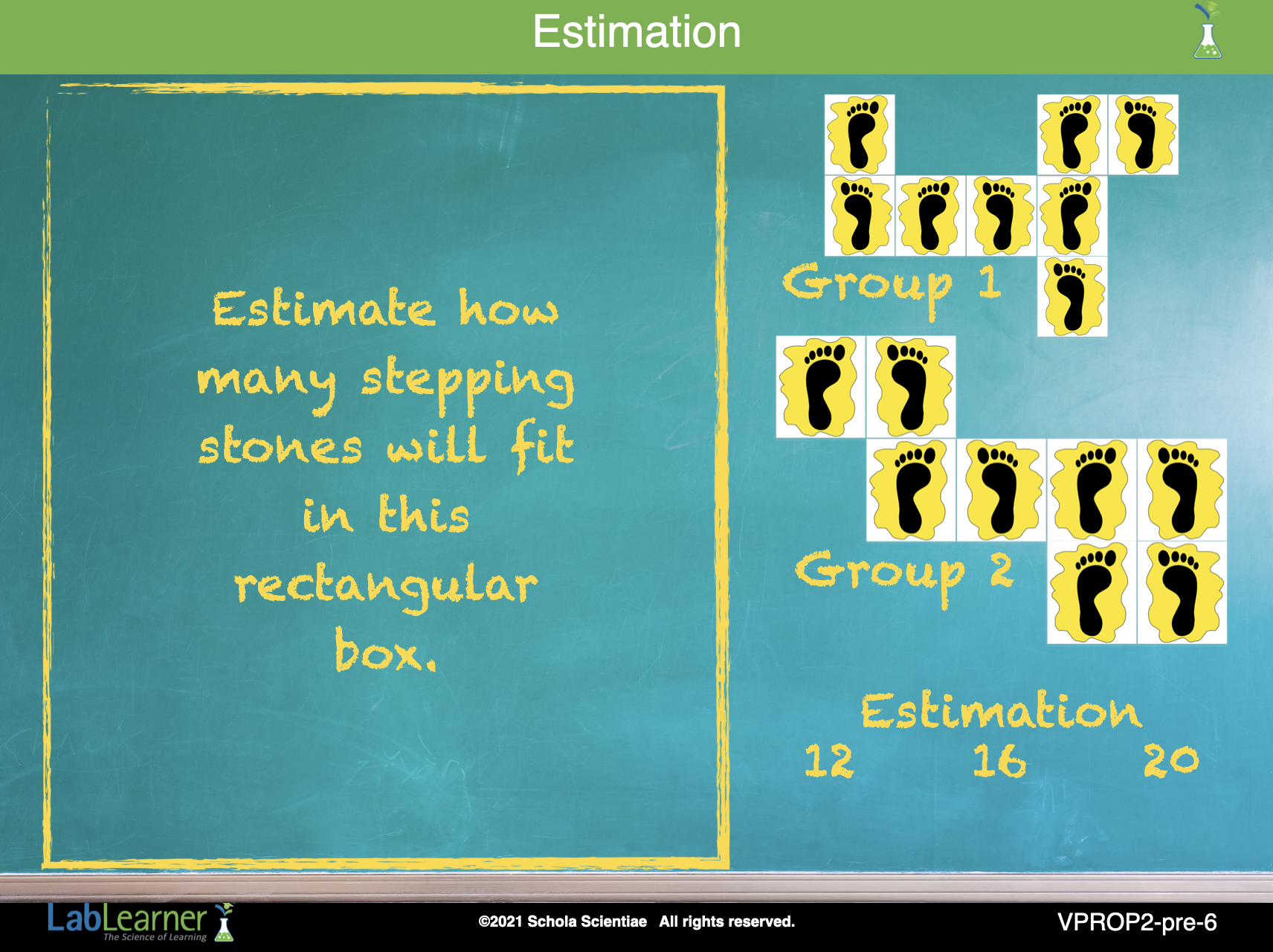
D. Demonstrate estimation through a group activity using the Stepping Stones. The goal of this activity is to show that arrangements of different configurations can have equal size.
1. Instruct students to locate their Student Data Record and Stepping Stones.
2. Divide students into five cooperative groups.
3. Refer students to Problem 1 in their Student Data Record. Instruct students: Arrange a grouping of Stepping Stones on the floor so that at least one edge of a Stepping Stone is touching the edge of another Stepping Stone.
Note to teacher: if groups have different numbers of students, give students a specific number of Stepping Stones to use to make the arrangement.
4. Direct students to record their arrangement in their Student Data Record.
5. Instruct students to have group members stand on the Stepping Stones so that one foot is on each stone.
6. Ask students: How many students did it take to fill the stepping stones? Direct students to record their answer in Problem 1b in their Student Data Record.
7. Have students return to their seats.
8. Choose a space away from the block you have prepared on the board, and ask a volunteer from each group to draw his or her arrangement on the board.
______________________________________________
SLIDE VPROP2-pre-6
9. Instruct students to compare the arrangements.
a. Ask students: Are all of these arrangements the same? No.
b. Ask students: Did all of these arrangements fit the same number of students? Yes.
c. Tell students: Even though the arrangements had different shapes, all of the arrangements held the same amount of students. In the same way, containers of different shapes can hold the same amount of liquid or have the same volume. You will be testing different containers in the lab to see if they have the same volume
 E. Demonstrate estimation using the Stepping Stones.
1. Remind students of how many Stepping Stones they used in their arrangement and how big their arrangements were.
2. Show students the square you have drawn on the chalkboard.
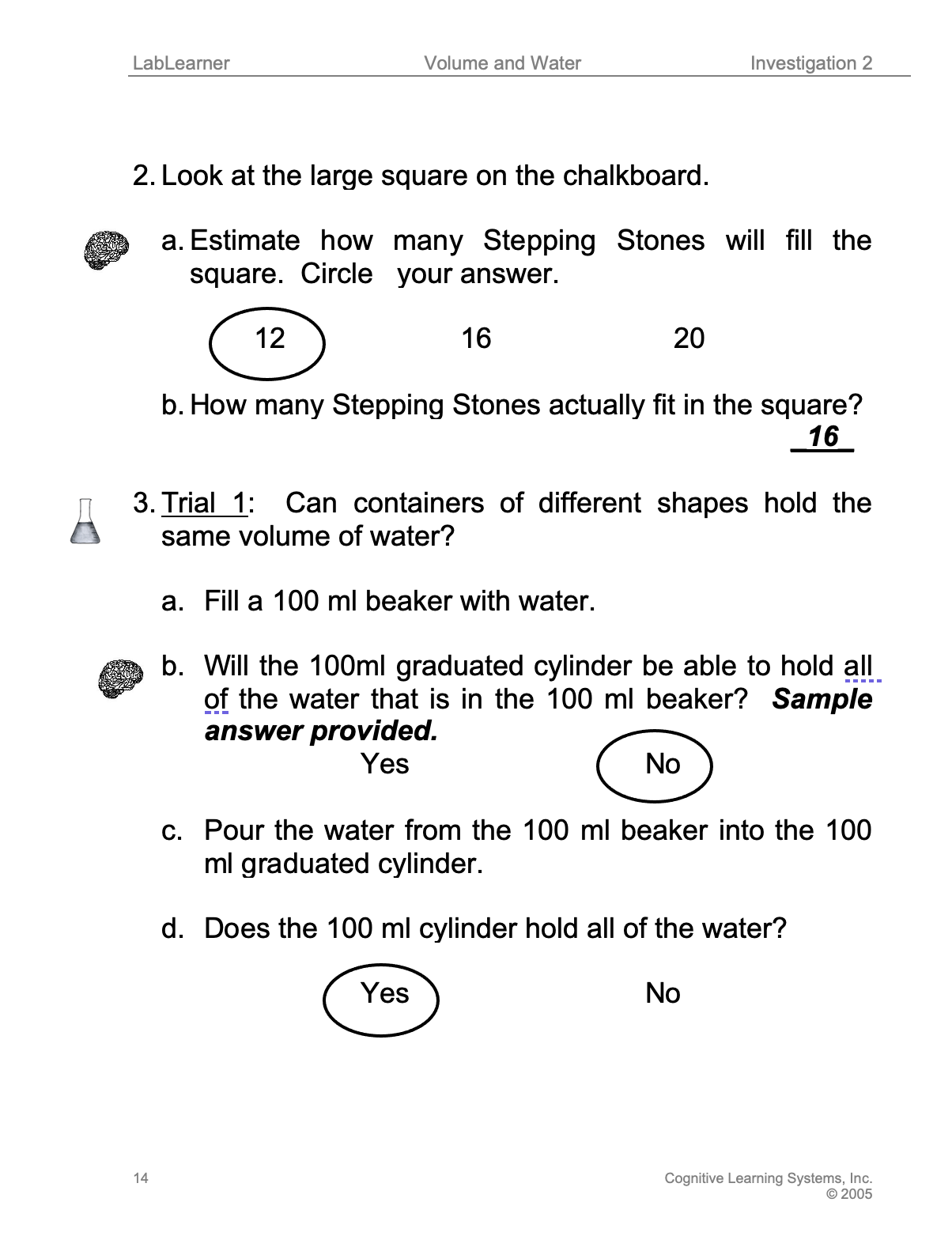
a. Write on the chalkboard 12, 16, and 20. Tell students: We are going to estimate how many Stepping Stones fit into this square.
b. Ask students: How many Stepping Stones do you think will fit: 12 stones, 16 stones, or 20 stones? Students should record the answer in Problem 2a of their Student Data Record.
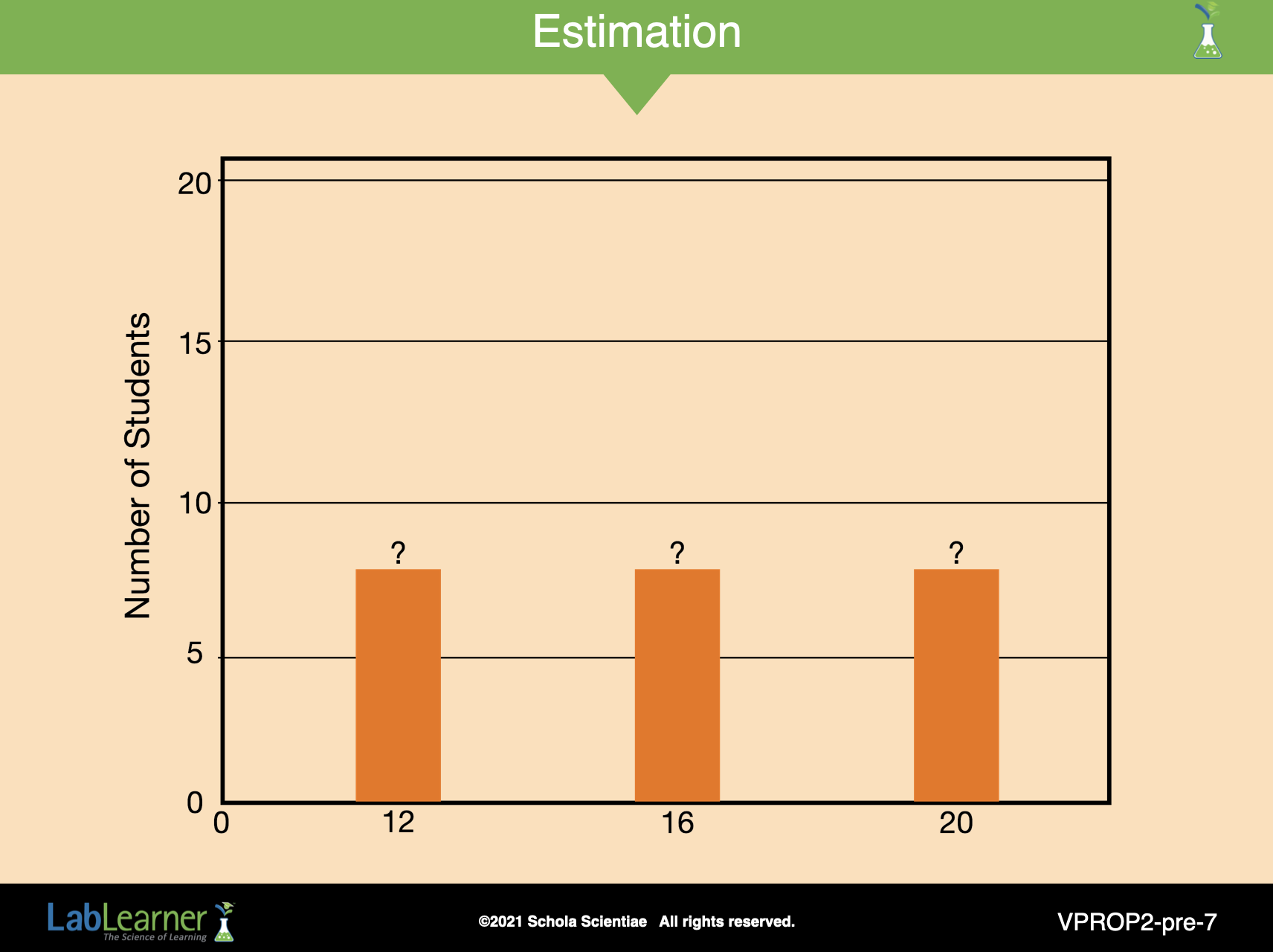
c. Ask students: How many think 12? How many think 16? How many think 20? Record the number of students who choose each amount on the chalkboard.
d. Make a chart on the board that illustrates how many students chose each number.
______________________________________________
SLIDE VPROP2-pre-7
3. Ask for student volunteers to take turns taping a Stepping Stone on the chalkboard inside of the block until it is filled.
a. Instruct students to record in Problem 2b of their Student Data Record, the actual number of Stepping Stones that filled the block.
4. Review with students.
a. Ask students: When we estimated how many Stepping Stones would fit into the block, did we all get the same answer? No.
b. Ask students: Why? Students should indicate that they had different ideas about how many would fit and they hadn’t measured yet to find out how many actually fit.
c. Ask students: When we measured how many Stepping Stones fit into the block, did we all get the same answer? Yes.
d. Ask students: Which was the accurate answer, when we estimated or when we measured? When the class measured.
e. Tell students: Estimating is not always accurate, but measuring ensures accuracy. You will be estimating and measuring volume in Lab.
______________________________________________
SLIDE VPROP2-pre-8
F. Tell students they will be conducting experiments that will increase their understanding of volume. During their experiments, they will use water to explore this concept. They will measure the volume of water using various equipment.
1. As they conduct their experiments, they should think about the following questions.
- Can containers of different shapes hold the same volume of water?
- How many of a smaller container will fill a larger container?
- What is the difference between estimating and measuring?
- How does an object affect the volume of water in a container?
- Does changing the shape of an object change the amount of water it displaces?
2. Explain that they should be able to answer these questions after they conduct the experiments.
Student Video
Watch the Investigation 2 Student Video after the Share It presentation to prepare for the PreLab.
KEYS