
Teacher Portal:
Exploring Electricity
Investigation 5
Investigation Five: Exploring Series and Parallel Circuits
Investigations One and Two introduced students to electricity as an event characterized by the movement of electrons between or through materials or objects and provided opportunities to explore static electricity through a series of experiments designed to demonstrate the attraction of negatively charged objects to neutral or positively charged objects.
In Investigation Three, students were introduced to current electricity and simple circuits. Students discovered that forming a complete circuit allowed caused a light bulb to glow, but that incomplete circuits did not. Investigation Four demonstrated to students that the ability of electrons to move through a circuit is determined by the composition of the materials that compose the circuit. Students discovered that some materials are conductors of electricity, while others are nonconductors, or insulators. Investigation Five continues students’ exploration of electricity through experiments designed to demonstrate the differences between series and parallel circuits.
A circuit is defined as a continuous path along which electrons flow. Electrons flow from a source of power, such as a battery, through a circuit and back to the power source. This circuit usually contains objects such as lights or appliances that are powered by the flow of electrons as they pass through the object. The arrangement of objects in relation to each other and to the power source determines their ability to function properly. There are two types of circuits: series and parallel.
Series Circuits
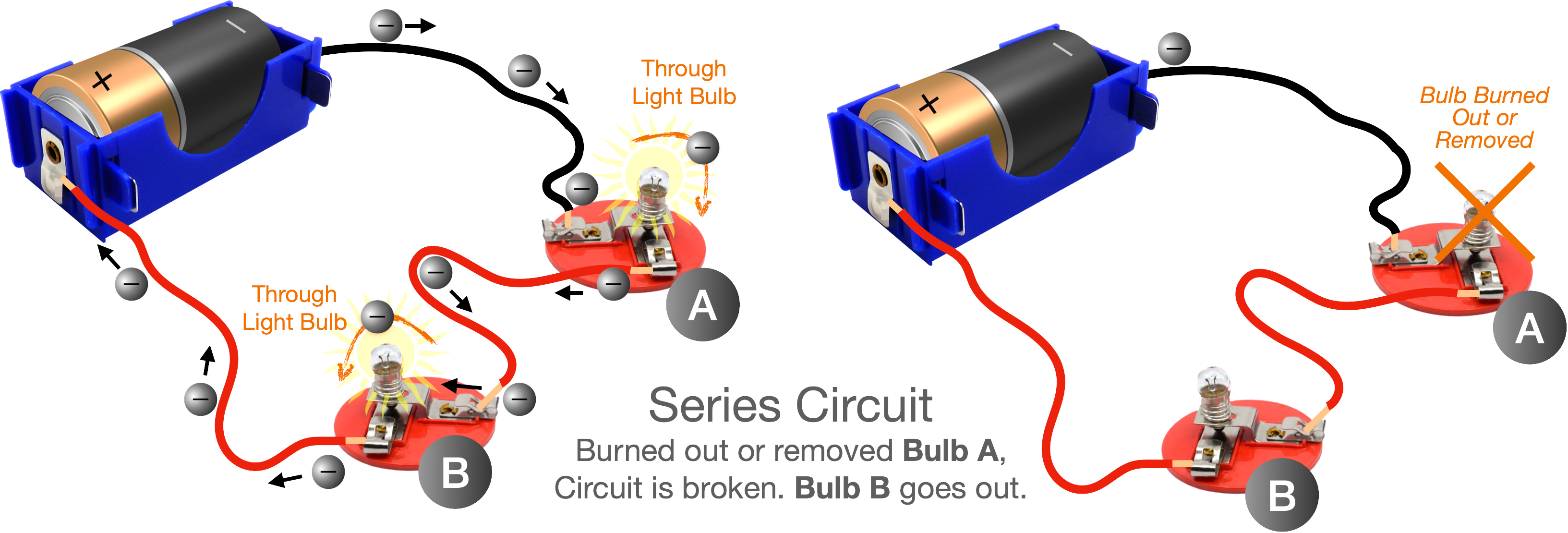
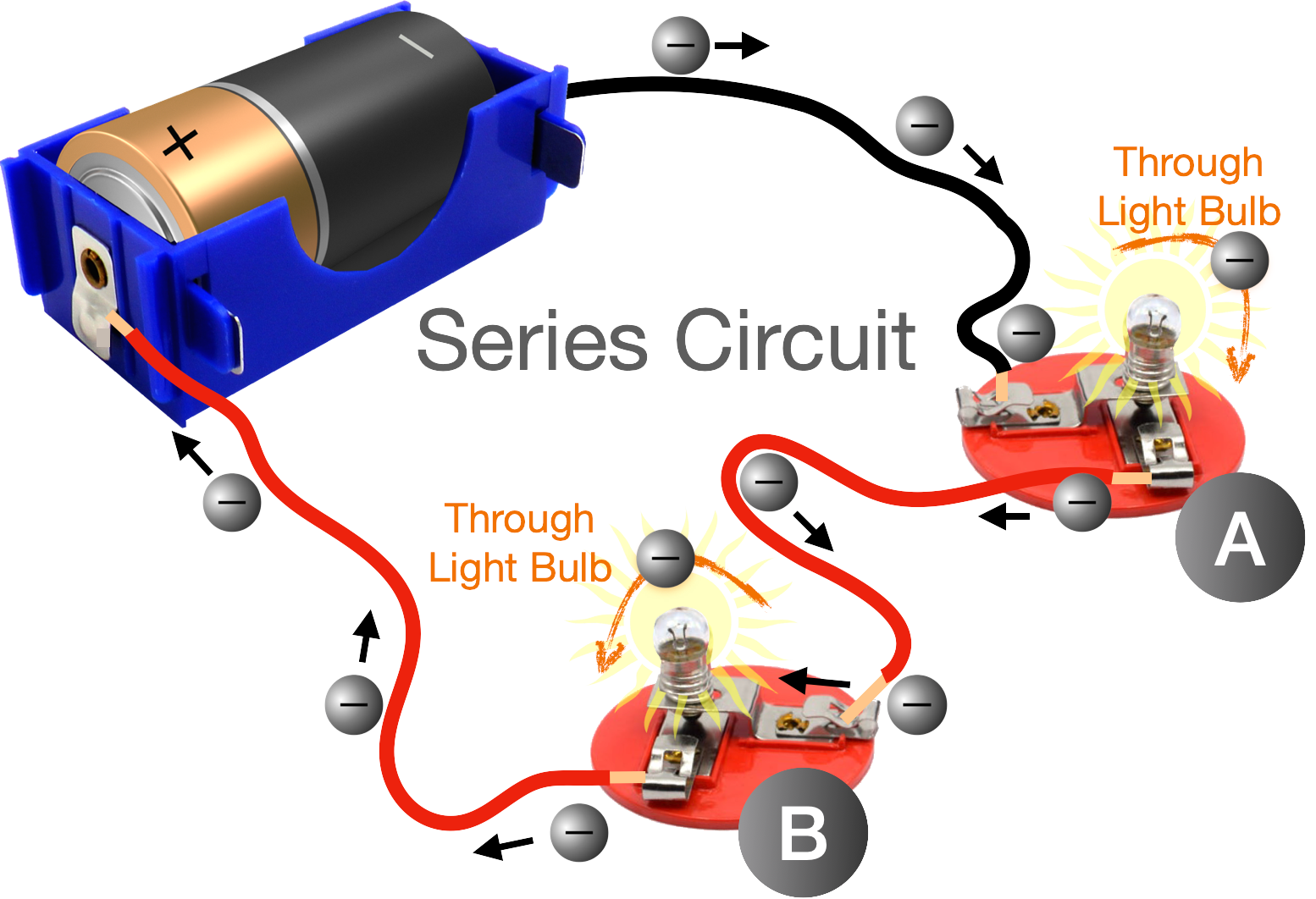 As the name series suggests, objects in a series circuit are arranged in sequential order. For example, if there are two light bulbs in a series circuit, the electrons flow from the power source through Bulb A, through Bulb B, and then back to the power source (see illustration to the right). Series circuits are easily constructed. However, as the number of objects in a series increases, the amount of electrons that reach each successive object in the series decreases. The first object in the series receives the full flow of electrons from the power source. However, the number of electrons leaving object A and reaching object B is lower than the amount received by object A because the ability of electrons to flow through object A is determined by its construction.
Electron flow slows when it passes through materials with high resistance, such as a light bulb filament. This decreases the number of electrons available to the next object in sequence. The end result is that all the objects in a series circuit receive fewer electrons than they need to fully function. If the objects are light bulbs, the result is the production of less light than each bulb is capable of producing. If appliances are involved in the circuit, the result is slower performance. Furthermore, if one object is removed or otherwise fails to complete the circuit (one light bulb burns out, for example), the other objects in the series circuit no longer function. A common example is a string of holiday lights connected in series. If one bulb burns out or is removed, the circuit becomes incomplete and none of the bulbs will work.
Parallel Circuits
The solution to this problem is to provide equal access for all objects to a full flow of electrons. One method of achieving this goal would be to connect each object to the power source individually, but this is impractical when a large number of objects need access to the power source simultaneously. However, connecting a large number of objects to a power source can be accomplished through the use of parallel circuits. Just as parallel lines do not intersect and are thus independent of one another, objects in a 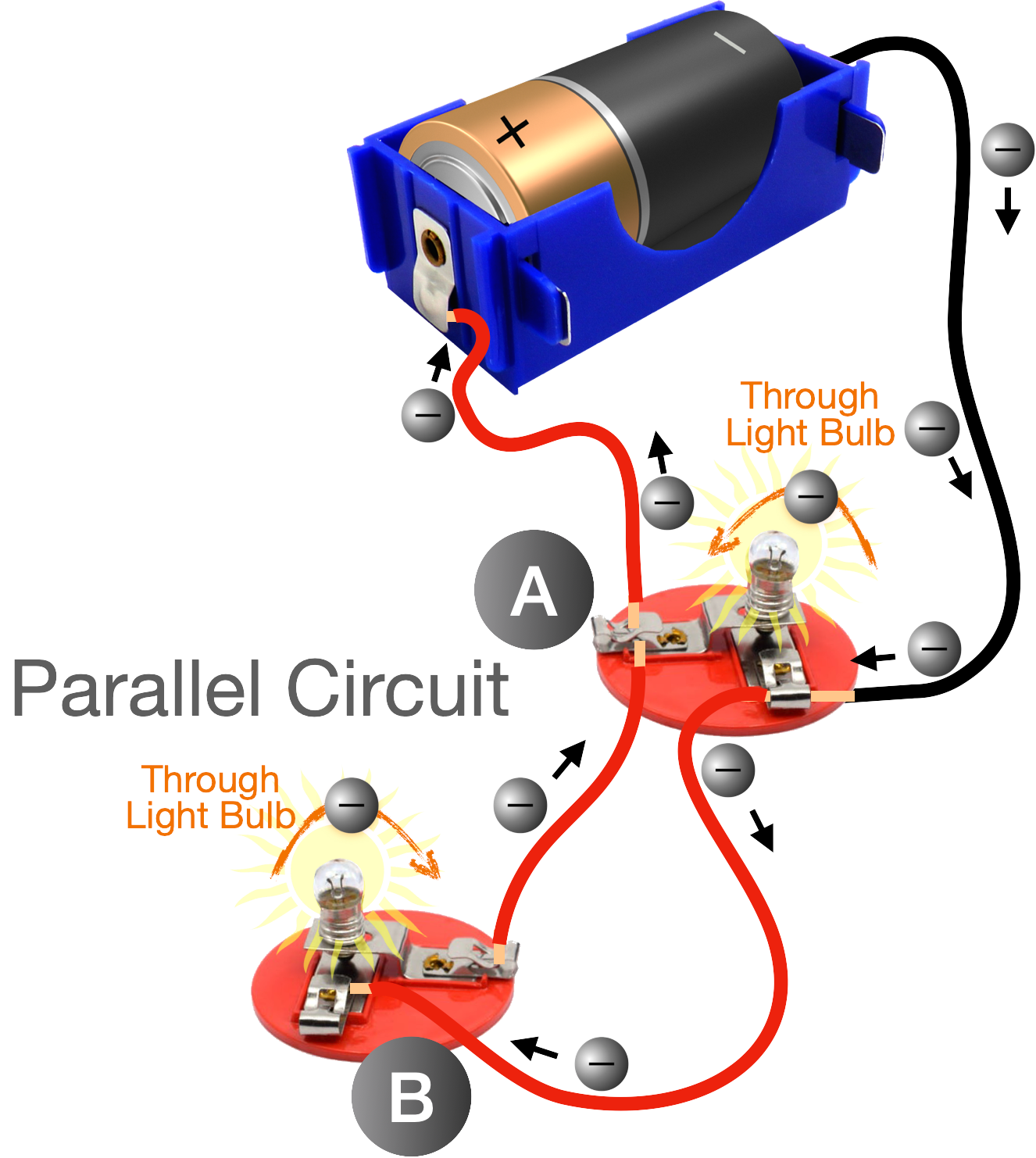 parallel circuit are also independent of one another. In other words, the objects are connected to each other in a way that allows each to draw electrons from the main flow, without impeding or reducing the flow of electrons to the other objects. This is accomplished by forming complete circuits with the power source for each object.
As illustrated to the right, Bulb A forms a complete circuit with the battery. The wires that connect Bulb B to Bulb A also form a complete circuit with the battery. Electrons flow from the battery to the connection terminal on light bulb holder A. There they can flow either to light bulb A or proceed on to Bulb B, but do not have to pass through Bulb A to reach Bulb B. Therefore, the resistance to electron flow caused by the filament of Bulb A cannot slow the passage of electrons to Bulb B, and each bulb receives the number of electrons it needs to fully power it. In contrast, objects in a series circuit are dependent upon previous objects to allow the passage of an adequate number of electrons for subsequent objects to function properly.
Not only does a parallel circuit provide equal access to the electron flow to all objects in the circuit, but this type of circuit also has an added advantage. If one object fails to complete a circuit with the power source (in this case, for example, Bulb A burns out or is removed), it has no effect on the ability of other objects in the circuit to function (Bulb B still lights), because they are not dependent upon the failed object to maintain a complete circuit with the power source. A string of holiday lights connected in parallel may have one or more bulbs burn out without preventing the remaining bulbs from continuing to glow.
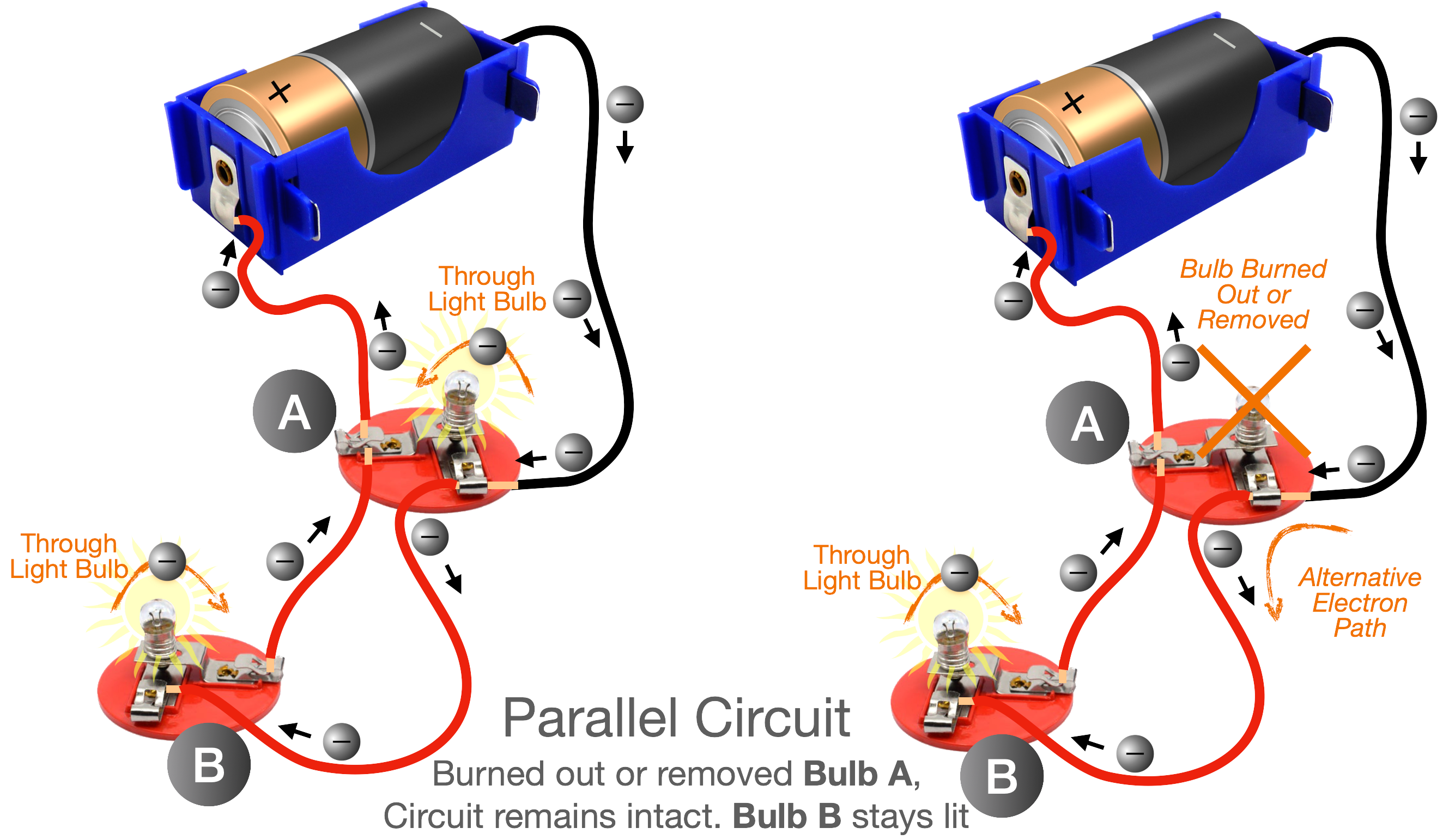
Investigation Five introduces students to series and parallel circuits through a series of experiments. Students will construct a series circuit and observe the amount of light coming from the bulbs in the circuit. They will discover that removing a bulb from its holder in a series circuit causes an incomplete circuit and prevents the second bulb from burning.
Students will then construct a parallel circuit and study the ability of the bulbs in this circuit to function properly. Students will discover that removing a bulb from its holder in a parallel circuit does not prevent the other bulb from burning, demonstrating that the second bulb is part of a complete circuit independent of the first bulb. They will then reconstruct each type of circuit and compare the circuits to each other in order to observe the differences between the two types of circuits.
Exploring Electricity: Investigation 5 - Mathematics Concepts
Prelab
• comparing (non)measurable characteristics
• problem-solving
• sequential order
Lab
• counting whole numbers
• problem-solving
• sequential order
• positive/negative
• comparing (non)measurable characteristics
Postlab
• sequential order
• problem-solving
• positive/negative
• Venn Diagram
• Comparing (non)measurable characteristics
Exploring Electricity: Investigation 5 - Procedural Tools

The design of this Investigation does not include a focus on the students’ work with tools from the Procedural Toolbox.
Exploring Electricity: Investigation 5 - Cognitive Tools

Exploring Electricity:
Investigation 5 Quiz

