Teacher Portal:
Exploring Electricity
Investigation 5 – PostLab
 PRINT IT
Use your browser to download a printable PDF as help during the slide presentation and to make additional notes. In your browser, go to File > Print and then choose to save as PDF.
NAVIGATE IT
Once the slide presentation is launched
- use your left and right arrows to advance or go back in the slide presentation, and
- hover your mouse over the left edge of the presentation to get a view of the thumbnails for all the slides so that you can quickly move anywhere in the presentation.
- Click HERE to launch the slide presentation for the CELL.
SHARE IT
SLIDE VELEC5-post-1
This is the fifth Investigation of the LabLearner CELL Exploring Electricity. In it, students learned about series and parallel electrical circuits.
Teacher Note: It is not as important for a third grader to know the uses of different types of circuits as it is to conceptualize the flow of electrons through a circuit. Simple series and parallel circuits can be used to assist them in making this conceptualization. For example, they may imagine that when they remove one bulb in a circuit that the electrons have to “figure out” an alternative path back to the positive end of the battery. That notion is fine as it demonstrates that electrons exist and move through wires and that the wires must connect, unbroken from the negative terminal to the positive terminal.
______________________________________________
SLIDE VELEC5-post-2
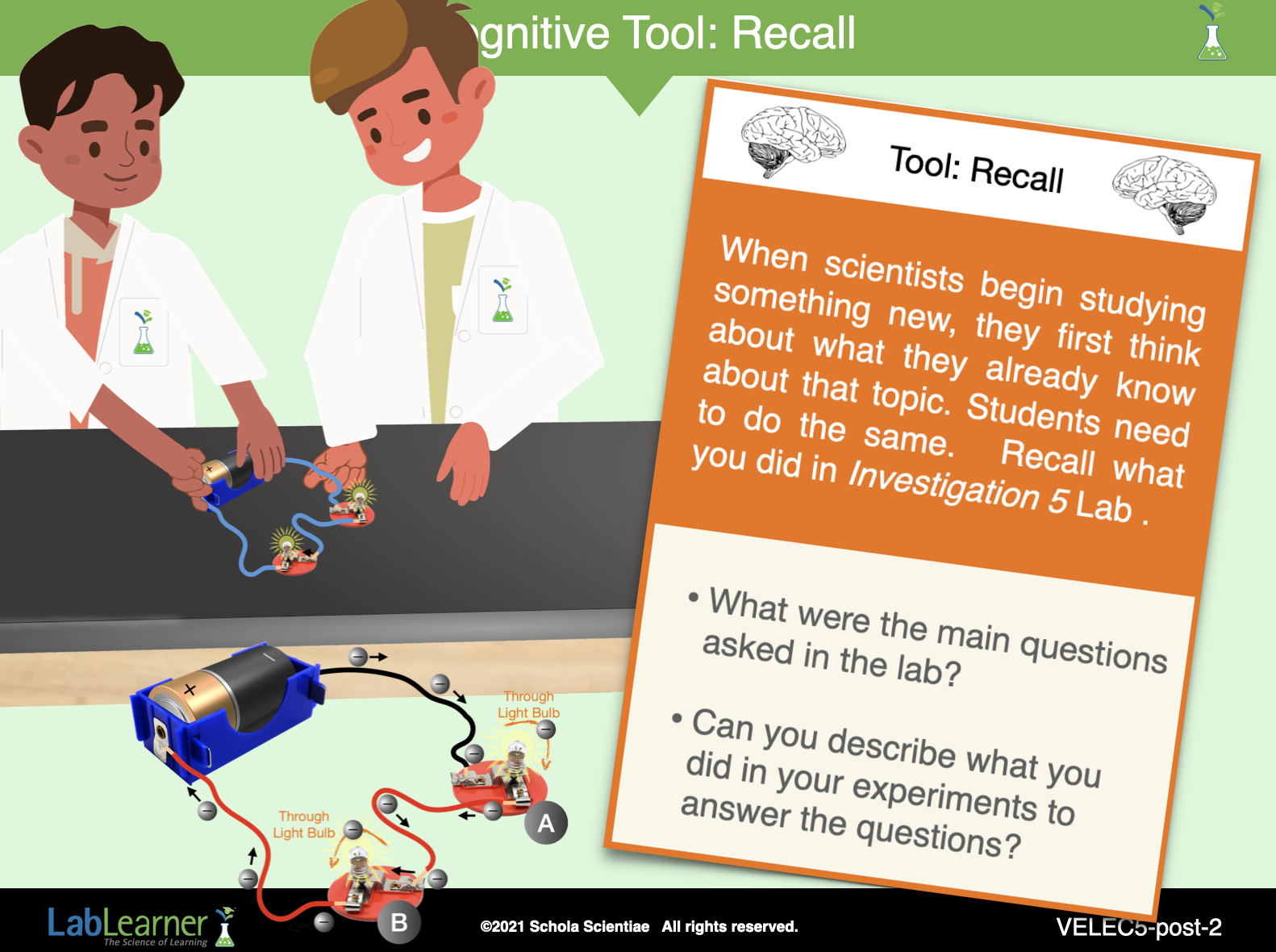
A. Begin the analysis of the Lab experiments by discussing what students explored during Investigation Five. The following questions can be used to prompt a discussion of these experiments.
1. Ask students: What were the main questions asked during the Lab? Students were asked the following questions. What is the path electrons follow in a series circuit? What happens to a series circuit when one of the light bulbs is removed? What is the path electrons follow in a parallel circuit? What happens to a parallel circuit when one of the light bulbs is removed? What are the differences between series circuits and parallel circuits?
2. Ask students: Can you describe what you did in your experiments to answer the questions? Students should suggest that to answer the first two questions, a series circuit was constructed and then one of the light bulbs was removed. To answer the third and fourth questions, a parallel circuit was constructed and one of the light bulbs was removed. To answer the third question, the results observed during Trials 1 and 2 were compared.
______________________________________________
SLIDE VELEC5-post-3
B. Continue to analyze the Lab experiments. The following questions may be included to prompt student discussion. Ask students:
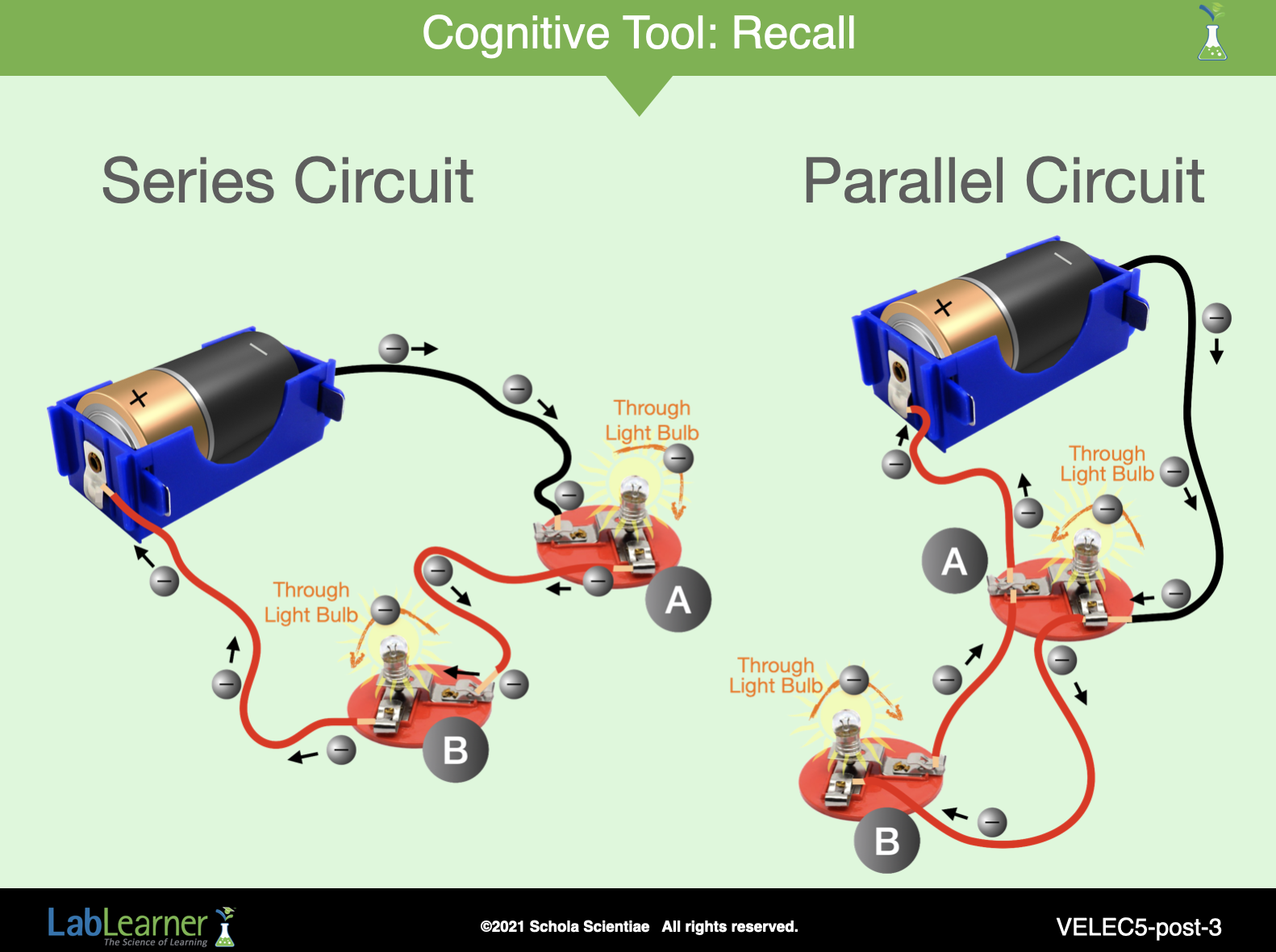
1. Ask students: After you built your series and parallel circuits, were your light bulbs bright or dim? The bulbs in the series circuit were dim, while the bulbs in the parallel circuit were bright.
2. Ask students: Why do you think there was a difference in how bright the bulbs glowed for the two circuits? Student answers may vary. The bulbs in the parallel circuit were both connected directly to the battery so they both received an equal amount of electrical current. The bulbs in the series circuit are not connected directly to the battery, so each bulb receives a smaller amount of electrical current which causes them to be dimly lit.
______________________________________________
SLIDE VELEC5-post-4
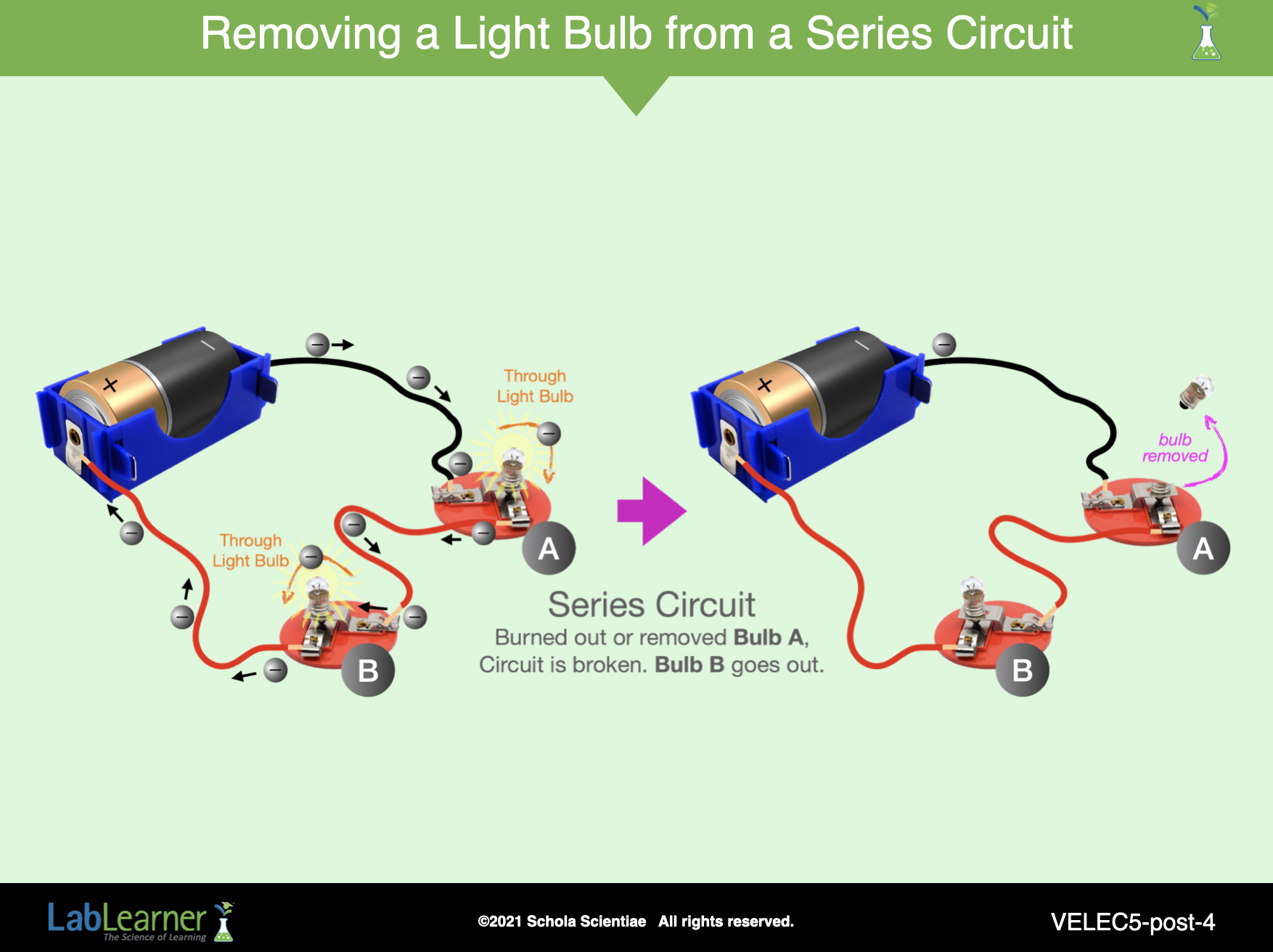
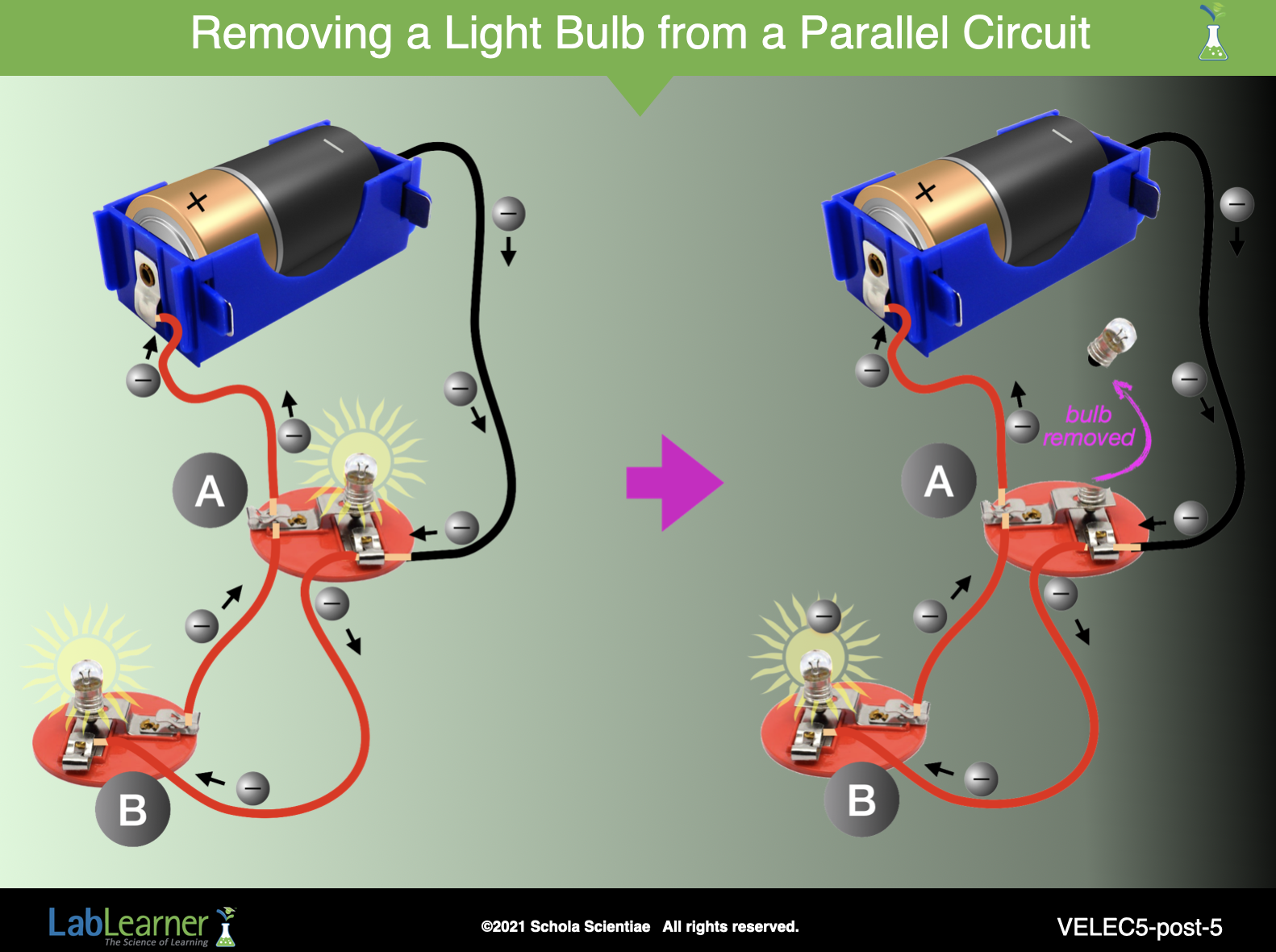
3. Remind students that, in Lab, when a light bulb was removed from the series circuit, the remaining light bulb when out. On the other hand, when a light bulb was removed from the parallel circuit, the other light bulb continued to glow.
4. Ask students: Why do you think this occurred? When both circuits were constructed, they were complete circuits. When the light bulb in the series circuit was removed, the circuit became an incomplete circuit. When the light bulb was removed from the parallel circuit, the circuit was still a complete circuit.
5. Ask students: Why was the parallel circuit still complete when the series was not?
Direct students to look at Problems 1 and 2 of their Student Data Record.
Tell students to study the diagrams as they answer the questions that follow.
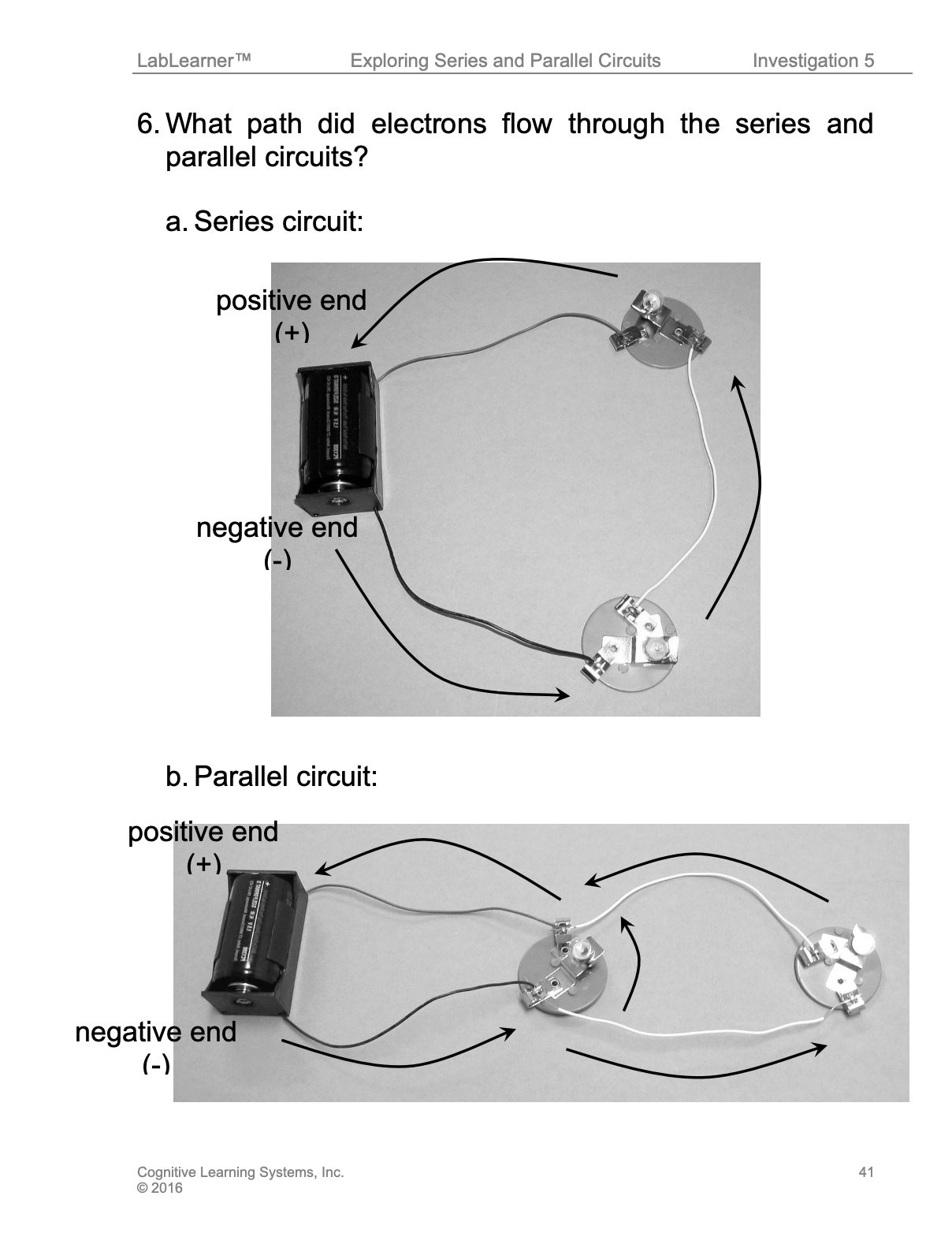
a. Ask students: Why did your series become an incomplete circuit when you removed one bulb? What is the path electrons follow in a series circuit?
When the bulbs were connected in series, there was only one path for the electrical current to flow; therefore, the electrical current leading from the battery to the bulbs was broken when either of the bulbs was removed.
Direct students to Problem 6 of their Student Data Record.
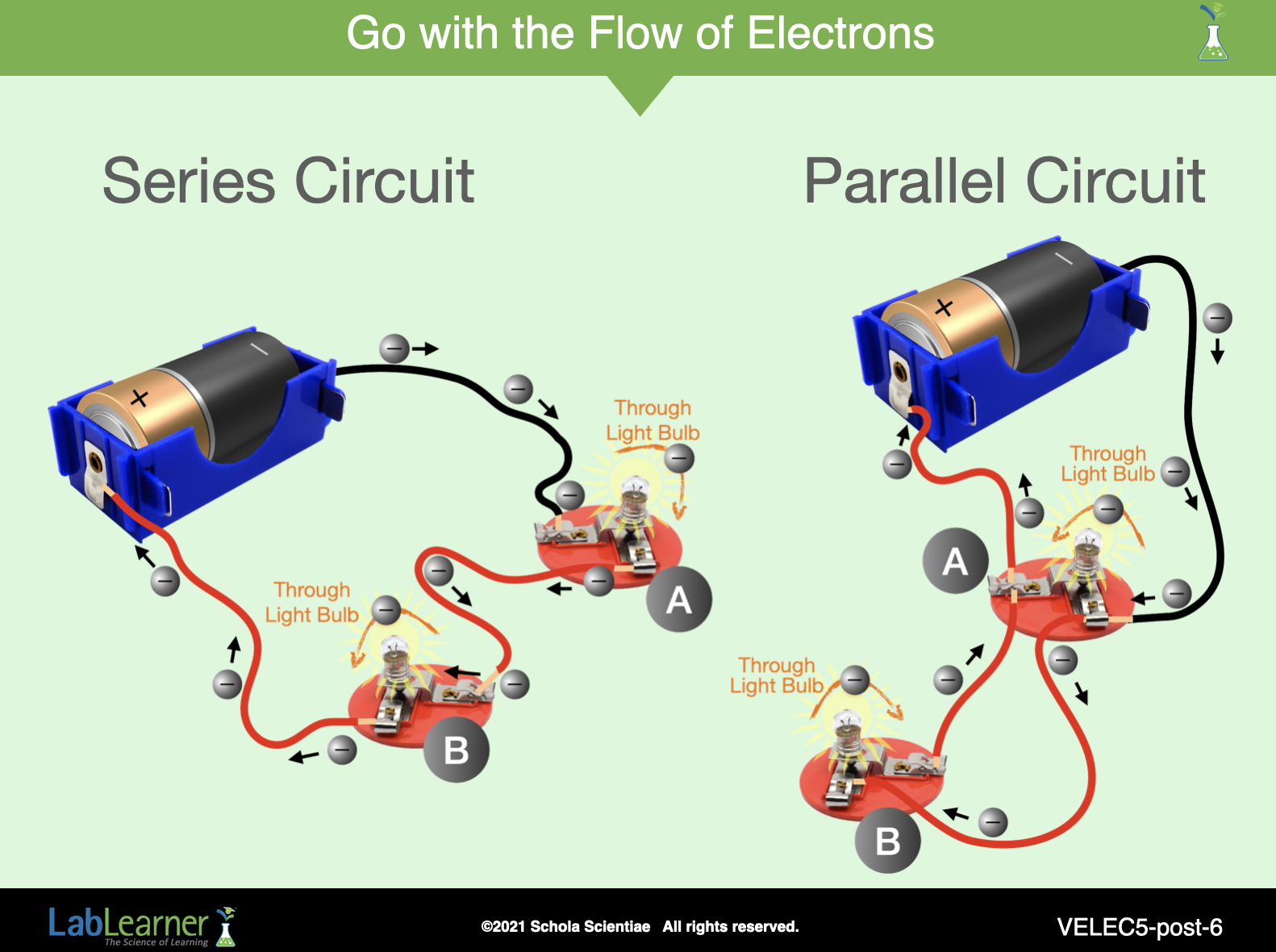
Instruct students to draw arrows to indicate the direction of the flow of electrons through the circuit.
______________________________________________
SLIDE VELEC5-post-5
b. Ask students: Why did the parallel circuit remain complete when one bulb was removed? What is the path of electron flow in a parallel circuit? When the bulbs were connected in parallel, there were two paths for electrical current. Therefore when one bulb was removed, the wires leading to the second bulb were still connected and the electrical current to the other bulb could continue. Instruct students to draw arrows to indicate the flow of electrons through the parallel circuit.
Teacher Note: During this discussion, students may need to be guided in understanding how the wires connect to the bulb holders.
______________________________________________
SLIDE VELEC5-post-6
6. After students have completed both sketches:
Review the flow of electrons through the circuits with the class.
Point out the differences in current flow between the two circuits.
______________________________________________
SLIDE VELEC5-post-7
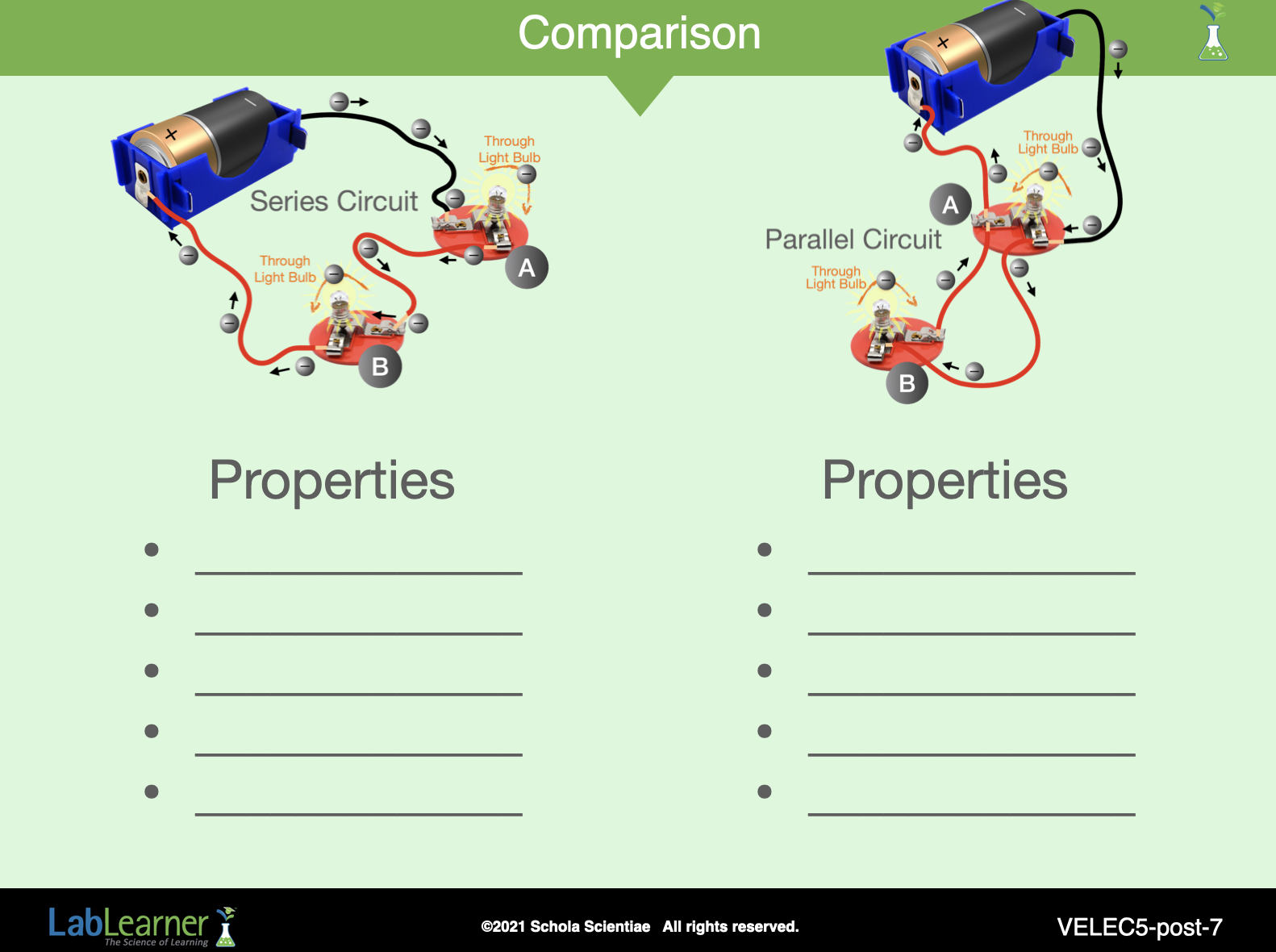
C. Ask students: How do you think the information you have learned about series and parallel circuits could be organized? Student answers will vary.
1. Permit students time to discuss several possibilities.
After listening to their ideas, suggest that students create two lists, one that will list the properties of a series circuit and one that will list the properties of a parallel circuit.
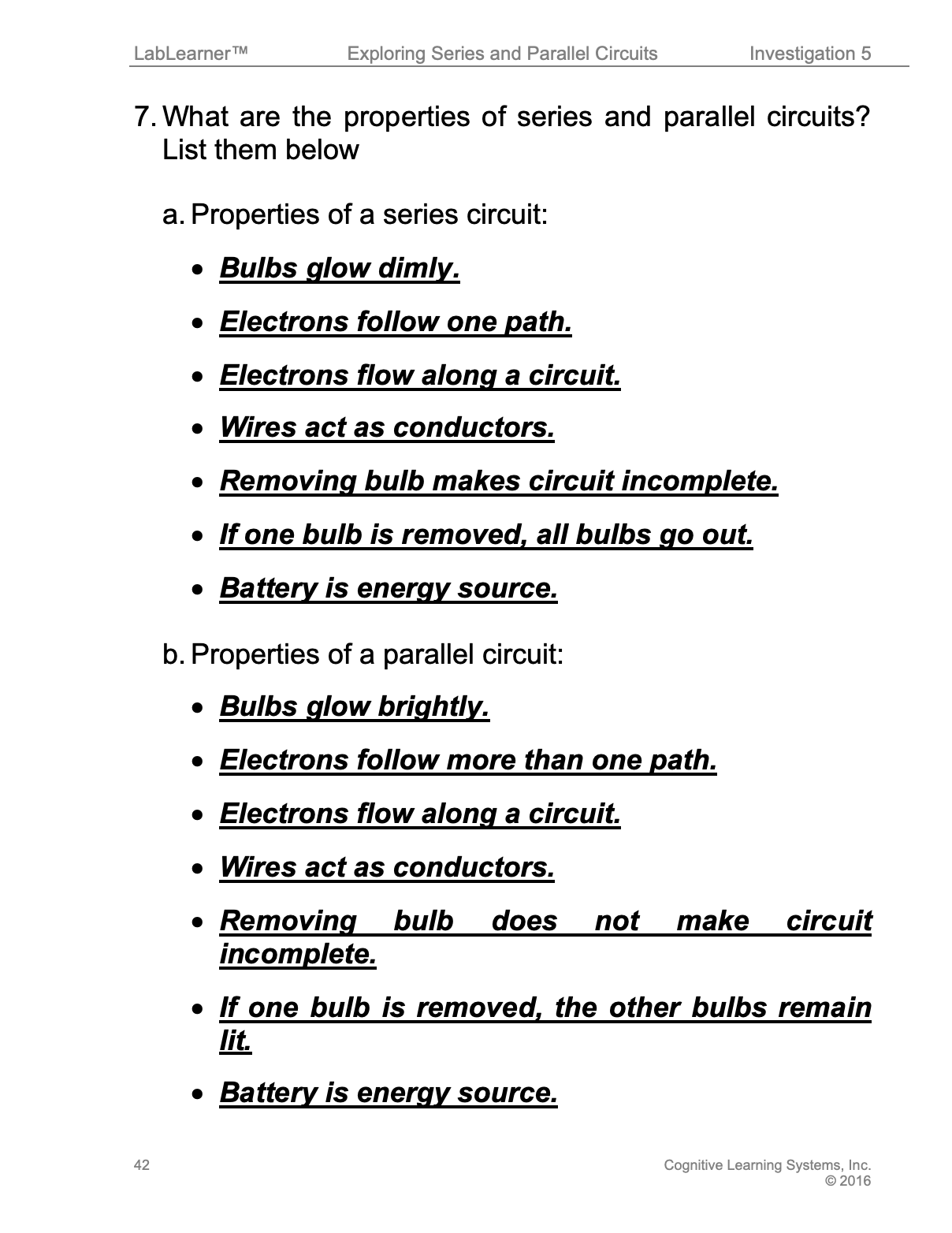
Tell students that they should record their lists in Problem 7 of their Student Data Record. The following are sample lists:
Teacher Note: Potential properties students should cite:
a. Properties of a series circuit:
• Bulbs glow dimly.
• Electrons follow one path.
• Electrons flow along a circuit.
• Wires act as conductors.
• Removing bulb makes the circuit incomplete.
• If one bulb is removed, all bulbs go out.
• Battery is energy source.
b. Properties of a parallel circuit:
• Bulbs glow brightly.
• Electrons follow more than one path.
• Electrons flow along a circuit.
• Wires act as conductors.
• Removing bulb does not make circuit incomplete.
• If one bulb is removed, the other bulbs remain lit.
• Battery is energy source.
______________________________________________
SLIDE VELEC5-post-8
2. Ask students: What is another way this information could be organized? Student answer may vary.
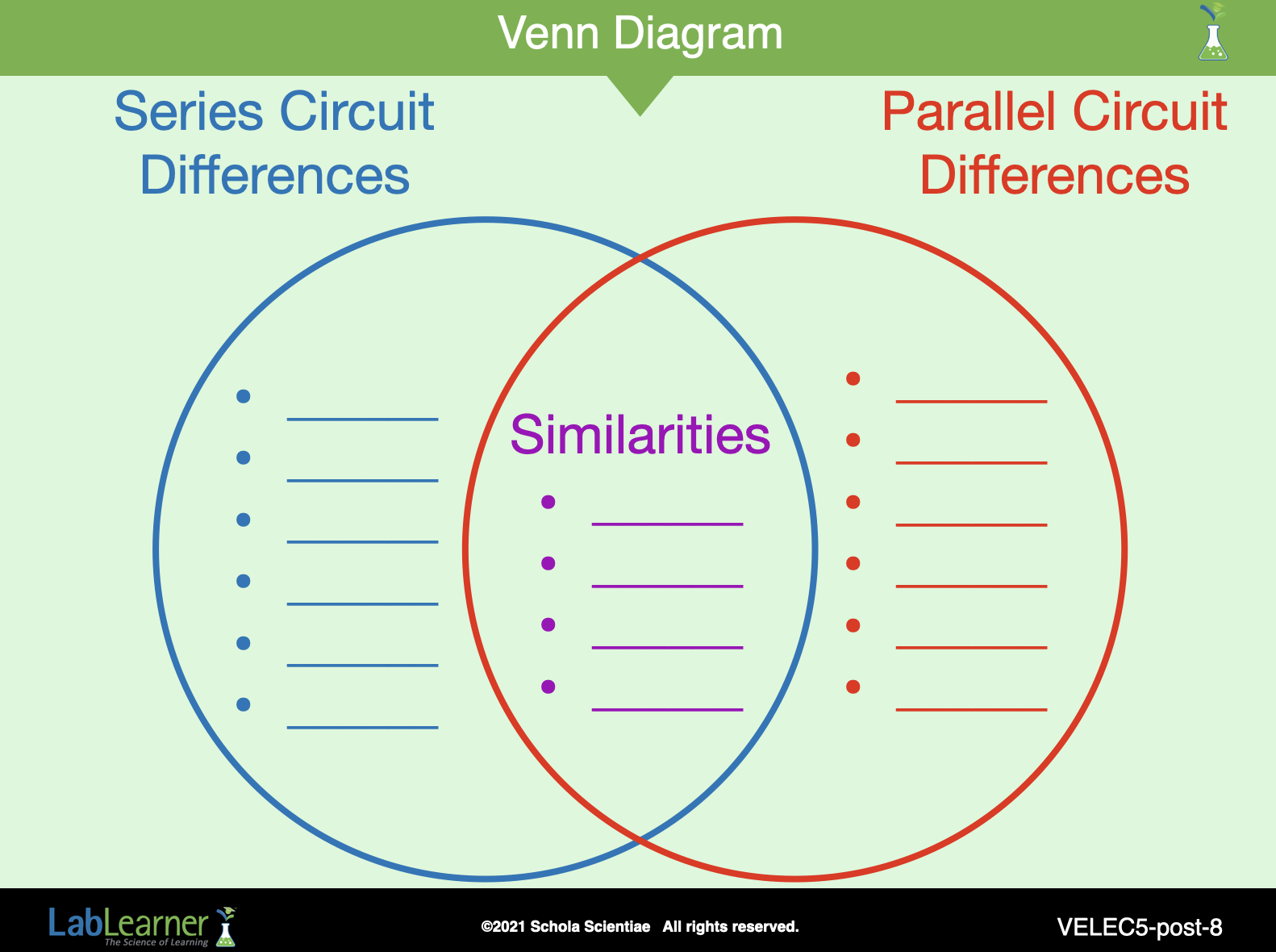
Guide students toward realizing that a Venn diagram is another way to organize this information.
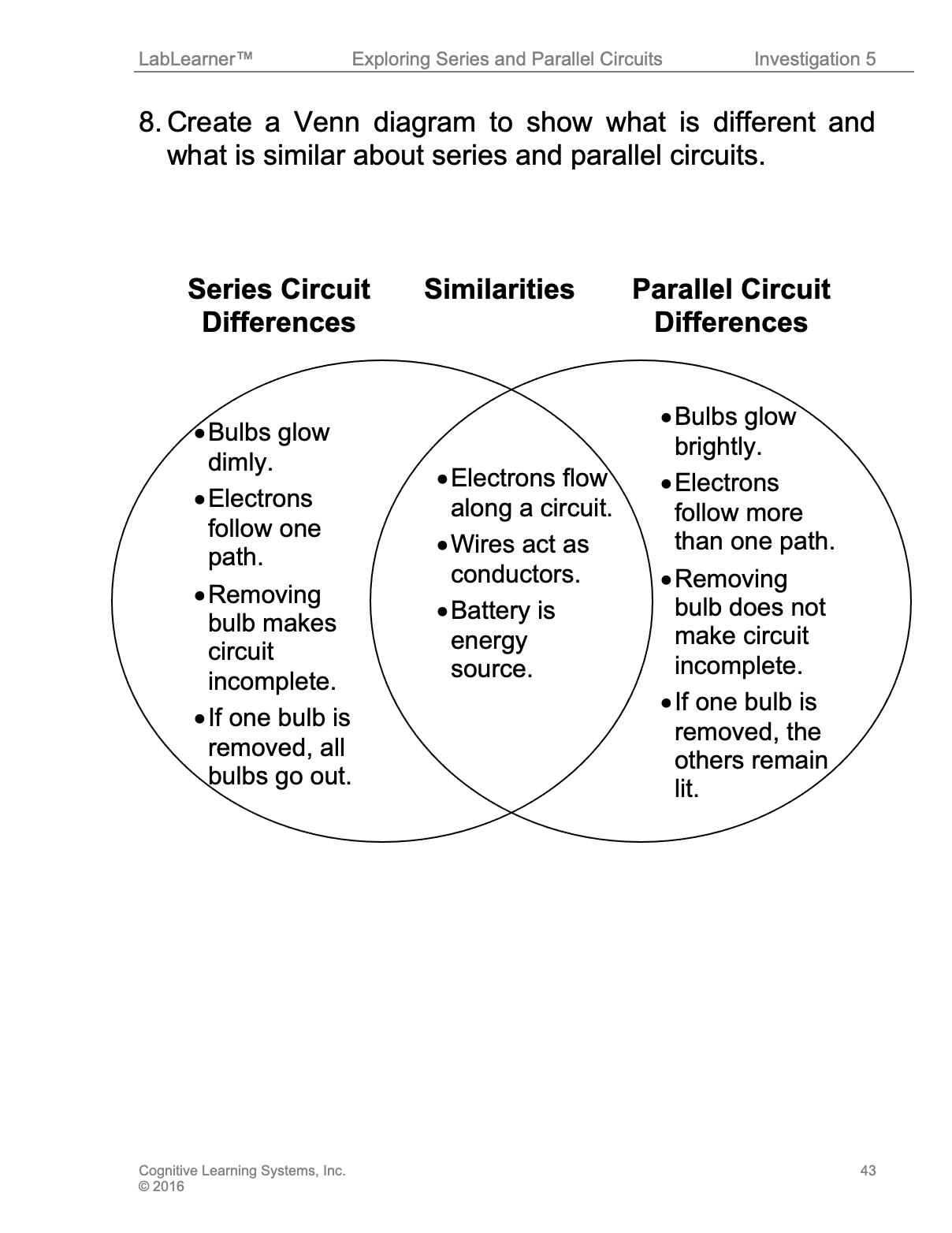
a. Explain to students that a Venn diagram can organize the properties of series and parallel circuits into a picture that shows the similarities and differences of the circuits.
b. Review how a Venn diagram is created.
• Two circles are drawn so that a part of each overlaps.
• One circle represents the properties of one item.
• The other circle represents the properties of the other item.
• The different properties are listed in the separate parts of the circles. The properties that are the same are placed in the middle where the two circles overlap.
c. Encourage students to use their lists to decide which properties are different and which are similar.
d. Work with students to create a Venn diagram for the series and parallel circuits.
Encourage students record the diagram in Problem 8 of their Student Data Record.
______________________________________________
SLIDE VELEC5-post-9
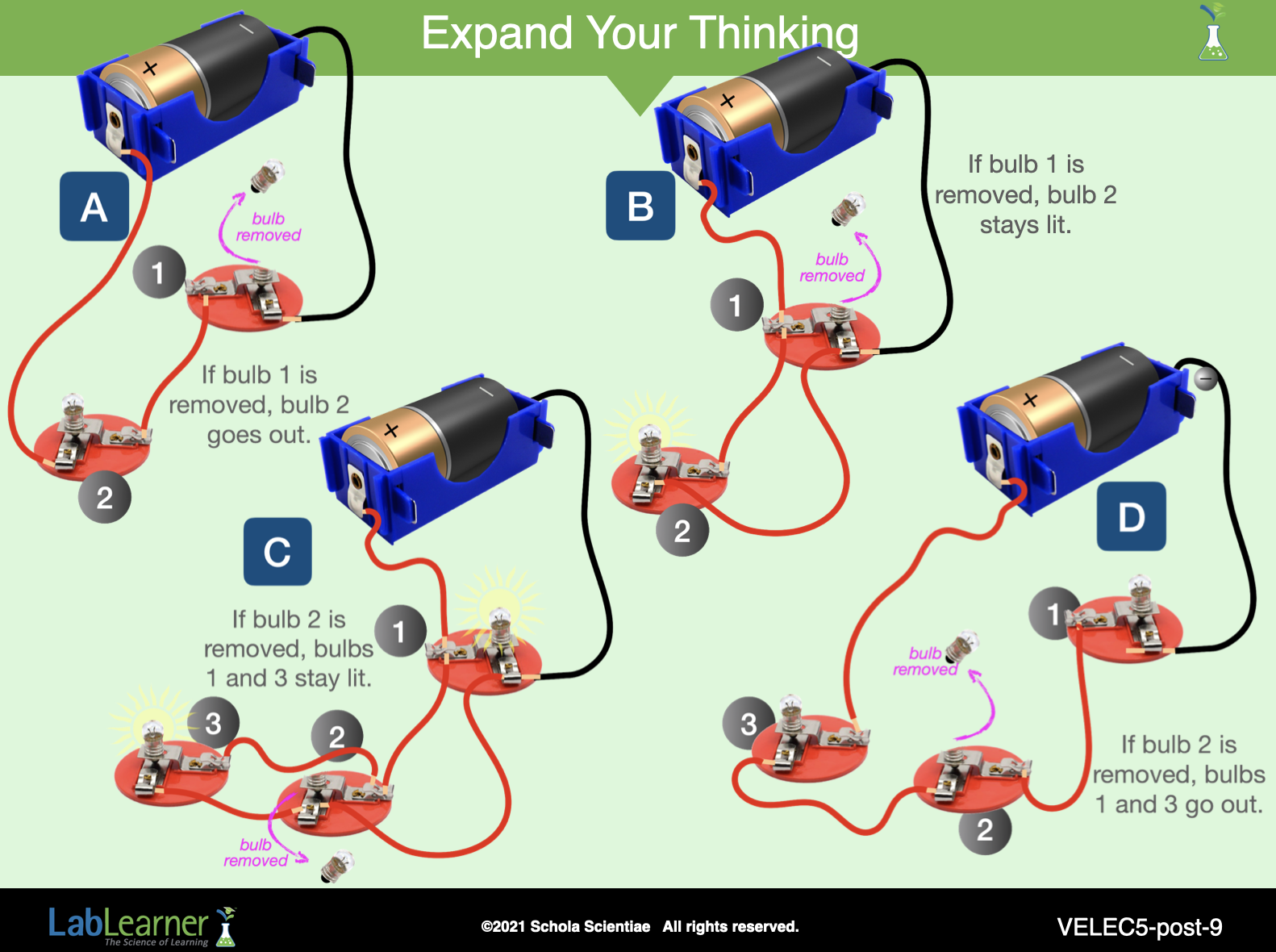
D. Complete the Investigation by providing students an opportunity to apply what they have learned about series and parallel circuits.
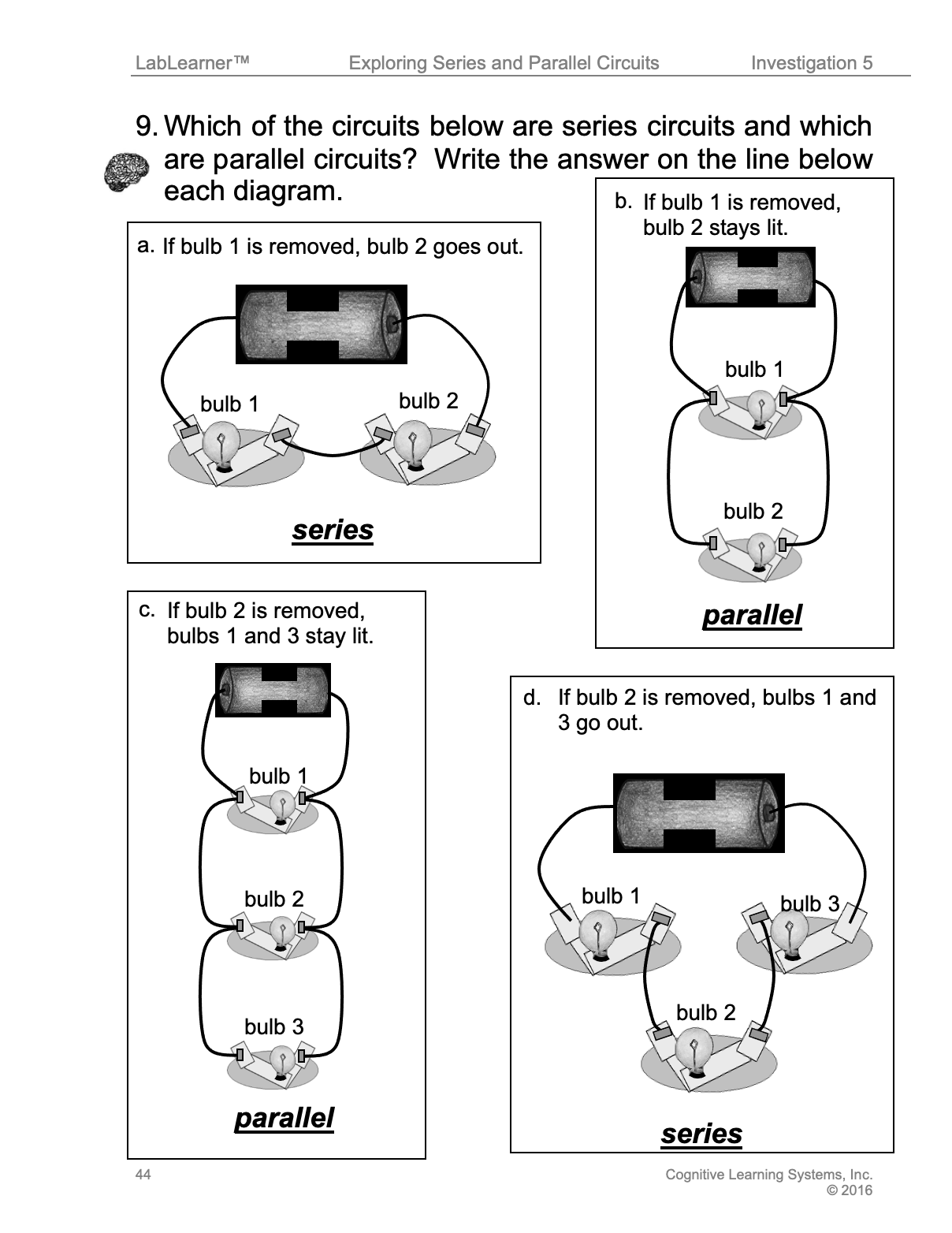
1. Tell students they will perform an activity in which they will determine whether four circuits are series circuits or parallel circuits.
2. Ask students to locate the circuits a through d in Problem 9 of their Student Data Record.
3. Direct students to think about the questions, then complete their task by writing whether the circuit is series or parallel on the line beneath each circuit.
4. After students have completed this task, discuss the answers with the class.
KEYS: POSTLAB