Teacher Portal:
Exploring Electricity
Investigation 5 – PreLab
 PRINT IT
Use your browser to download a printable PDF as help during the slide presentation and to make additional notes. In your browser, go to File > Print and then choose to save as PDF.
MINDSET
This Investigation is designed to:
- reinforce student understanding of the concept that materials act as conductors or insulators for electrical current, depending upon their properties.
- introduce the concept of series and parallel circuits.
- assist students in understanding that in a series circuit the electrons are directed along a single path, while in a parallel circuit the electrons can follow more than one path.
- encourage students to recognize the differences between series and parallel circuits.
- reinforce the concept of complete and incomplete circuits.
- provide students with the opportunity to construct several series and parallel circuits.
SCIENTIST’S GLOSSARY
- Circuit: A continuous path along which an electrical current can move.
- Current: A flow of electrons along a path.
- Electricity: An event that occurs when electrons move through or between objects or materials.
- Parallel circuit: A circuit that allows electrons to follow several different paths.
- Series circuit: A circuit that directs electrons to follow along a single path.
BE PREPARED
Watch the Investigation 5 Teacher Video and Student Video below to prepare for the PreLab.
SET FOR SUCCESS
- Tell students that they will continue their work on the Exploring Electricity CELL.
- Tell them that they will study series and parallel electrical circuits.
- Ask students to share the kinds of things they might learn in this Investigation.
Begin the PreLab Concept Slides to start students on their learning journey. Then watch the Pre-Lab Student Video afterward as a class.
NAVIGATE IT
Once the slide presentation is launched
- use your left and right arrows to advance or go back in the slide presentation, and
- hover your mouse over the left edge of the presentation to get a view of the thumbnails for all the slides so that you can quickly move anywhere in the presentation.
- Click HERE to launch the slide presentation for the CELL.
SHARE IT
SLIDE VELEC5-pre-1
This is the fifth Investigation of the LabLearner CELL Exploring Electricity. In it, students will learn about series and parallel electrical circuits.
Teacher Note: It is not as important for a third grader to know the uses of different types of circuits as it is to conceptualize the flow of electrons through a circuit. Simple series and parallel circuits can be used to assist them in making this conceptualization. For example, they may imagine that when they remove one bulb in a circuit that the electrons have to “figure out” an alternative path back to the positive end of the battery. That notion is fine as it demonstrates that electrons exit, move through wires and that the wires must connect, unbroken from the negative terminal to the positive terminal.
______________________________________________
SLIDE VELEC5-pre-2
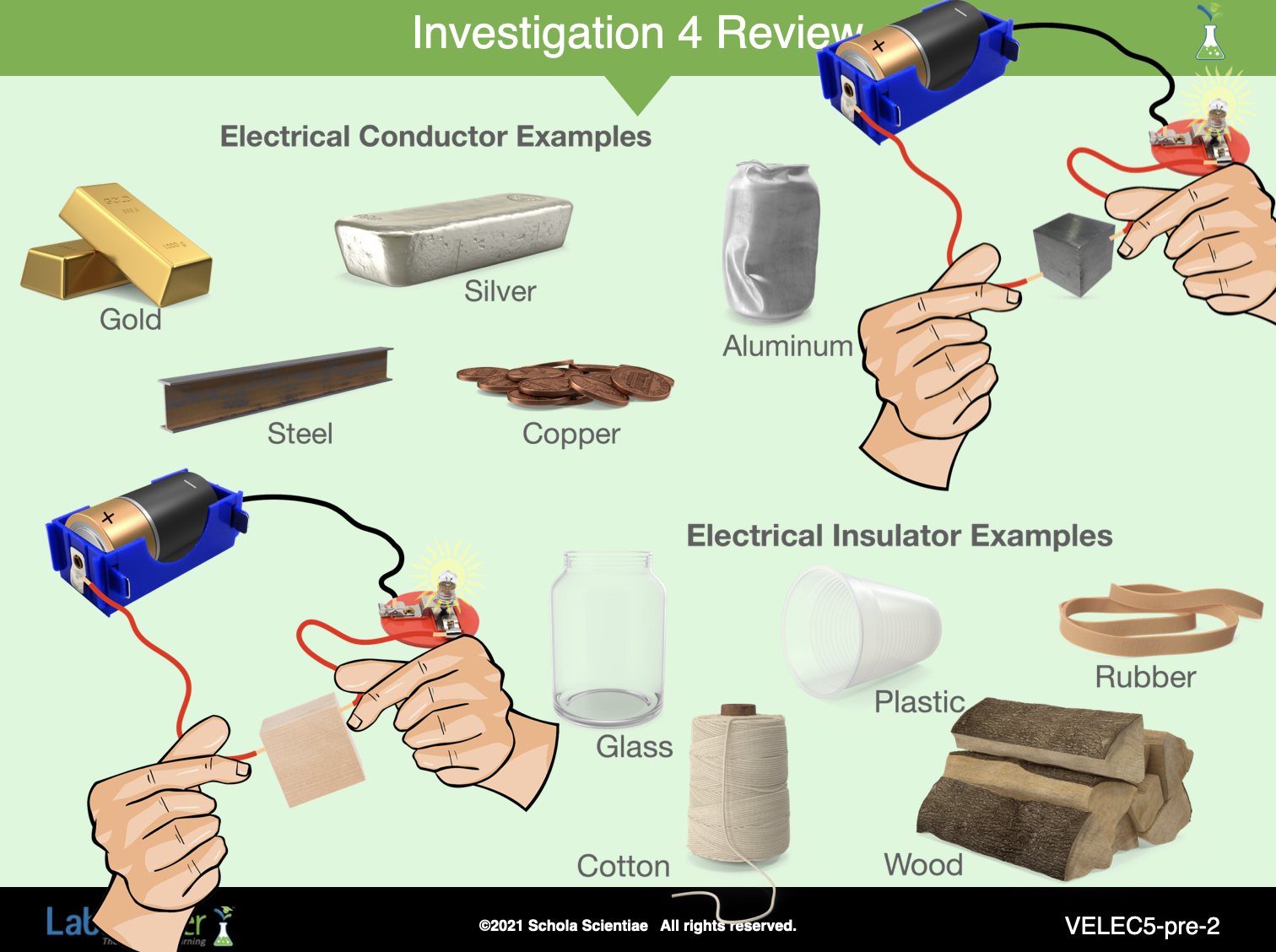
A. Begin this Investigation by reviewing the concepts students learned in Investigation Four. Use the following questions to prompt discussion with students. Ask them:
1. Ask students: What did you discover about conductors and insulators in Investigation Four? Students should indicate that whether an object or material is a conductor or insulator is dependent upon what it is composed or made of.
2. Ask students: How did you test whether an item was a conductor or insulator? Students should indicate that a simple circuit was used to test the items. The item was placed in between the wires of the circuit. If the item was a conductor, the light bulb lit up because a complete circuit was made. If the item was an insulator, the light bulb did not light up because the circuit was not complete.
3. Ask students: What property or properties did the items that were conductors have in common? Students should indicate that the conductors they tested all consisted of metal.
4. Ask students: What rule can you use to predict whether an item is a conductor or an insulator? Students should indicate that if an object is composed of metal, it is most likely a conductor of electrical current. If the object is composed of materials other than metal, it is likely an insulator.
______________________________________________

SLIDE VELEC5-pre-3
B. Lead into a discussion of series and parallel circuits by explaining to students that the simple circuits they have studied so far had only one light bulb.
Ask students: Can you ever have more than one bulb attached to a circuit? Student answers will vary.
1. Explain to students that two types of circuits that have more than one bulb are series circuits and parallel circuits.
2. The story that follows was developed to assist students in understanding and associating the terms series and parallel with circuits.
Read the story to the students. Tell them to listen carefully to how the terms series and parallel are used in the story.
Jason and Zach are at a baseball game. Their team hits a series of home runs. Zach says, “Our team may have a chance to go to the World Series this year. They’re doing great!”
As they continue to watch the game, Jason studies the positions of the bases and notices something about them that reminds him of his electricity experiments at school. “Look Zach, the bases are arranged in a series, just like a series circuit.”
“You’re right Jason. Can you see anything in the stadium that is parallel, like a parallel circuit?”
They study the ballpark. Zach says, “The rows of seats run parallel. This finding parallels game is fun. Let’s continue playing it until we get home.”
As they are going home, Jason notices, “The two yellow lines down the middle of the road are parallel.” They approach where a set of railroad tracks cross the road. “The tracks are parallel too.”
As they turn onto Zach’s street, he notices that a series of street lamps run along both sides of the road. “Hey, I found another series, the street lamps,” he points out to Jason.
3. After reading the story, ask students: From listening to the story, what do think the terms series and parallel mean? Student answers may vary. However, students may be able to infer from the story and past experience that the term series refers to objects or events in a row and parallel refers to objects in two lines that are beside each other.
______________________________________________
SLIDE VELEC5-pre-4
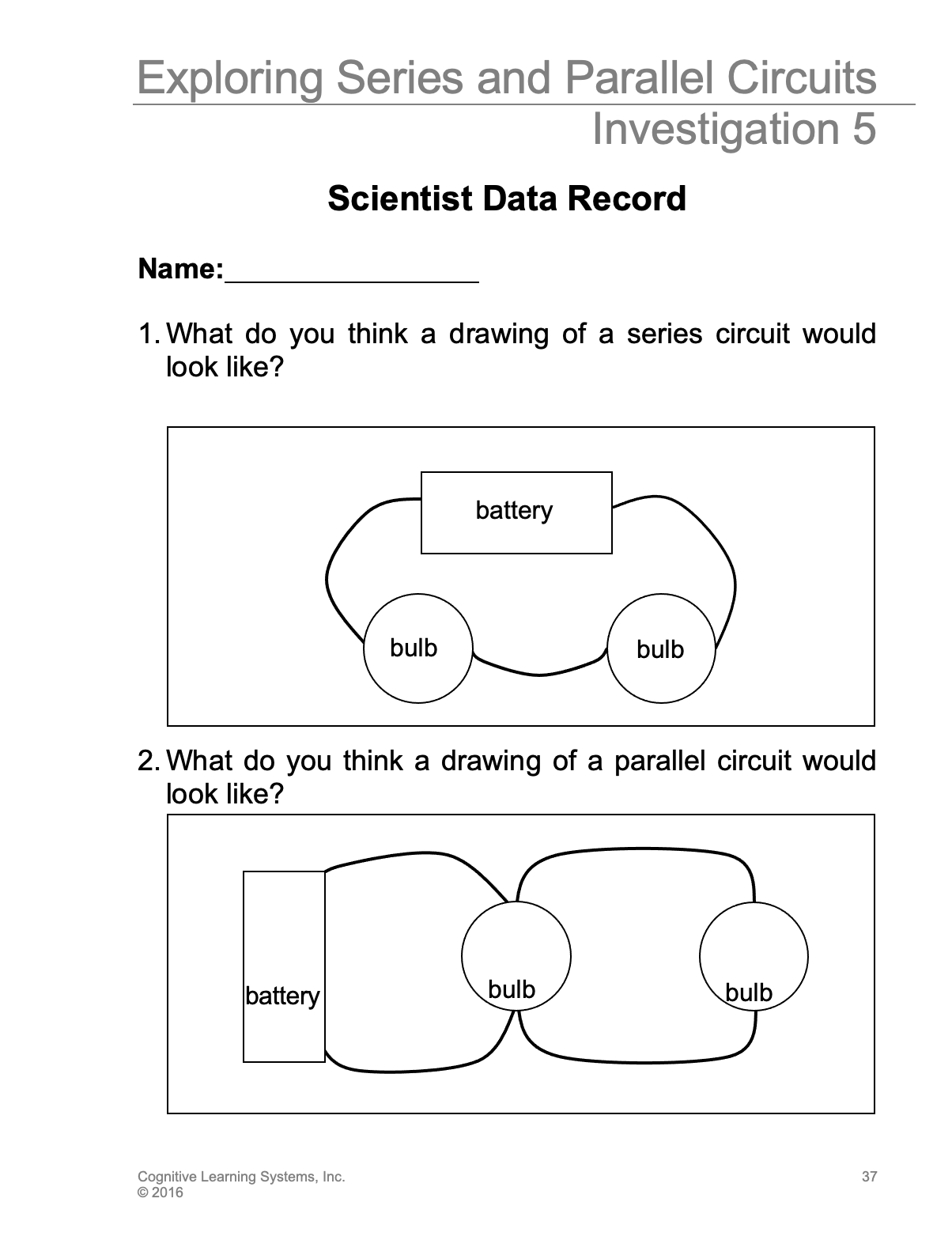
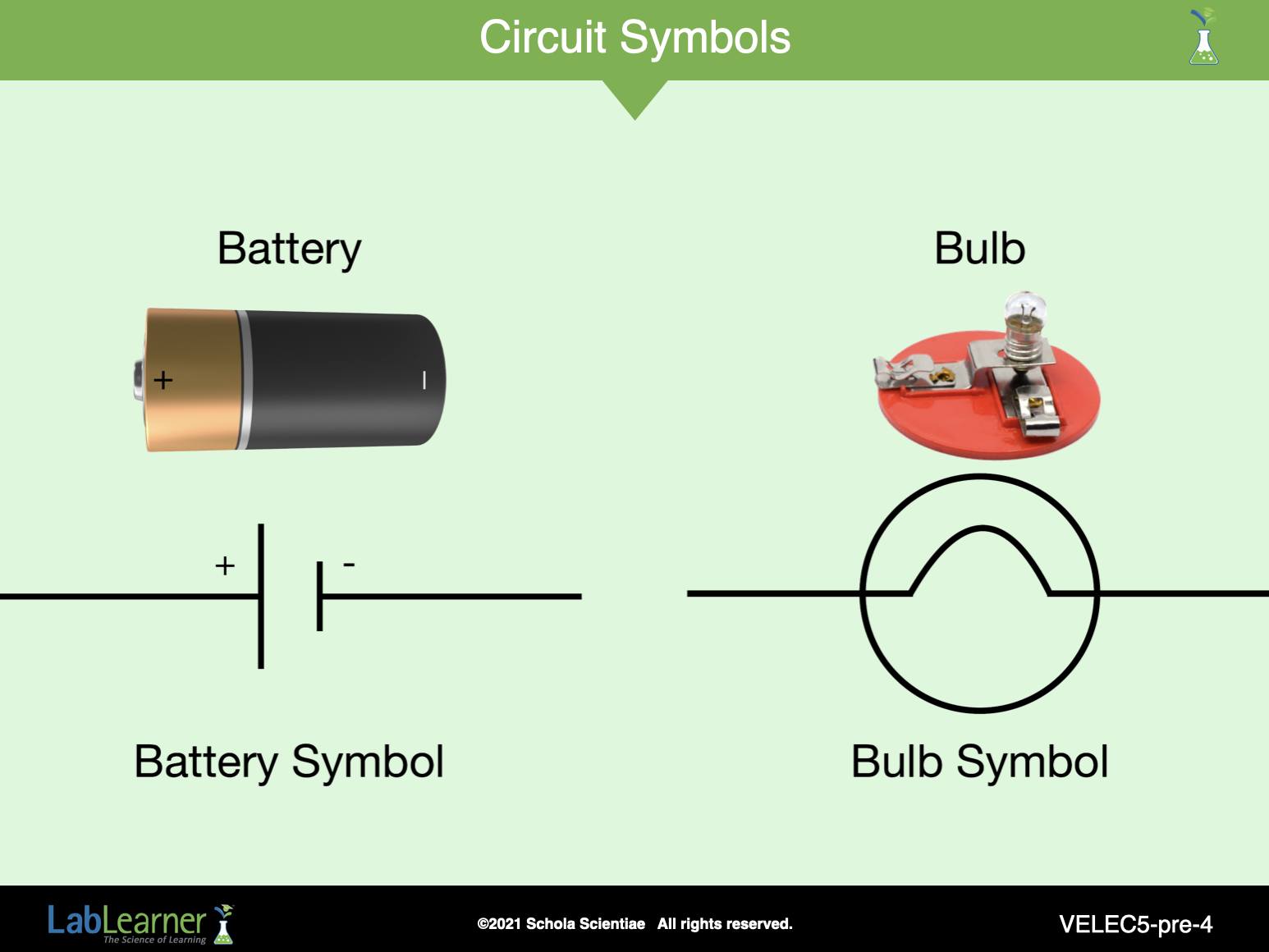
4. Ask students: How do you think the terms relate to a series circuit and a parallel circuit? What do you think a drawing of a series circuit would look like? Student answers may vary.
a. Work with students to create a sketch of a series circuit in Problem 1 of their Student Data Record.
b. The protocol prescribes representing the battery with a rectangle and the bulb and bulb holder as a circle in schematic circuit drawings*.
Teacher Note: However, in the slides presented here, the actual, authentic symbols for battery and bulb are used. Students should have little trouble using authentic symbols rather than rectangles and circles. In addition, the correct symbol uses a short and long crossbar to designate the plus and minus ends of the battery. Even if not actually marked with a “+” and “–“, the shorter of the two crossbars is always the minus end of the battery. Thus, the end of the battery from which electrons flow upon establishing a completed circuit is always identified in real schematic drawings.
c. Assist students through this process by sketching the representation on the board.
______________________________________________
SLIDE VELEC5-pre-5
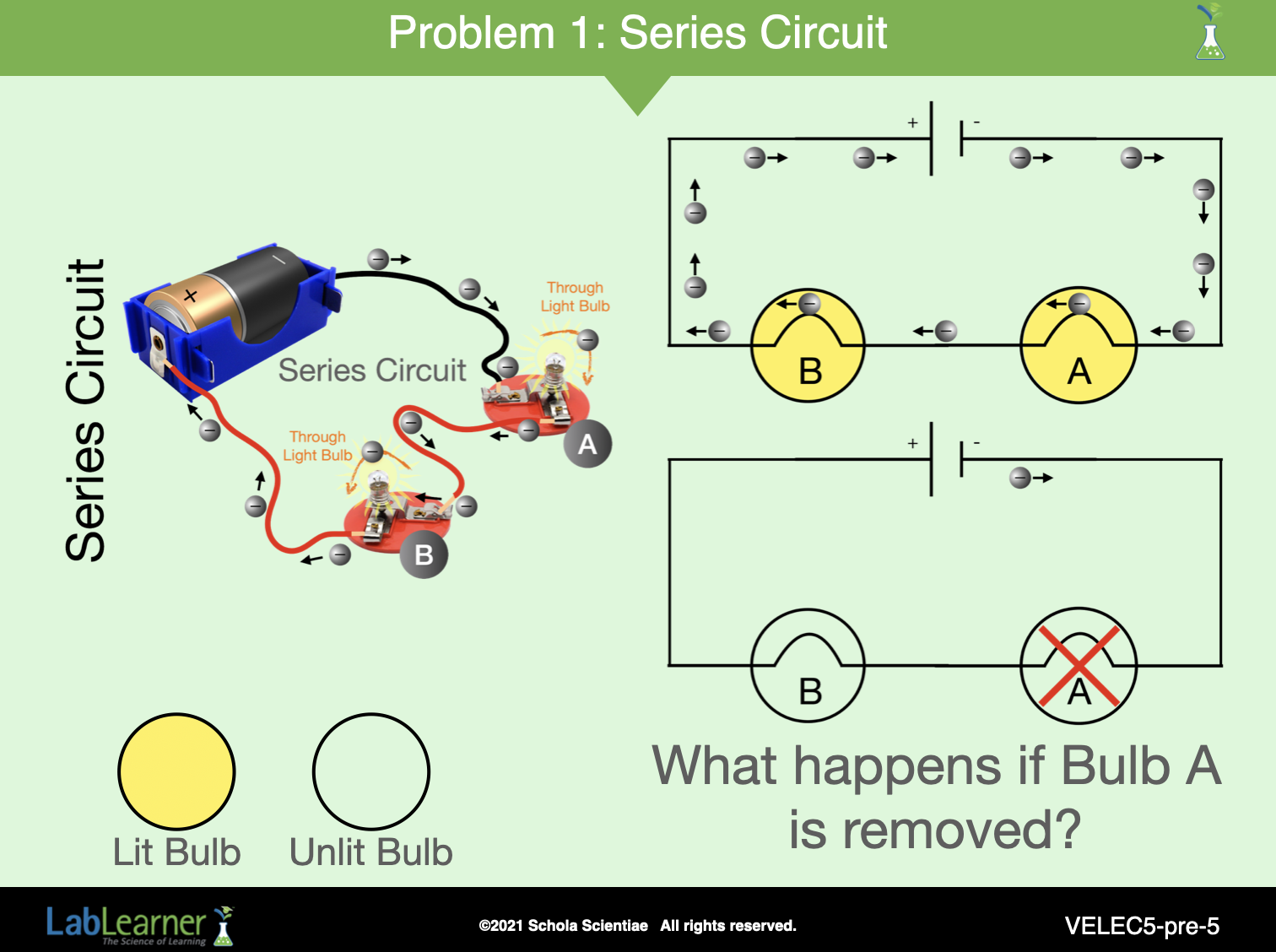
a. Work with students to create a sketch of a series circuit in Problem 1 of their Student Data Record.
b. Instruct students to use the correct symbols for the battery and light bulb.
c. Assist students through this process by sketching the representation on the board or referring to this slide.
d. Discuss the flow of a complete series circuit with the class using the diagram and the term in students’ Scientist’s Glossary.
-
-
- A series circuit is a circuit that allows electrons to flow along a single path.
- In the diagram, the wires are connected in such a way that there is only one path for electrons to flow.
-
______________________________________________
SLIDE VELEC5-pre-6
5. Ask students: What do you think a drawing of a parallel circuit would look like?
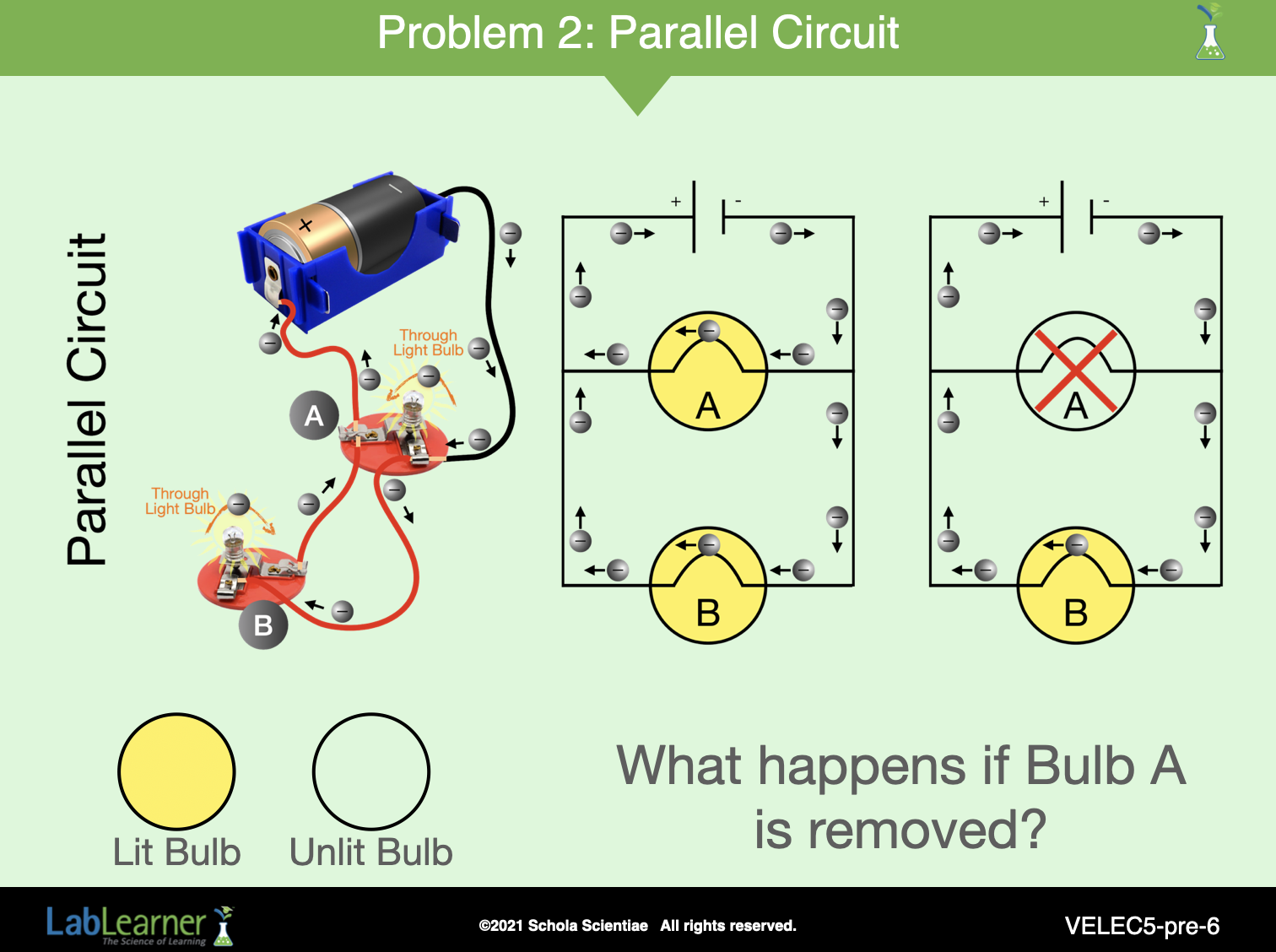
a. Work with students to create a sketch of a parallel circuit in Problem 2 of their Student Data Record.
b. Instruct students to use a rectangle to represent a battery, the energy source for their circuit and circles to represent a light bulb and light bulb holder.
c. Assist students through this process by sketching the representation on the board.
d. Discuss the flow of a complete parallel circuit with the class, using the diagram and the term in the students’ Scientist Glossary.
-
-
- A parallel circuit is a circuit in which electrons have more than one path to flow.
- In the diagram, the wires are connected to the bulb in such as way that there is more than one path for electrical current.
-
______________________________________________
SLIDE VELEC5-pre-7
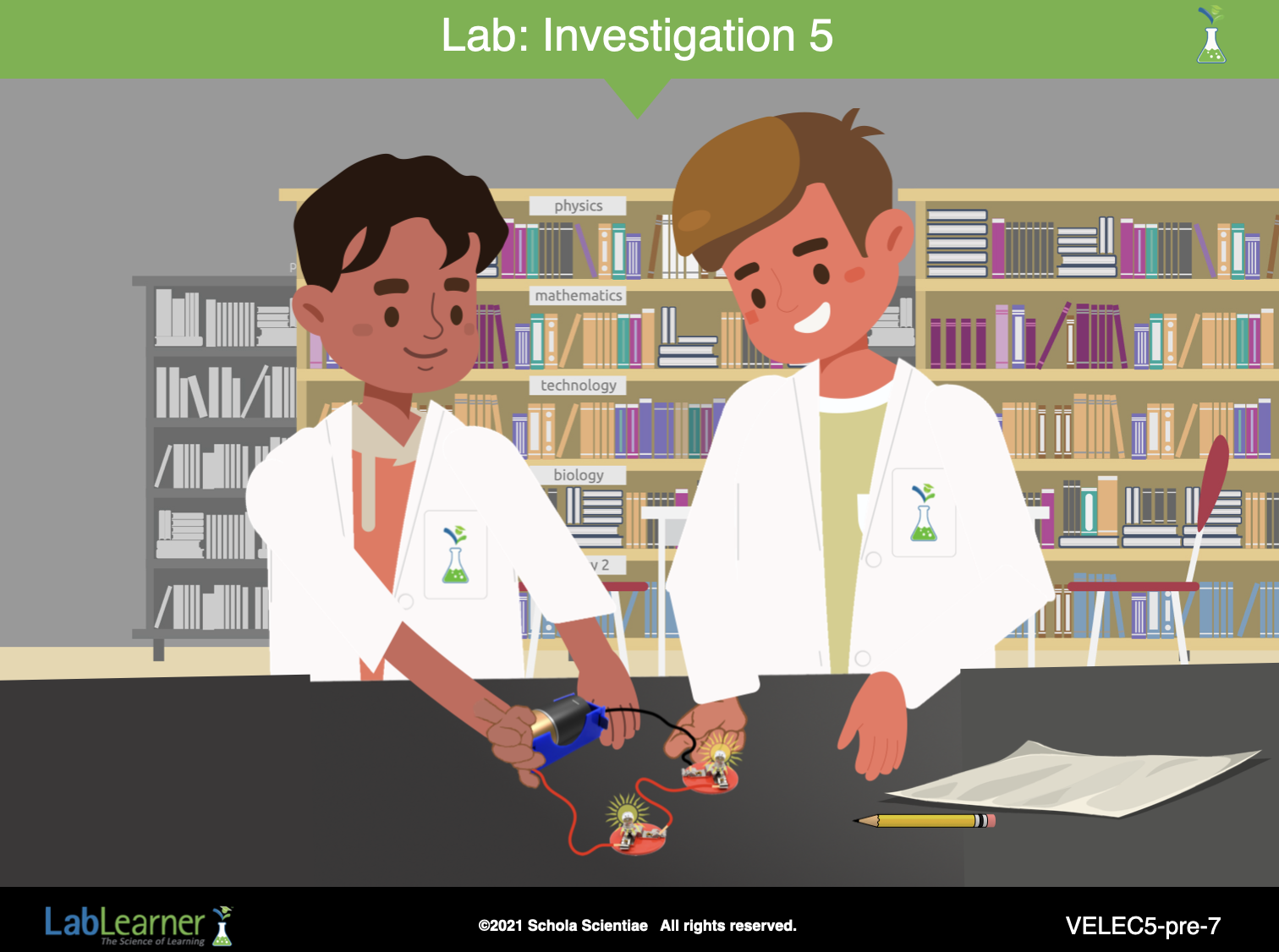
C. Tell students they will be conducting experiments that will increase their understanding of current electricity and how electrons flow through circuits. During their experiments, they will construct several circuits to explore this concept. As they conduct their experiments, they should think about the following questions.
• What is the path electrons follow in a series circuit?
• What is the path electrons follow in a parallel circuit?
• What are the differences between series and parallel circuits?
Student Video
Watch the Investigation 4 Student Video after the Share It presentation to prepare for the PreLab.
KEYS