
Teacher Portal:
Exploring Electricity
Investigation 3
Investigation Three: Understanding Simple Circuits
In Investigation One, students were introduced to static electricity as the movement of electrons from an uncharged surface to another uncharged surface, creating positively and negatively charged surfaces, respectively. Students explored this concept by rubbing balloons with wool swatches and 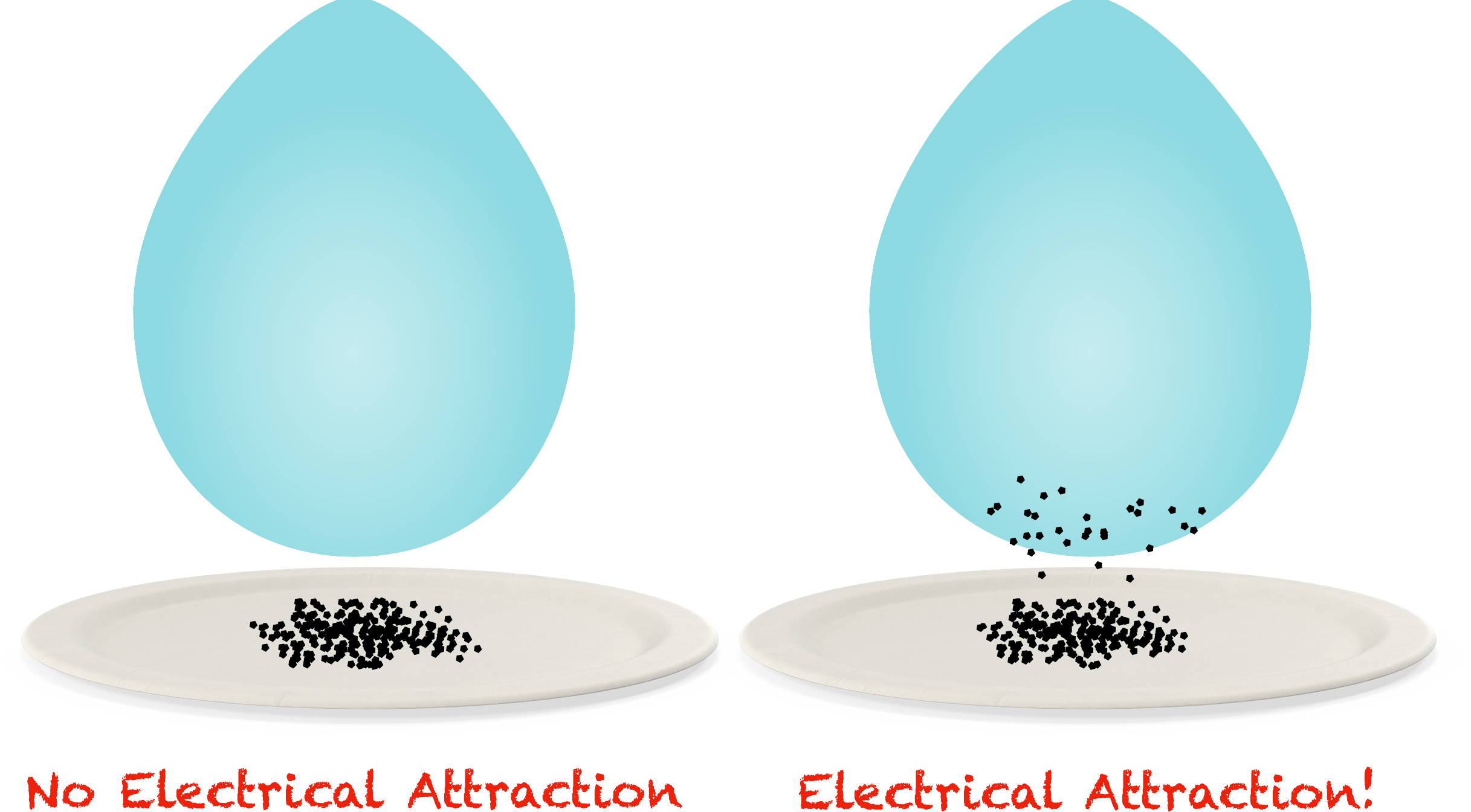 observing the effect the development of a negative charge on a balloon had by placing the charged balloon against a piece of paper attached to a wall.
Students continued their observation of electrical charges in Investigation Two by conducting more experiments with wool swatches and balloons to explore the concept that charged materials attract uncharged materials while like charges repel. Students will continue their study of electricity in Investigation Three by exploring current electricity through the construction and testing of a simple circuit.
Current Electricity
Current electricity is the result of the movement of electrons through a material. The term “current” electricity arises from the fact that electrons move in a single direction along a path. Electrons are negatively charged, and their direction of movement is toward a positive charge. The path is usually a wire, although electricity can also move through objects or other substances, such as human or animal bodies.
Looking at the animation above, one can see the analogy of water moving down a river and the movement of electrons in current electricity in one direction through a wire. Thus the term “current” has been used to describe the movement of electrons almost from the beginning. Even the term “flow”, as in electron flow, refers back to the water current analogy.
Batteries
Current requires a source of electrons in order for it to flow. The current for buildings comes from power plants, which generate it from steam, nuclear reactions, or flowing water. However, chemicals can also be used to generate electricity, because many chemicals can give or receive electrons under special conditions. Batteries are a source of chemical energy. A battery consists of two electrodes made of different metals arranged within a portable, sealed metal can (see below). Sometimes batteries, like the large batteries in cars and trucks, contain liquid chemicals and must be maintained in a position where the liquid does not spill out. Other batteries, which are lighter and more portable, are made of solids and pastes and are referred to as “dry cell” batteries.
In any case, the metals must be different for the current to be generated. Students will learn much more about the actual fascinating chemical reactions that take place inside batteries in LabLearner middle school CELLs. The alkaline batteries used in this CELL are similar to the one shown below.
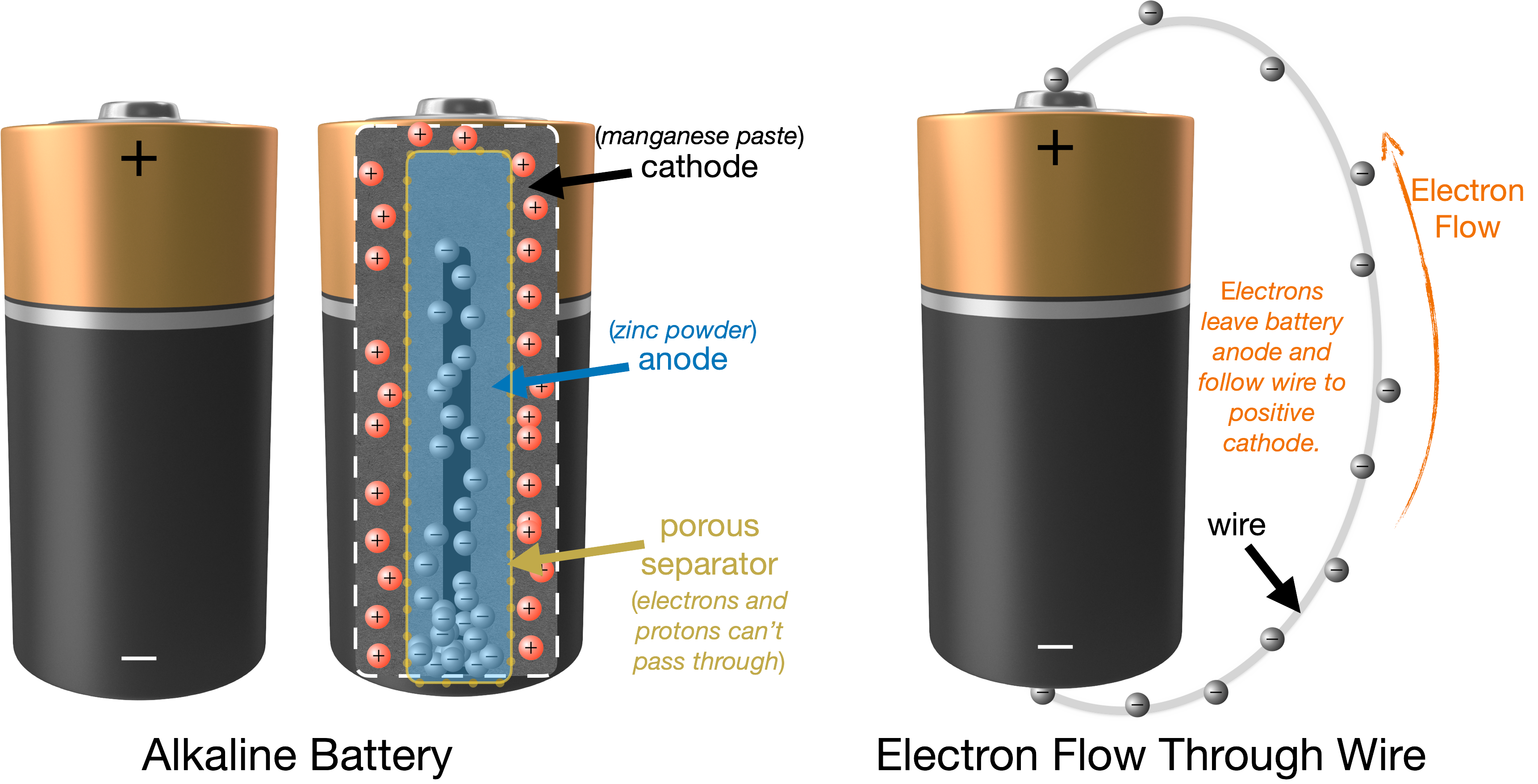
An alkaline battery consists of a steel can lined with a paste of manganese dioxide and powder inner core. This paste is divided from the interior core of the battery by a paper separator. In the center of the battery is zinc powder. The manganese oxide is connected to the positive terminal, and the zinc powder is connected to the negative terminal. When a circuit, or continuous path, is completed between the positive and negative terminal, the electrons flow from the negative terminal (the anode) to the positive terminal (the cathode), where they are taken up by the positively-charged manganese dioxide paste.
Electrical Current and Wires
The ability of electrons to move through a substance is determined by the composition of the substance as well as the size of the path. The preferred path for electricity is metal wire. Power lines, or transmission lines, are usually made from aluminum. Wiring used in buildings and appliances is copper. These materials were chosen because their molecules are less resistant to the passage of electrons than other substances.
The diameter of the wire helps determine its resistance, and thus the amount of current it is capable of carrying. Electrons cause friction as they pass the molecules in the wire. Decreasing the diameter of a wire increases its resistance. When more electrons are forced through the wire than it can easily carry, the increased friction causes heat. This is why it is important to use the proper size extension cord for the amount of current needed by an electrical appliance.
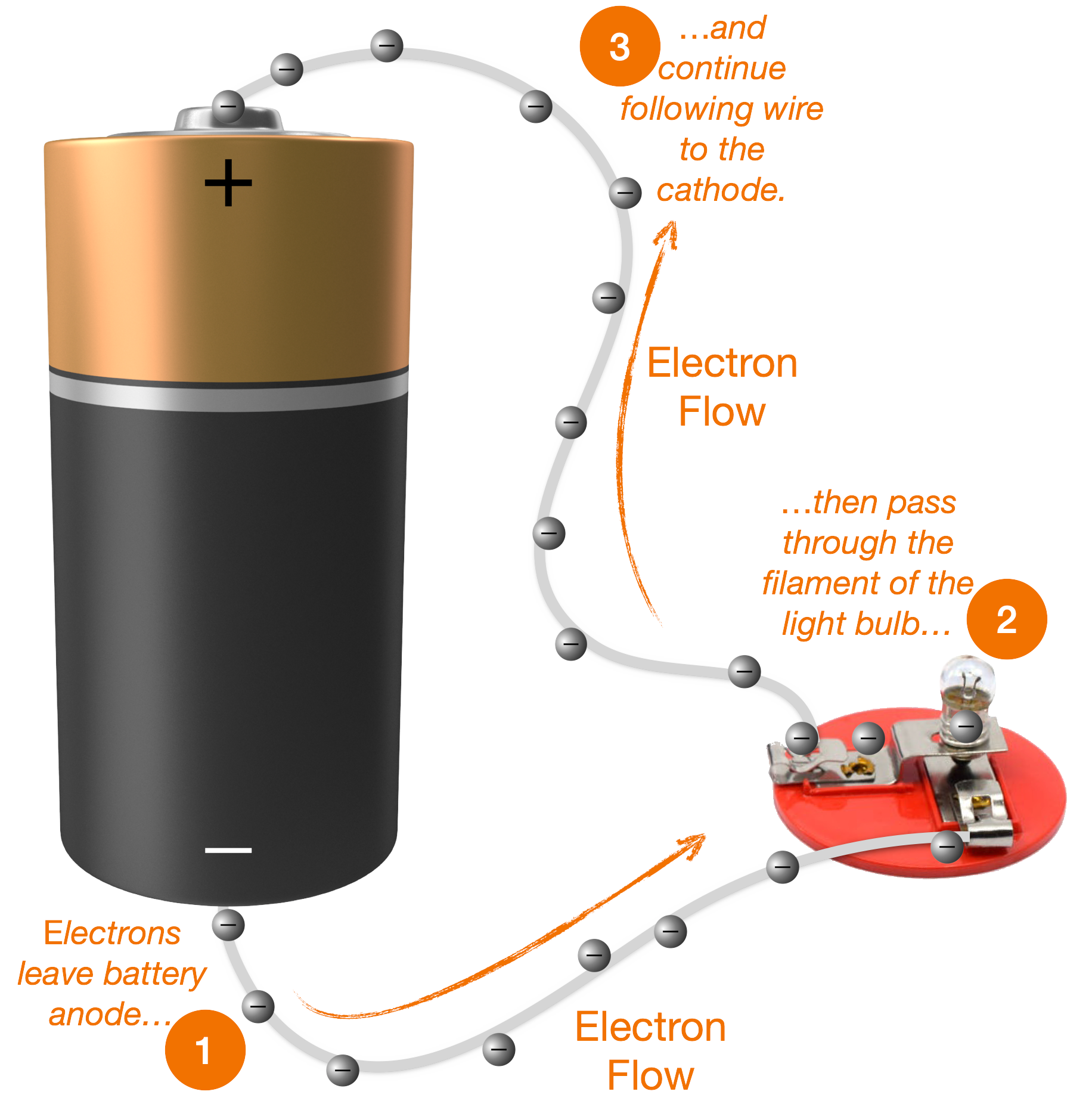
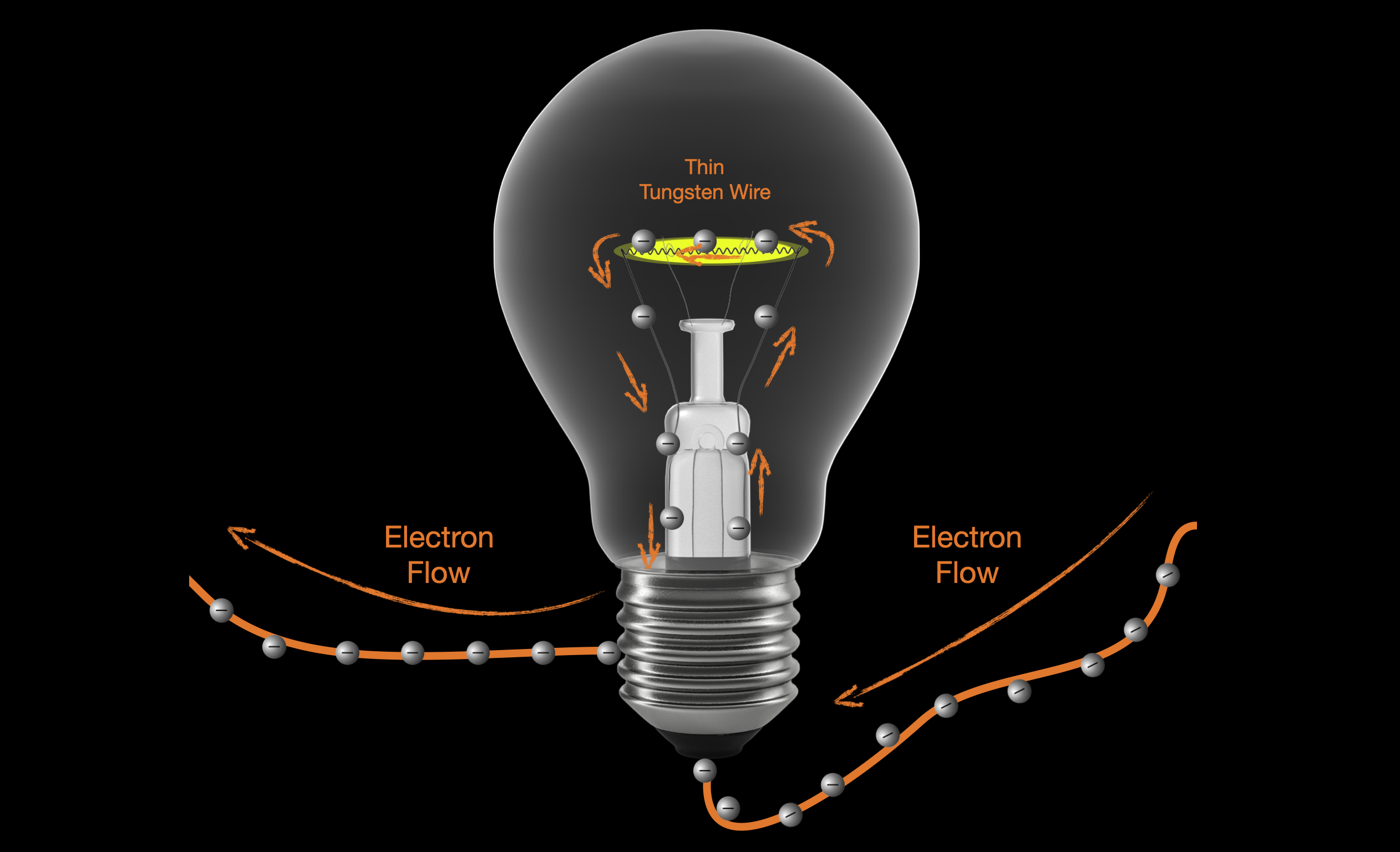
Electron flow cannot be seen directly. However, scientists can use an indicator to prove whether or not electrons are flowing through a circuit. Light bulbs are often used as indicators in electrical circuits. When a circuit is complete, the bulb produces light.
A light bulb consists of a filament made of very fine tungsten wire coiled into a spring. The filament is connected at one end to the base of the light bulb, while the other end is connected to the tip of the light bulb. Current flows into the filament from the base, through the filament, and back out of the bulb through the tip. The tungsten wire has a much smaller diameter than the wires connecting it to the circuit, which makes the filament have a very high resistance to electrons. The force of the electrons being pushed through the tungsten molecules generates so much heat that the wire glows white-hot, providing light. Tungsten is used because it has the highest melting point of any metal, and therefore the filament will not melt from the heat generated by the electrons.
Investigation Three introduces students to the concept of current electricity and provides them with the opportunity to construct a simple circuit with a battery, a wire, and a light bulb. Students will first attempt to create a complete circuit independently. They will then be given the steps to complete a circuit. Students will be asked to use the knowledge they gained from the first two experiments to test five circuits illustrated in their Scientist Data Record to determine which of the five circuits is complete.
Exploring Electricity: Investigation 3 - Mathematics Concepts
Prelab
• positive/negative
• problem-solving
Lab
• counting whole numbers
• positive/negative
• sequential order
Postlab
• problem-solving
• comparison
• positive/negative
• sequential order
Exploring Electricity: Investigation 3 - Procedural Tools

The design of this Investigation does not include a focus on student work with tools from the Procedural Toolbox.
Exploring Electricity: Investigation 3 - Cognitive Tools

Exploring Electricity:
Investigation 3 Quiz

