Teacher Portal:
Exploring Electricity
Investigation 3 – PreLab
 PRINT IT
Use your browser to download a printable PDF as help during the slide presentation and to make additional notes. In your browser, go to File > Print and then choose to save as PDF.
MINDSET
This Investigation is designed to:
- introduce the concept of current electricity.
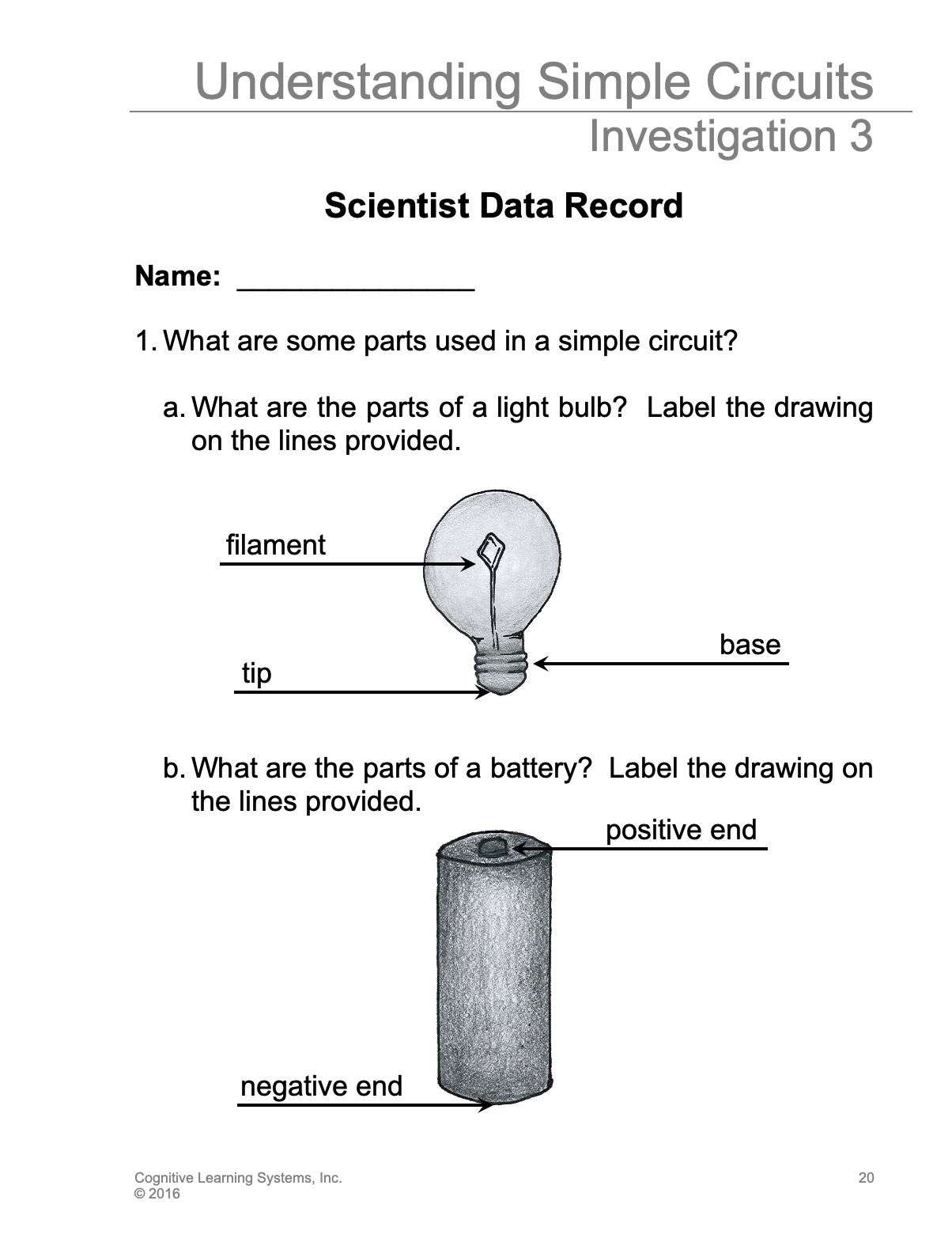
- familiarize students with the main components of a light bulb and a battery.
- assist students in understanding that a battery is a source of electrical current.
- help students realize that components of a complete electrical circuit include a power source and electrical current.
- assist students in understanding the differences between complete and incomplete circuits.
- increase students’ awareness that guidelines for safety must be followed when dealing with current electricity.
- provide students with the opportunity to build a complete simple circuit.
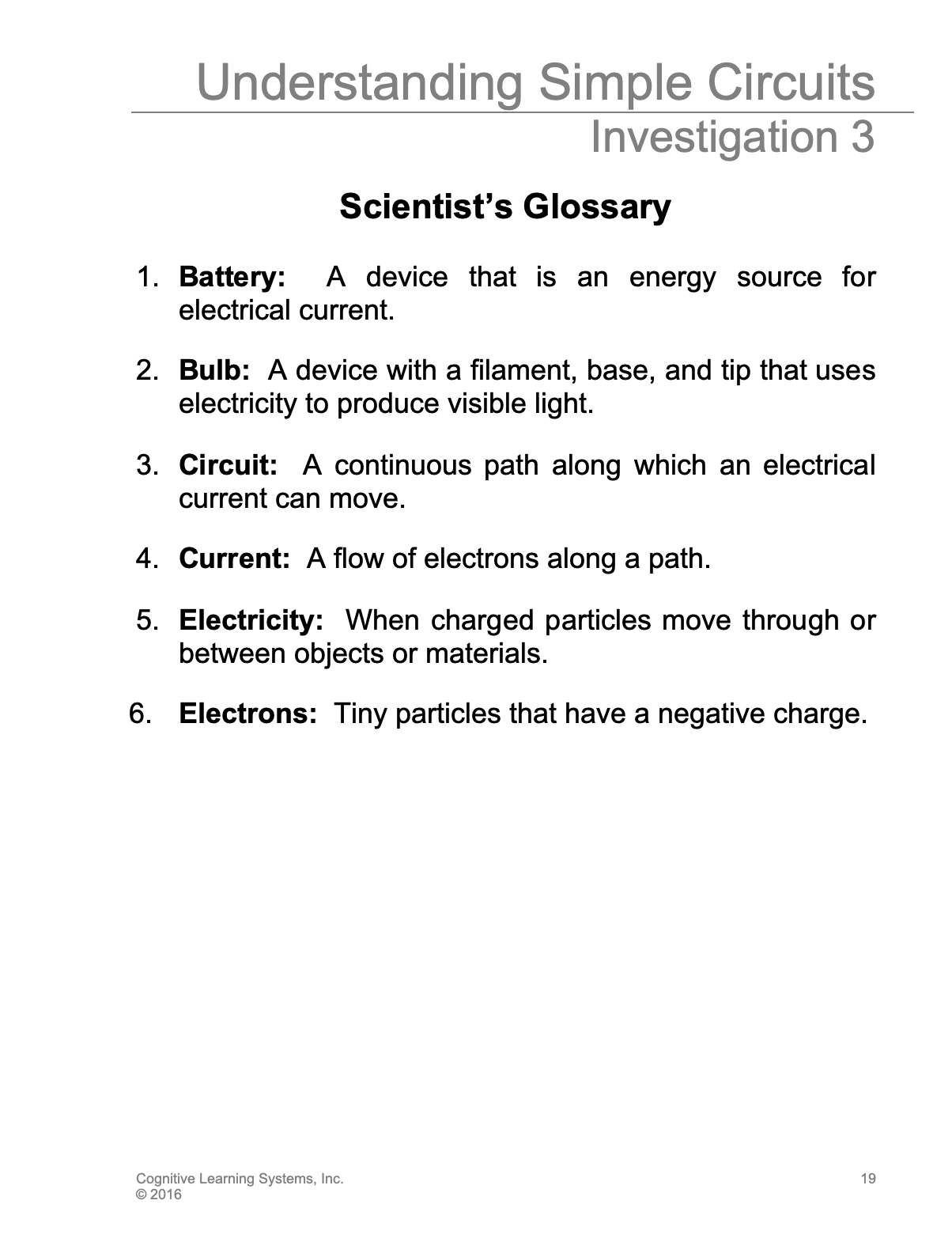
SCIENTIST’S GLOSSARY
- Battery: A device that stores chemical energy and can be used to produce electrical current.
- Bulb: A device consisting of a filament, base, and tip that uses electricity to produce visible light.
- Circuit: A continuous path along which an electrical current can move.
- Current: A flow of electrons along a path.
- Electricity: An event that occurs when electrons move through or between objects or materials.
- Electrons: Tiny particles found outside the nucleus of an atom. Electrons have a negative charge.
BE PREPARED
Watch the Investigation 3 Teacher Video and Student Video below to prepare for the PreLab.
SET FOR SUCCESS
- Tell students that they will continue their work on the Exploring Electricity CELL.
- Tell them that they will begin to study the kind of electricity that is carried by wire, current electricity.
- Ask students to share the kinds of things they might learn in this Investigation.
Begin the PreLab Concept Slides to start students on their learning journey. Then watch the Pre-Lab Student Video afterward as a class.
NAVIGATE IT
Once the slide presentation is launched
- use your left and right arrows to advance or go back in the slide presentation, and
- hover your mouse over the left edge of the presentation to get a view of the thumbnails for all the slides so that you can quickly move anywhere in the presentation.
- Click HERE to launch the slide presentation for the CELL.
SHARE IT
SLIDE VELEC3-pre-1
This is the third Investigation of the LabLearner CELL Exploring Electricity. In it, students will begin to learn about current electricity.
______________________________________________
SLIDE VELEC3-pre-2
Begin the Investigation by reviewing some of the concepts that the students have encountered in the CELL thus far.
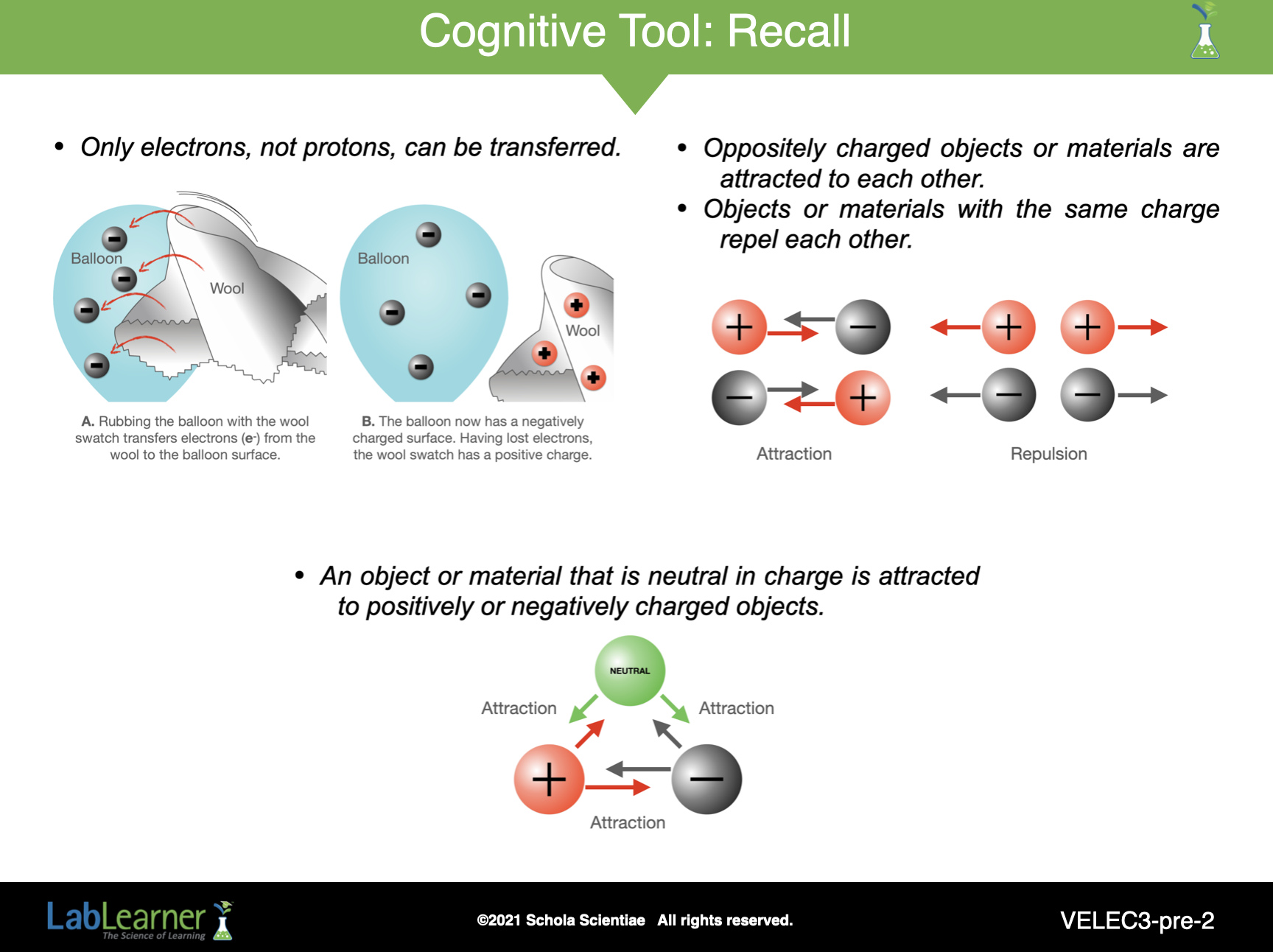
1. Say to students: Let’s Recall your conclusions about static electricity from the experiments in Investigations One and Two.
2. Essential points from Investigation One and Two:
- We can’t see the direction that electrons move, but we know they move because objects can develop a charge and static electricity. Special tools can tell us the direction that electrons move in.
- Only electrons, not protons, can be transferred.
- Rubbing the surface of an object or material causes electrons to move.
- Objects or materials are neutral in charge until an action, such as rubbing, causes the electrons on their surface to move.
- Oppositely charged objects or materials are attracted to each other.
- Objects or materials with the same charge repel each other.
- An object or material that is neutral in charge is attracted to positively or negatively charged objects.
- The amount of electrical charge an object or material has can vary.
______________________________________________
SLIDE VELEC3-pre-3
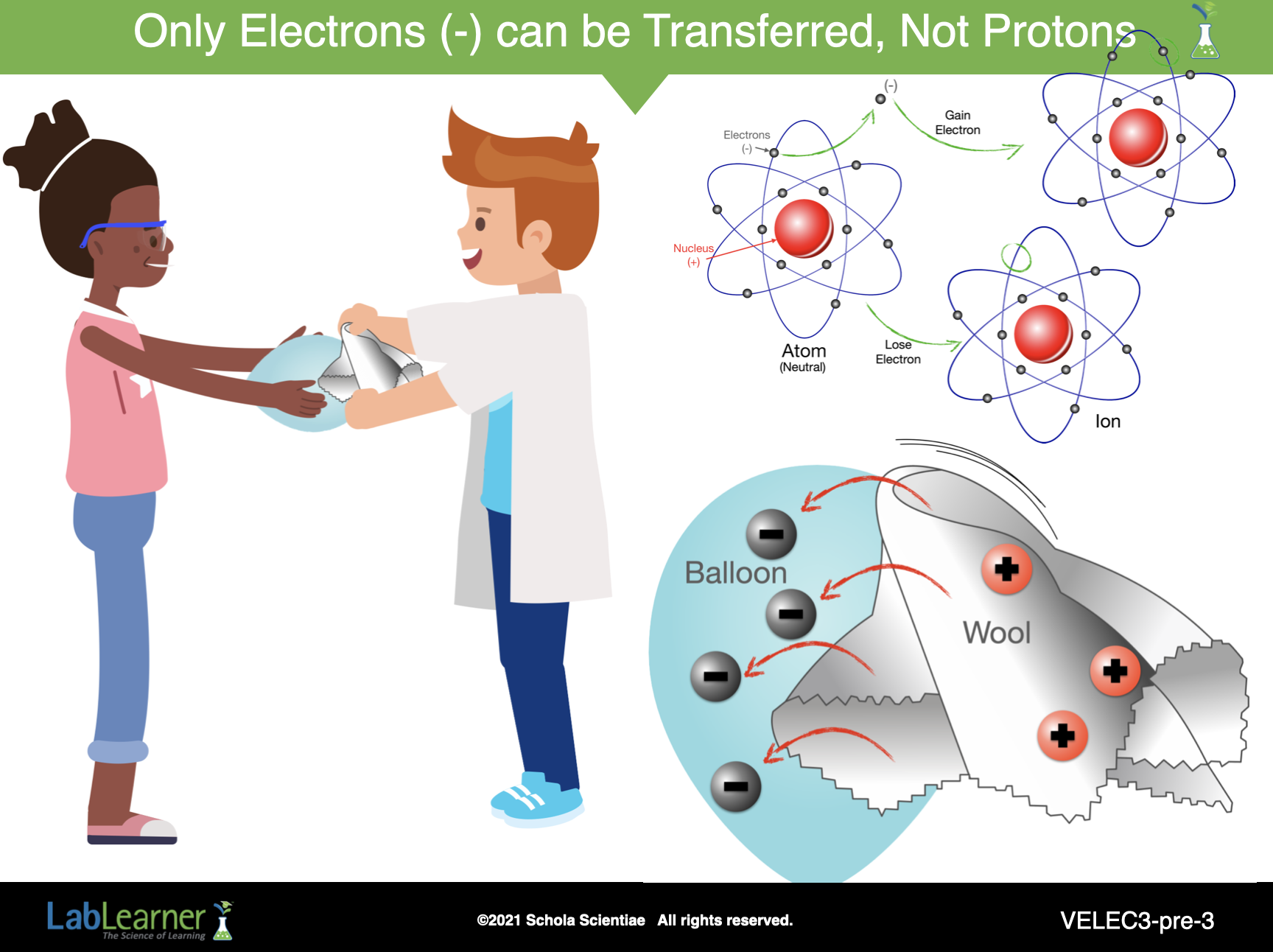
A. Expand on the concepts students have learned by asking them several leading questions.
1. Ask students: Do you think the amount of electrical charge a material can have when it is rubbed is a property of that material? Student answers may vary. All materials on Earth vary in the amount of electrical charge they can have when they are rubbed. Therefore, the electrical charge on that object, as a result of static electricity, is a property of that material.
2. Ask students: What happened when you rubbed the balloon with the wool? Students should indicate that electrons moved from the wool to the balloon.
3. Ask students: What do you think would happen if you kept rubbing the balloon with the wool? Would electrons keep moving from the wool to the balloon as long as you rubbed? No. The wool has a specific number of electrons. Only as many electrons as the wool contains can move to the balloon. Then, the movement of electrons from the wool to the balloon stops.
4. Ask students: What do you think happened to all the electrons that left the wool? Where did they go? Students should indicate that they accumulated on the surface of the balloon.
5. Ask students: Did the electrons follow a specific path from the wool to the balloon? Student answers will vary. Help students understand that the electrons did not follow a path. Wherever the balloon and wool were rubbed together, the electrons moved from the wool to the balloon. In other words, the electrons moved from the wool to the balloon at all points where they were rubbed together.
______________________________________________
SLIDE VELEC3-pre-4
B. Transition students from the concept of static electricity to the concept of current electricity.
1. Ask students: Can you think of a form of electricity that does follow a specific path? Can you think of some examples? Student answers may vary.
Explain that current electricity is a form of electricity that follows a specific path. Examples include the electricity in homes and businesses that travel through a wire. Appliances and devices that use electrical current include televisions, radios, refrigerators, microwaves, hairdryers, and lamps.
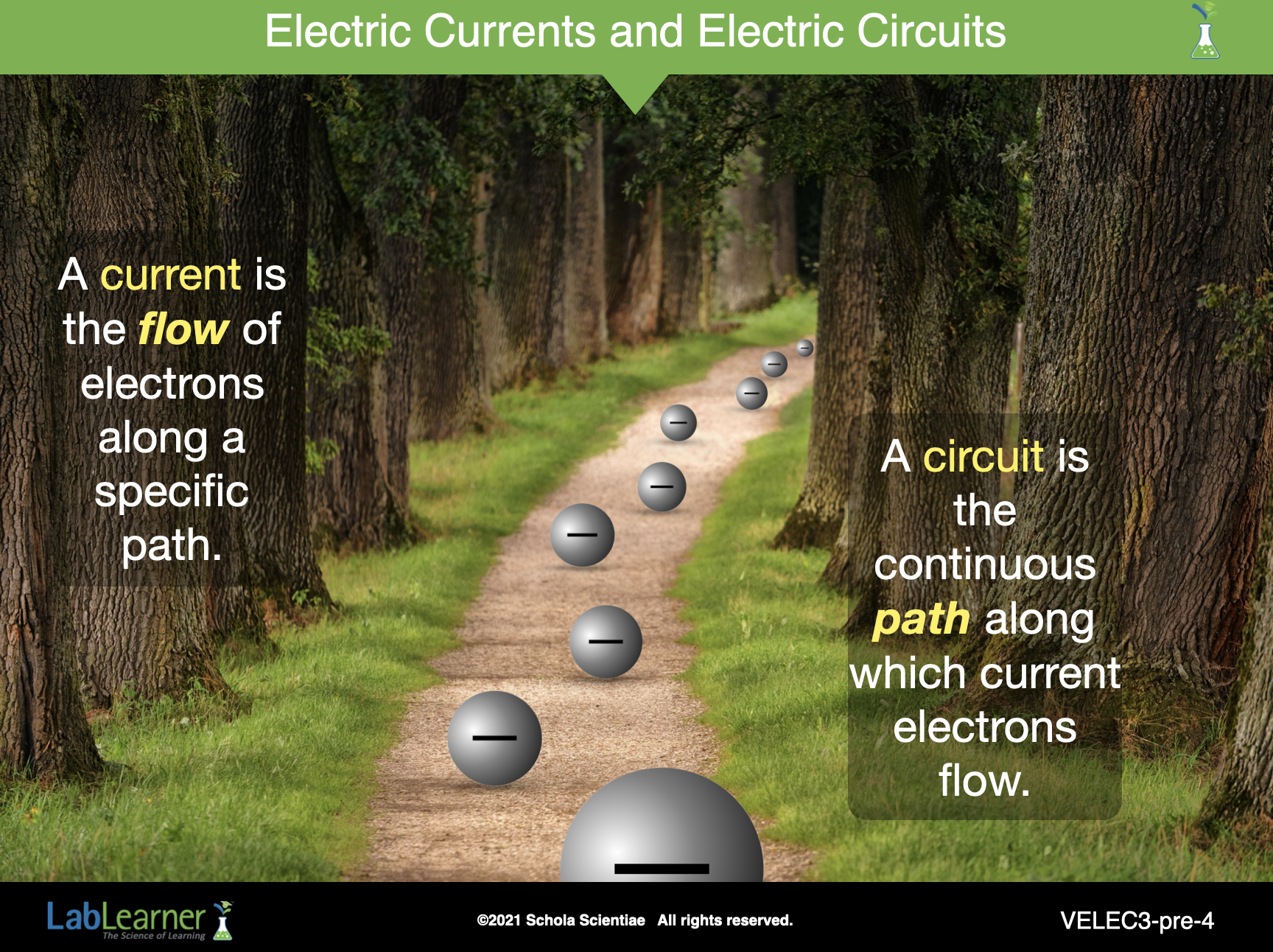
2. Tell students that the path along which the electrons flow in an electric current is called a circuit. Draw students’ attention to the term circuit and current in their Scientist’s Glossary.
Circuit: A continuous path along which an electrical current can move.
Current: A flow of electrons along a path.
3. Ask students: What is the term that describes the flow of electricity along a path? A current.
4. Ask students: What is the difference between a current and a circuit? A current describes the flow of electrons along a path. A circuit provides the path along which a current moves.
Sometimes an electrical current is compared to the flow of water in a river. The animation below illustrates this analogy.

______________________________________________
SLIDE VELEC3-pre-5
C. In order that students understand the concept of circuits, they must realize that an electrical current can only operate properly if it is complete. Since this may be a difficult concept for students to understand, the activities that follow were developed to assist students in comprehending the concept.
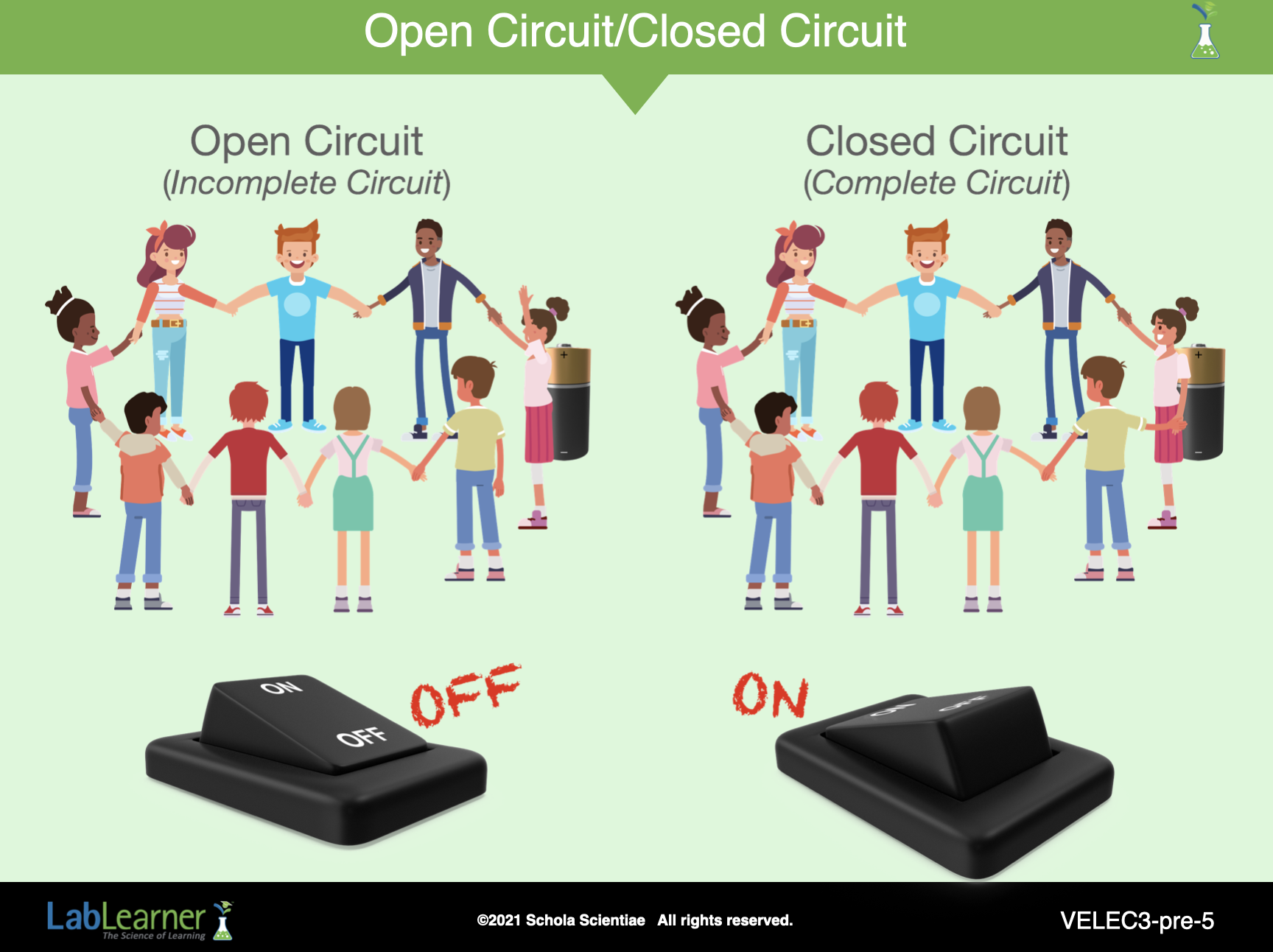
1. Perform a role play that will help students conceptualize the movement of electrons or an electrical current along a circuit. Use the directions that follow:
a. Ask students to move to a clear area of the classroom and form a circle, facing inward. Direct the students to stand with hands at their sides. Explain that the circle represents a path that electricity can follow.
b. Designate one student as the power source. Tape a piece of paper with the letter “P” written on it to the chest of the student.
c. Explain to students that the power source is where the electrical current starts. It is a source of electrons. Direct the student labeled as the power source to hold his/her left hand up.
Note: The lifting of the left hand represents the end of the circuit. Until the hand is grasped by another, the circuit is not complete.
Note: The lifted left hand is also analogous to a switch in a circuit. You may point out this to students and refer to the “on/off” switches at the bottom of the slide.
d. Tell students that an electrical current is leaving the power source. Direct the student labeled as the power source to grasp, with their right hand, the left hand of the student standing next to him/her. Explain that as the students touch hands the electrons are moving along the circuit.
e. Instruct students to continue around the circle in this manner until they reach the student labeled as the power source. Tell them the activity they just performed represents the flow of an electrical current along a path, a circuit.
f. Explain that a circuit is not complete until it returns to its starting point.
Direct the student labeled as the power source to lower his/her left hand and allow the student next to him/her to grasp it.
g. Point out to students that the circuit is now complete because the current can continue to move along its path. Its path is not broken, but continuous.
______________________________________________
SLIDE VELEC3-pre-6
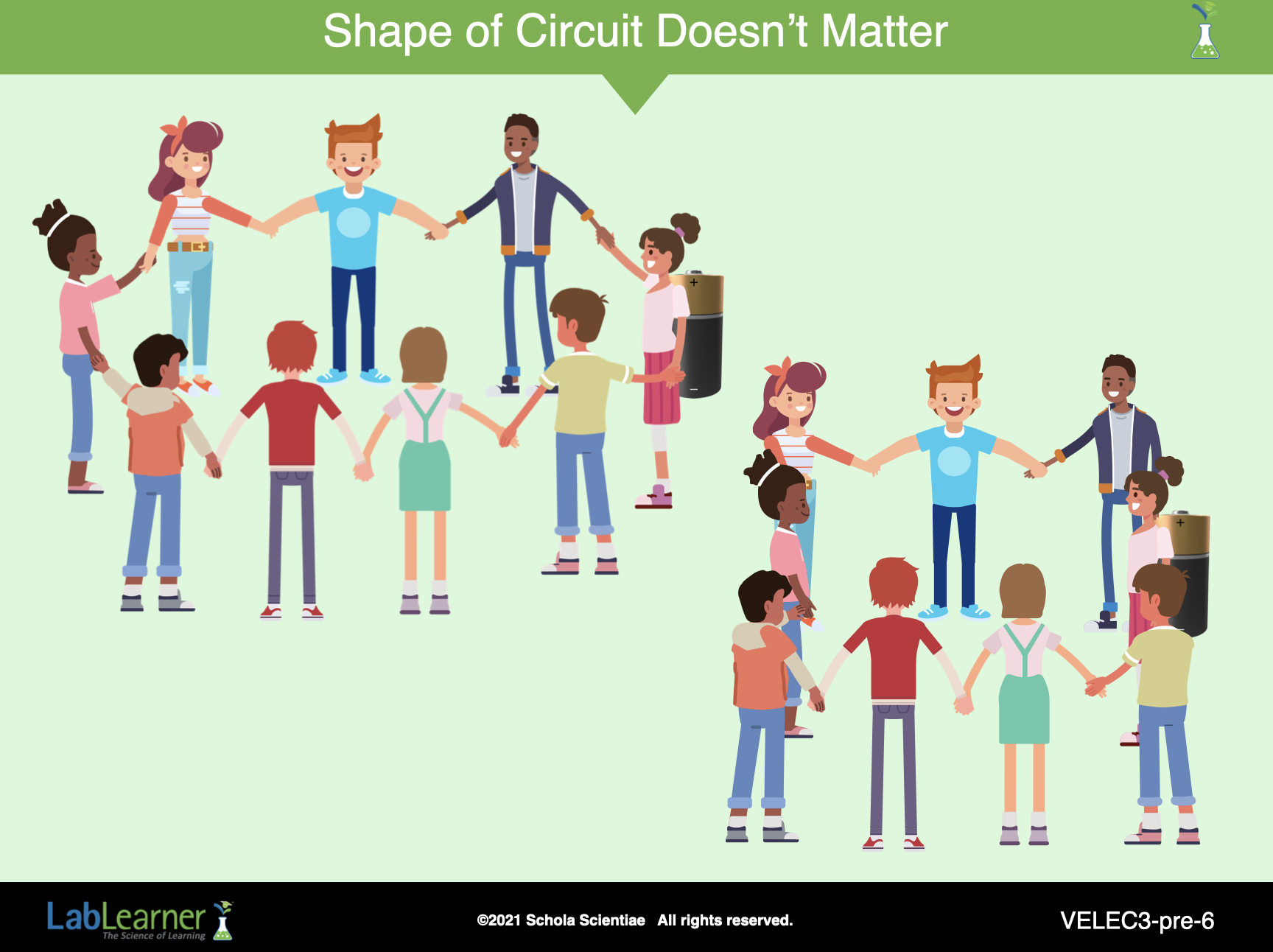
2. Use the next two variations of the activity to help students understand that a circuit is not always circular, but is considered complete regardless of shape, if the electrical current can travel continuously without interruption.
a. Instruct students to form the shape of a square as they continue to hold hands, but the student labeled as the power source should remain at the same position.
b. Ask students: Do you still have a complete circuit? Yes.
c. Ask students to again change the shape of their circuit with the student labeled as the power source should remain in position. Allow them to experiment forming different angles, curves, shapes, etc.
Point out that as long as they continue to hold hands as they form their different circuits, they will have a complete circuit.
______________________________________________
SLIDE VELEC3-pre-7
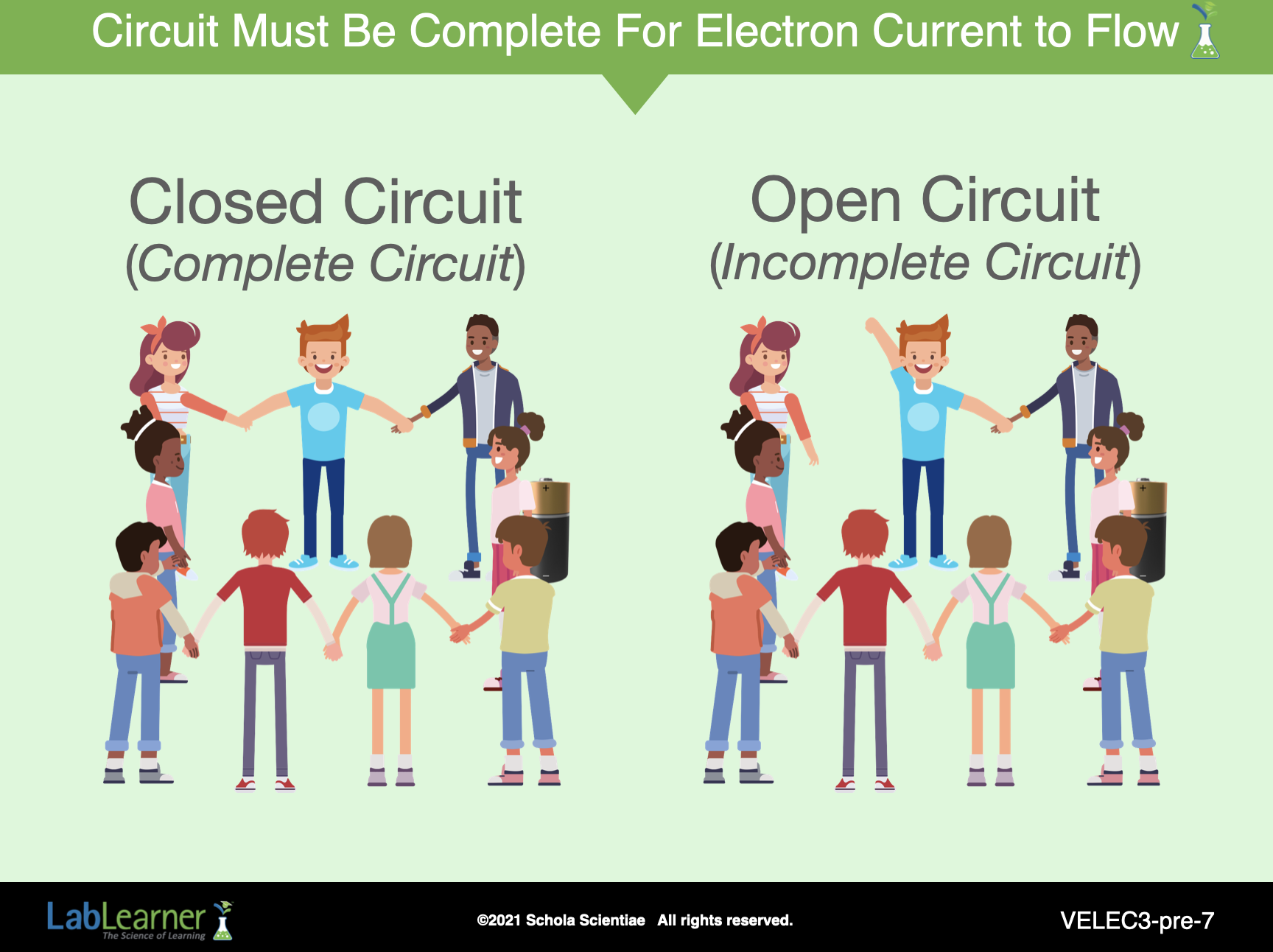
d. Chose a student in the circle and ask him/her to hold up his/her right hand, letting go of the next student in the circuit.
Explain to students that now would be a good time to use the Cognitive Tool: Check Understanding to see if they understand the differences between an incomplete and complete circuit.
1. Ask students: Is the circuit still complete? Can the electrical current continue to flow through the circuit? No. The current cannot flow along the path of the circuit and be complete if the connection is broken.
2. Affirm that the students now represent an incomplete circuit.
3. Direct the student holding up his or her hand to reestablish contact.
4. Ask students: What if the circuit is broken at a different point? Would you have a complete circuit? Direct another student to hold up his/her right hand. No. If the circuit is broken at any point along the path, the current will not flow through the circuit and will not make a complete circuit. The current must be able to flow from a starting point and continues until it returns to the starting point to make a complete circuit.
5. Ask students to return to their seats.
______________________________________________
SLIDE VELEC3-pre-8
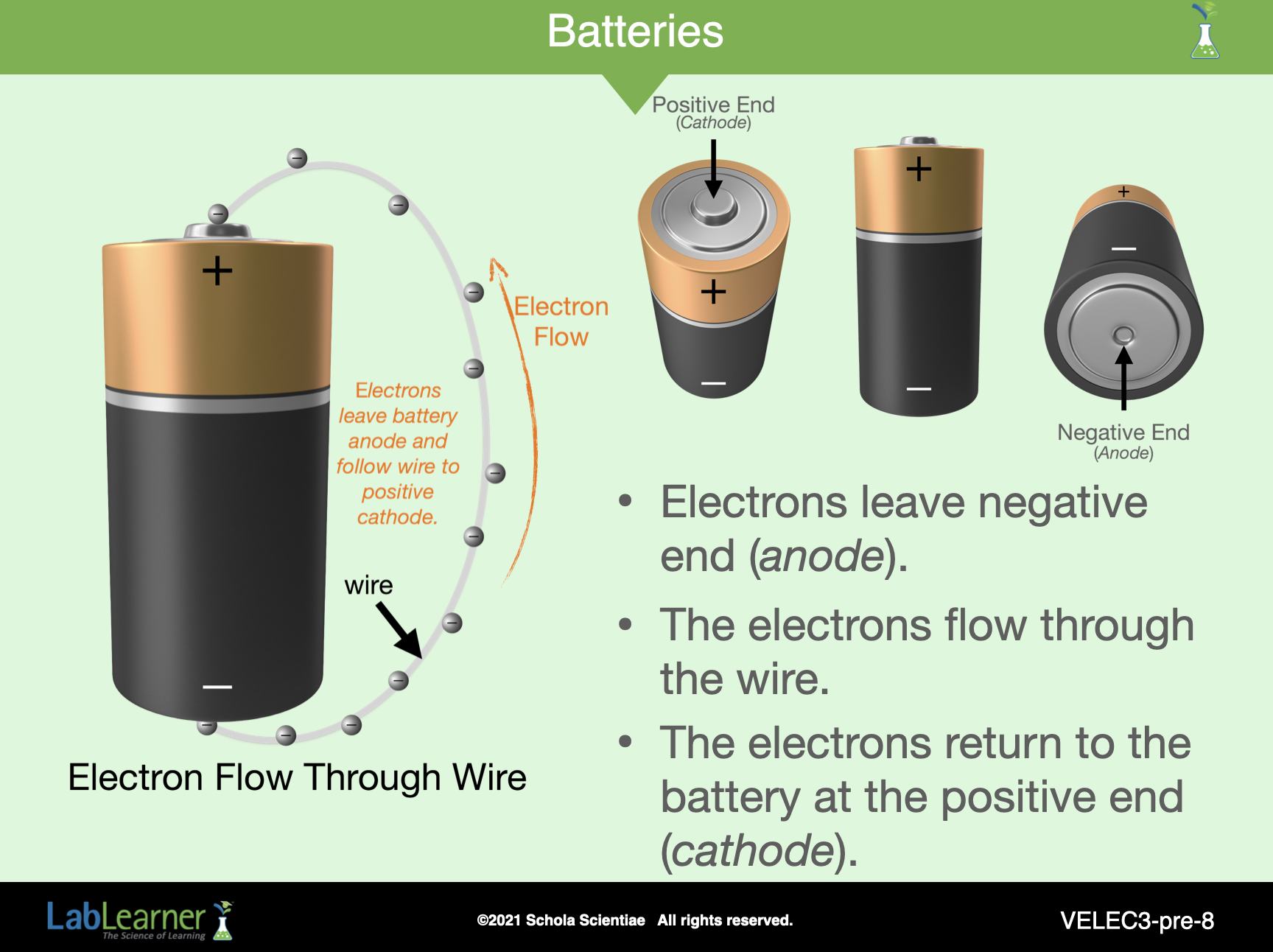
3. Apply some of the concepts from the role play to the formation of circuits that use a battery.
a. Point to the battery on the slide.
Tell students that a battery is one example of a power source.
b. Discuss the main parts of a battery (the positive and negative ends). Students should label the parts in the drawing in Problem 1a in their Student Data Record as you conduct the discussion.
c. Explain that when a battery is used in a circuit, electrons begin moving from the negative end and return to the battery at the positive end.
______________________________________________
SLIDE VELEC3-pre-9
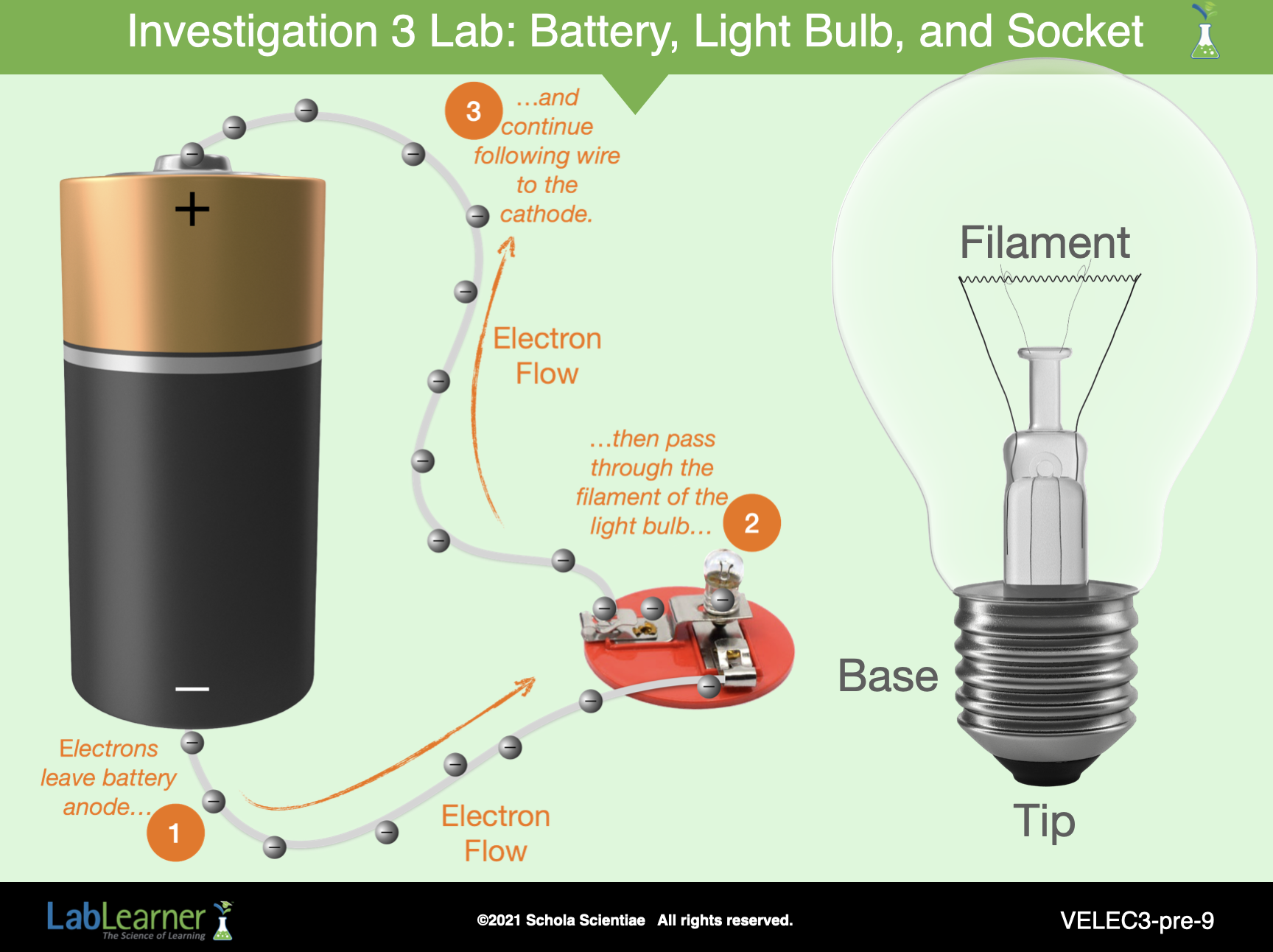
D. Tell students they will be conducting several experiments that will increase their understanding of current electricity. As they conduct their experiments, they should think about the following questions:
How can you assemble a complete circuit?
How will you know if you have assembled a complete circuit?
______________________________________________
SLIDE VELEC3-pre-10
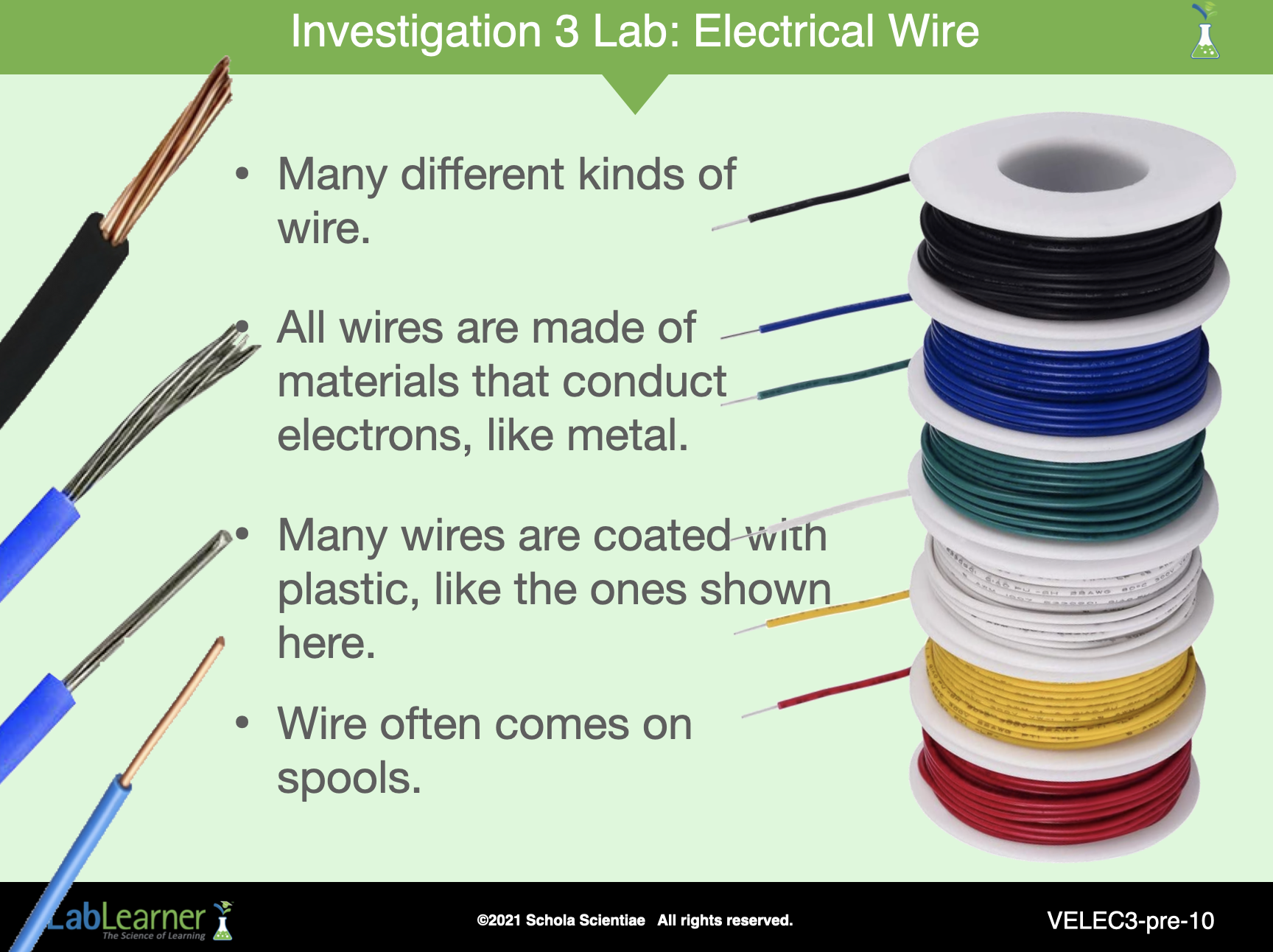
Explain that wires must be able to carry or conduct a flow of electric current. Therefore, most all wires are made of metals. Copper, for example, is very commonly used to make wires.
______________________________________________
SLIDE VELEC3-pre-11
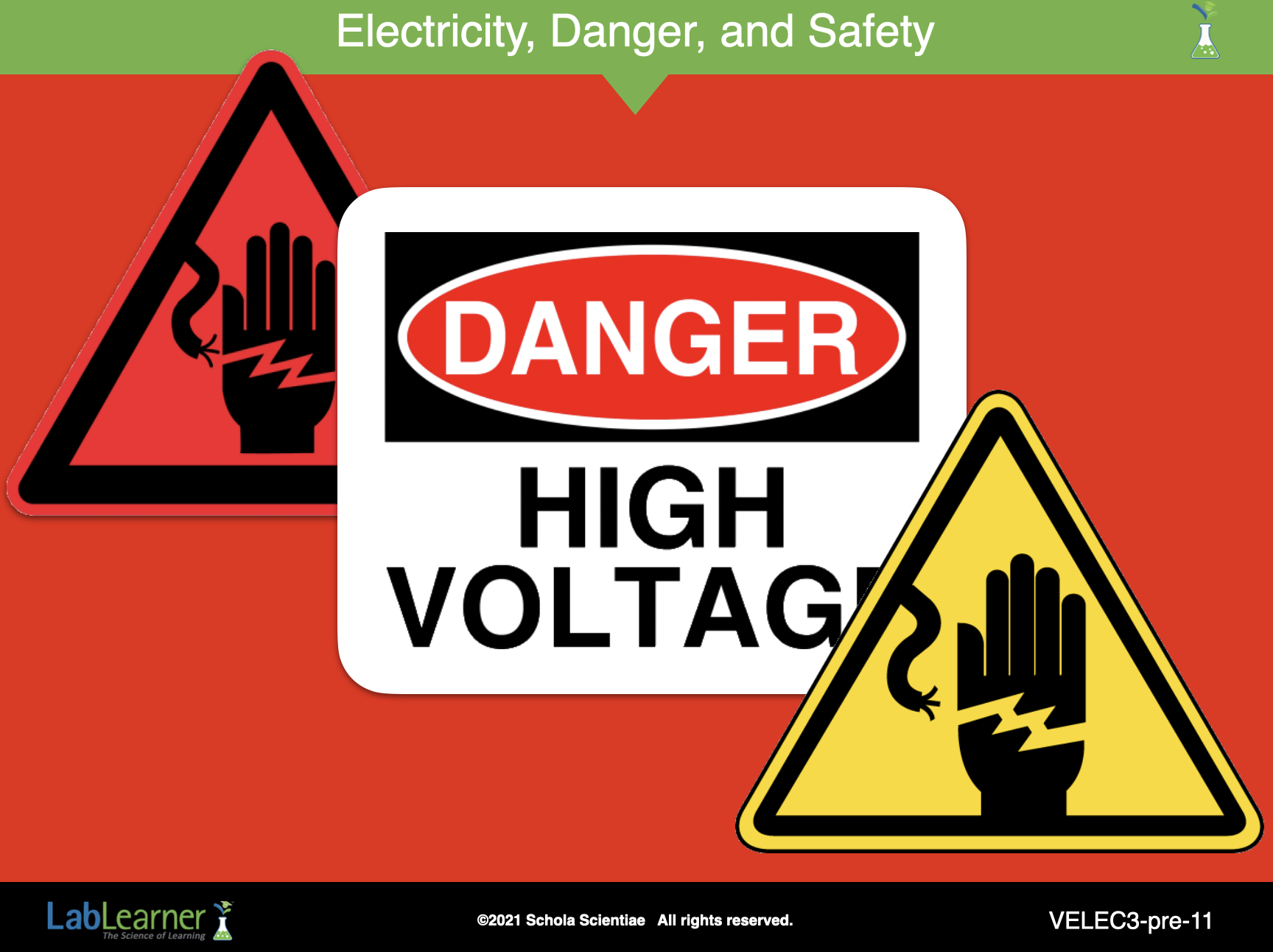
E. End this part of the investigation by discussing with students the necessity for using safety guidelines when they are around current electricity.
1. Ask students: Is an electrical current dangerous? Can it hurt people? Yes. Electrical currents can be very dangerous and cause serious injuries if they are not handled properly.
Point out that in lab, students will use batteries that are too weak to harm humans.
However, house current, like available elsewhere at school and at home, is very strong and can easily hurt a human badly if handled incorrectly.
2. Ask students: Can you think of examples of safety precautions you can take when using electricity? Write students’ suggestions on the board. Student answers may vary. Students may suggest the following examples. If not, guide them to these safety rules:
-
- Don’t touch exposed electrical wires.
- Don’t use plugs that are not grounded (don’t have three prongs).
- Don’t use electrical appliances with wet hands.
- Don’t drop electrical appliances in water that are plugged into an electrical outlet.
- Don’t use electrical appliances when standing in water.
- Don’t get your fingers between the prongs of a plug and an electrical outlet.
Student Video
Watch the Investigation 2 Student Video after the Share It presentation to prepare for the PreLab.
KEYS