Teacher Portal:
Exploring Electricity
Investigation 3 – PostLab
 PRINT IT
Use your browser to download a printable PDF as help during the slide presentation and to make additional notes. In your browser, go to File > Print and then choose to save as PDF.
NAVIGATE IT
Once the slide presentation is launched
- use your left and right arrows to advance or go back in the slide presentation, and
- hover your mouse over the left edge of the presentation to get a view of the thumbnails for all the slides so that you can quickly move anywhere in the presentation.
- Click HERE to launch the slide presentation for the CELL.
SHARE IT
SLIDE VELEC3-post-1
This is the third Investigation of the LabLearner CELL Exploring Electricity. In it, students will began to learn about current electricity.
______________________________________________
SLIDE VELEC3-post-2
A. Begin the analysis of the experiments by reviewing several of the concepts introduced thus far. The following questions can be used to prompt a discussion of these concepts.
1. Ask students: What were the three main questions asked during the Lab? Students were asked the following questions. “Can you build a complete simple circuit using a light bulb, battery, and electrical wire?” “How do you know a complete circuit was created?” “Can you identify a complete circuit?”
2. Ask students: Can you describe what you did in your experiments to answer the questions? Students should suggest that to answer the first question, they independently explored how to assemble a complete simple circuit using a light bulb, battery, and electrical wire and then presented to the class a sketch of their design.
To answer the second question, they assembled a complete simple circuit using directions supplied by their instructor. They compared this circuit to the circuit they built in Trial 1.
To answer the third question, they tested several different circuits to determine which were complete and described the differences between the complete and incomplete circuits.
______________________________________________
SLIDE VELEC3-post-3
B. Direct students to refer to their sketch in Problem 2 of their Student Data Record.
1. Ask students to share with the rest of the class their design for the first simple circuit they created. If some student pairs have the same design, choose one pair to represent those pairs.
2. After student pairs have presented their designs,
Ask Students: Did any of the sketches show a complete simple circuit? Why or why not? Student answers will vary. If students were successful during Trial 1, their sketches should indicate a continuous path for electrical current to flow from the battery, through the wire and bulb, and back to the battery.
3. Ask students: How did you know whether a complete circuit was made? Student answers may vary. Students should indicate that when they made a complete circuit, the light bulb illuminated.
4. If students were not successful in creating a complete circuit, a continuous path for electrons would not be indicated by their sketches. Discuss either observation depending on what the student sketches indicate.
______________________________________________
SLIDE VELEC3-post-4
C. Continue to review the Lab experiments. Students may wish to refer to their Student Data Record during the review. Ask students the following questions to prompt discussion.
1. Ask students: How did the circuit you assembled in Trial 2 compare to the circuit you designed in Trial 1? Student answers may vary. Some students’ circuits may be identical. Other students’ circuits may be different, indicating that either a complete circuit was created in Trial 2 but not in Trial 1 or that a complete circuit was created in both Trials but with a different structure.
2. Ask students: In Trial 2, how did you know that what you made was a complete circuit? Students should indicate that the light bulb was illuminated.
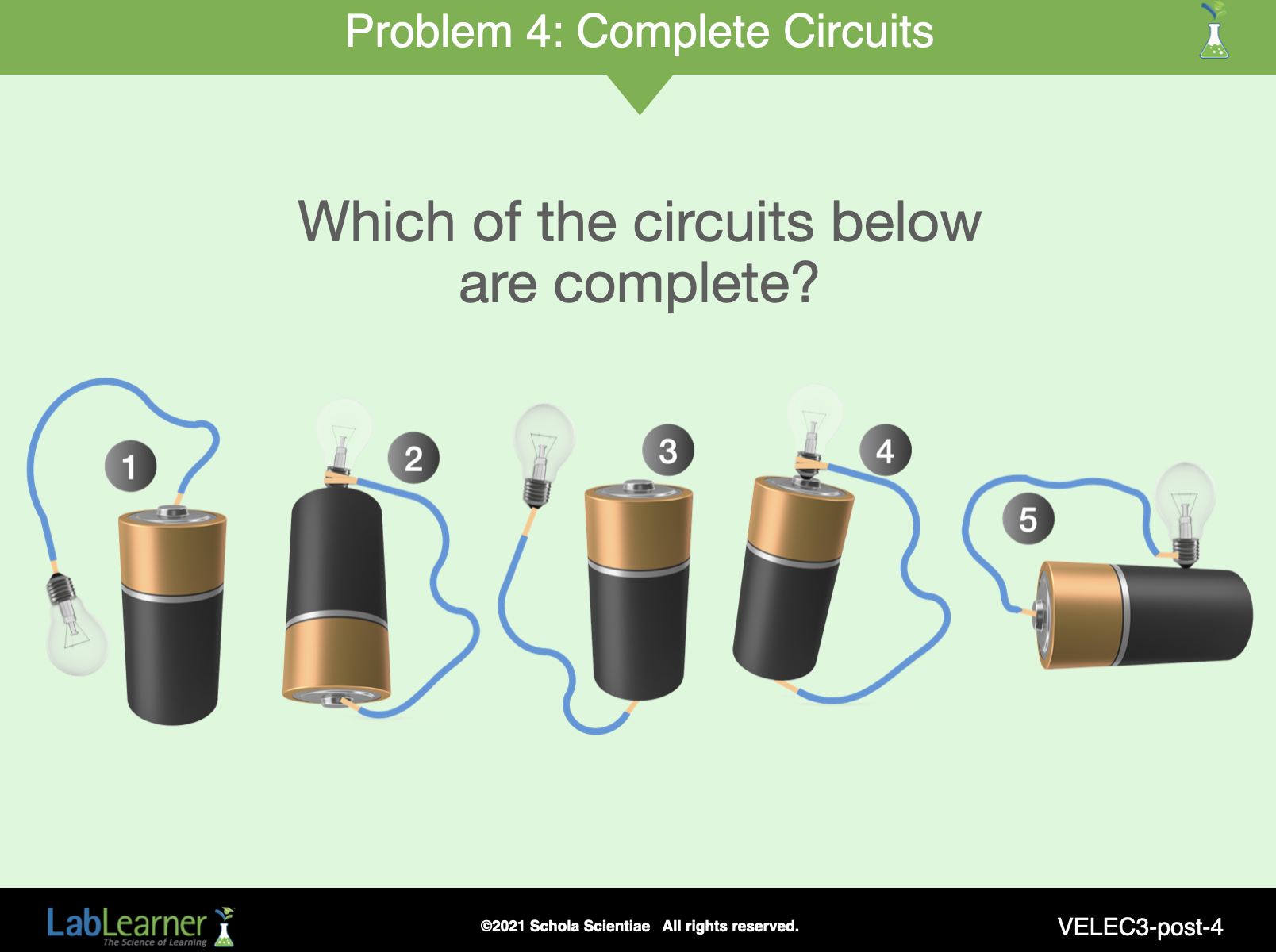
3. In Trial 3, you tested the four examples of circuits. Which were complete circuits? How do you know they were complete? Students should indicate that the circuits numbered 2 and 4 were complete because, after they were assembled, the light bulb was illuminated.
4. Ask students: What did you do differently that made examples 2 and 4 complete circuits but not examples 1, 3, and 5? Students should realize that circuits 1, 3, and 5 were not complete because the electrical current from the battery did not make a complete circuit.
- In circuit 1, the wire was connected from the positive end of the battery to the base of the light bulb but did not connect to the negative end of the battery.
- In circuit 3, the wire was connected from the negative end of the battery to the base of the light bulb but did not connect to the positive end of the battery.
- In circuit 5, the wire was connected from the positive end of the battery to the base of the light bulb but did not connect to the negative end of the battery. In all three circuits, current was not able to flow because the circuit did not end where it started and, therefore, a complete circuit was not accomplished.
- However, in circuits 2 and 4, the wire was connected from the negative end of the battery, through the bulb, to the positive end of the battery.
______________________________________________
SLIDE VELEC3-post-5
D. Ask students: How do you think the battery in our experiments works? How does it provide a source of electrons to flow through the circuit? Student answers will vary.
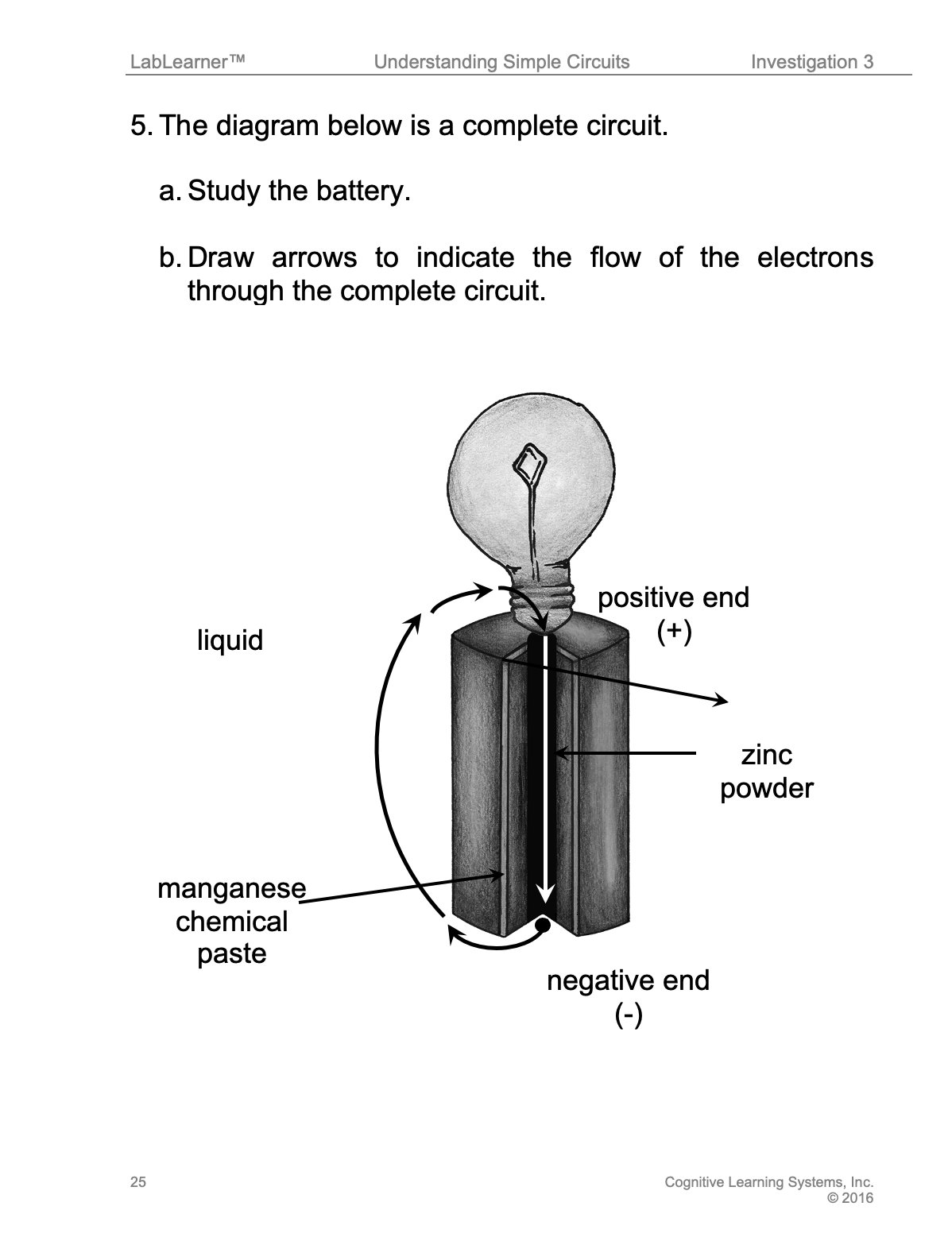
1. Ask students to locate the Diagram in Problem 5 of their Student Data Record.
2. Tell students that the battery used in the Lab experiments is called an alkaline battery.
Ask students: What are some common examples of where an alkaline battery is used? Examples that students may suggest, such as cameras, radios, watches, clocks, toys, flashlights, etc., can all use dry cell batteries.
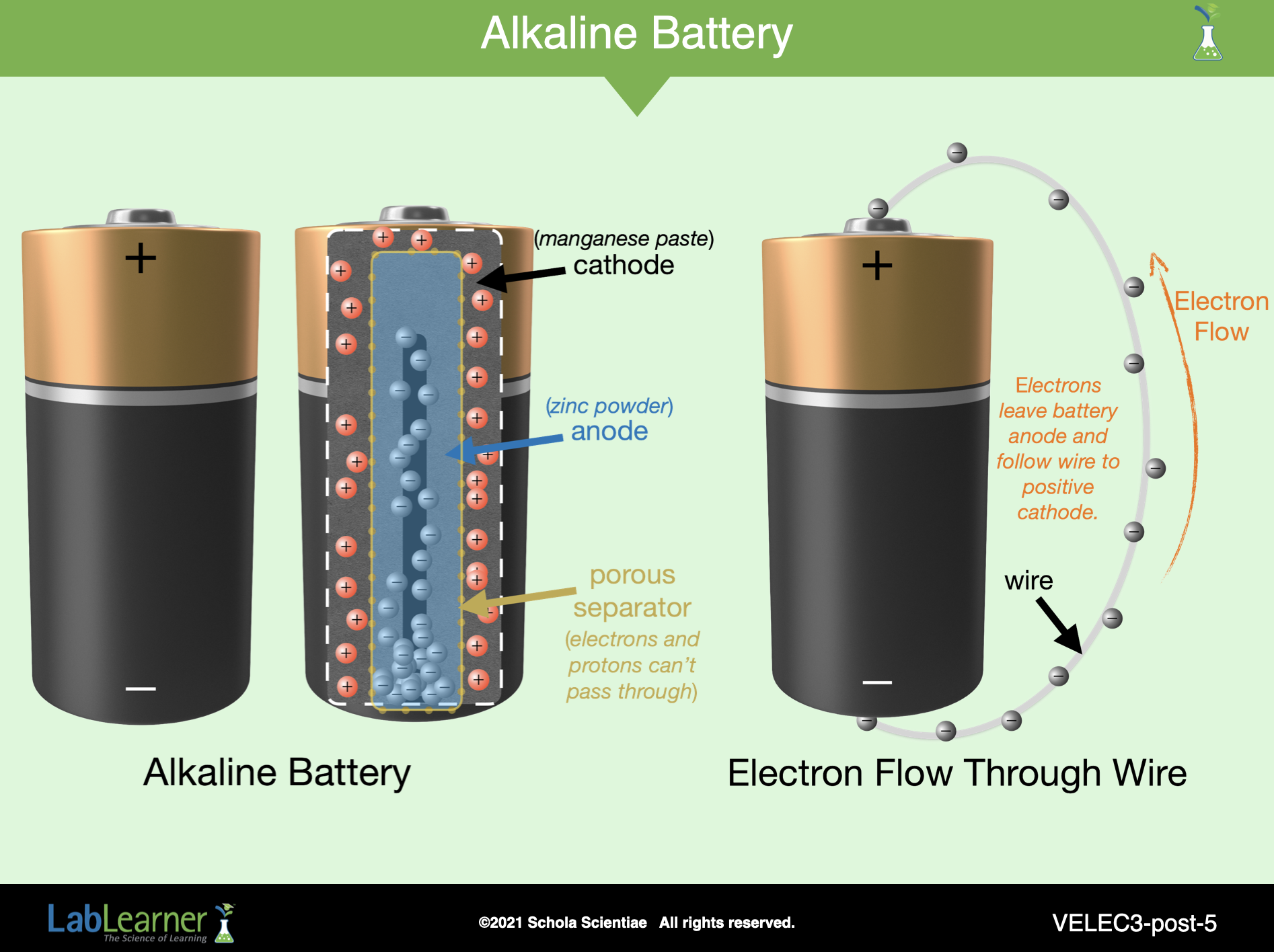
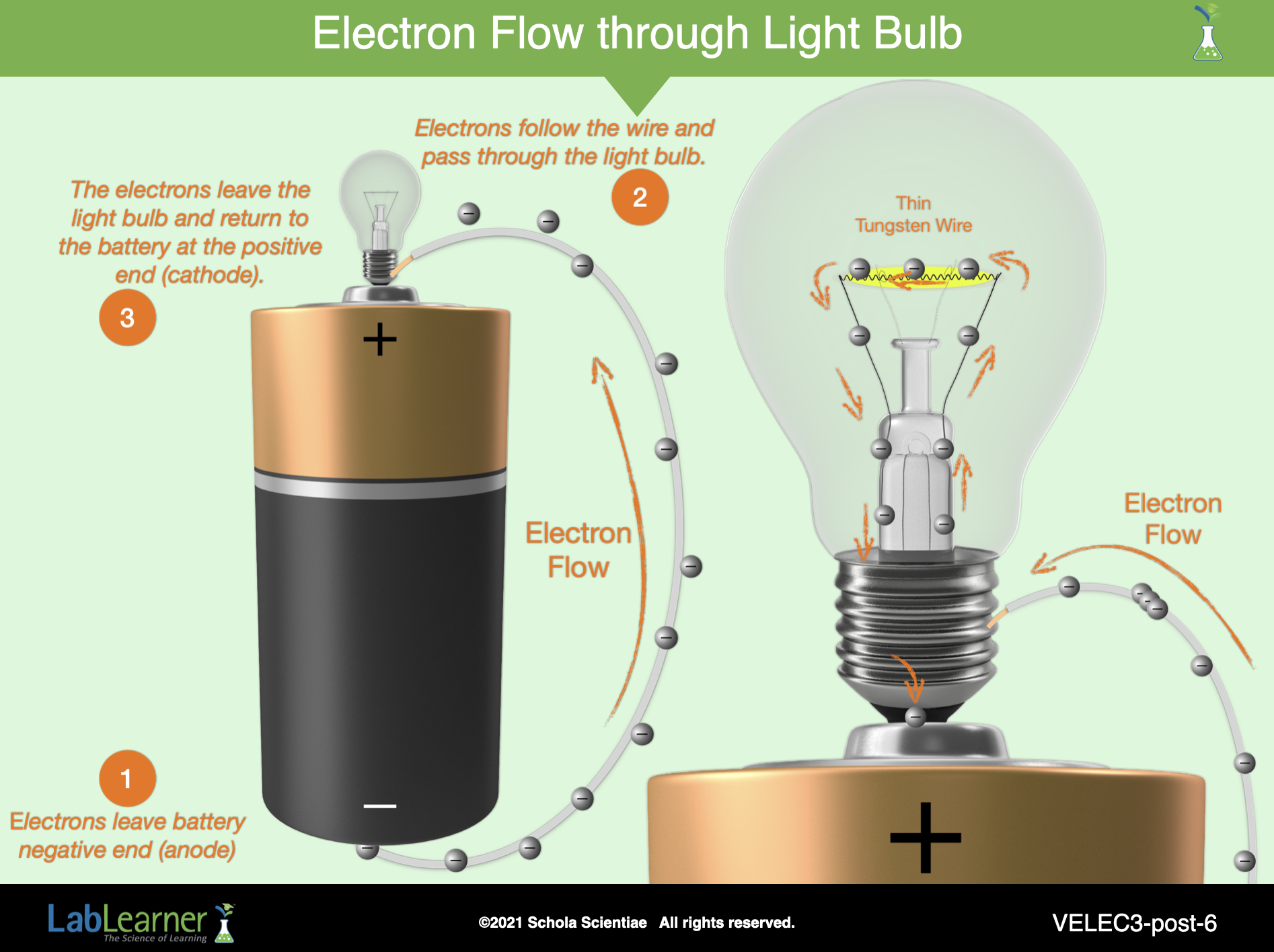
3. Explain how an alkaline battery is constructed using the information that follows. Use the illustration on this slide to indicate the flow of electrical current as you discuss this process. Direct the students to study the labeled Diagram in Problem 5 in their Student Data Record during the explanation.
A battery has an outer shell made of metal.
Inside the metal shell is a chemical paste. One of the chemicals in the paste is called manganese dioxide. The paste is connected to the positive terminal.
In the center of the battery is another cylinder with a chemical powder called zinc. The zinc powder is connected to the negative terminal.
Even though there are both negative and positive charges inside the battery, they cannot mix with each other because they are separated by a separator.
Therefore, for the negatively charged electrons to reach the positive particles within the battery itself, they must leave the battery through the negative end (the anode), pass through a complete circuit, and only then can they reach the positive terminal of the battery (the cathode).
______________________________________________
SLIDE VELEC3-post-6
4. Discuss with the class how an alkaline battery operates. Use this slide to indicate the flow of electrical current as you discuss this process. Instruct students to draw arrows on their Diagram as they follow along during the discussion.
• The manganese chemical paste and the zinc powder react.
• The reaction causes negatively charged electrons to be released from the liquid into the zinc powder at the negative terminal.
• When a complete circuit is created by connecting the negative and positive ends of the battery, electrons move in a current from the negative end to the light bulb and then to the positive end of the battery. As a result, the electrical current moves through the circuit.
• Tell students to draw arrows from the negative end of the battery to the positive end of the battery.
• At the positive end of the battery, the electrons in the current combine with the manganese rod. This reaction occurs very quickly.
5. Ask students: Why can batteries last for a long time if they are not used? When a battery is not in use, the chemical reaction occurs very, very slowly. It is only when the battery is part of a complete circuit that the reaction occurs quickly. If the battery is connected in a circuit for a long time, eventually the chemical reaction will slow and the battery will lose its ability to generate electrical current.
______________________________________________
SLIDE VELEC3-post-7
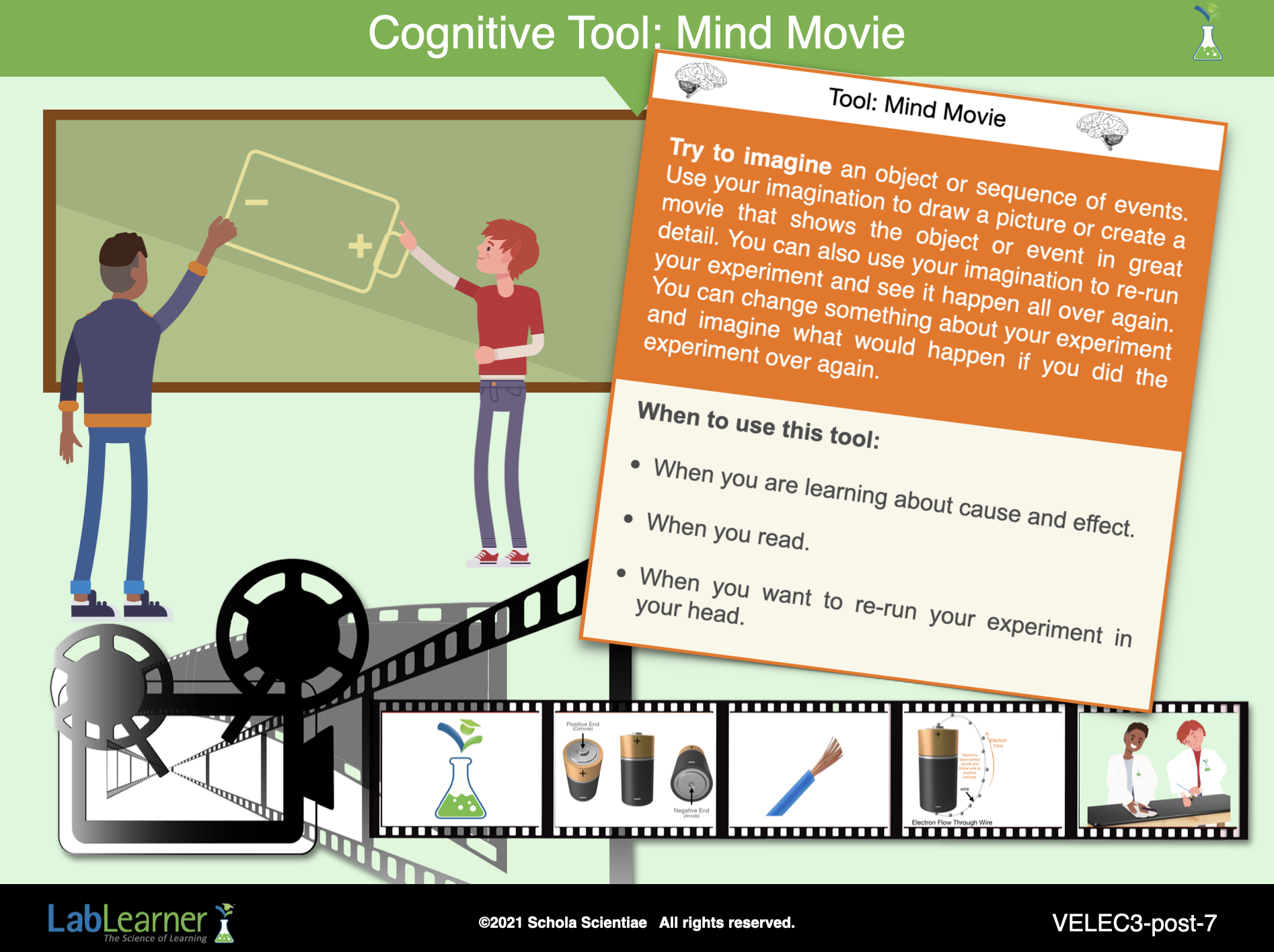
Tell students that now would be a good time to use the Cognitive Tool, Mind Movie to rehearse what they just learned about electron flow.
1. Tell students to imagine the battery, wire, and light bulb connected in a complete circuit. Students should close their eyes and visualize how the three components are connected.
2. Pose the following questions to students to help them create their Mind Movie. Encourage students to answer by imagining the events or even using their finger to trace the path along the imaginary circuit.
• Ask students: In your complete circuit, the wire is connected to the negative terminal of the battery. Where is the negative end? The negative end is at the bottom of the battery.
• Ask students: The wire leaves the negative end. Where does it go? It extends toward the light bulb and the positive end of the battery.
• Ask students: Where are the electrons moving in the wire? They are moving from the negative end to the light bulb.
• Ask students: Where is the positive end of the battery? The positive end is at the top of the battery.
• Ask students: How do the electrons travel around the circuit? Electrons move in a circle from the negative end through the wire to the light bulb, to the positive end of the battery, and then through the battery to the negative end.
______________________________________________
SLIDE VELEC3-post-8
E. Combine the information introduced to students about the construction and operation of a battery and electron flow with the concepts introduced during the Lab experiments.
1. Ask students: When a circuit is incomplete, can electrons move along a continuous path? No. If a circuit is broken at any point, the flow of electrons is halted.
2. Ask students: What is the source of the current electricity in homes and businesses? Can you think of other electrical sources? Student answers may vary. Power plants are the source of electricity for homes and businesses. Another source of electricity would be batteries.
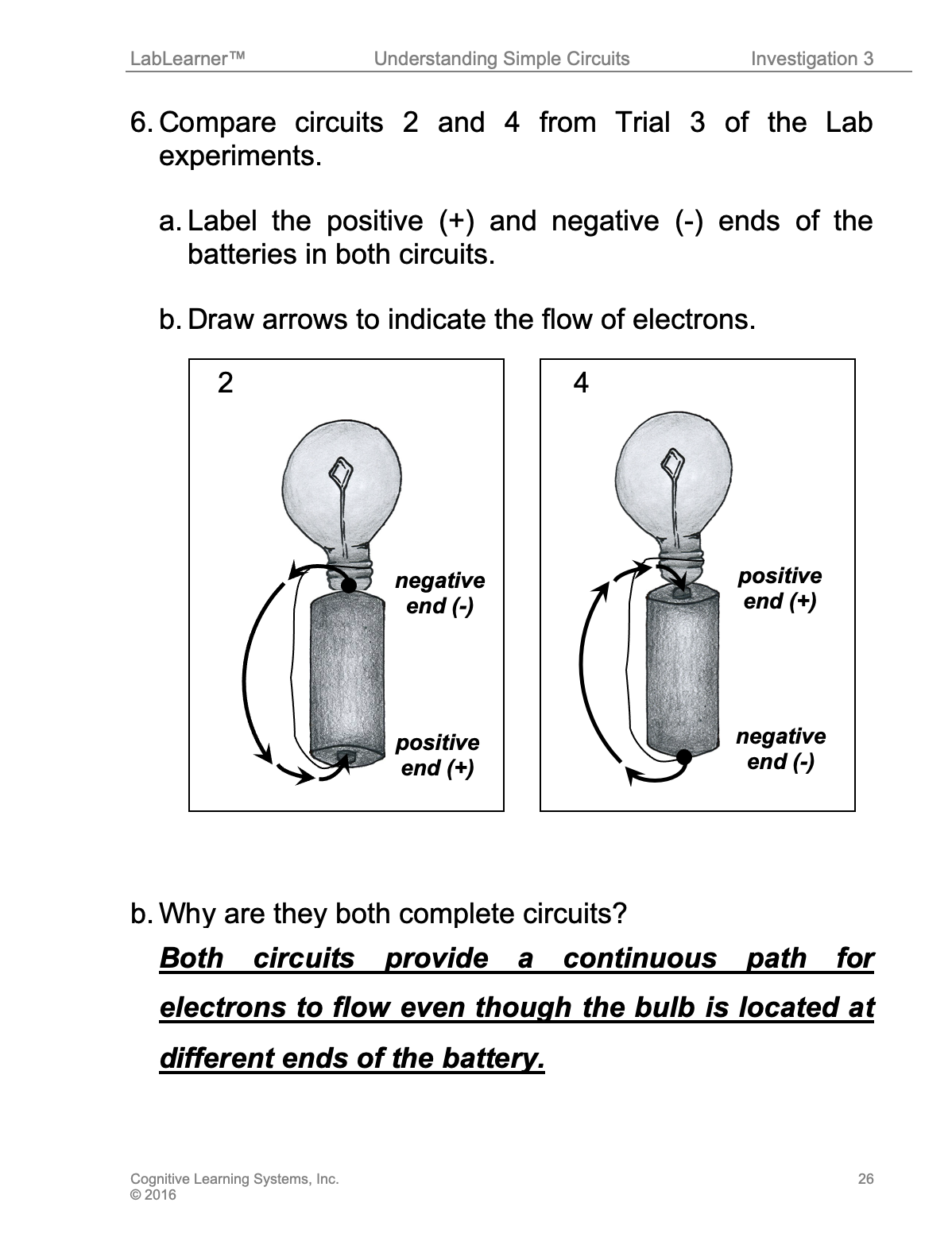
3. Ask students: In Trial 3, why were examples 2 and 4 complete circuits, even though they were different?
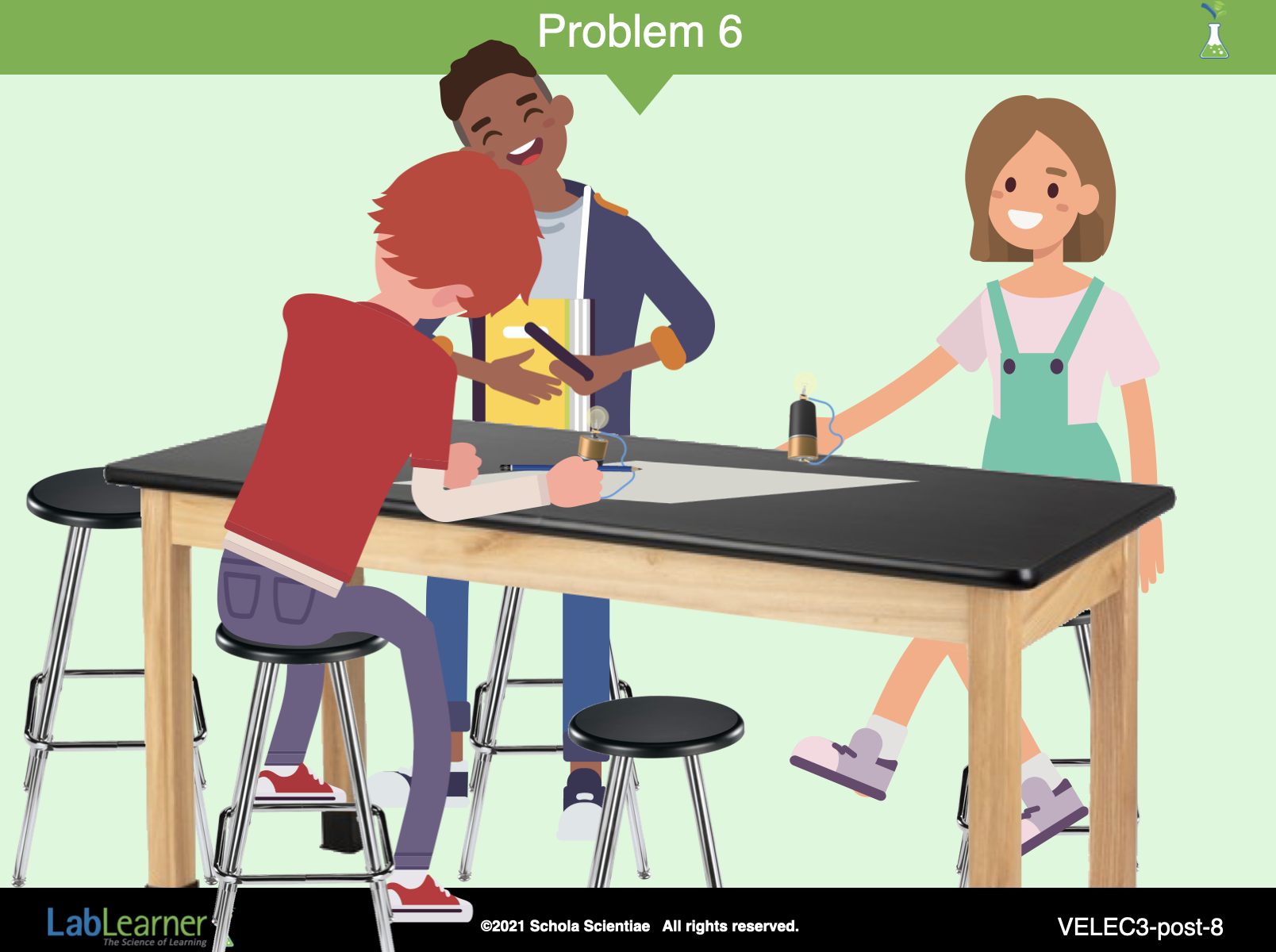
a. Divide the class into pairs and tell students to locate Problem 6 in their Student Data Record.
b. Direct students to draw arrows in both diagrams in problem 6a to indicate the flow of electrons through the circuits. Tell them to work with their partner to complete this task.
c. Encourage students to compare examples 2 and 4 and answer the question in Problem 6c.
d. Discuss the answer as a class. Both circuits provide a continuous path for electrons to flow even though the bulb is located at different ends of the battery.
______________________________________________
SLIDE VELEC3-post-9
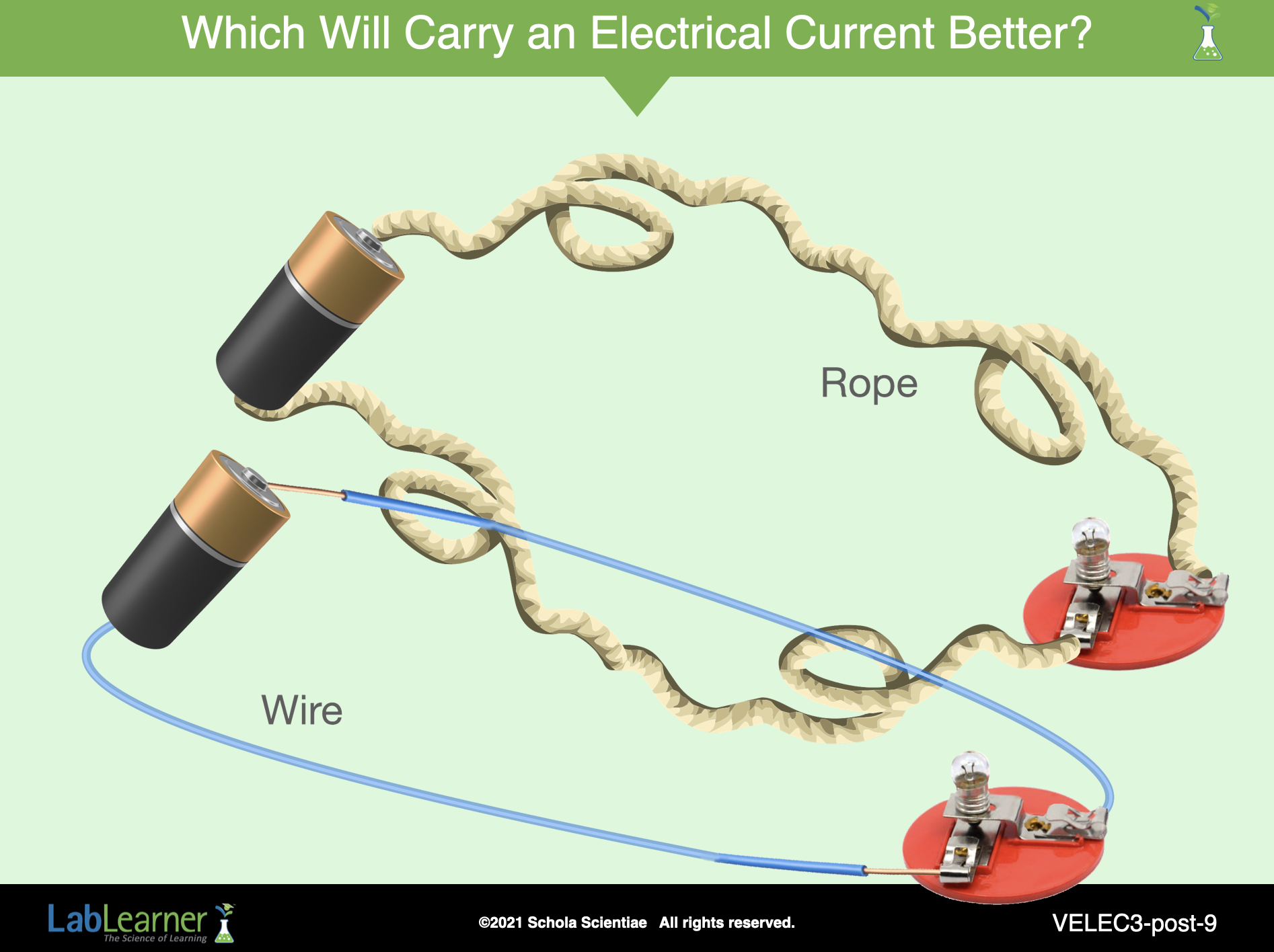
F. Conclude the Investigation by posing the question that follows about how circuits relate to the flow of electrons through different types of materials. Encourage students to think about this question before they begin Investigation Four.
Are there materials that allow electrical current to flow through them more easily than other materials?
KEYS: POSTLAB