
Teacher Portal:
Exploring Ecosystems
Investigation 4
Investigation Four: Environmental Pollutants
In the previous Investigations in this CELL, experiments were performed that were targeted toward increasing student understanding of the important interdependencies among organisms. Also discussed was the importance of interactions between organisms and the environment, how populations of animals and plants change as features of the environment also change, and how this process is termed natural selection. In this Investigation, Environmental Pollutants, these same themes will be considered but an emphasis is placed on the effect that man-made alterations to the environment have on organisms. In particular, the focus of the Investigation surrounds the concept of pollution.
Pollution is often defined as the addition of harmful or toxic materials into the environment. A pollutant is a substance that enters the environment and is harmful to the environment. While hundreds of different compounds may contribute to the pollution of the ecosystem, pollution is typically considered in three general categories; air pollution, land pollution, and water pollution.
Air Pollution
 Air pollution is caused by the release of particles and gases into the air. Since all organisms, both plants and animals, are dependent on air to support their most basic life processes, alterations in air quality are very dangerous. A major source of air pollution comes from the burning of fossil fuels, not only by big factories, but also by the millions and millions of automobiles in the world. Driving a car is an average citizen’s greatest contribution to air pollution, and almost everyone does it. Air pollution has been found to be implicated in global warming, as mentioned above, as well as in variety of human respiratory aliments and in the production of acid rain.
Land Pollution
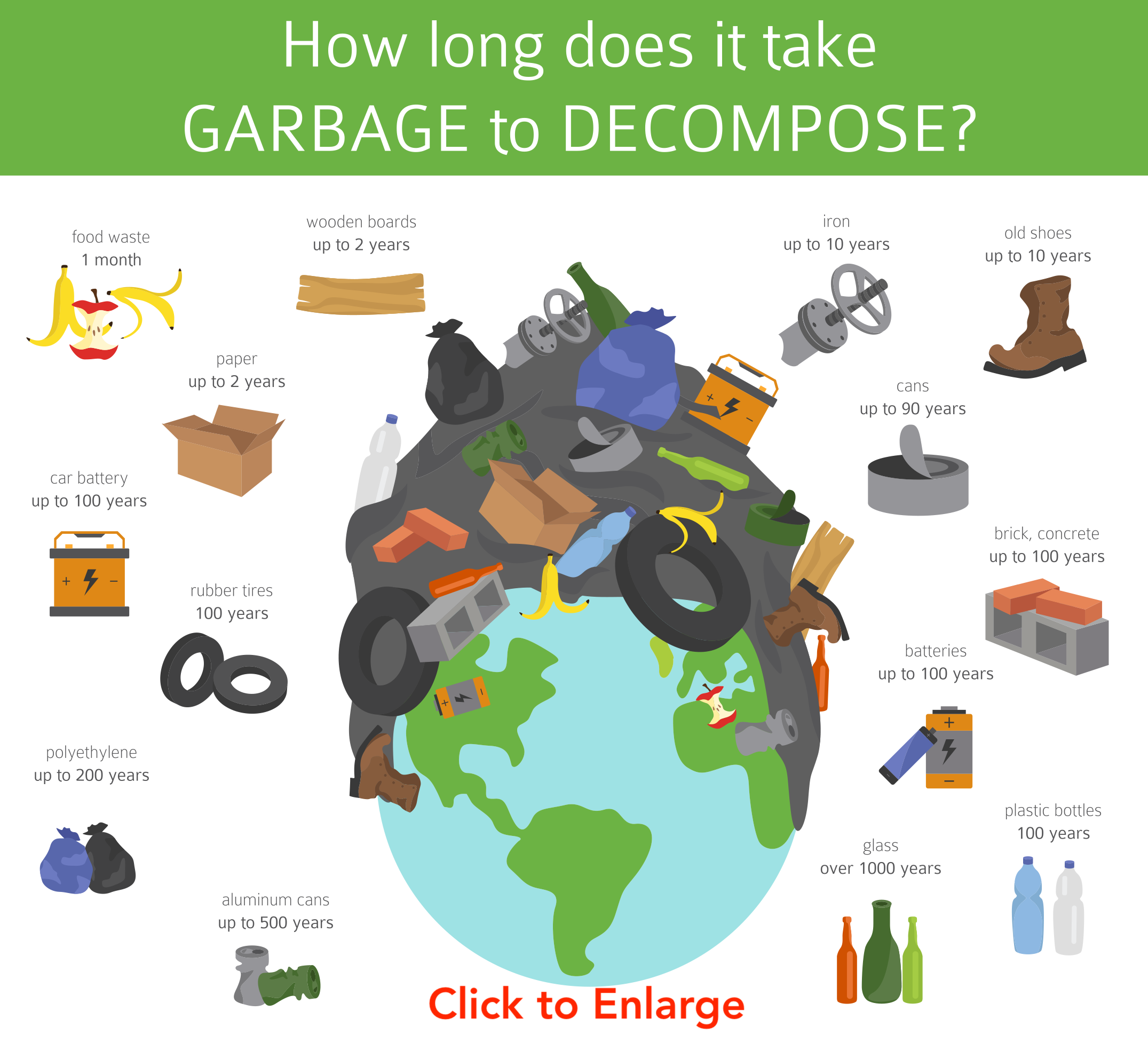 The second category of pollution is land pollution. The illustration shown here highlights one of the problems with land pollution in the form of garbage, landfills, and municipal and industrial dumping. That is, it takes a very long time for many items that we throw away every day to break down and decompose through natural processes. Look at the graphic, a car battery that reaches a garbage dump can take 100 years to decompose. Thus, these types of toxic land pollutants accumulate over many, many decades making the problem worse all the time.
While common “littering” is the most obvious form of land pollution, it is probably not the most harmful to the environment. More important is the addition of toxic materials to the soil. Sometimes waste motor oil, old paint, and turpentine are disposed of by pouring them onto soil or into shallow holes. While this form of disposal is no longer popular in our country anymore and is in fact illegal, a tremendous amount of these hazardous chemicals have been introduced into the soil over the years.
Another way such materials can pollute the soil is by dumping them in landfills that are then covered up and buried. Also, land and soil pollution can occur by leakage of petroleum or other chemicals from underground tanks or accidents at oil refineries, chemical manufacturing plants, or other places where large amounts of hazardous chemicals are manufactured or stored.
Regardless of how hazardous chemicals enter the soil, one of the most significant problems is that as rain percolates down through the soil, it can act to carry the chemicals into the groundwater. In turn, groundwater can carry the chemicals into wells, rivers, streams, lakes, and oceans, thus directly contributing to water pollution.
Water Pollution
 In addition to contamination from polluted groundwater, water pollution can also occur by direct dumping of harmful substances into natural bodies of water, or indirectly by water runoff from streets, fields, and other land sources after rainfall. Torrents of thousands of gallons of water pouring into just a single storm drain during heavy rain, gives an idea of the magnitude of the problem that runoff can become. An important concept built into this investigation is that pollutants introduced into the ecosystem do not stay in one place long, but quickly spread. It also emphasizes the interdependence of land, fresh water, and salt water system. In this Investigation, students will construct a model that clearly shows how pollutants applied to land quickly find their way into lakes and oceans.
Students may not realize the variety of substances that may be classified as, or may impact the environment as, pollutants. For example, fertilizer run-off from farms and lawns constitutes a major danger for rivers 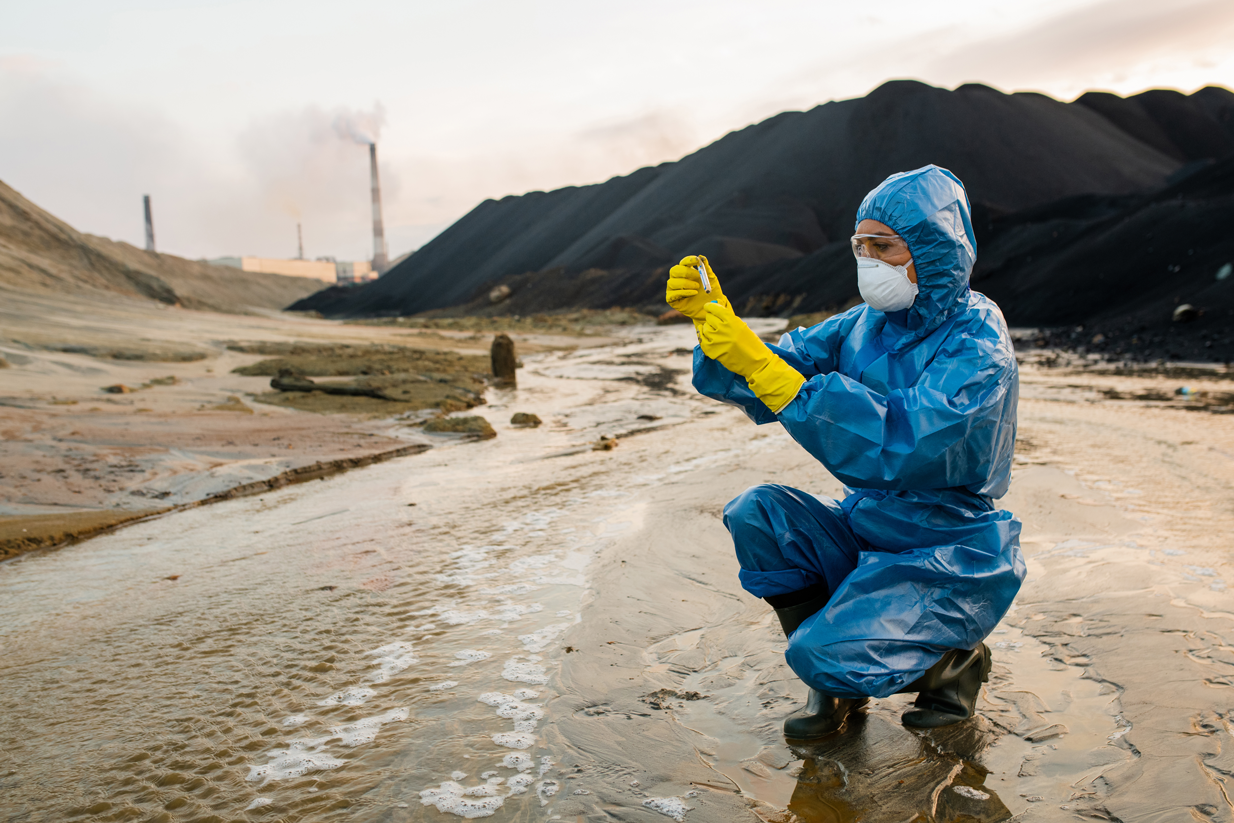 and lakes. This is because upon entering natural bodies of water, fertilizers can cause “blooms” of algae (small one-cell plants) to develop, with sometimes devastating consequences. Phosphate detergents can have the same effect if released into natural bodies of water. The phosphate in the detergent acts as a fertilizer to aquatic algae and causes large blooms.. However, because of the common existence of positive connotations towards fertilizers (which make things grow) or detergents (which get things clean), students may not realize that such substances can be harmful to the environment. The source of such confusion is often apparent when students equate the terms “pollutant” and “toxic.” While fertilizers and phosphate detergents certainly can act as pollutants and pollute and harm the environment, they are not necessarily “toxic”. In fact, students may site the beneficial value of either of these compounds to man. Therefore, in our definition of a pollutant, we must include non-toxic, or even otherwise beneficial agents, if their accidental release into the ecosystem results in harmful environmental changes.
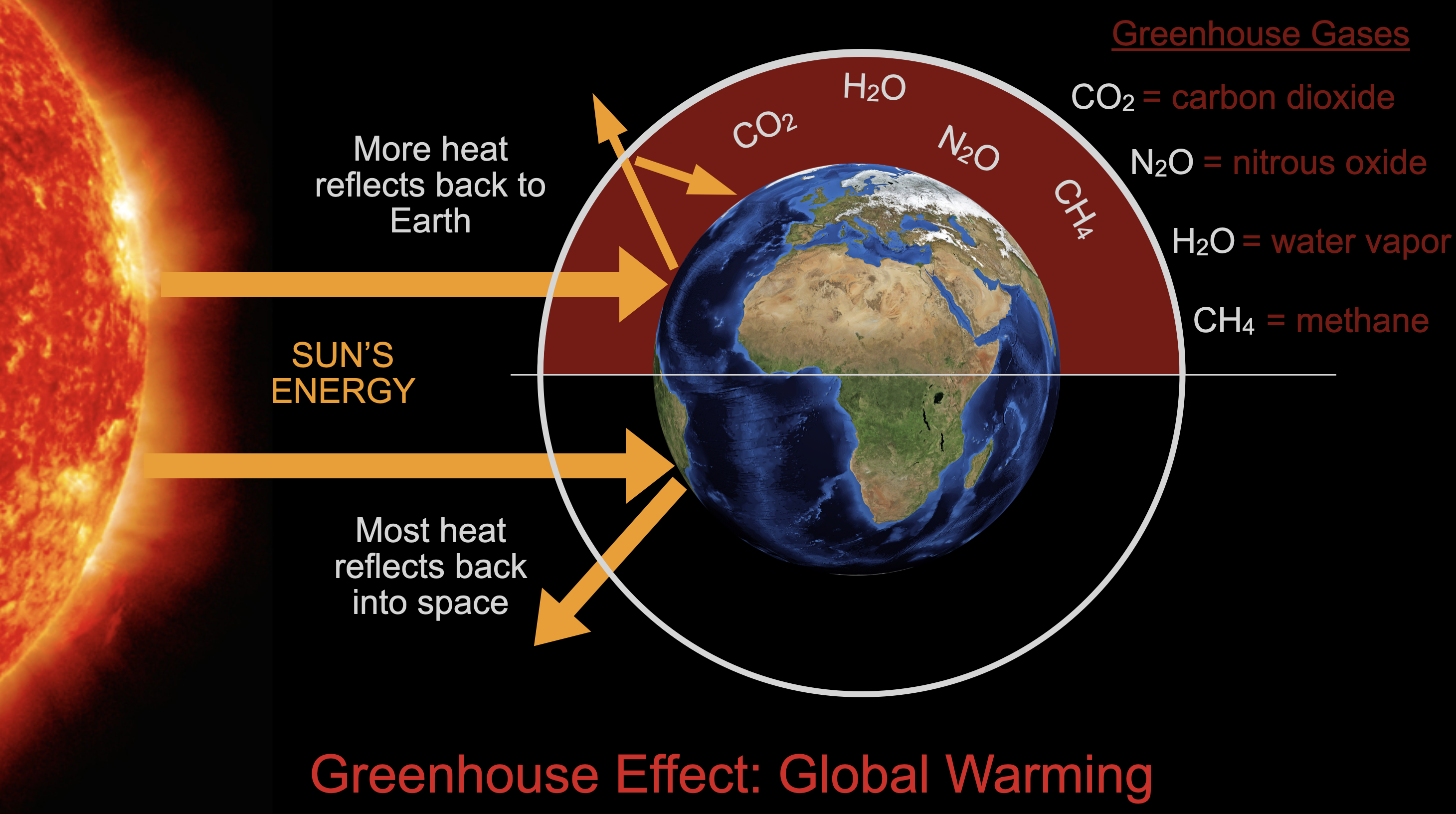
A further cause for confusion among students may arise when they consider that agents or compounds that are said to pollute the environment are actually compounds that occur in the environment naturally. One good example of this is carbon dioxide (CO2). CO2 is a component of every breath we and all other animals exhale. It is a normal component of air and is essential for plants to photosynthesize. Yet, students may hear that CO2 is a pollutant, which it is. CO2 is one of the breakdown products when fossil fuel is burned and is considered one of the “greenhouse gases” by the U. S. Environmental Protection Agency. Along with other gases released from fuels and other pollutants, it acts to trap the Earth’s heat and may contribute to global warming.
Students may thus bring a narrower or alternate definition of pollutant with them as they approach this investigation. It is encouraged that pollutant be defined as a man-made or naturally occurring substance, either directly toxic or non-toxic, that when released into the ecosystem in high enough concentrations can produce harmful environmental changes.
Exploring Ecosystems: Investigation 4-Mathematics Concepts
Prelab
- grouping/classifying
- greater than/less than/equal to
- data table
- whole numbers
- volume in mL
- problem-solving
Lab
- greater than/less than/equal to
- volume in mL
- data table
- addition
- problem-solving
Postlab
- volume in mL
- problem-solving
Exploring Ecosystems: Investigation 4 - Procedural Tools

The design of this Investigation does not include a focus on student work with tools from the Procedural Toolbox.
Exploring Ecosystems: Investigation 4 - Cognitive Tools

Exploring Ecosystems:
Investigation 4 Quiz

