Teacher Portal:
Exploring Ecosystems
Investigation 4 – PreLab
 PRINT IT
Use your browser to download a printable PDF as help during the slide presentation and to make additional notes. In your browser, go to File > Print and then choose to save as PDF.
MINDSET
This Investigation is designed to:
- offer students an opportunity to simulate the impact of pollutants on the environment.
- help students understand how pollution in one area of the environment can have effects in other areas.
- increase student understanding of how pollution can negatively impact humans.
- allow students to practice communicating and interpreting experimental results.
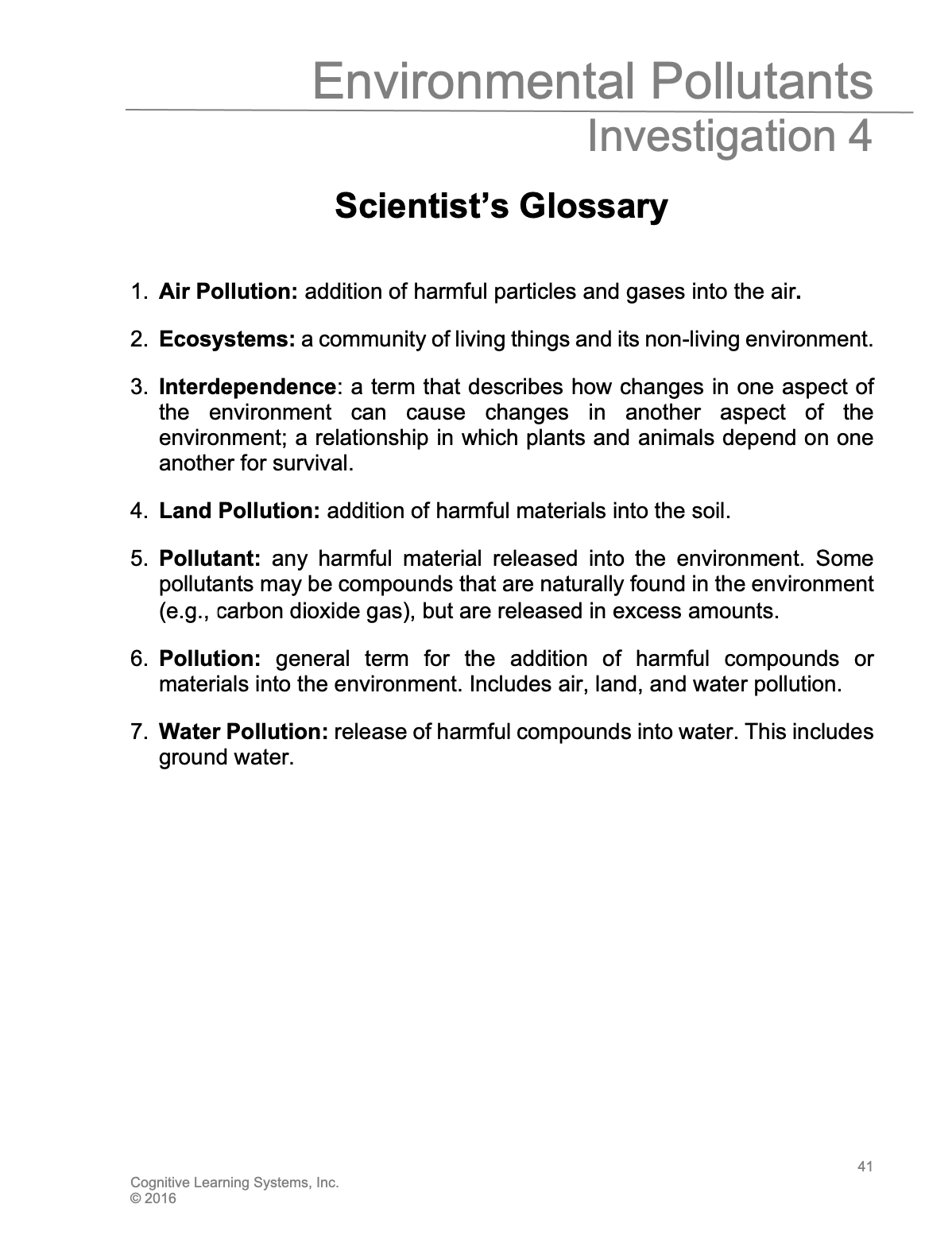
SCIENTIST’S GLOSSARY
1. Air Pollution: the addition of harmful particles and gases into the air.
2. Ecosystems: a community of living things and their non-living environment.
3. Interdependence: a relationship in which organisms depend on one another in order to survive; a term used to describe how changes in one aspect of the environment can cause changes in another aspect of the environment.
4. Land Pollution: the addition of harmful materials into the soil.
5. Pollutant: any harmful material released into the environment. Some pollutants may be compounds that are naturally found in the environment (e.g. carbon dioxide gas) but are released in excess amounts.
6. Pollution: general term for the addition of harmful compounds or materials into the environment. Including air, land, and water pollution.
7. Water Pollution: release of harmful compounds into water. This includes groundwater.
BE PREPARED
Watch the Investigation 4 Teacher Video and Student Video below to prepare for the PreLab.
SET FOR SUCCESS
- Tell students that they are continuing their study of the Exploring Ecosystems CELL.
- Ask students to share the kinds of things they might learn in these Investigations.
Begin the PreLab Concept Slides to start students on their learning journey. Then watch the Pre-Lab Student Video afterward as a class.
NAVIGATE IT
Once the slide presentation is launched
- use your left and right arrows to advance or go back in the slide presentation, and
- hover your mouse over the left edge of the presentation to get a view of the thumbnails for all the slides so that you can quickly move anywhere in the presentation.
- Click HERE to launch the slide presentation for the CELL.
SHARE IT
SLIDE VECO4-pre-1
This is the fourth Investigation of the LabLearner CELL Exploring Ecosystems. In it, students will explore the impact of environmental pollutants on plants and animals in an ecosystem.
______________________________________________
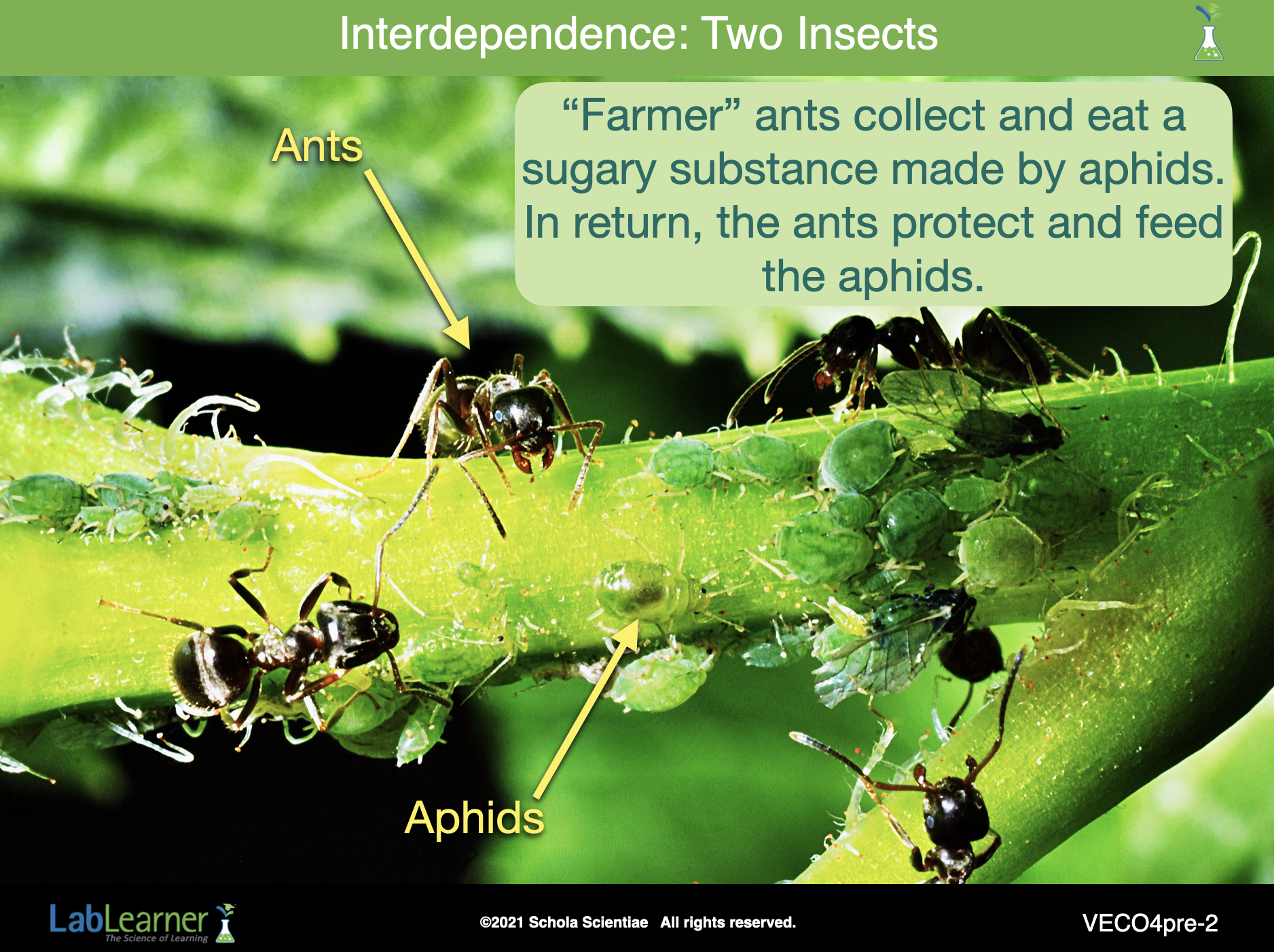
SLIDE VECO4-pre-2
A. Begin with a class discussion aimed at exploring the meaning of the word “interdependence”. Introduce the term after ensuring that students understand the concepts of “dependence” and “independence”.
1. Ask students: Can you think of a definition of the term “independence”? Student answers may vary. Students may recall the July 4th holiday as the day when American Independence is celebrated. Guide students to consider independence as being free from needing others in order to survive.
2. Ask students: Can think of a definition of the term “dependence”? Student answers may vary. Students may recall that babies and young children are dependent on others in order to survive and receive food, water, and shelter. Guide students to consider dependence as needing others in order to survive.
NOTE: This slide shows an example of interdependence between a species of ants and the smaller aphids. Aphids produce an energy-right sugary substance that the ants collect and use to help feed the ant colony. In return, the ants care for the aphids by protecting them. These species of ants and aphids are interdependent on each other.
3. Ask students to recall the previous Investigations. The following questions should facilitate students recognizing that organisms are not independent of one another, and yet are not necessarily entirely dependent on one another for basic needs such as shelter.
a. Tell students to recall the food web.
Ask students: Are the animals in the food web independent from one another? Do they need each other to exist in order for them to survive? Students should recall that animals and plants are not independent from one another. Herbivores require producers (plants) in order to survive, and carnivores require herbivores in order to survive.
b. Ask students: Are the animals in a food web dependent on one another for survival?Student answers may vary. Guide students to realize that the animals of different types (species) are not directly dependent on one another for survival but acknowledge student answers in which a form of dependence is described. However, animals are independent in general terms, for example, adult foxes are capable of finding their own food, water and shelter.
c. Tell students to recall the experiment from the previous Investigation where the survival and extinction rates of birds were modeled.
Ask students: Were the birds dependent or independent on one another? Students should describe independence between types of birds, since the amount of food that a particular type of bird obtained for any given Trial was not contingent or related to the amount of food that any other type of bird had obtained during that Trial.
d. Guide students to realize that the birds were dependent on particular aspects of the environment, namely, the type of food source and the relative amount of that food source that was available. Therefore, the organism was dependent on the amount of food available. However, if this scenario was borne out in real life, producers would as a species be somewhat dependent on the birds because birds would eat and carry the seeds across a distance, thereby allowing the population of a plant to spread. This type of mutual dependence is an example of interdependence.
______________________________________________
SLIDE VECO4-pre-3
B. Continue the discussion by conducting a brainstorming activity in which groups of students generate examples of how organisms are interdependent on one another within an ecosystem.
1. Direct students to locate their Scientist’s Glossary and review the definitions of interdependence and ecosystem as a class:
Interdependence: a relationship in which organisms depend on one another in order to survive; a term used to describe how changes in one aspect of the environment can cause changes in another aspect of the environment.
Ecosystem: a community of living things and their non-living environment.
2. Divide the class into collaborative groups. Challenge the groups to think of examples of changes that may take place in an environment.
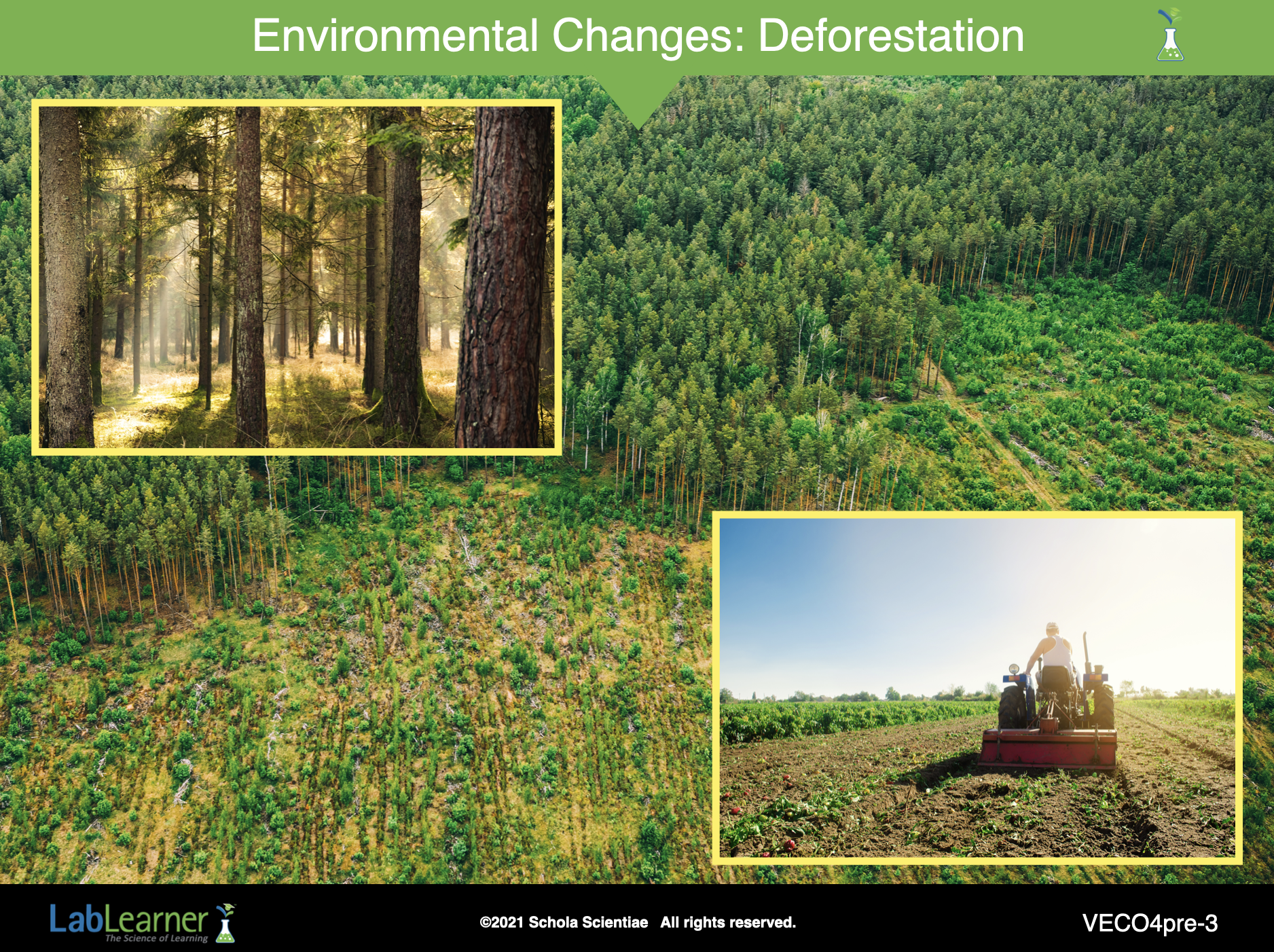
NOTE: The example shown on this slide is of cutting down large areas of trees to make farmland. The two inserts show vastly different ecosystems.
To facilitate the activity, generate some examples as a class and note them on the board. Samples are listed below:
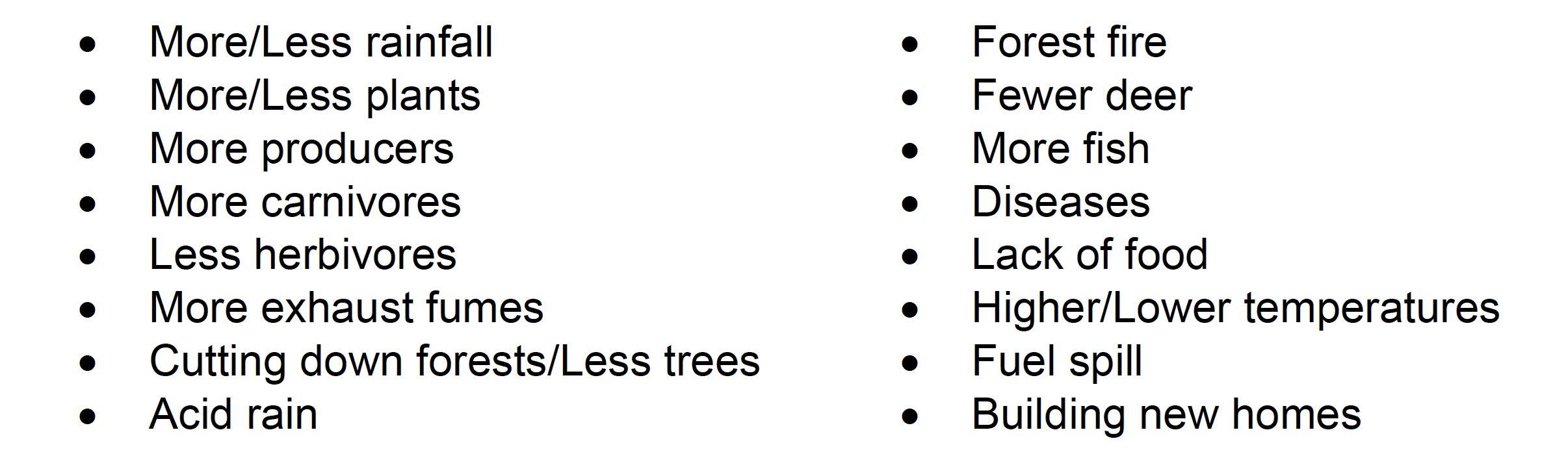
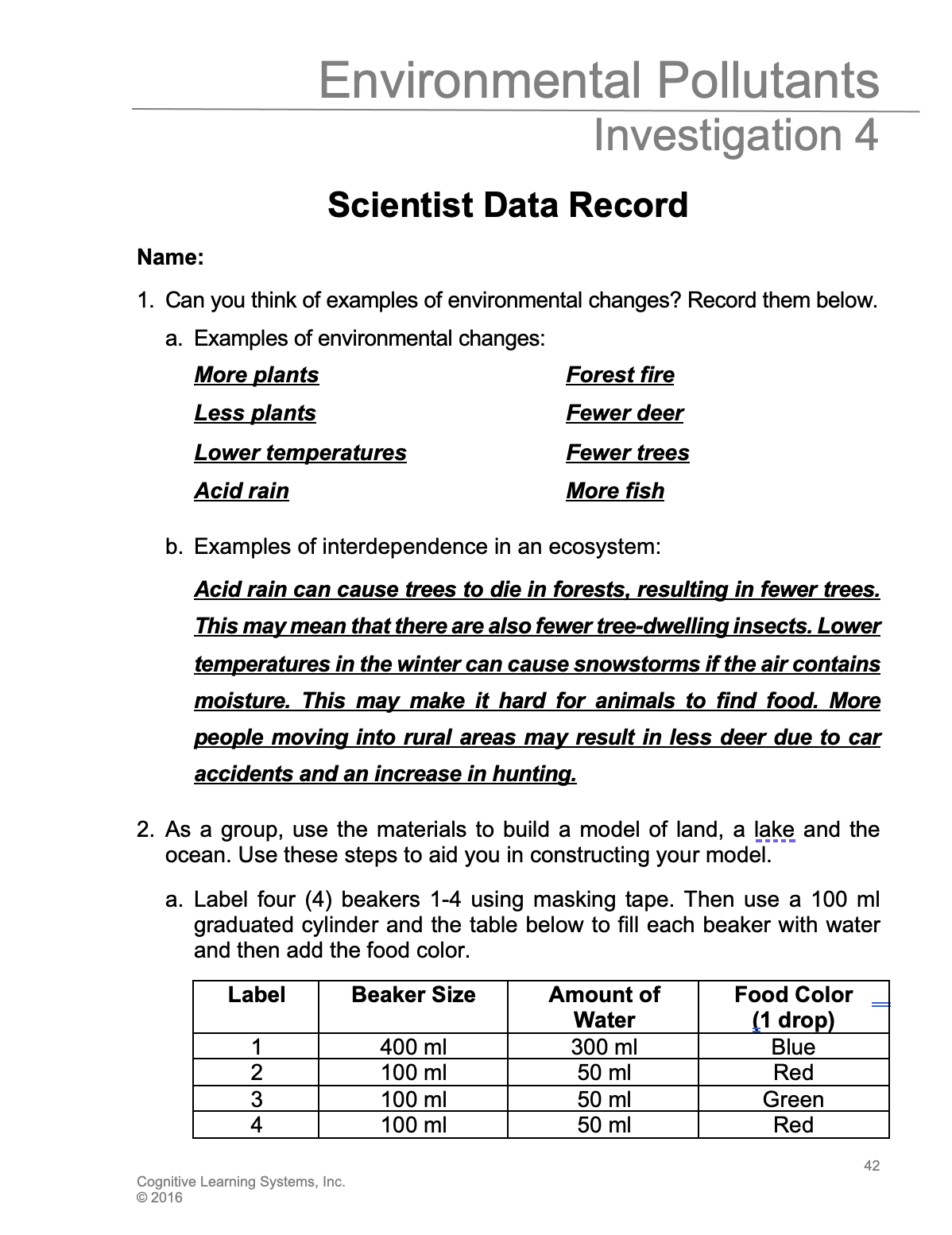
3. Allow an additional period of time for students to generate their answers and record them in Problem 1a in the Student Data Record. Ask groups to share their answers. Record them on the board.
4. Challenge the groups to think of relationships that may exist between any two examples. Tell students that they should create sentences that demonstrate examples of interdependence in an ecosystem. Allow students approximately 5 minutes to discuss and compose their sentences. Direct students to record their examples in Problem 1b in the Student Data Record.
5. Discuss answers as a class and record sample answers on the board.
______________________________________________
SLIDE VECO4-pre-4
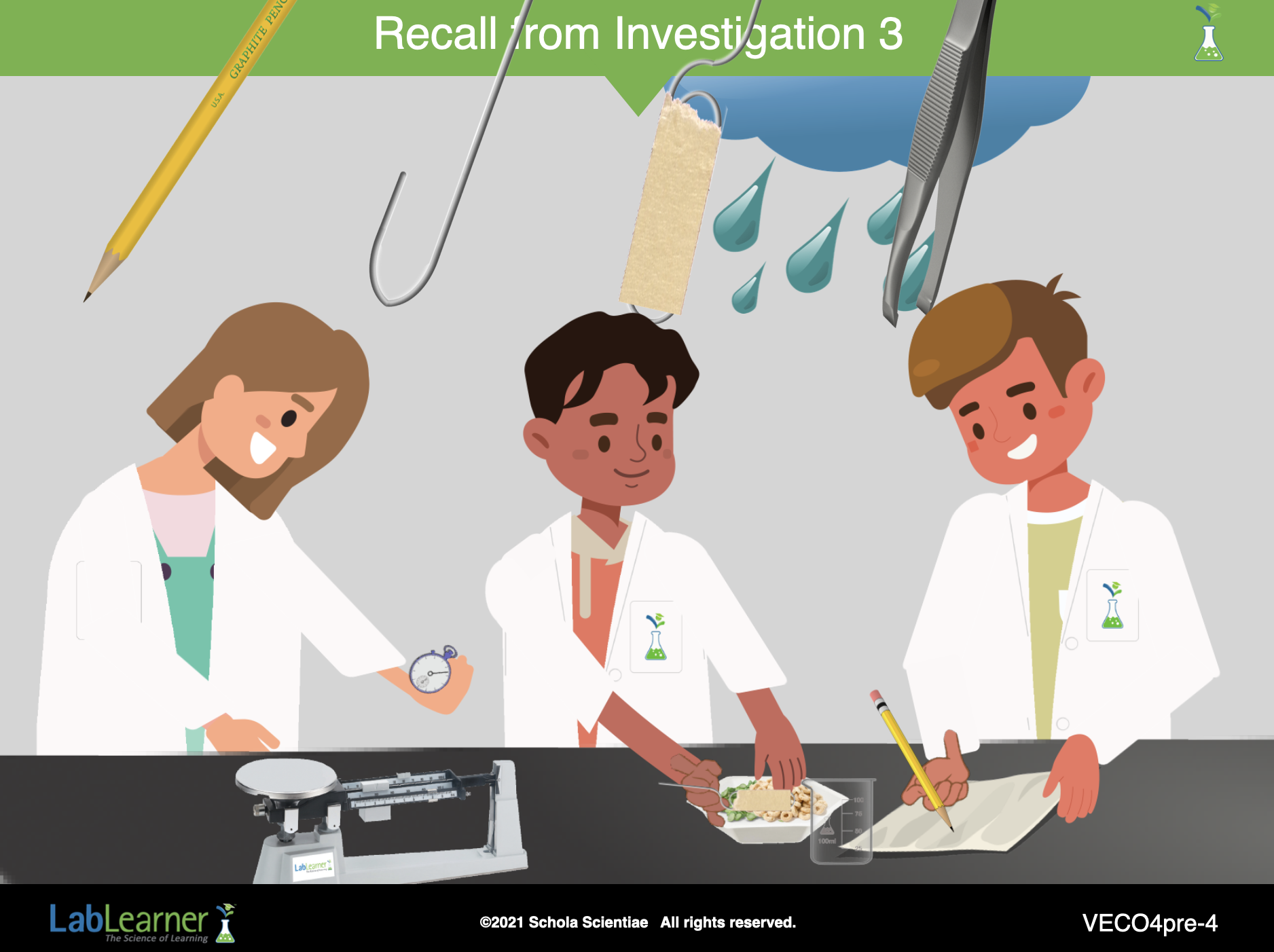
6. Remind students of the interdependence of the rainfall, pea, and oat cereal, and feeding of the Pencil-, Hook-, Scoop-, and Forceps beak birds model in Investigation Three.
This model demonstrated the interdependence of rainfall and survival of various kinds of birds that were in turn interdependent upon the effect of the rainfall on the production of the birds’ food supply.
Another example of interdependence in the ecosystem would be that the survival of deer is dependent upon the severity of winter temperatures, while the survival of wolves that feed on the deer is dependent on the number of deer that survive.
Discuss how one aspect of an ecosystem affects others. Rarely does anything happen in the ecosystem, either biological (e.g. plant and animal related) or physical (rainfall, temperature, volcanoes, etc.), that does not impact other parts of the ecosystem.
______________________________________________
SLIDE VECO4-pre-5
C. After a discussion of “interdependence”,
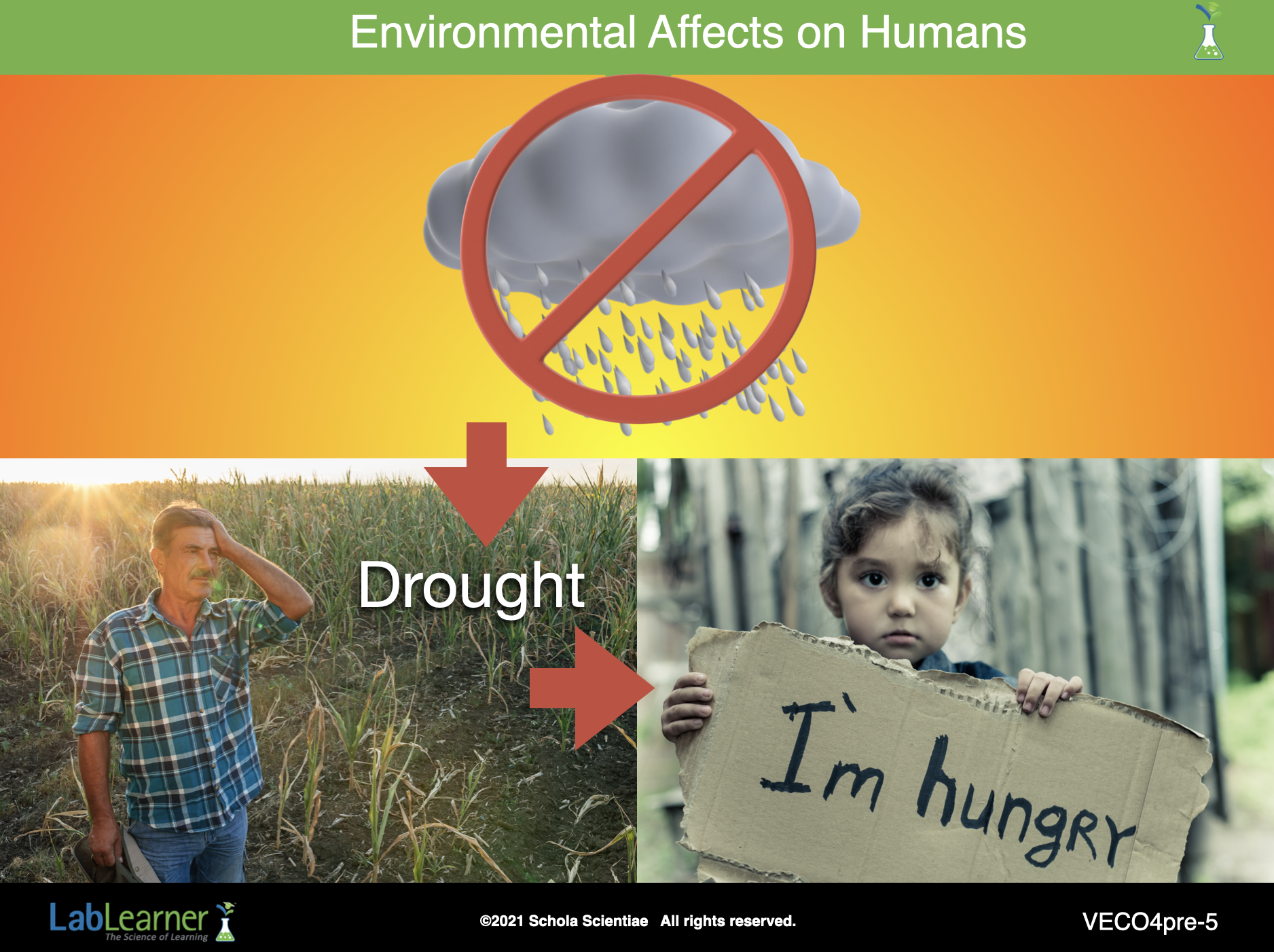
Ask students: Do you think that the environment can affect us, as human beings? Student answers will vary. Discuss the impact shown in this example of how low rainfall for extended periods of time (drought) can harm crops, and lead to human hunger.
Ask students: Can you think of other ways potential ways environmental changes can affect students? Student answers will vary.
Some examples are listed below:
- A high amount of rainfall may increase the number of mosquitoes in the summer: more bug bites!
- A low amount of rainfall may make some crops small: no corn on the cob!
- Mild winters may increase the deer population as a result of more deer running onto highways and being hit by cars, possibly hurting the riders.
- High levels of precipitation during the winter in northern climates may result in many “snow days” off school. However, these days may be added on to the end of the year and “put off” summer vacation!
- The smoky exhaust fumes billowing from a truck or car may cause eyes to become irritated (burn) or make one cough.
______________________________________________
SLIDE VECO4-pre-6
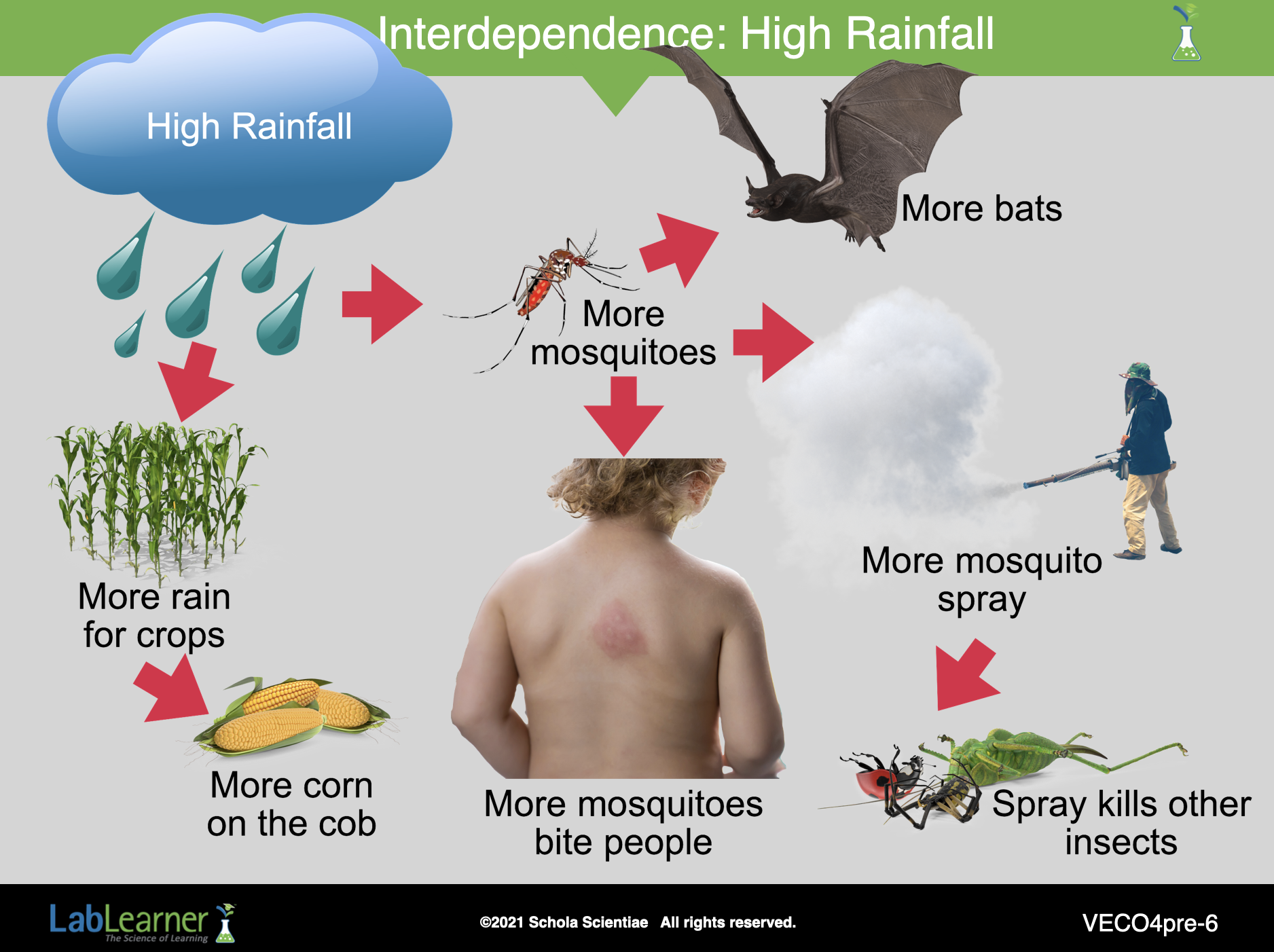
1. As a class, examine the interdependence of effects shown on this slide. For example, a high amount of rainfall may not only prevent drought and increase crops, it can also increase the number of mosquitoes in the summer. This, in turn, may cause further effects. For example, more people may be bitten by mosquitoes. As a class, discuss other potential effects of more mosquitoes.
2. Point out to students that in addition to the effect of “High Rainfall” on “More Mosquitoes,” “High Rainfall” also has the effect of providing “More Rain for Crops.”
Ask students: Can you think of more examples of impacts of High Rainfall besides increasing crops and the mosquito population? Student answers may vary. Examples might include flooding, having to play inside, more runoff pollution, and so on.
______________________________________________
SLIDE VECO4-pre-7
D. Discuss interdependence in the context of the effects of an environmental change that causes harm, namely pollution.
1. Direct students to locate their Scientist’s Glossary. Ask for a volunteer to read the term pollution.
Pollution: general term for the addition of harmful compounds or materials into the environment. Includes air, land, and water pollution.
2. Ask students: Is pollution related to the interdependence of organisms in an environment? How? Student answers may vary. Students may realize that many of the examples they have generated are examples of pollution. For example, a fuel spill or an increase in the amount of insecticide present in the atmosphere are types of pollution. The smoke produced by a large forest fire is a form of pollution.
3. As a class, read the definitions of Air Pollution, Land Pollution, and Water Pollution:
Air Pollution: the addition of harmful particles and gases into the air.
Land Pollution: addition of harmful materials into the soil.
Water Pollution: release of harmful compounds into water. This includes ground water.
Return to the examples generated in Problems 1a and 1b in students’ Student Data Record and classify each example of pollution as being air, land or water pollution.
Ask students to place a subscript “a” “l” or “w” to denote each type.
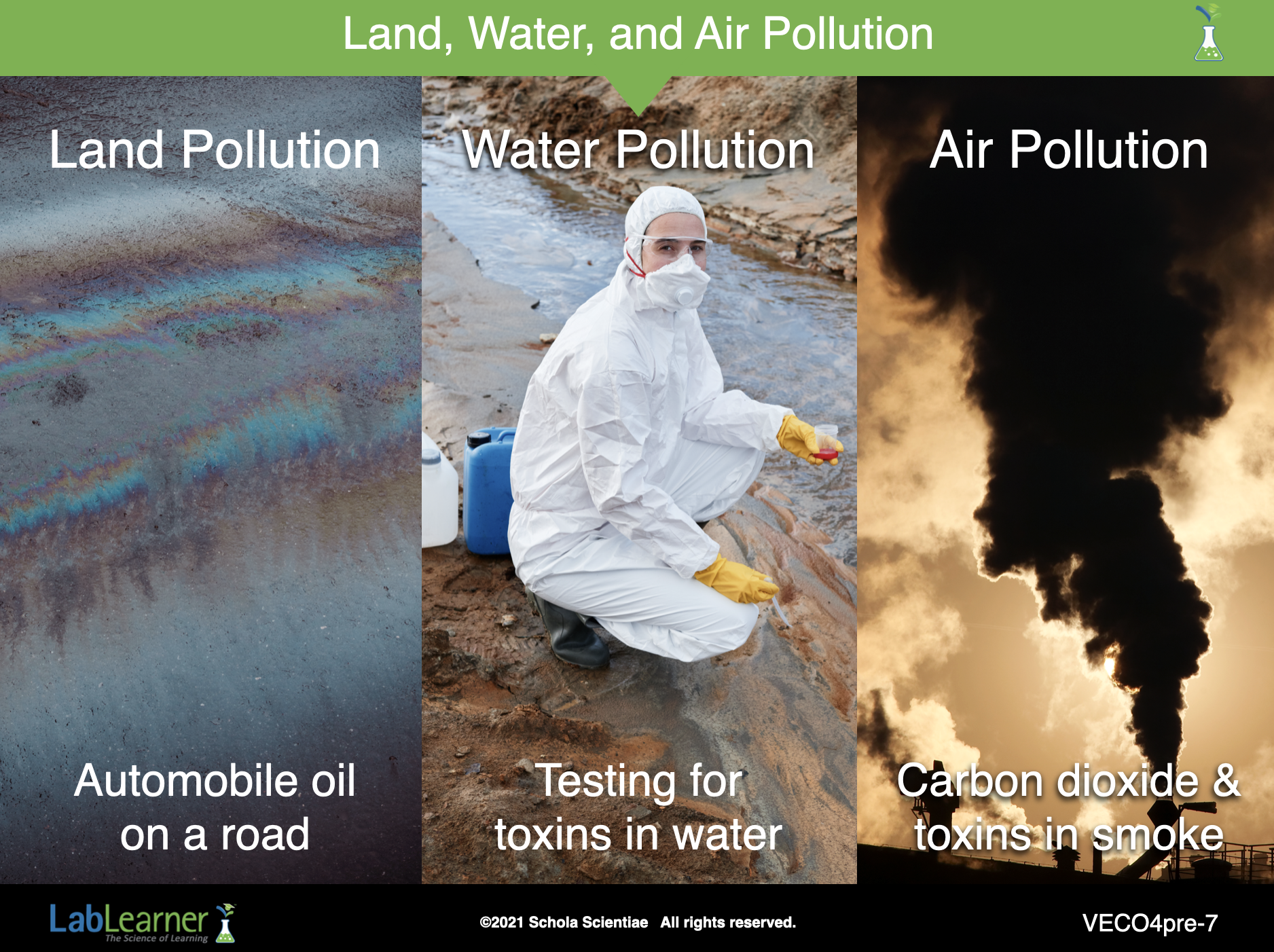
Note: Students may have difficulty deciding if some types of pollution are exclusively members of one category of pollution or another. For example, acid rain may be classified as air pollution but it is carried in water, and therefore students may wish to describe it as water pollution. Permit this discussion, should it occur, since the idea that pollution that begins on land can travel into water, or pollution that begins as air pollution but then polluted the land, is central to the focus of the investigation. The example of land pollution shown on this slide depicts oil on an asphalt pavement, but this oil will wash into the surrounding soil with the next rain.
______________________________________________
SLIDE VECO4-pre-8
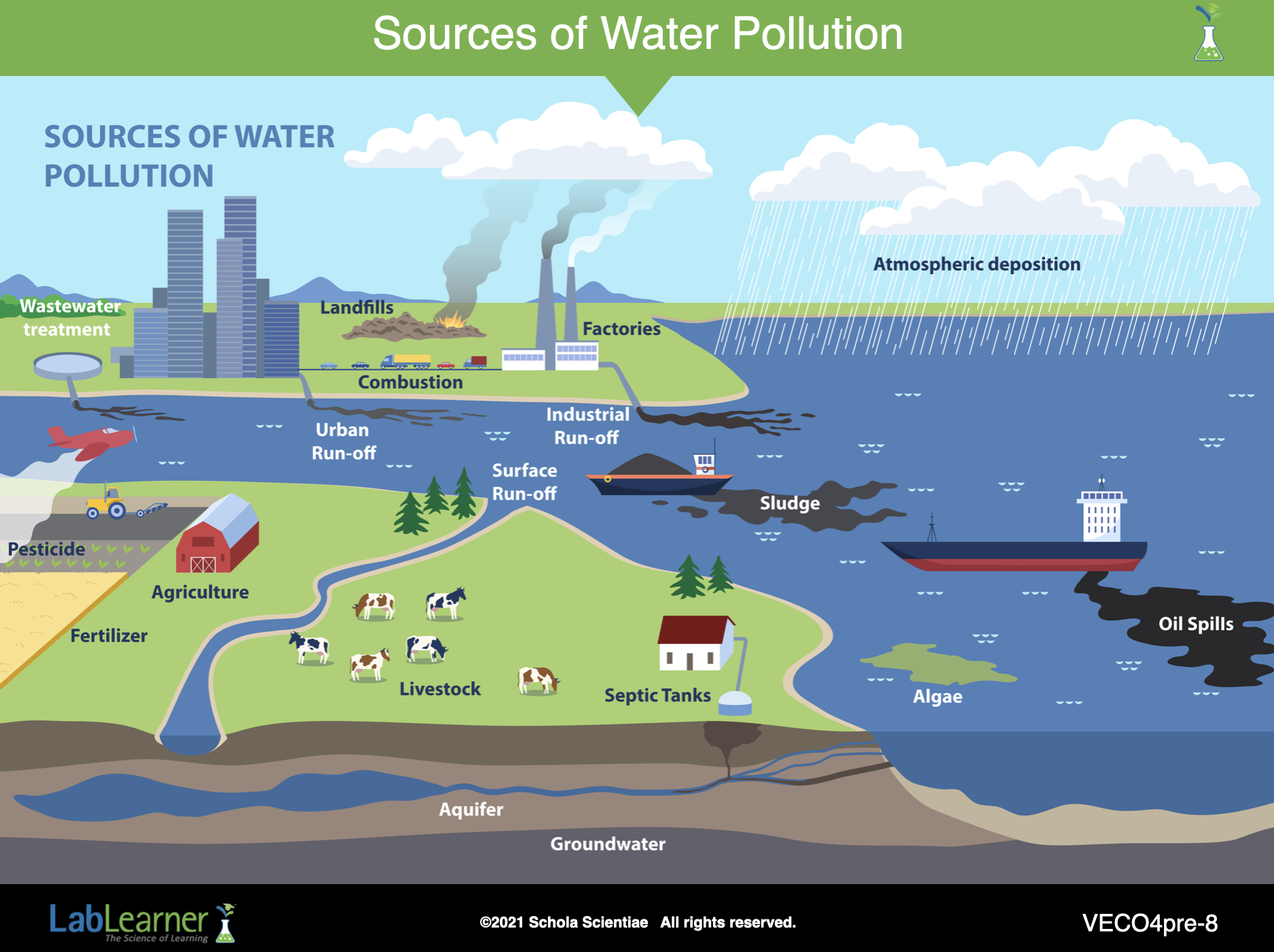
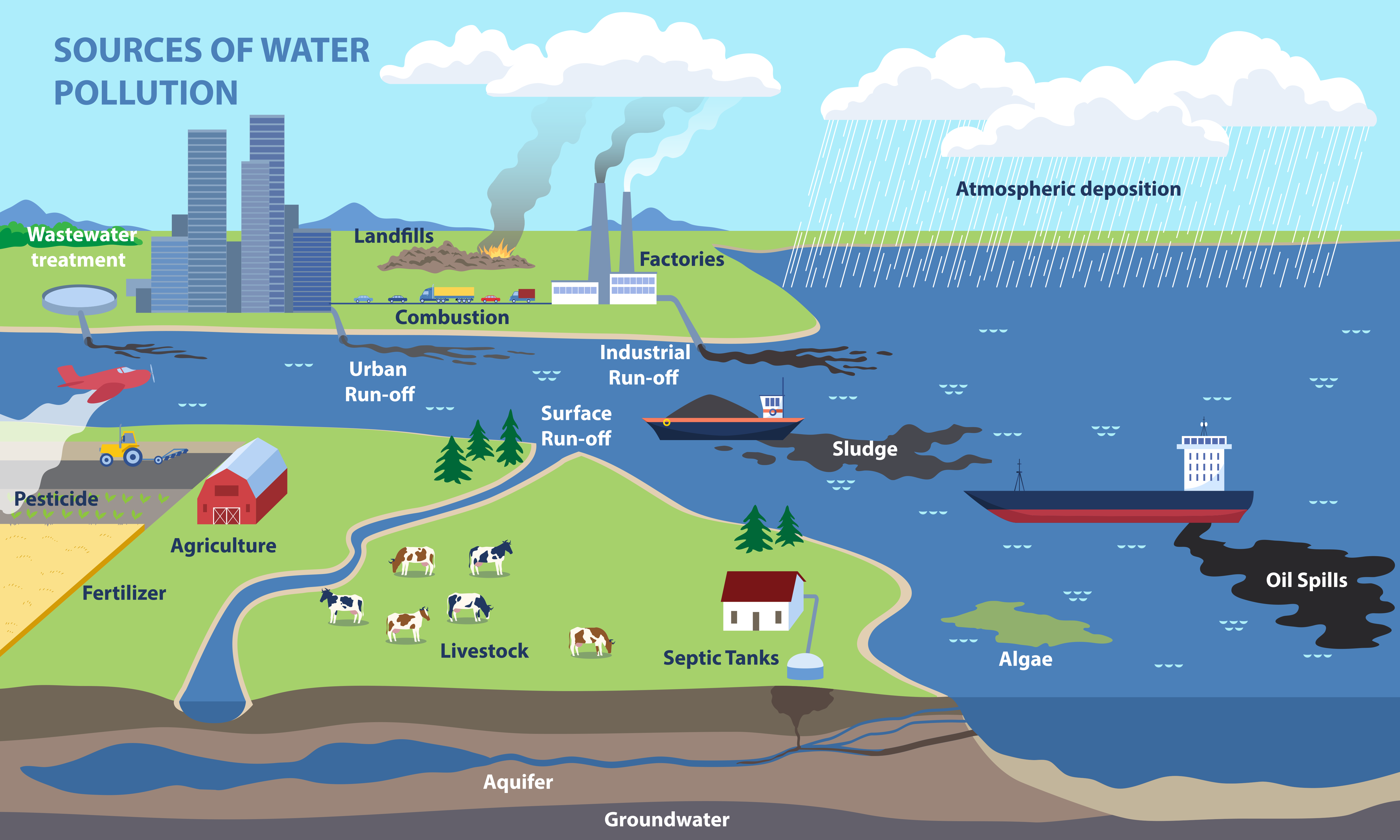
E. To provide closure for this portion of the Investigation, discuss the infographic about water pollution on this slide. Have students identify all of the ways that pollutants can enter the water. Notice, for example, that both land and air pollution ultimately can lead to water pollutants. Sludge is viscous, muddy waste material, often the product of an industrial or refining process.
Explain that in the experiments in Lab students will seek to answer the following questions:
- How does pollution spread?
- What can be done to prevent pollution?
Click on the image below to enlarge this infographic to see the details.
______________________________________________
Student Video
Watch the Investigation 4 Student Video after the Share It presentation to prepare for the Lab.
KEYS