
Teacher Portal:
Exploring Ecosystems
Investigation 4 – Lab
 BE PREPARED
Supplies and Equipment:
Class Materials
- Red, green, and blue food coloring
Group Materials:
- 1 400 ml beaker
- 1 400 ml beaker filled with 200 ml gravel
- 1 400 ml beaker filled with 175 ml blue-colored water
- labeled “Ocean”. 1 piece wire mesh, 15 cm x 15 cm
- 1 1 liter pitcher filled with water
- 1 5.7 liter plastic container
- 1 glass rod
- 1 15 ml centrifuge tube
- 1 acrylic cylinder
- 3 100 ml beakers
- 1 100ml graduated cylinder
- 1 plastic dropper
- 5 pieces masking tape, 4 cm long
Individual Materials:
- 1 Student Data Record
Teacher Preparation:
Teacher Materials
1000 ml gravel
5 400 ml beakers 365 g salt
1 glass stir rod
1 triple beam balance I metric ruler
1 1 liter pitcher
Blue food coloring Masking tape
Water
Directions:
1. Add gravel to the 200 ml mark of five (5) 400 ml beakers.
2. Add 1 liter of water to five (5) 1-liter plastic pitchers.
3. Prepare the “ocean” water solution by dissolving 365 g of salt (NaCl) in 880 ml of water in a 1-liter pitcher. Use a stir rod to mix well and then add a few drops of blue food coloring and mix again. Pour 175 ml of this blue salt solution into five (5) 400 ml beakers and label “Ocean” for ocean water.
4. Place these prepared materials at the class distribution center.
5. Place red, green, and blue food coloring at the distribution center.
6. Divide the class into five (5) cooperative groups.

GET FOCUSED
Investigation four introduces students to the concept of land pollution, air pollution, and water pollution.
INVESTIGATE
As a class:
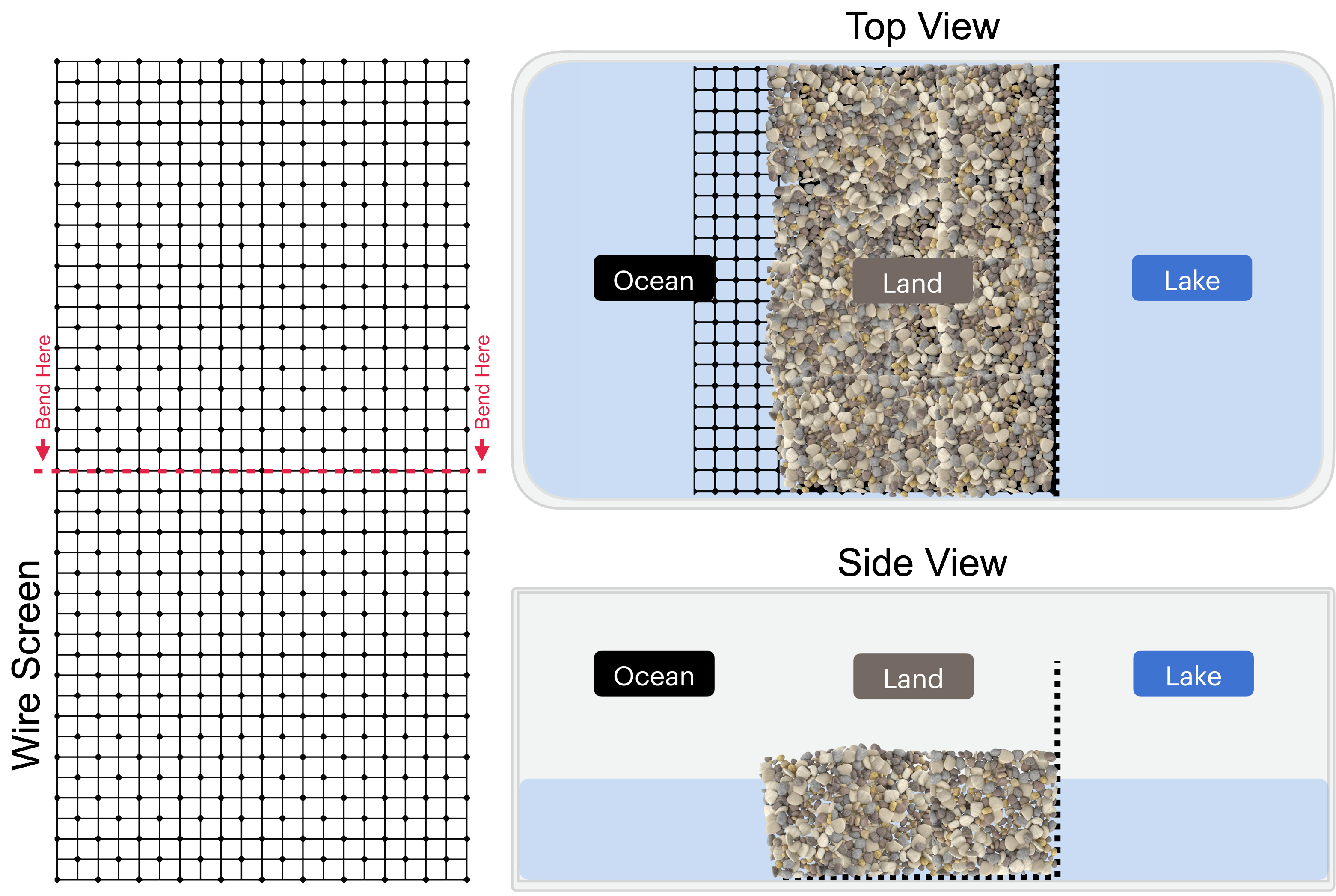
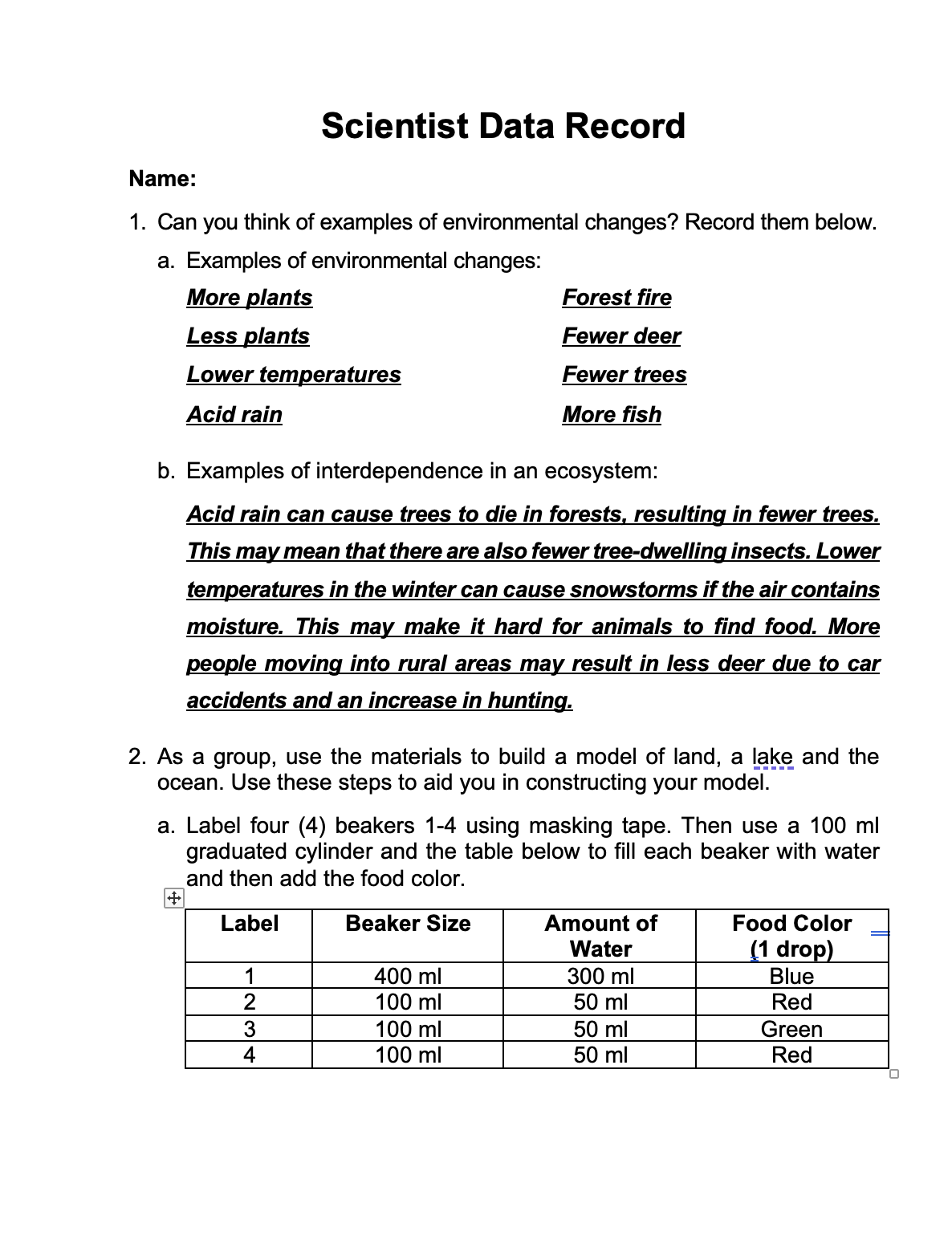
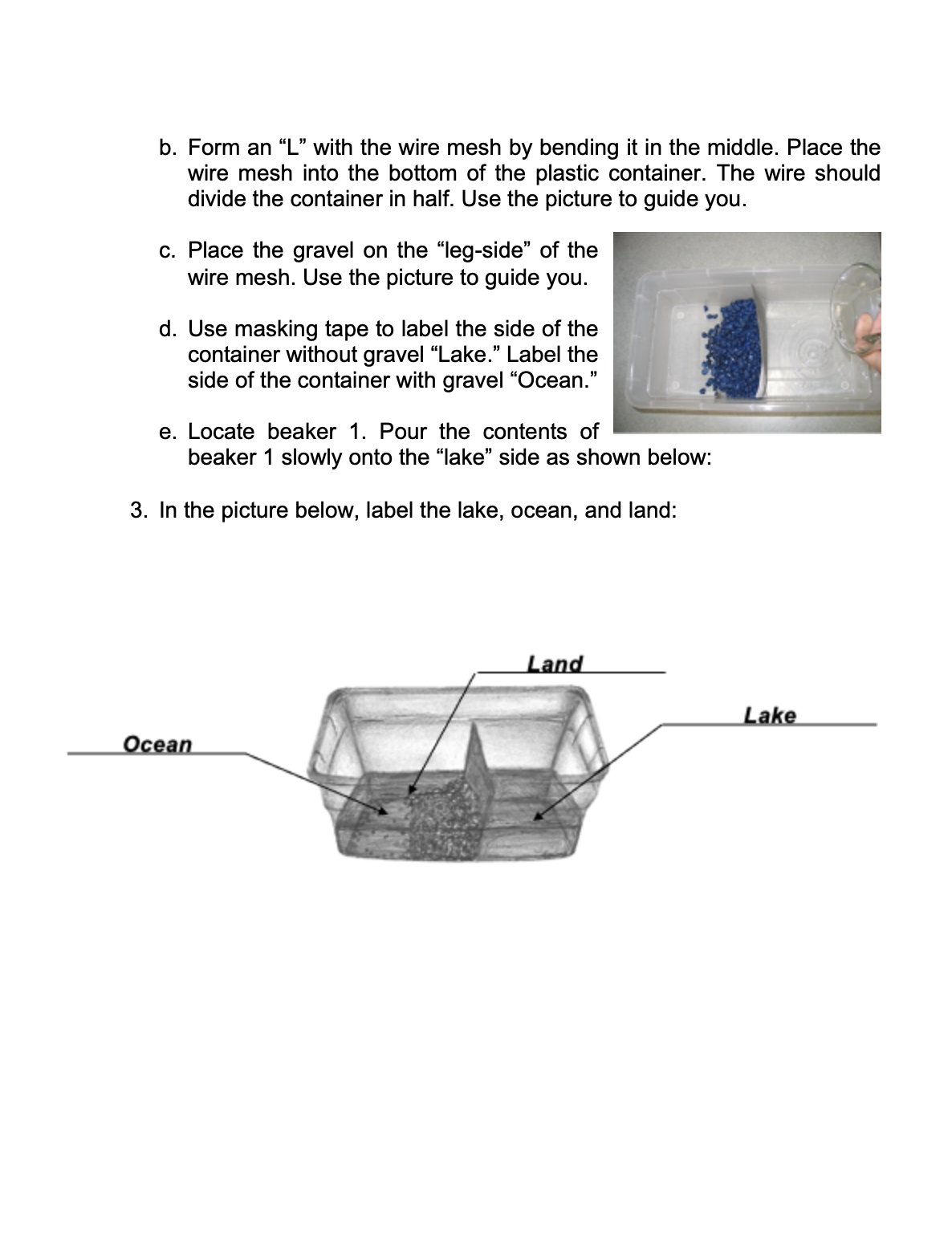
1. Construct the land, lake, and ocean model. Guide students through the steps for creating the model, located in problems 2a-2e in the Scientist Data Record.
a. Instruct students to label 4 beakers as beakers 1-4 and follow the Table in Problem 2a. Students should use the 100 ml graduated cylinder in order to fill each beaker with the correct amount and color of the water.
b. A wire mesh barrier will divide the container.
c. Gravel will be placed on the wire mesh.
d. Students should label the “leg side” of the mesh onto which the gravel has been placed “Ocean”. The other side should be labeled “Lake.”
e. The 400 ml beaker containing 300 ml of blue-colored water should slowly be poured onto the “Lake” side of the model.
2. Ask students to inspect the model.
a. Inform students that the gravel represents land near the ocean and that the beaker of red water represents a kind of liquid pollution from a factory.
b. Direct students to label the parts of the model in Problem 3 of the Student Data Record.
Trial 1
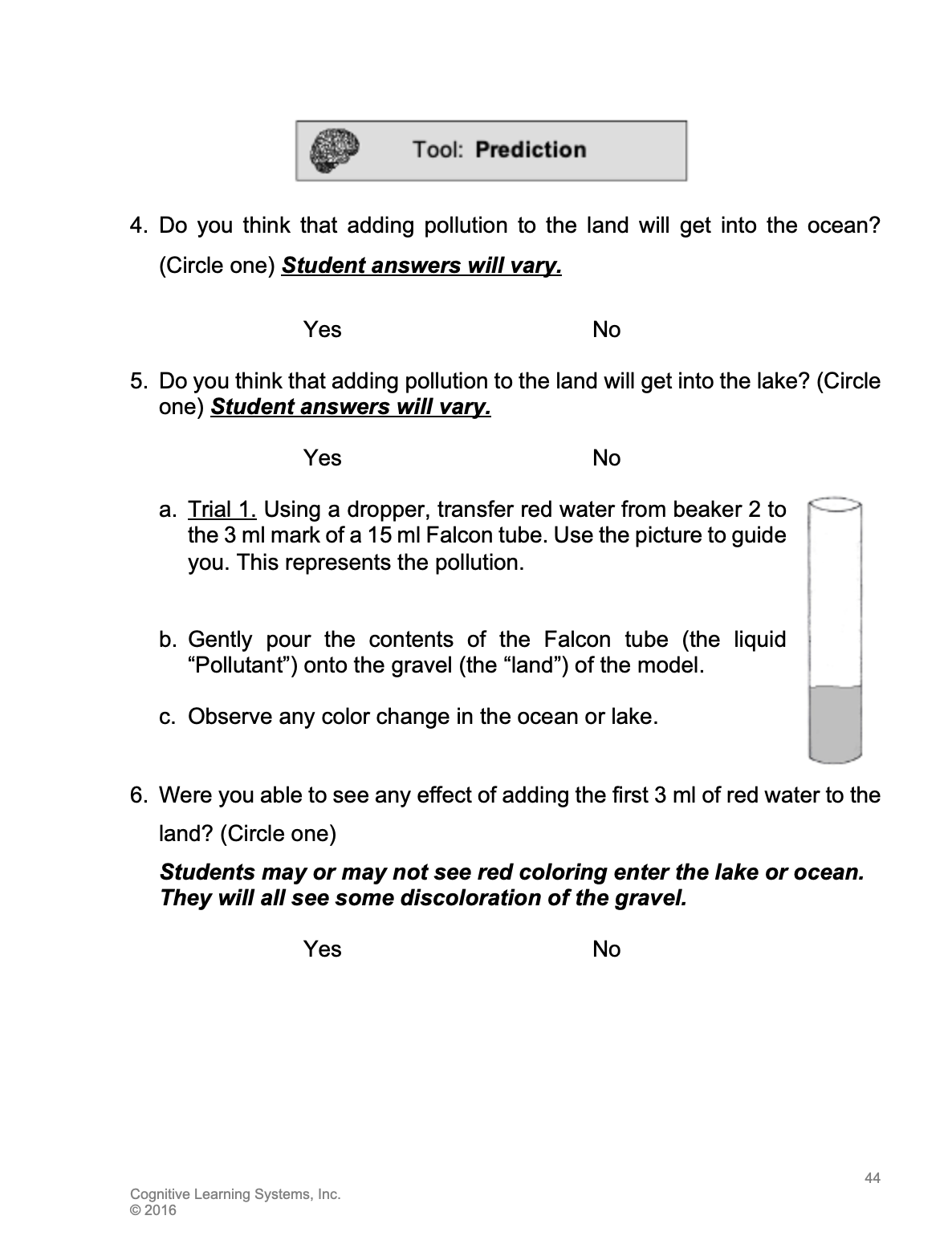
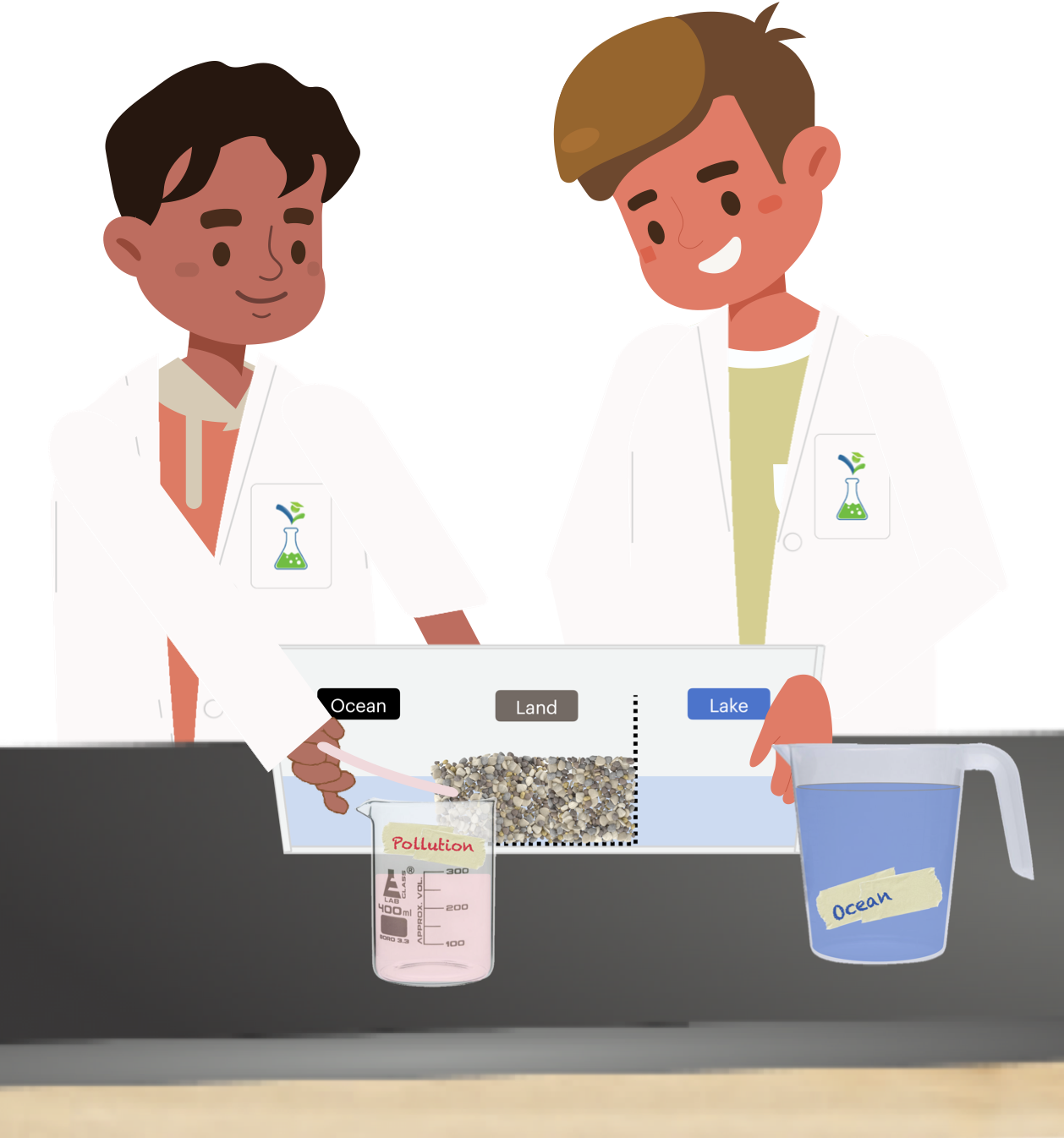 In this Trial, students will predict and then test, whether pollution added to the “land” will reach the ocean and/or the lake. Students will repeatedly measure out 3 ml of red “pollutant” using the 15 ml centrifuge tube, will add it to the model, and observe the effects. Students should conduct the Trial and consider the following question as they do so:
Does pollution on land impact pollution elsewhere?
- Discuss with the class whether they think that pollution added to the “land” will get into the ocean and the lake.
- Direct students to record their prediction in Problem 4 of the Student Data Record.
a. Students should perform the trial using the following steps:
-
-
- Transfer 3 ml of red water to the 15 ml falcon tube.
- Pour the contents of the falcon tube over the gravel.
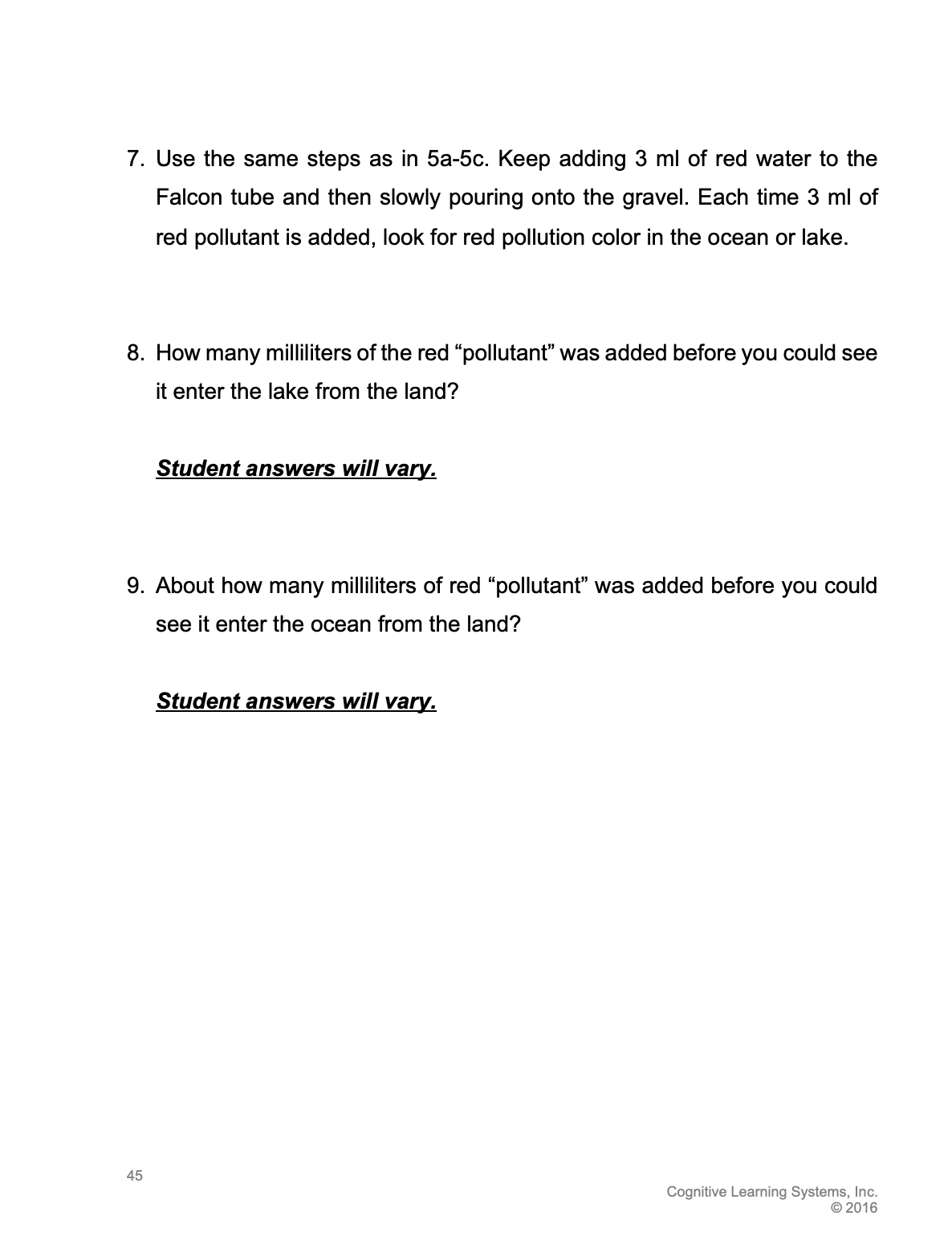
- Observe any color changes in the ocean or lake.
- Record the results in Problem 8 and for subsequent amounts, in Problem 9.
-
Trial 2
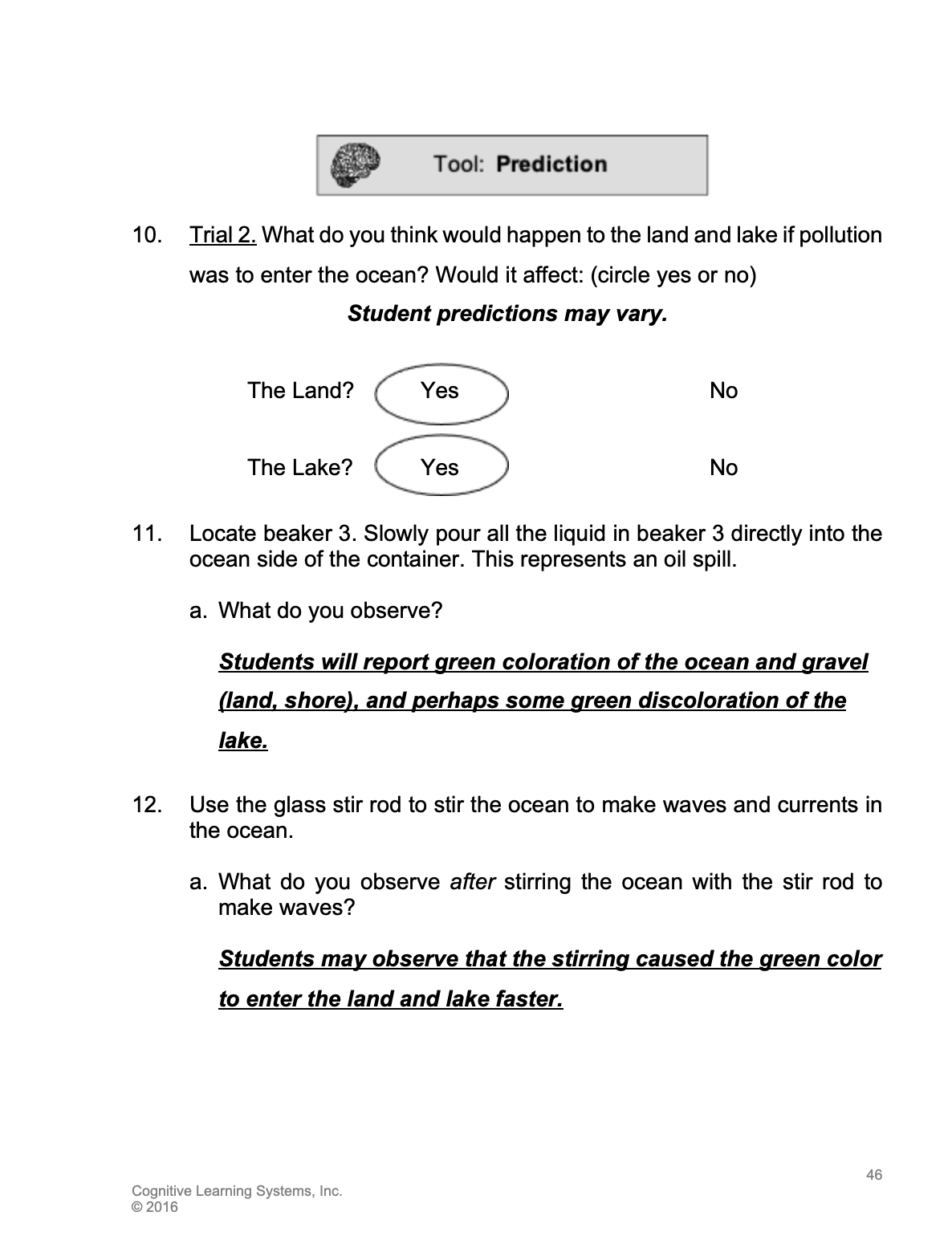
In this Trial, students will consider the impact of a further source of pollution. Students will use the green-colored water to model an oil spill that occurs in the ocean. Students should conduct the trial and consider the following question as they do so:
Does pollution in the ocean impact land and water elsewhere?
Discuss with the class whether they think that pollution added to the “ocean” will impact the land and the lake.
Direct students to record their prediction in Problem 9 of their Student Data Record.
a. Students should perform the trial using the following steps:
-
-
- Transfer all of the green water from beaker 3 into the “ocean” side of the model.
- Observe any color changes in the ocean, the land, and the lake.
- Record the results in Problem 10 of the Student Data Record.
- Use the glass stir rod to make “waves” in the ocean.
- Observe any color changes in the ocean, the land, and the lake.
- Record the results in Problem 11 of the Student Data Record.
-
NOTE: This is a good stopping point if time does not permit finishing this experiment.
Trial 3
In this Trial, In this trial, students will model the impact of pollution on a fish whose habitat is the ocean. Students will use the 400 ml beaker of blue “ocean” water and will first add the “fish” to determine whether or not it inhabits the surface of the ocean. Students will then add red “pollutant” water to the 400 ml beaker and will find that the fish no longer swims near the surface. Students should conduct the trial and consider the following question as they conduct the trial: !
How does pollution in an ocean impact organisms that live there?
a. Introduce this experiment using the following directions for students:
-
-
- Ask students: What may happen to the fish and other organisms in the ocean, if it becomes polluted? Student answers may vary. Tell students that the next experiment will explore this question.
- Ask students to locate the acrylic cylinder. Explain that the acrylic cylinder represents a fish that lives in the ocean, that can only survive by eating food at the surface.
- Direct students to locate the 400 ml beaker with blue-colored water, representing the ocean.
- Ask students to add the cylinder to the beaker. Students should answer Problem 14 in their Student Data
Record. - Students should add the red “pollutant” from the 100 ml beaker to the “ocean” water, and observe what happens to the “fish.”
-
b. Conclude this trial by explaining that in this scenario, the fish can only eat other fish and plants that exist at the surface of the ocean.
-
-
- If the polluted water affects either of these food sources, the fish will not survive. If the polluted water affects the ability of the fish to swim and live at the surface of the ocean, the fish will not survive.
- When students have applied this information to their observations of the fish model, they should record their observations in Problem 15 in their Student Data Record.
-
KEYS

CLEAN UP
Let students know your expectations for clean-up. Ask them to clean up.