Teacher Portal:
Exploring Ecosystems
Investigation 4 – PostLab
 PRINT IT
Use your browser to download a printable PDF as help during the slide presentation and to make additional notes. In your browser, go to File > Print and then choose to save as PDF.
NAVIGATE IT
Once the slide presentation is launched
- use your left and right arrows to advance or go back in the slide presentation, and
- hover your mouse over the left edge of the presentation to get a view of the thumbnails for all the slides so that you can quickly move anywhere in the presentation.
- Click HERE to launch the slide presentation for the CELL.
SHARE IT

SLIDE VECO4-post-1
This was the fourth Investigation of the LabLearner CELL Exploring Ecosystems. In it, students explored the impact of environmental pollutants on plants and animals in an ecosystem.
______________________________________________
SLIDE VECO4-post-2
A. Begin the analysis with a review of the experiments conducted in Lab. The following questions are intended to guide the class discussion:
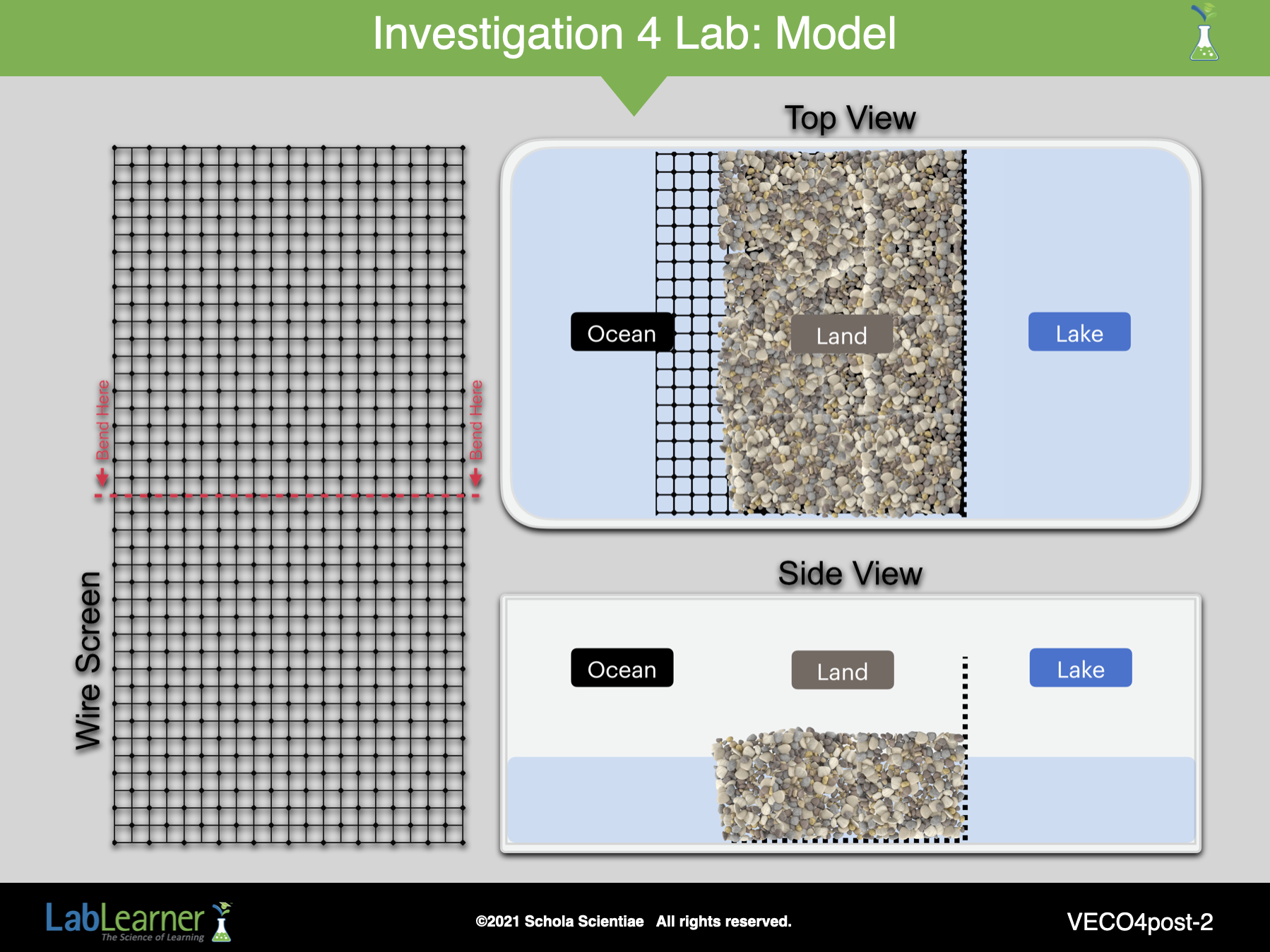
1. Ask students: Can you describe the model that was created in Lab? Students should recall that in Lab, they created a model of land, lake, and ocean using colored water and gravel supporting wire mesh.
2. Ask students: How did we simulate the effects of pollution using our model? Students introduced increasing amounts of pollution onto the land and observed the effects on the ocean and the lake. Students then modeled the introduction of a further source of pollution in the ocean and observed the effects on the land and the lake.
3. Ask students: What types of pollution did we create with the model? Students should recall that water and land pollution was simulated. Air pollution was not simulated in this model.
4. Ask students: How did we model the impact of pollution on wildlife? Students should recall that they modeled the impact of water pollution on fish in the ocean by adding an acrylic cylinder to a beaker of blue-colored water, then observing what happened when a red “pollutant” was added to the water. If necessary, refer students to Problems 14 and 15 of their Student Data Record.
5. Ask students: Did you see an example of interdependence between features of an ecosystem in the lab? Student answers may vary. Guide students to discuss the fact that polluted water could also affect the other fish and plants that the model fish needed in order to survive. In this way, an indirect connection was made between the effects of pollution and the interdependence between aspects of an ecosystem.
______________________________________________
SLIDE VECO4-post-3
B. Continue to review the Trials conducted in Lab. The following questions are intended to guide a discussion.
1. Ask students: When the pollutant was added to the land, did you immediately see an effect? Student answers may vary. Students may indicate that the effects were visible on land but not in the water.
2. Ask students: How many milliliters of the pollutant did it take for you to see the effect of the pollution in the water? Student answers will vary depending on the data gathered in Lab.
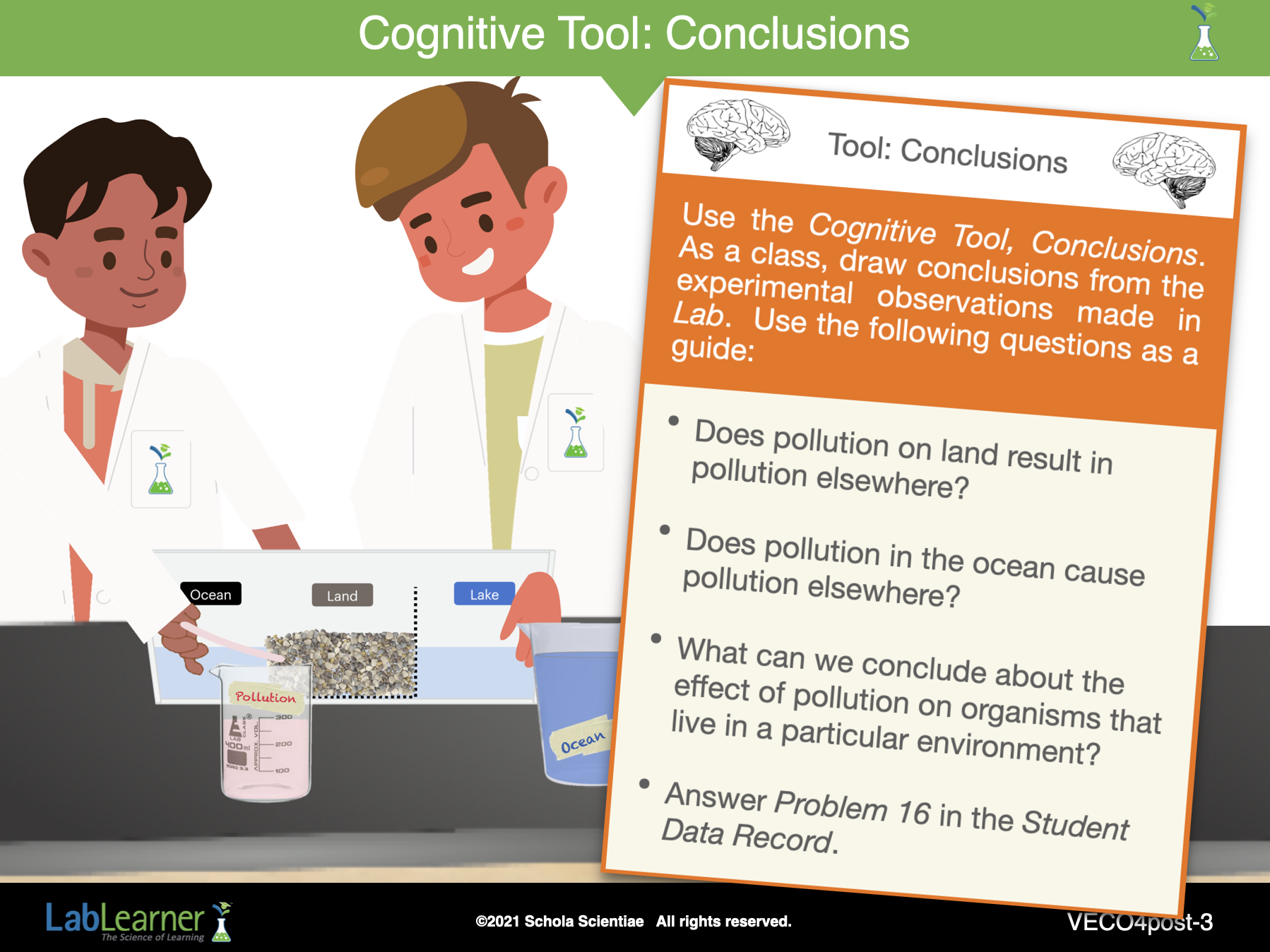
Cognitive Tool: Conclusions
Use the Cognitive Tool, Conclusions. As a class, draw conclusions from the experimental observations made in Lab. Use the following questions as a guide:
-
- Ask students: Does pollution on land result in pollution elsewhere? Students should conclude that land pollution can affect water.
- Ask students: Does pollution in the ocean cause pollution elsewhere? Students should conclude that ocean pollution can affect land and water elsewhere.
- Ask students: What can we conclude about the effect of pollution on organisms that live in a particular environment? Students should conclude that pollution can negatively impact the organisms that live in an environment.
- Ask students: Answer Problem 16 in the Student Data Record. Student answers may vary. Example conclusions are given above.
3. Ask students: If pollution is found in the ocean but comes from a factory on the land, what can be concluded about the amount of pollution or the time that the pollution was released onto the land? Guide students to realize that land pollution must be present before it is evident in the water, if the source is known to be land pollution. Guide students to recall that the model of the land had more pollutant than the model in the ocean due to the fact that more pollutant was added to the land prior to pollution being seen in the water. Therefore, it is often the case that a highly concentrated source of pollution exists on the land.
______________________________________________
SLIDE VECO4-post-4
C. To reinforce concepts learned in this CELL, engage the class in a discussion to deepen their processing of the information they encountered. Ask students the following questions:
1. Ask students: Do you think it is safe to add small amounts of pollutants to the environment? How do you know? No, because even when we added only a small amount of red pollution to the land (gravel), we observed that it started to spread into the water. While it may be worse the more pollution that is added, even small amounts could be harmful.
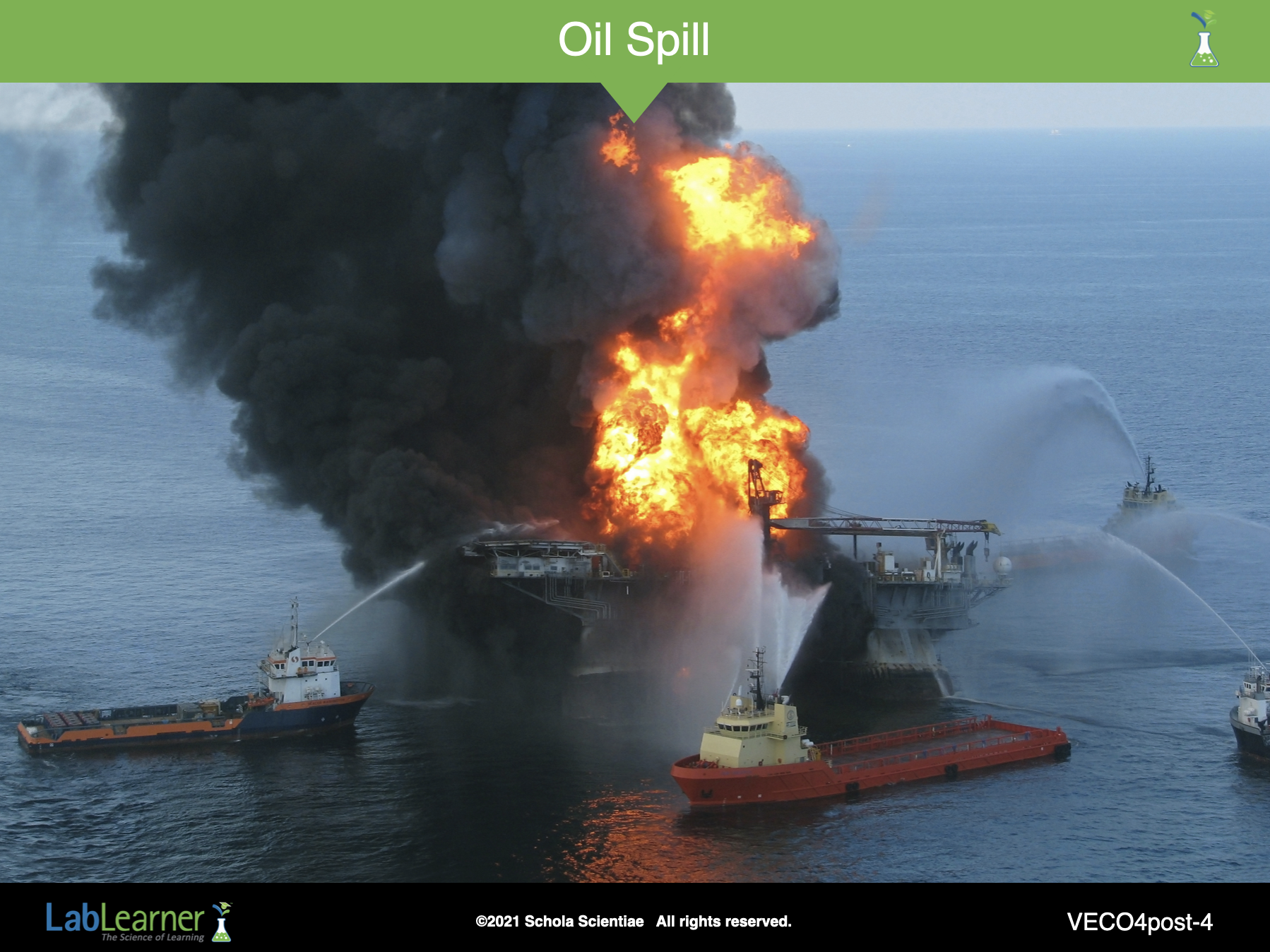
2. Ask students: How do you think that weather might have an effect on the way pollution spreads? In the experiment where the green water (“Oil”) was poured into the ocean, it spread much quicker into the land and then the lake when the ocean was stirred to make waves. In a similar way, storms and currents in lakes and oceans may disperse pollutants faster and further than in calm weather.
This slide shows the fire at the British Petroleum offshore oil rig, the Deepwater Horizon.
[CONTINUED ON NEXT SLIDE]
______________________________________________
SLIDE VECO4-post-5
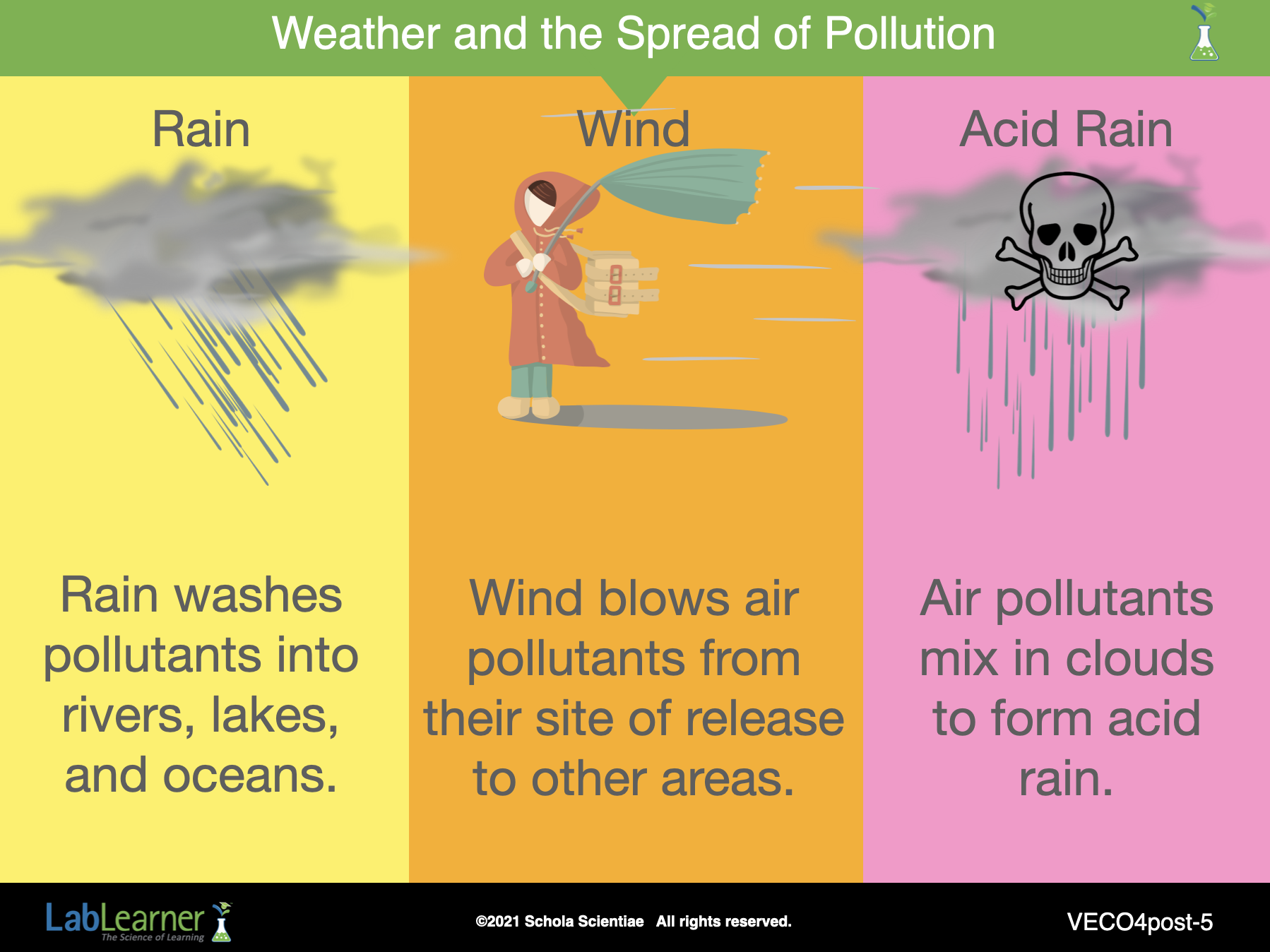
2. Ask students: How do you think that weather might have an effect on the way pollution spreads?
- Rain can also help spread pollution. For example, if a golf course puts fertilizer on their grass or farmer a farmer sprays pesticide on their crops, a heavy rain, soon afterward, could cause some of the fertilizer and pesticide to be washed away and potentially into rivers and lakes, where it might have a negative effect.
- Also, rain can trap certain gases and particles in the air and in the process form a weak acid. When these raindrops fall to earth, they can cause the acid concentration of bodies of water to increase. This so-called “acid rain” can also have a destructive effect on manmade structures such as stone buildings and statues.
- Another way weather can increase the spread of pollution is through the wind. Air pollution can spread gas pollution from factories, for example, to spread quickly from the sight they were formed. Sometimes people, plants, and animals at great distances from the site of the air pollution can be affected by pollutants because the wind carries them so far and fast.
______________________________________________
SLIDE VECO4-post-6
D. To facilitate students’ understanding of the fact that pollution may not always be visible, conduct the following teacher demonstration.
1. Ask students: can we always see pollution? Students may have difficulty imagining something that they can’t see, so it is important that the teacher discuss two instances with the class. In the first instance, refer to the students’ recent experience in this Investigation with the spread of colored water from land (gravel) into the lake and ocean water.
2. Ask students: If we did not add food color to the water to color it, would we have been able to see the polluted water pass from the gravel into the ocean and the lake? Students should indicate that no, it is likely that they would not have been able to tell the difference between polluted water and clean water.
3. Ask students: Would pollution that we cannot see enter the ocean and the lake? Students may conclude that even if they cannot see the pollutant, it could still spread.
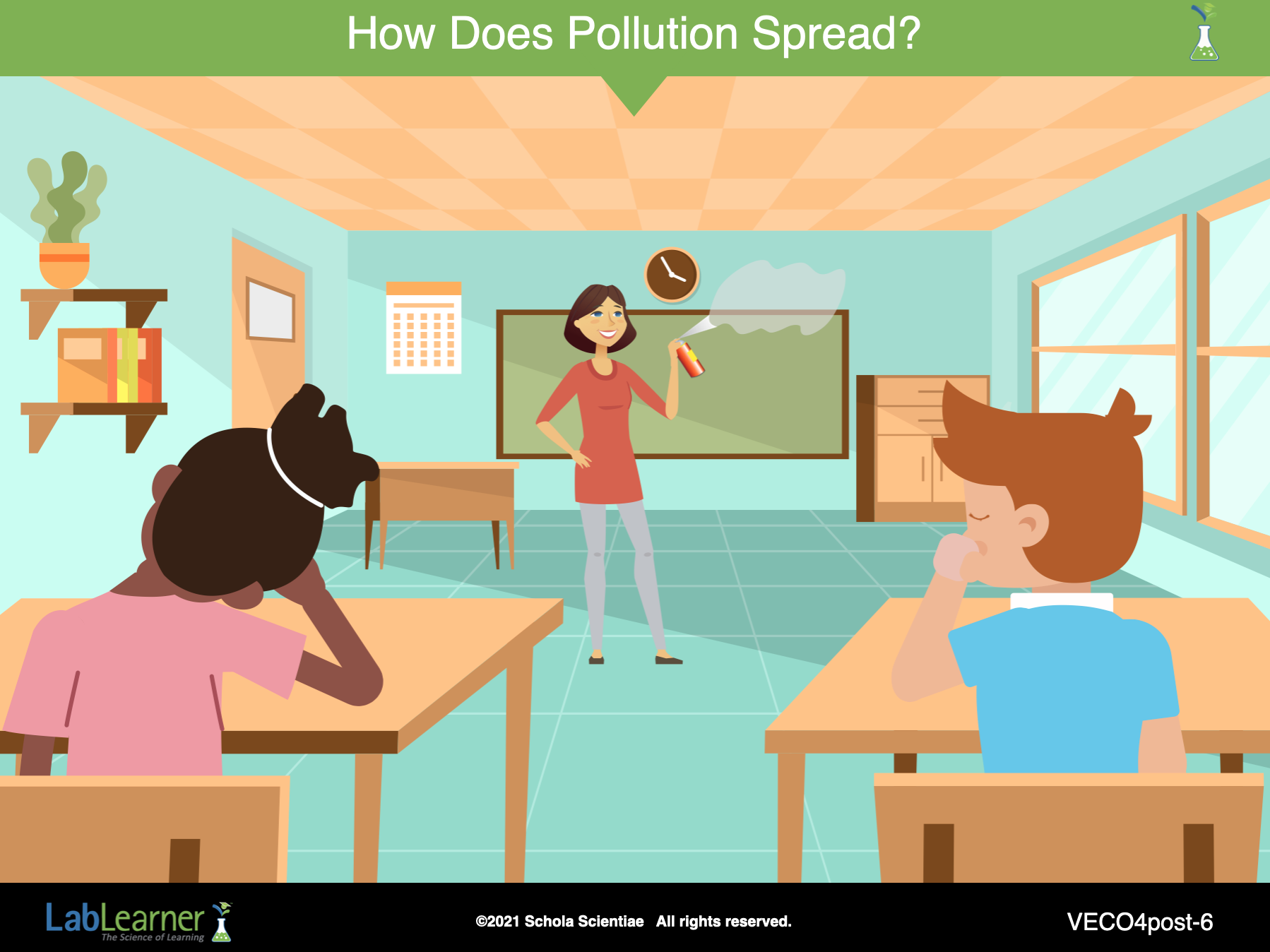
4. Stand stationary in the center of the room. Conduct the following demonstration:
- Spray air freshener or cologne around you, being careful not to directly spray the students.
- Tell students to pretend that the spray is a pollutant.
- Ask students if they can see the pollutant. It is unlikely that they will be able to see it.
- Ask students to smell the air around them until they begin to smell the “pollutant”. If necessary, quicken the spread of the “pollutant” by fanning the air using a notebook.
- Explain that the fanning is taking the place of the wind in spreading invisible air pollution quickly.
______________________________________________
SLIDE VECO4-post-7
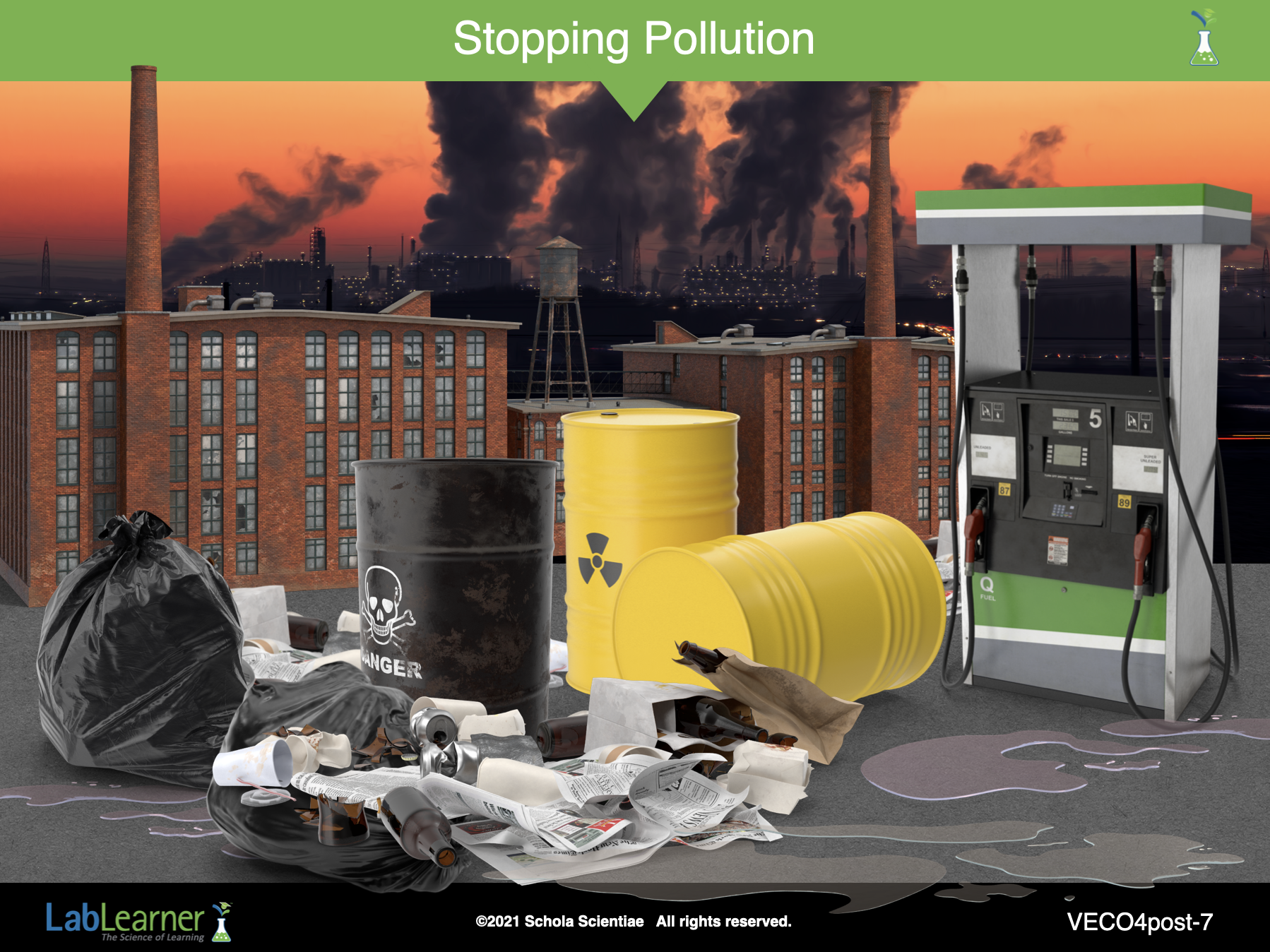
E. Divide the class into five (5) cooperative groups and conduct a brainstorming session. Encourage students to write down as many ways as they can think of to stop pollution. Allow 5 to 10 minutes for students to think of ways to stop pollution, then discuss their answers.
A sample discussion is paraphrased below.
1. Ask students: Do you think that there is anything people can do to stop pollution? Students may have a variety of answers. They may discuss the reduction in visible trash (solid pollution) by picking up papers or not throwing bottles in parks and roadways. This may lead to a discussion of recycling, something that many children experience through collection containers at home. The teacher might point out that the value of recycling extends much further than simply keeping trash out of sight, in that we can reuse many of the materials such as plastics, paper, glass, and metals that cause a significant amount of pollution in their original production. Thus, by recycling these materials, we reduce a major cause of pollution.
Another way students may mention is carpooling or riding bikes to cut down on exhaust pollutants. Children in cities may be familiar with “hov” lanes that are reserved for carpool drivers at certain times of the day to promote ride-sharing. Not only does carpooling lead to less emissions, but it also reduces the amount of petroleum products used. This, in turn, helps decrease pollution as the production of petroleum products, such as motor oil and gasoline, can also produce pollutants as “byproducts”.
In this discussion, the teacher can also remind students of the experiment with the land, lake, and ocean model, in which groundwater pollution was demonstrated. Ask the students where they think oil or paint that is spilled on the ground or poured down a storm drain will end up. Emphasize the concept that even if these pollutants appear to sink into the ground, rainfall will eventually bring them into contact with important water resources such as lakes, streams, rivers, and oceans.
Finally, it might be interesting to discuss the fact that many of the people who are working on ways to either reduce pollution or clean up existing pollution are trained as scientists. So, if some of the students in the class become scientists, they may help people in the future reduce pollution and make the world a cleaner and safer place.
______________________________________________
SLIDE VECO4-post-8
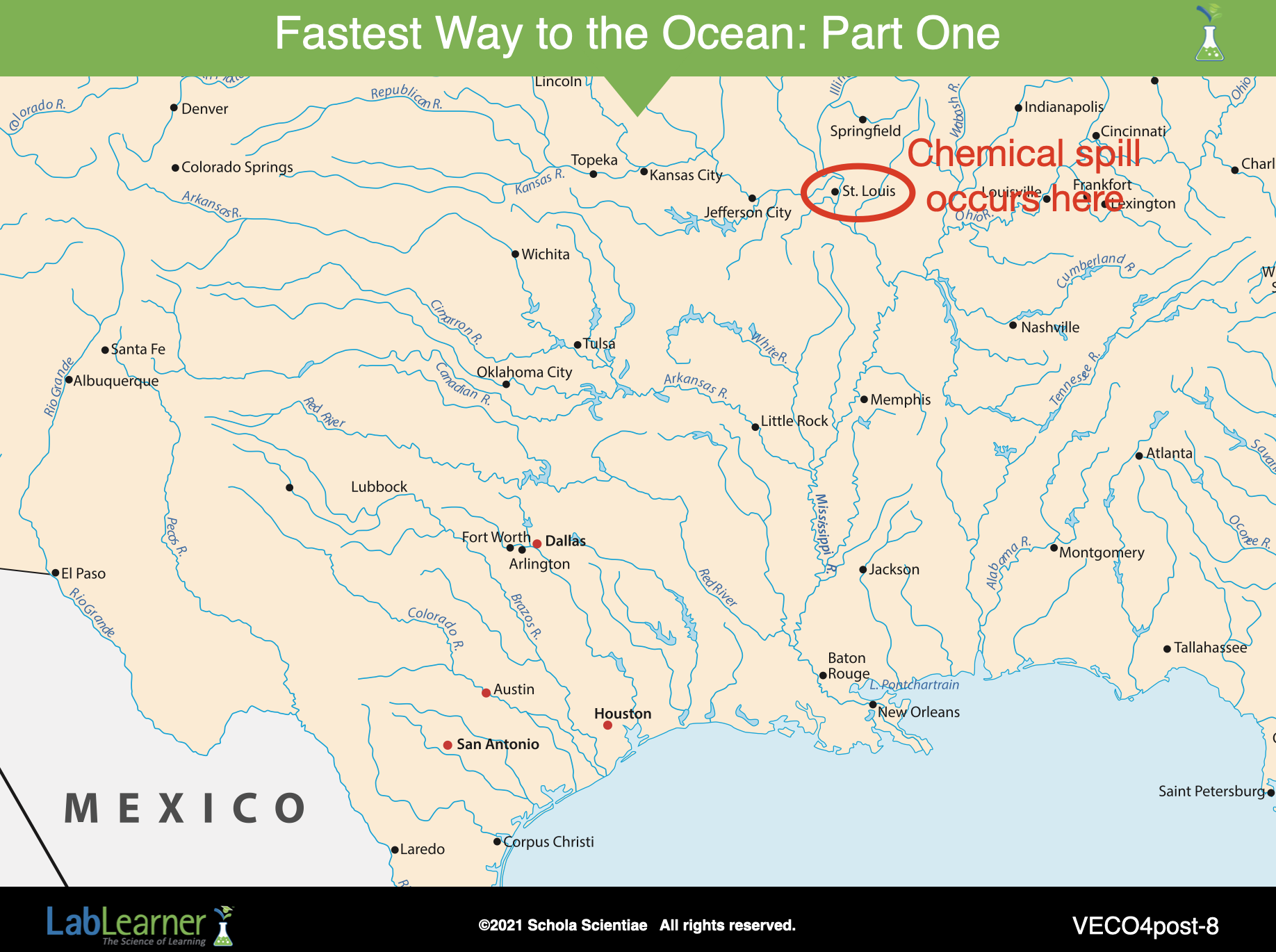
F. Map activity.
1. How can pollutants released inland eventually find their way to the ocean?
To illustrate the concept of pollutants being carried to the ocean, refer to a map of the United States or a World Map and propose specific examples.
a. Locate and point to the US city of Saint Louis and
Ask students: If a chemical spill occurs here in Saint Louis, what path might the pollution follow to eventually reach the ocean? Students should trace the course of the Mississippi River.
b. Direct students to look at a map and determine which other cities along the Mississippi River would be directly affected by the water-born chemical pollutants coming from a spill in Saint Louis.
______________________________________________
SLIDE VECO4-post-9
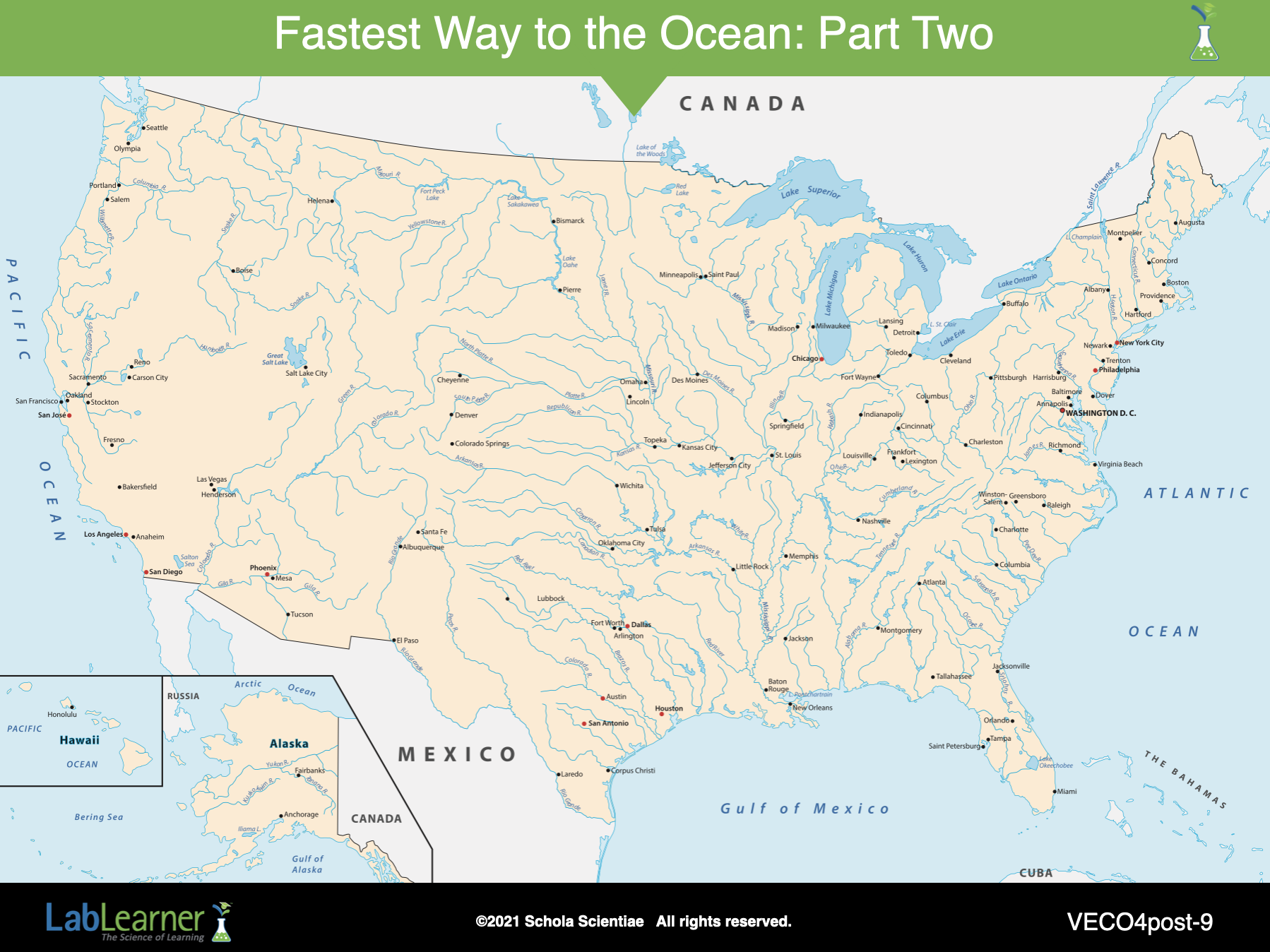
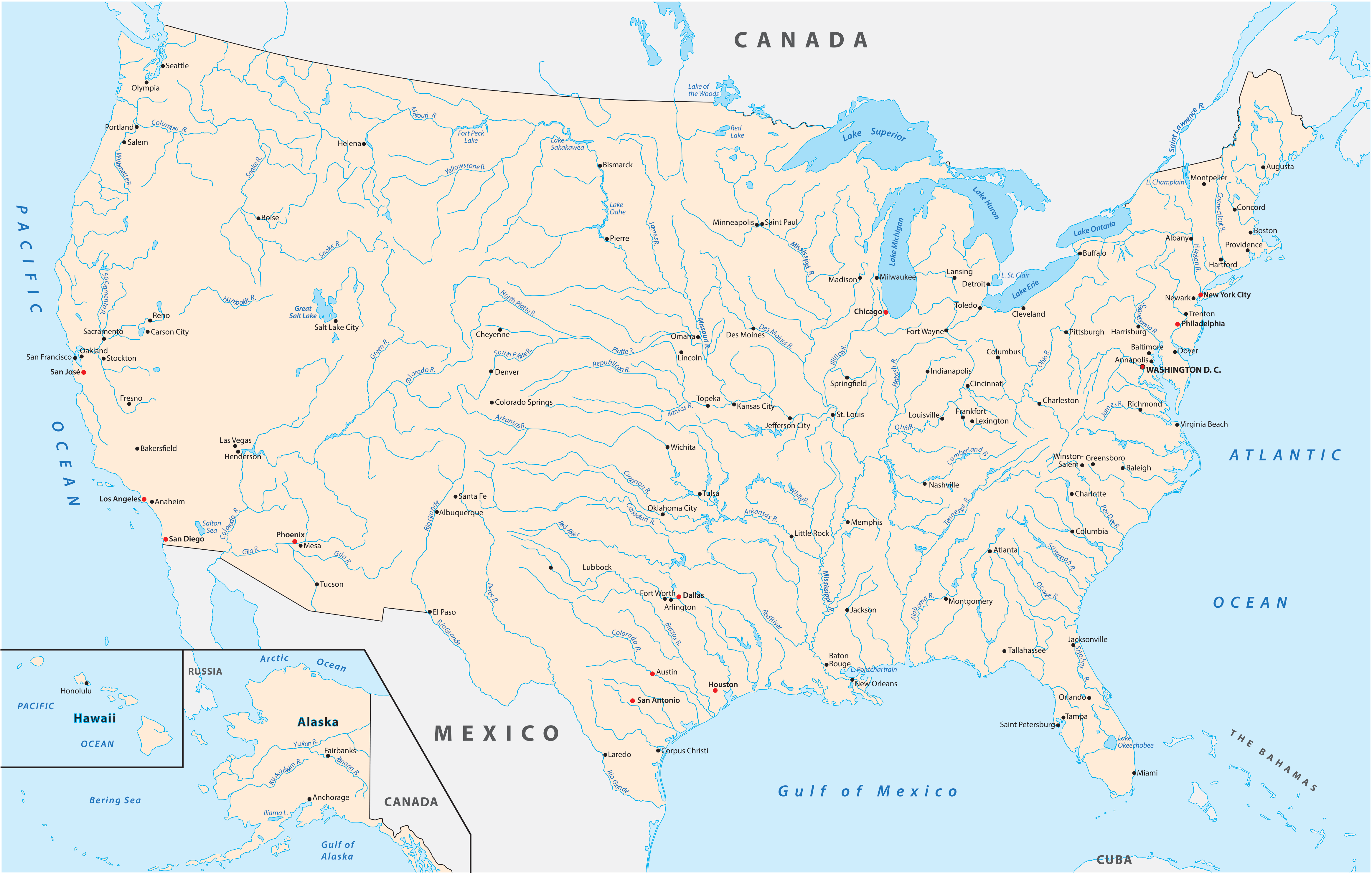
2. Repeat the hypothetical chemical spill at locations in the United States or other countries that are near major rivers. Ask students to follow the waterways until reaching the ocean and determine which cities would be affected.
Below is a high-resolution map similar to the map on this slide. You may click on the image below to open the map in another window for easier reading.
______________________________________________
KEYS: POSTLAB