
Teacher Portal:
Exploring Ecosystems
Investigation 3
Investigation Three: Environmental Changes
In the previous Investigation, students were introduced to the concept that certain structures and behaviors reflect adaptations of an organism to live in its environment. They also learned that when the environment changes, not all organisms have adaptations that permit them to survive as well as others. As we continue our study of ecosystems, students will now perform experiments that demonstrate the ultimate consequence of a species not possessing appropriate numbers of individuals with adequate adaptations to permit survival in a changing environment – extinction.
Speed of Environmental Change
Before we delve into the effect environmental changes have on plants and animals, we should first consider how rapid environmental changes occur. In general, environmental changes take place over incredibly long periods of time. The Earth is 4,543,000,000 years (4.543 billion years) old. Over that period, not only has life changed profoundly, but the entire planet has radically changed. Look at the illustration below from NASA (National Air and Space Administration).
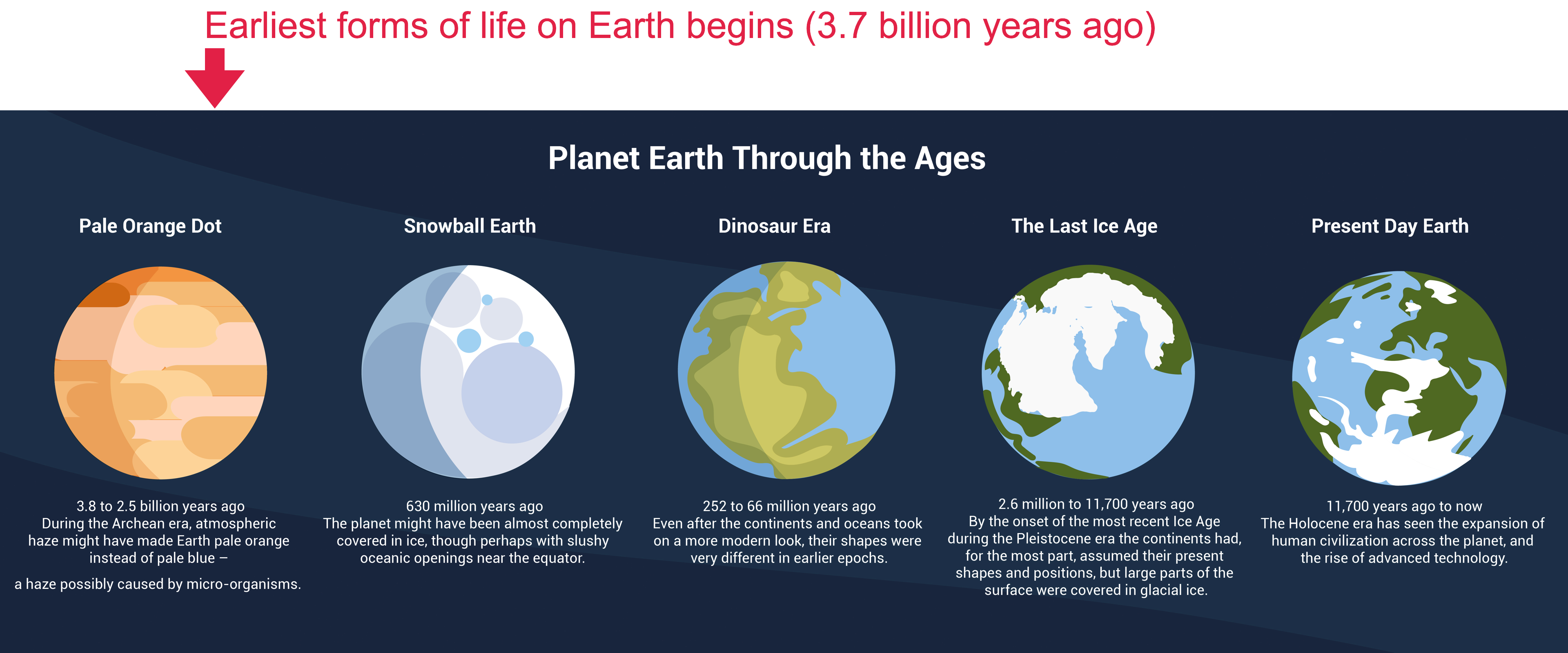
Image Credit: NASA/JPL-Caltech/Lizbeth B. De La Torre
Given that the entire Earth has undergone such dramatic changes in everything from its temperature, gases in the atmosphere, ice cover, and even a total rearrangement of every land mass on the globe, it is not hard to realize that life on Earth has had to adapt to enormous environmental changes. For example, during the Snowball Earth period, the planet was completely buried under ice, even the oceans. For many millions of years, what simple life existed was confined to the depth of the frozen oceans.
During the time of the dinosaurs, all of the lands on Earth were joined into one giant continent called Pangea. Since that time, the continents have been moving across the planet, eventually reaching their current locations. However, they are still moving and the Earth will continue to change into the future. These types of environmental changes were very, very slow but, as you can imagine, exerted tremendous pressure on living organisms. 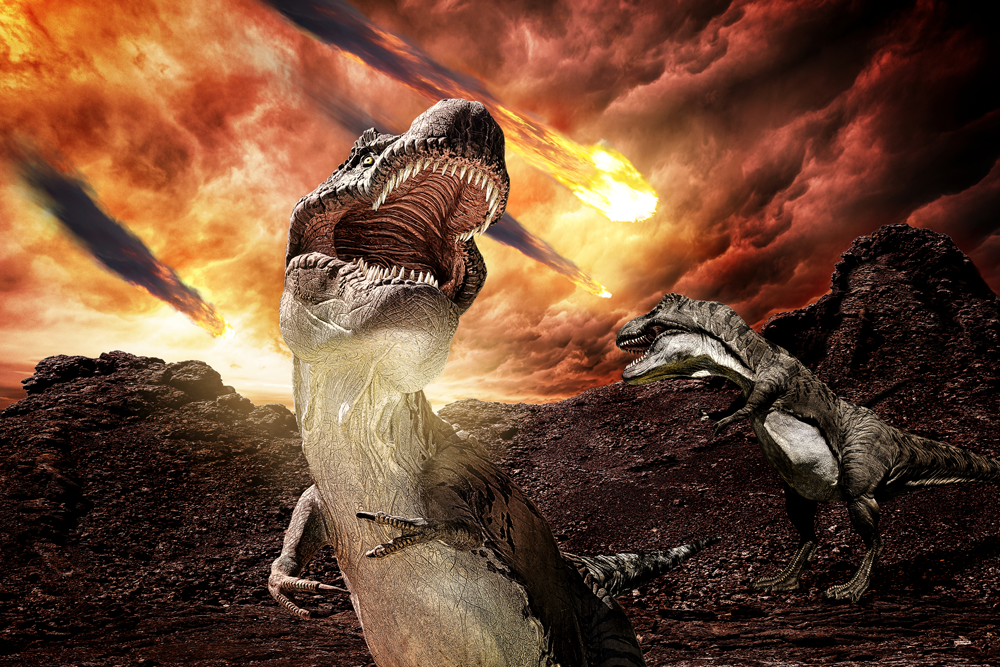 Nearly all of the organisms that once existed over the Earth’s history did not survive and a long gone – they became extinct.
On the other hand, massive environmental changes may occur much more rapidly in certain circumstances. One of the most dramatic occasions occurred around 65,000,000 (65 million) years ago. At that time, the Earth had been populated with dinosaurs for well over 150 million years. Then, one day a large asteroid crashed into our planet and changed the environment so dramatically and rapidly, that the dinosaurs disappeared (became extinct) very rapidly as well. If an environmental change happens on a large scale and very quickly, the extinction of some plants and animals is almost certain.
Extinction
There are a number of ways in which a species can become extinct. One way is the occurrence of a major, often violent change in the environment, such as widespread volcanic eruptions or an asteroid impact on the surface of the Earth such as the asteroid that killed off the dinosaurs. Such “catastrophes” have occurred numerous times during geological history, many with corresponding evidence in the fossil record of the extinction of numerous species. Such catastrophic events result in extremely rapid changes in the environment and rapid extinctions. Even if certain species are not immediately killed off by the violence of the catastrophe, the environmental changes that accompany the change are so rapid, that populations simply don’t have time (generations) to adapt.
Another way a species may become extinct is by slow environmental changes that, over very long periods of time, perhaps millions of years, favor one species, with its particular environmental adaptations, over others that it may compete with for food, shelter, or other resources. Therefore, several important factors are in play in this type of extinction.
The first is change. Something in the environment must change – such as rainfall, temperature, amount of predators, amount or type of food, availability of shelter, etc.
Second, the change must be of a sort that has an effect on the ability of the species to survive and reproduce. For example, if a species is capable of surviving in a wide range of temperatures, slow changes in environmental temperature would be unlikely to cause its extinction. If, however, the environmental temperature change also causes the species’ essential food source to disappear, the species itself may face extinction if it is unable to survive by changing to another food source.
Competition and Natural Selection
 This brings us to another important factor in the process of extinction, competition. Competition occurs when two or more species require the same environmental resource (such as food type, for example). The concept of competition suggests that when species compete, the one best adapted for the competition will “out-compete” the other species. Thus, the result of competition is that one species tends to benefit at the expense of another. If driven far enough, extinction of the least “fit” species may occur.
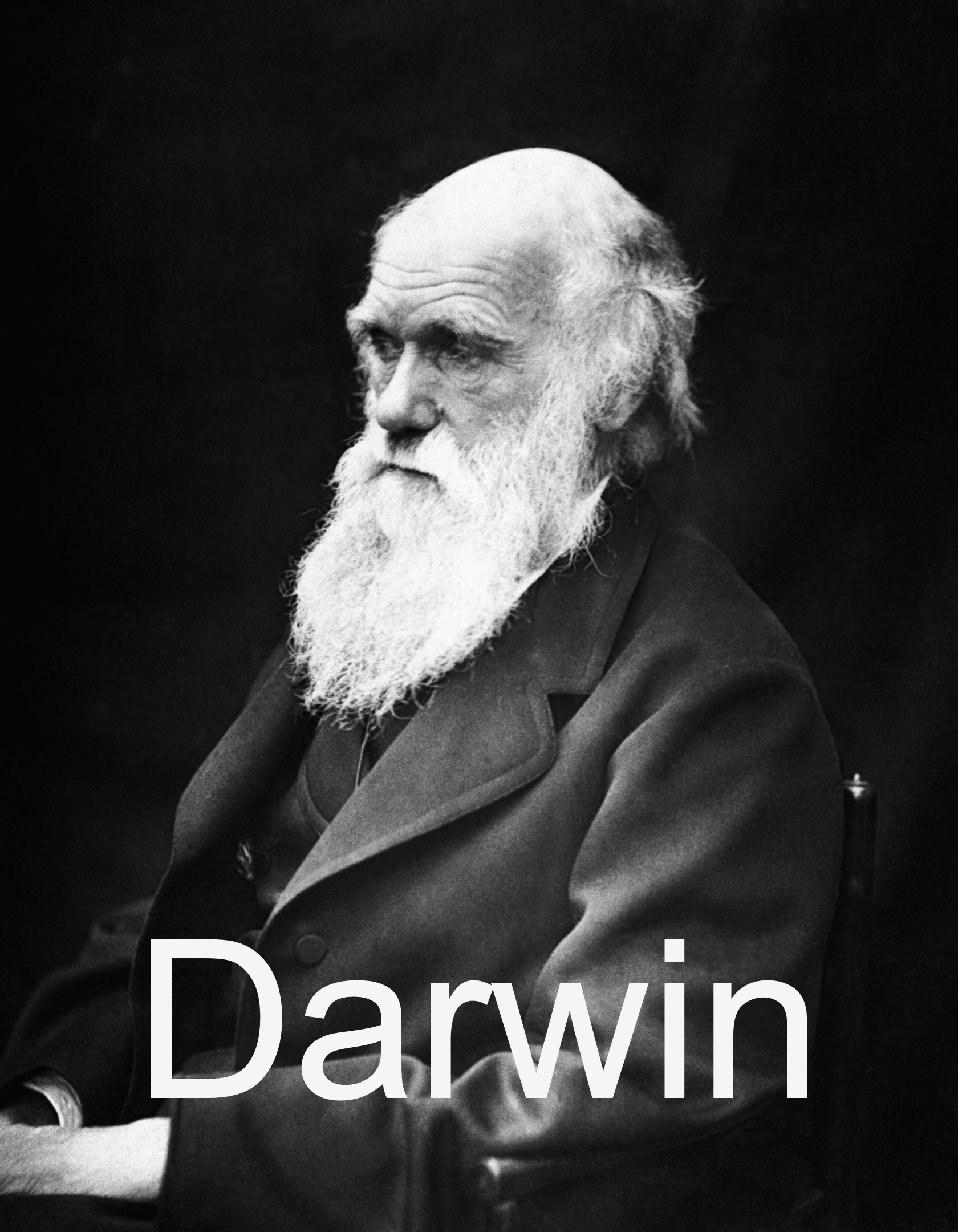
This idea of the “survival of the fittest” was introduced by the English biologist, Charles Darwin, in the second half of the nineteenth century. Darwin referred to this process as natural selection, to distinguish it from the artificial selection man performs when breeding new forms of agricultural crops and animals. The idea of competition and natural selection in the process of extinction is crucial. Without competition, a species or population may have enough time to adapt to a changing environment. On the other hand, if a competing species is already better adapted to the new environment, the other species may simply not be given enough time to adapt (or evolve). The more fit species will out-compete the “weaker” species, prosper, and reproduce more generations of its kind. The weaker species will fail to thrive, reproduce at a reduced rate, and may eventually become extinct.
Peppered Moths and the Industrial Revolution
A famous example of his type of natural selection is the case of the peppered moth in England during the Industrial revolution. Before the coming of large factories that burned huge amounts of coal and released massive amounts of black soot into the atmosphere, there were two kinds of peppered moths, one was white and the other was black. Since birds could easily see and catch the black moths on the light-colored trees before the Industrial Revolution, over 90% of the feeding was on the black moths, which became very rare in the peppered moth population.
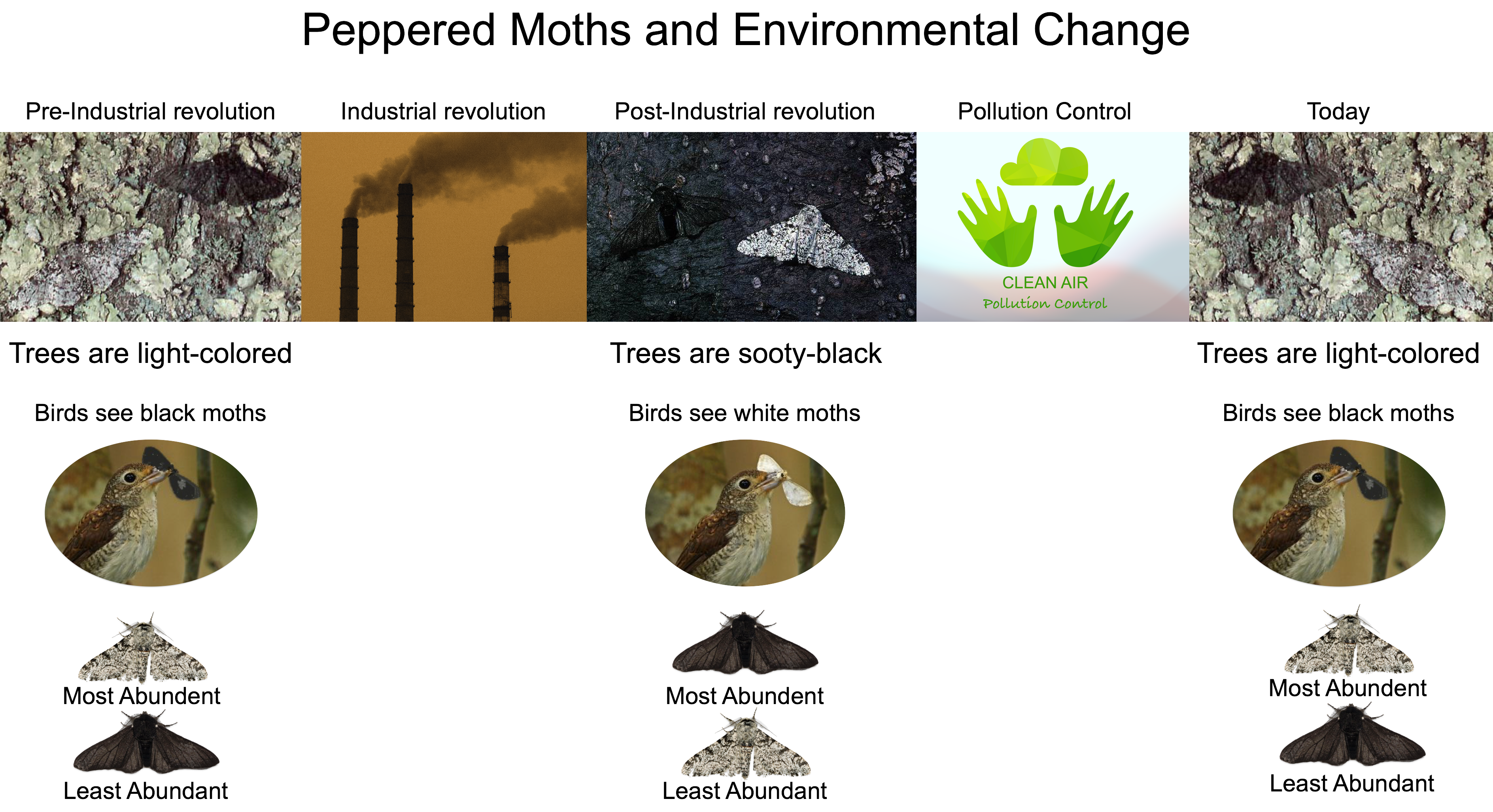
However, as the trees were darkened by the polluted air, birds became more likely to see and eat the white moths and they became rarer in the moth population. Finally, because of improved production practices and a significant reduction in soot in the air, after the Industrial Revolution trees once again returned to their natural light color. This again made the black moths easier to see for the birds to capture and the black moth population once again decreased in numbers compared to the white moths.
Extinction is Forever
An important point to consider about extinction – one that students may have difficulty with – is that once a species becomes extinct, it is permanently gone from the face of the Earth forever. It does not exist in some low numbers, hidden away awaiting environmental conditions to change again to something more favorable. It is not dormant, sleeping, latent, or inactive. It no longer exists alive on the face of the Earth. Even if environmental conditions were to change to suit its particular physical and behavioral adaptations perfectly, it would be irrelevant – once extinct, it no longer has anything to do with the process of life whatsoever. The only reason that the white pepper moths were able to increase in numbers compared to the black variety is that not ALL of the white moths were captured and eaten. Had that happened, it would have made no difference whatsoever that the trees returned to their original light color after the Industrial revolution. The white moths would never return, they would no longer exist on Earth – they would be extinct.
Students will become familiar with this aspect of extinction in the experiments they will perform in this Investigation. They will simulate beak types of birds and see how the different beak structures are able to compete for food as the type of food changes through four moments in time, millions of years apart. The “loser” at each stage drops out – it no longer takes part in the rest of the experiment.
An Adaption Misconception
Students often have misconceptions about how adaptation occurs. These misconceptions include ideas about adaptations resulting from changes in the environment, when in fact adaptations arise from pre-existing variations in traits that become selected for and hence more prevalent in the total population over time. In the case of the peppered moths, recall that both white and black varieties of moths existed BEFORE any changes were introduced into the ecosystem by air pollution. The black moths did not suddenly appear from out of nowhere – they existed prior to the Industrial Revolution and were selected for survival by the change in the environment.
Exploring Ecosystems: Investigation 3-Mathematics Concepts
Prelab
- time in hours/minutes
- addition/subtraction
- grouping/classifying
Lab
- mass in grams
- data table
- addition/subtraction
- whole numbers (ones, tens, hundreds)
- whole numbers to the nearest tenth
- length in cm
- volume in mL
- time in seconds/minutes
Postlab
- comparing (non)measurable characteristics
- addition/subtraction
- continuum scale
- grouping/classifying
- ordinal numbers
- least to greatest
- problem solving
Exploring Ecosystems: Investigation 3 - Procedural Tools


Exploring Ecosystems:
Investigation 3 Quiz

