Teacher Portal:
Exploring Ecosystems
Investigation 3 – PreLab
 PRINT IT
Use your browser to download a printable PDF as help during the slide presentation and to make additional notes. In your browser, go to File > Print and then choose to save as PDF.
MINDSET
- This Investigation is designed to:
- introduce students to the concept of extinction.
- help students understand fossils and the fossil record as tools to study ancient life on Earth.
- build student understanding of how organisms have adaptations that allow them to live in specific environments.
- introduce students to concept of natural selection.
- increase understanding of the interactions of organisms with their environment.
SCIENTIST’S GLOSSARY
1. Adaptation: a pre-existing, genetic characteristic of an organism that allows it to survive more effectively in a particular environment.
2. Biomass: the quantity of living matter in an ecosystem.
3. Competition: a situation that exists in nature when two or more different species require the same environmental resource (food, shelter, etc.) to survive.
4. Extinct: a species that is no longer living on Earth; describes a species that has completely died
off.
5. Fossil: the remains or impressions of plants and animals which lived on the Earth in the past
and are now preserved in rocks.
6. Natural Selection: the process in nature by which organisms that are best adapted to their environment tend to survive and reproduce while those less adapted tend to die off; also called “survival of the fittest”.
7. Paleontologist: a scientist who uses fossils to study organisms that lived in ancient times.
BE PREPARED
Watch the Investigation 3 Teacher Video and Student Video below to prepare for the PreLab.
SET FOR SUCCESS
- Tell students that they are about to begin the Exploring Ecosystems CELL.
- Ask students to share the kinds of things they might learn in these Investigations.
Begin the PreLab Concept Slides to start students on their learning journey. Then watch the Pre-Lab Student Video afterward as a class.
NAVIGATE IT
Once the slide presentation is launched
- use your left and right arrows to advance or go back in the slide presentation, and
- hover your mouse over the left edge of the presentation to get a view of the thumbnails for all the slides so that you can quickly move anywhere in the presentation.
- Click HERE to launch the slide presentation for the CELL.
SHARE IT
SLIDE VECO3-pre-1
This is the third Investigation of the LabLearner CELL Exploring Ecosystems. In it, students will explore environmental changes and how they exert an influence on all life on Earth.
______________________________________________
SLIDE VECO3-pre-2
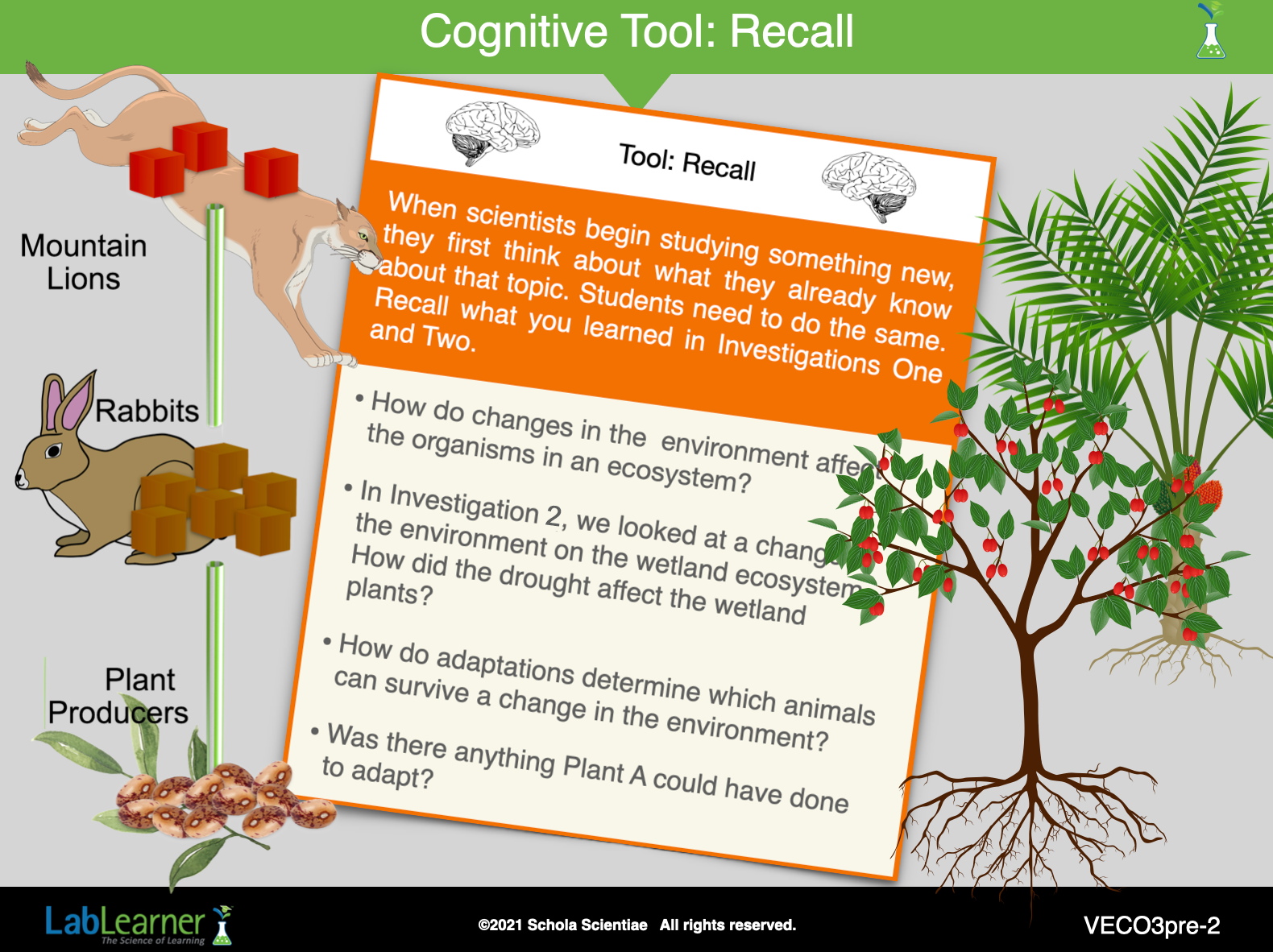
A. Begin the Investigation by reviewing adaptations and the effects of the environment on organisms in an ecosystem.
Ask students to Recall the experiments that they performed in Investigations 1 and 2. Tell students that using the Recall Cognitive Tool may help them to recall the answers to the questions that follow:
Ask students: In Investigation 1, we discussed two changes in the environment. A drought caused the loss of pinto beans and a plant disease caused the loss of kidney beans. How did these environmental changes affect the organisms in the ecosystem? The loss of plants in both cases caused a decrease in population size for the organisms that depended on the plants for food or on animals that ate the plants for food.
Ask students: In Investigation 2, we looked at a change in the environment on the wetland ecosystem. How did the drought affect the wetland plants? One of the plants (Plant A) survived the drought, but the other plant (Plant B) could not get enough water from the environment and did not survive.
Ask students: How do adaptations determine which animals can survive a change in the environment? Student answers may vary. Guide students to recall that adaptations are characteristics that enable organisms to live in a specific environment. Students may recall that Plant A was adapted to live in the wetlands under drought conditions but was not adapted to live in a forest.
Ask students: Was there anything Plant A could have done to adapt? No, individual plants and animals do not adapt.
______________________________________________
SLIDE VECO3-pre-3
B. Explain that in this Investigation students will continue to explore how the adaptations of organisms determine whether they will be able to survive changes in their environment.
1. Introduce students to the terms extinct, paleontologist, and fossil with the following steps:
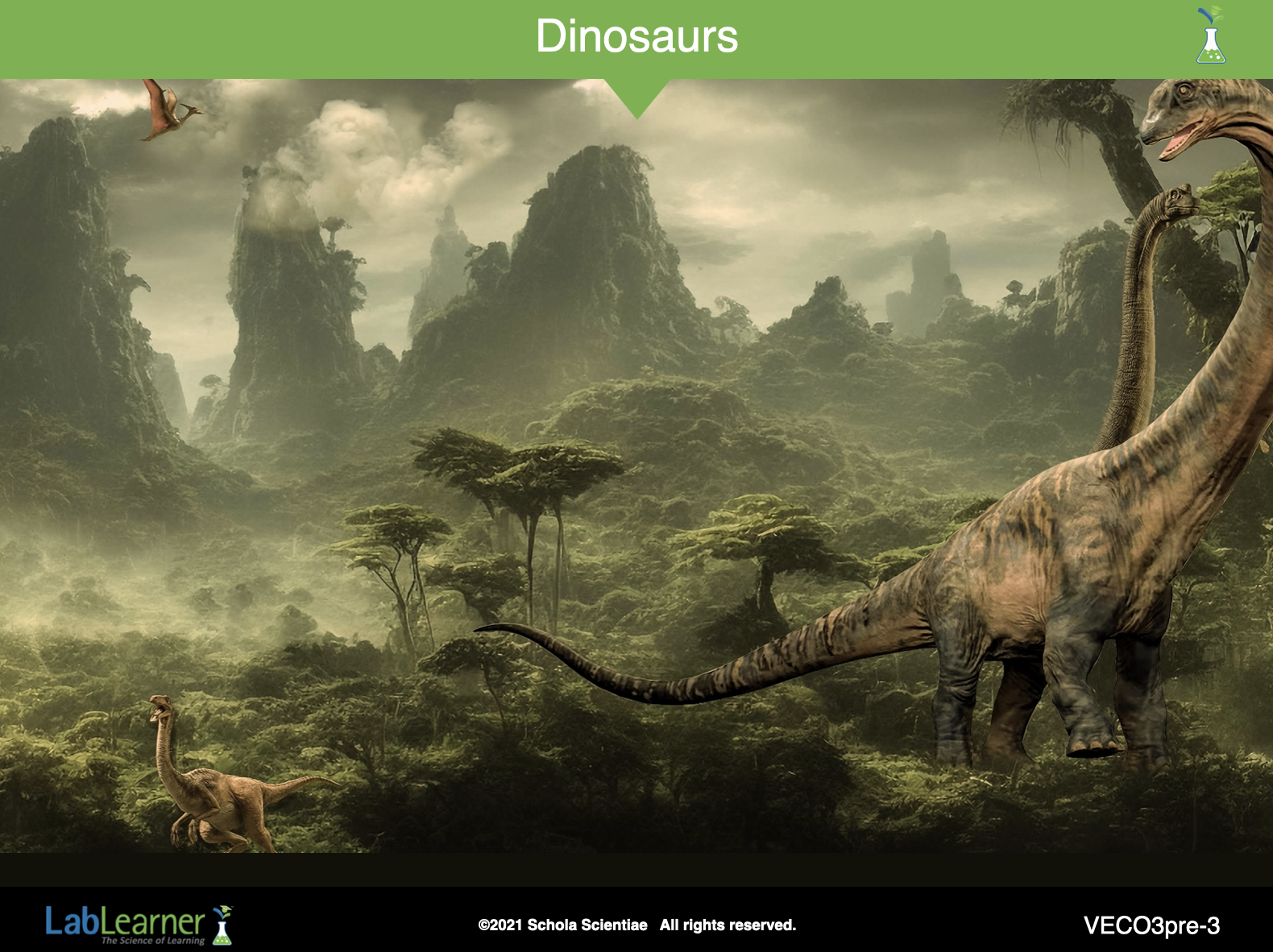
a. Ask students: What is a dinosaur? Student answers may vary. Dinosaurs were reptiles that lived on Earth millions of years ago.
b. Ask students: Are dinosaurs alive today? No.
c. Explain to students that dinosaurs are extinct. Something that is extinct is no longer living. When all animals of one kind die, that type of organism becomes extinct and can never be found on Earth again.
Ask students: What caused the dinosaurs to become extinct? Student answers may vary. Tell students that a major change in Earth’s environment happened around the time the dinosaurs became extinct. The dinosaurs were not adapted to survive in the new environment and became extinct.
NOTE: Scientists have several theories as to why environmental change occurred and caused the mass extinction of dinosaurs. One theory suggests that an asteroid hit the Earth causing large tsunamis, fires, and storms and sending large amounts of dust and debris into the air, blocking sunlight for months and changing Earth’s climate. Other theories suggest that increased volcanic activity, an ice age, or the gradual receding of oceans over time may have caused climate change. Still, another theory suggests that the environmental change was not a climate change but a deadly and contagious disease that killed the dinosaurs either directly or through the food web.
______________________________________________
SLIDE VECO3-pre-4
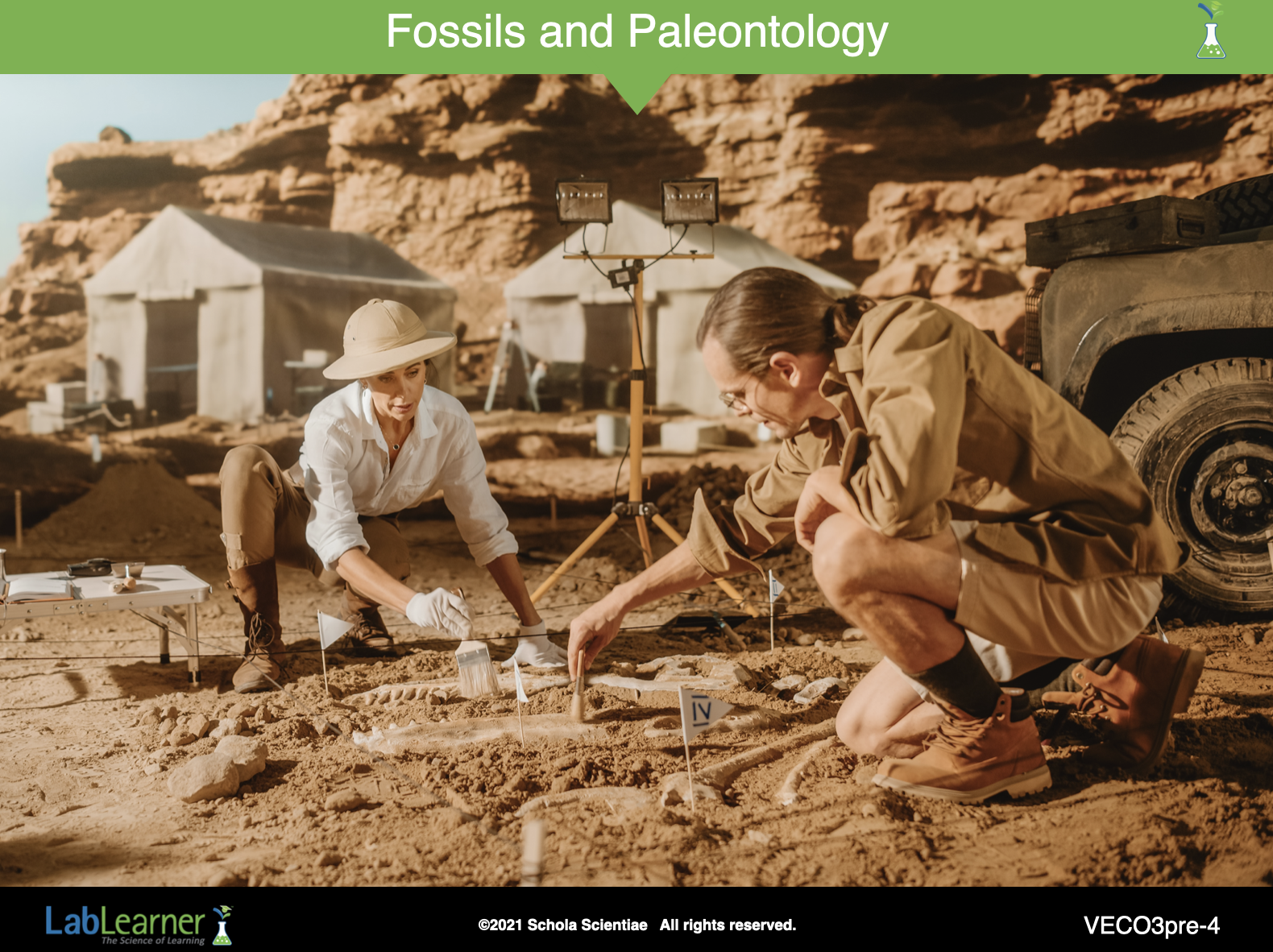
d. Ask students: If dinosaurs are extinct, how do we know about them? Student answers may vary. Some students may suggest that we know about dinosaurs because fossils of dinosaur bones have been found.
e. Explain to students that we know about dinosaurs because dinosaur fossils have been found. Read the definition of fossil on the Scientist’s Glossary or ask for a student volunteer to read the definition:
Fossil: the remains or impressions of plants and animals which lived on the Earth in the past and are now preserved in rocks.
Tell students that scientists that study fossils are called paleontologists. Point out the definition of a paleontologist in the Scientist’s Glossary:
Paleontologist: a scientist who uses fossils to study organisms that lived in ancient times.
2. Tell students that paleontologists can determine when organisms were alive on Earth and when they became extinct based on the fossil record. The fossil record acts as a timeline. Fossils that are found in the older, deeper layers of the Earth’s crust are of organisms that lived very long ago. Fossils found closer to the Earth’s surface are of organisms that lived more recently or that still exist on Earth today.
______________________________________________
SLIDE VECO3-pre-5
C. Introduce students to layers in the fossil record with the following two slides.
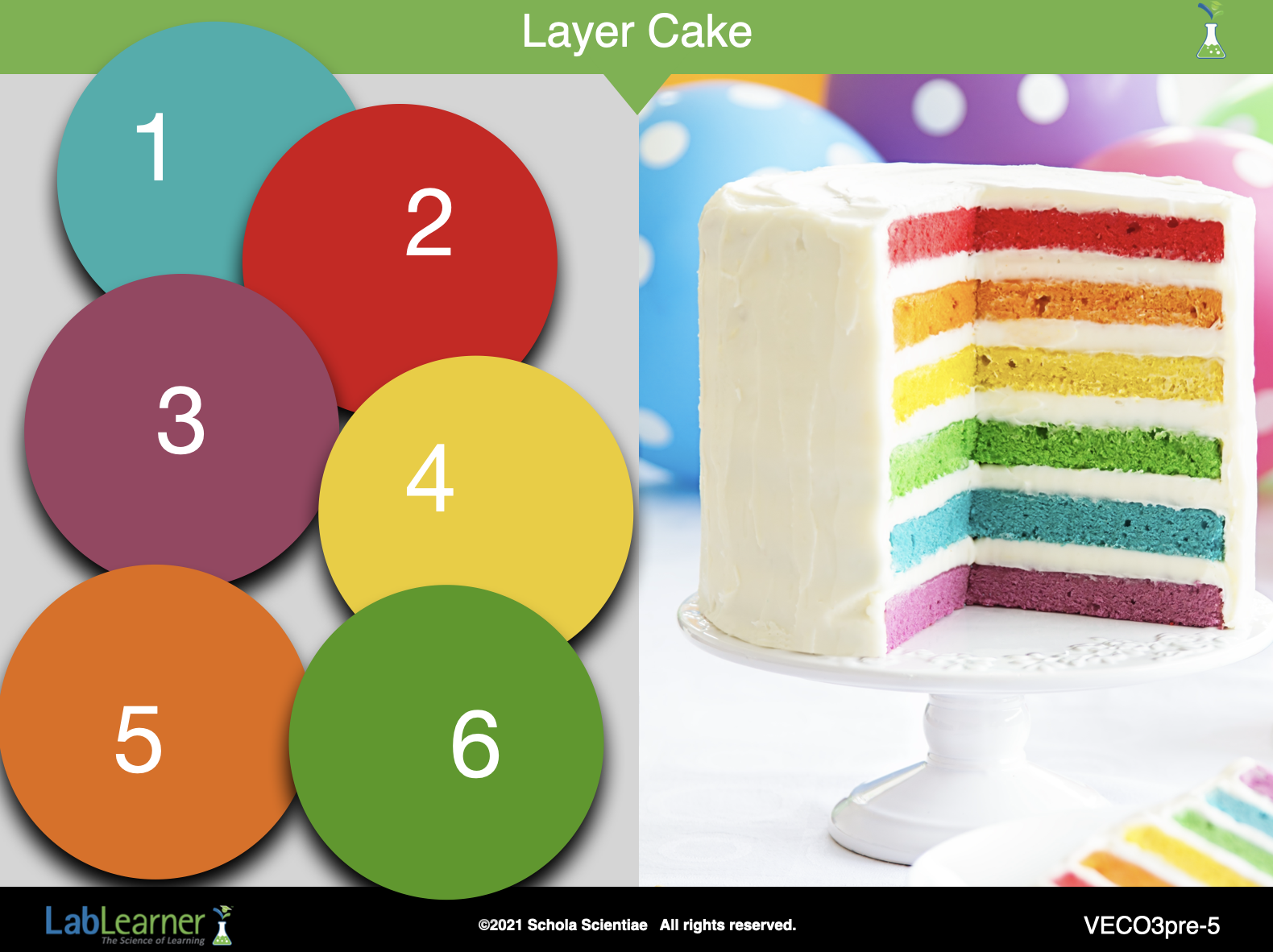
Look at the colorful layer cake on the right. It was made from the colored cake layers on the left side of the slide.
1. Ask students: If we want to assemble the cake on the right from the layers on the left, which layer would we start with? We would start with the purple layer “3”.
2. Ask students: How do you know that the baker didn’t put down layer “4” first? If layer “4” was put down first, it would be on the bottom in the finished cake.
3. Ask students: By looking at the finished cake, can you tell the order in which the layers were stacked? Yes, you can tell the order by seeing which layers are on top of each other.
4. Ask students: Can you list the order in which all of the layers were laid down? Yes, the layers were put down in the following order: 3, 1, 6, 4, 5, the layer 2 was laid down last.
5. Ask students: If the layers of the cake were used as a model for layers of rock in the fossil record, which layer would have been laid down closest to the present time? Which would be the “oldest” layer? The most recent layer would be layer 2 and the “oldest” layer would be layer 3.
6. Ask students: So, if you go from top to bottom, are you going forward or backward into time that the layer was added to the cake? You would be going backward in time. The bottom layer is the oldest and the top layer is the most recent.
______________________________________________
SLIDE VECO3-pre-6
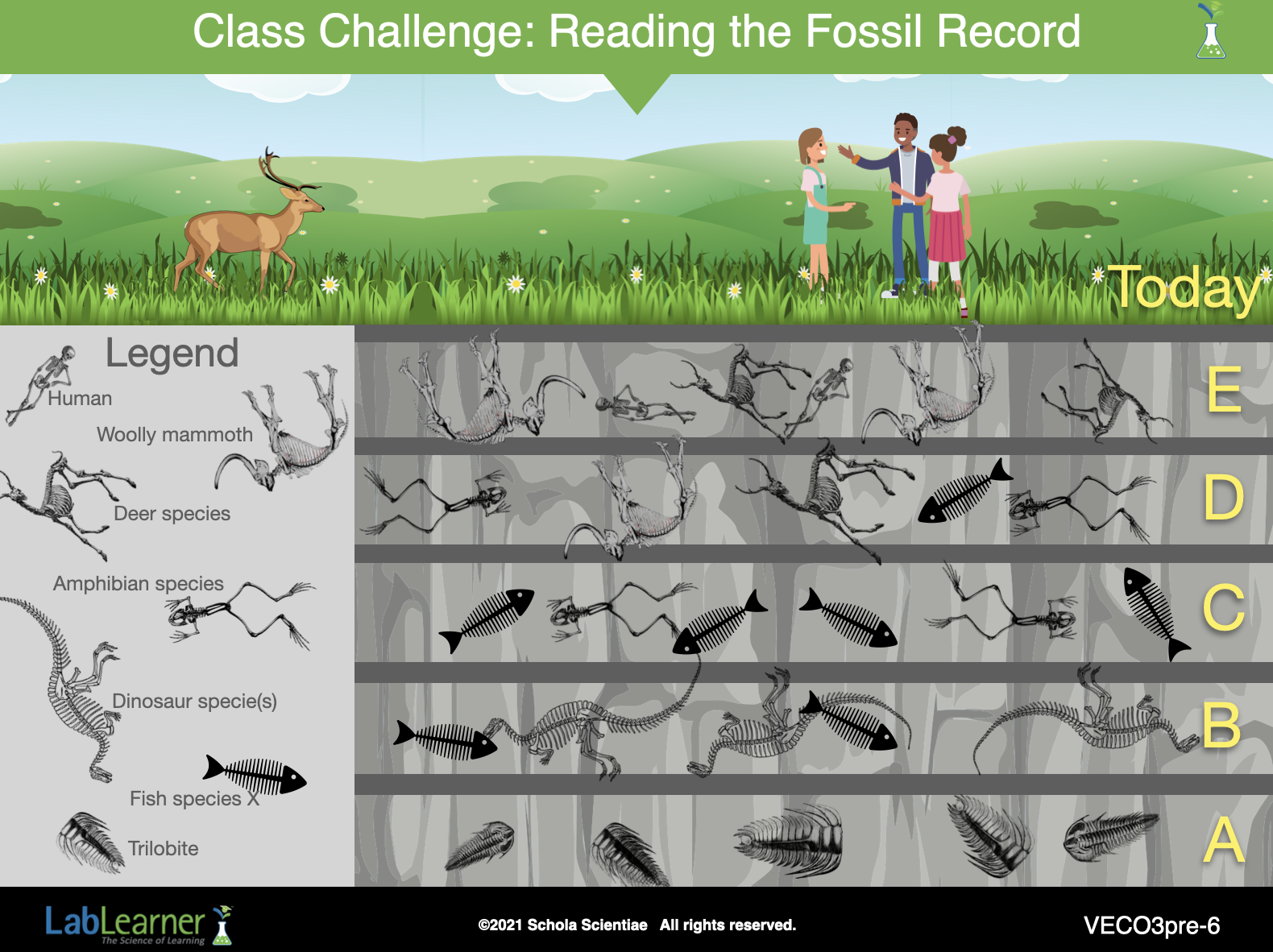
Look at the fossil-containing rock layers. Also, notice that there is a legend on the left to help identify the fossils found in the different layers.
1. Ask students: Which layer was formed longer ago, layer B or layer D? Layer B formed longer ago than layer D.
2. Ask students: Which layer contains the oldest fossils in these layers of rock? Layer A
3. What was the main type of animal that lived during the time layer A formed? Trilobites.
4. Why do you think that there are no trilobite fossils found in layer B? The trilobites likely became extinct.
5. Are trilobites found in any of the more recent rock layers (layers C through to today)? No, they appear to have disappeared from the fossil record between the time layer A and layer B formed and have never been seen again. The trilobites became extinct.
6. What fossils are found in layer B? Dinosaurs and fish fossils.
7. What conclusions might you draw from comparing layer B to layer C? The dinosaurs are no longer found in layer C, so they may have become extinct between the time layers B and C formed. The fish species that was present in layer B is more abundant in layer C. Finally, a new amphibian species appears for the first time in layer C.
8. What conclusions might you draw from comparing layer C to layer D? The fish species that was very abundant in layer C is far less abundant in layer D. The amphibian species that appeared first in layer C is still present in layer D. Finally, a new species of deer and wooly mammoth appear in the more recent layer D.
9. What conclusions might you draw from comparing layer D to layer E? The fish species that was found in layer D is no longer found in layer E, therefore it may have become extinct by the end of layer D. The amphibian species that was found in layer D is also absent from layer E, so it may have become extinct around the same time as the fish spices in layer D became extinct. Finally, human fossils are also found in layer E.
10. What conclusions might you draw from comparing layer E to today? The deer species and humans are still present today, however, the wooly mammoth has become extinct and is not found today.
______________________________________________
SLIDE VECO3-pre-7
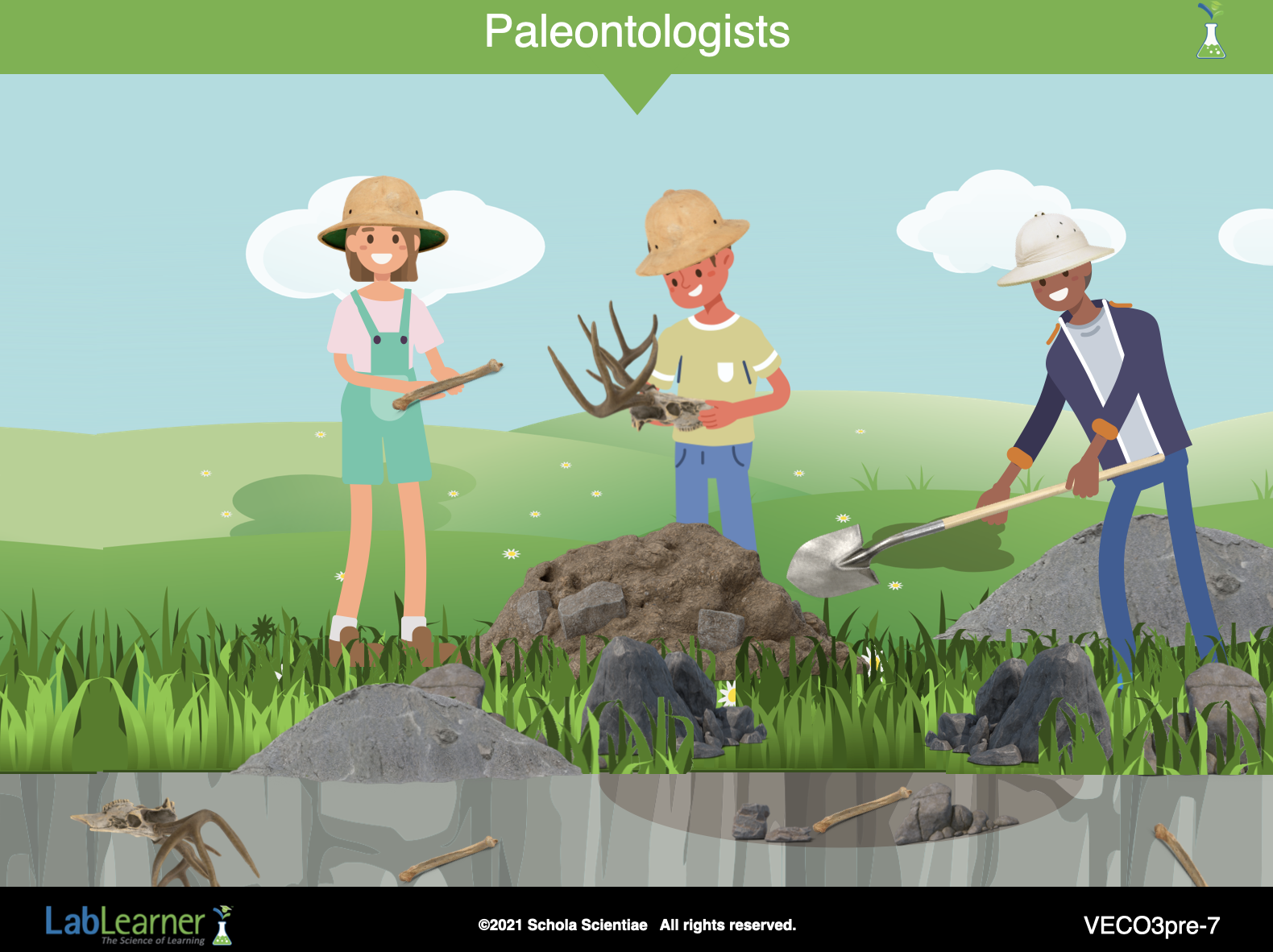
D. Look at the three paleontologists as they dig for fossils.
1. Ask students: If I am a paleontologist looking for fossils and I begin digging, which fossils will I find first? The first fossils will be from animals and plants that most recently died and were buried.
2. Ask students: Does an organism have to be extinct to be found in the fossil record? No. Guide students to understand that a fossil can form whenever an organism dies and the right conditions exist to make a fossil. Just because one organism dies does not mean that all of the animals of that kind have died off and become extinct.
3. Ask students: How can differences in when rock layers form help paleontologists to figure out where an organism has become extinct? Student answers will vary. Explain to students that paleontologists can only determine when an organism went extinct by looking at newer layers of rock. If fossils are not found in newer layers of rock then the organism went extinct during the time period of the highest layer of the fossil record where fossils of the organism are found.
______________________________________________
SLIDE VECO3-pre-8
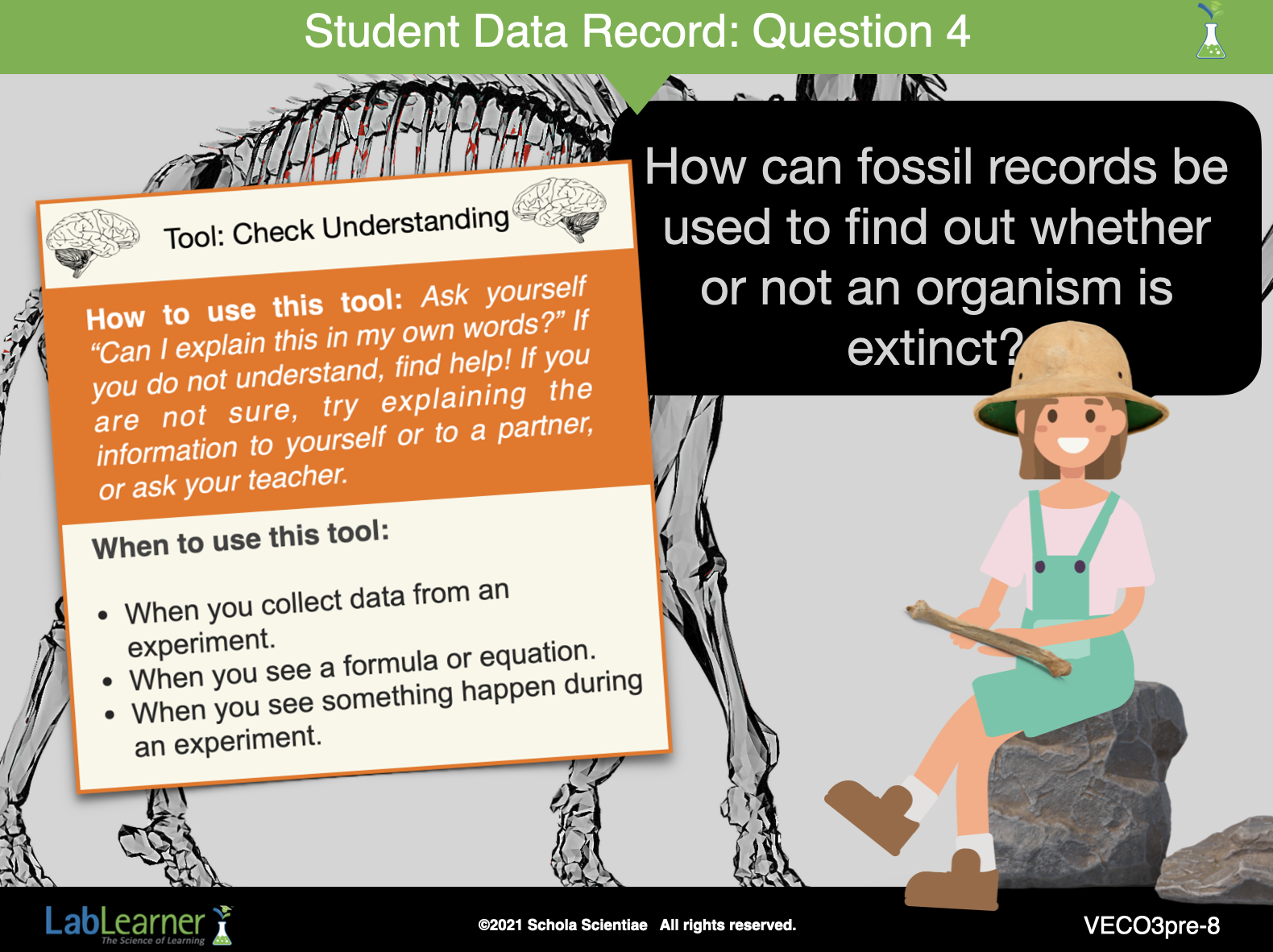
Tell students that after being introduced to something new, it is helpful to use the Check Understanding cognitive tool. Students can stop and check their understanding by explaining something in their own words. Understanding extinction and the fossil record at this point will help prevent confusion later. Explain that if a person is confused about something, he or she will probably not remember it. Using the Check Understanding tool will help students remember what they learned about the fossil record.
Ask students to read Problem 4 in their Student Data Records. Instruct them to turn to their partner and answer the question in their own words. After discussing the answers with their partners, students should write their answers in their Student Data Records. Then review the answers as a class:
4. Ask students: How can fossil records be used to find out whether or not an organism is extinct? Fossil records allow paleontologists to study the order in which organisms lived and died because as time passes new layers of rock form on the Earth’s surface. The layers trap the remains of plants and animals. Older layers and older fossils can be found underneath newer layers and fossils. If paleontologists find fossils of a type of organism in old and new layers it is a sign that the organism is not extinct. If no fossils of the organism are found in new layers, it is probably extinct.
Reinforce to students that if they had not stopped to check their understanding by using their own words and listening to what their partner was thinking, they might not know how the fossil record can be used to determine when organisms lived and when organisms became extinct. By checking understanding, students will be better able to use their knowledge later on in this Investigation.
______________________________________________
SLIDE VECO3-pre-9
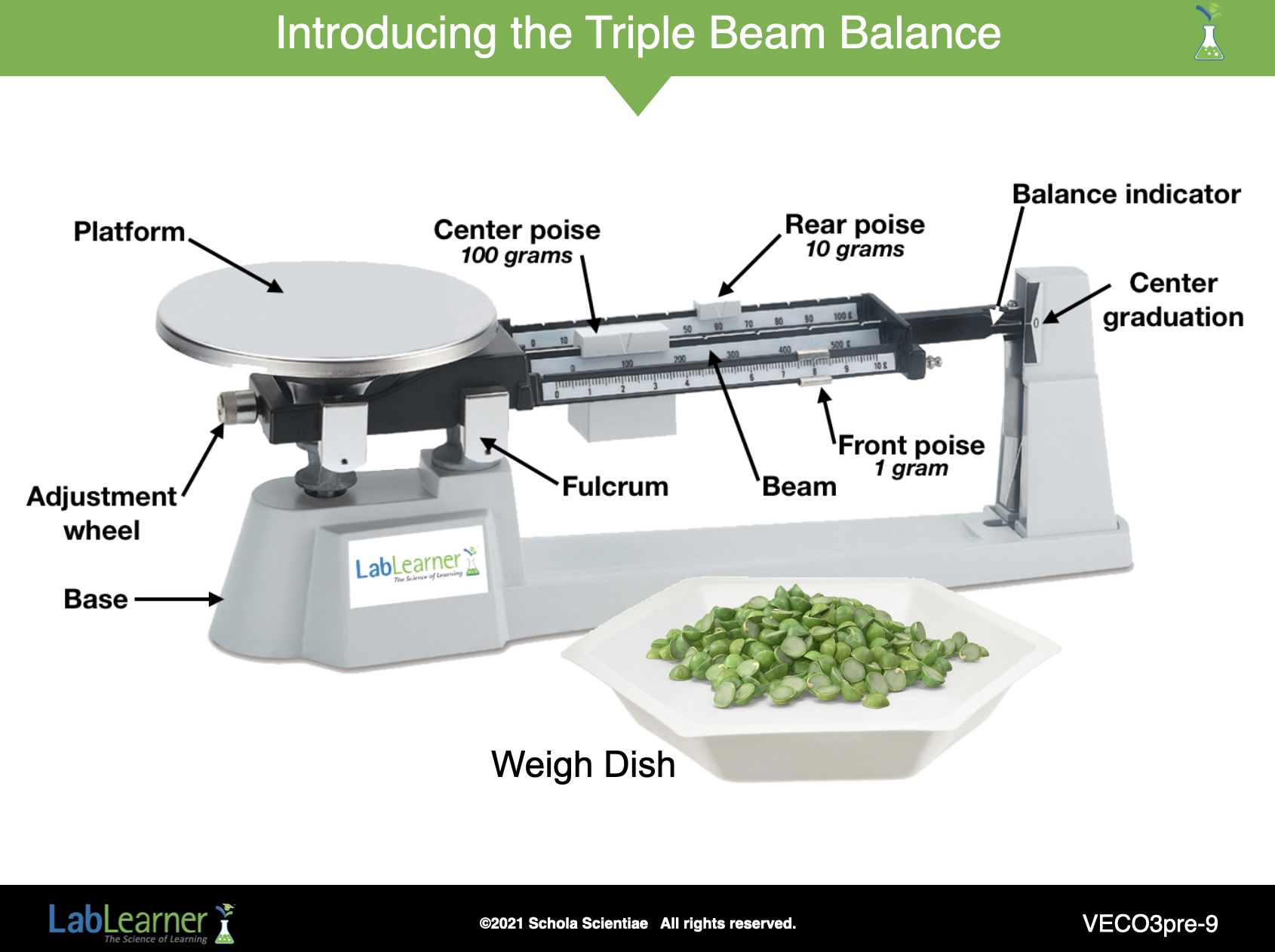
In Investigation 3 Lab, students will be introduced to the triple beam balance. This tremendously useful instrument will be used time and again for the rest of LabLearner through the eighth grade.
The triple beam balance is so useful because it permits us to measure the exact mass of an object or sample down to less than a gram. Such accuracy is essential for all of the more complex experiments beginning in the fourth grade forward.
NOTE TO TEACHER: In Investigation 3 Lab, the first section is devoted to learning to use the triple beam balance. If scheduling permits, this first section of the Lab might be broken out into a separate trip to the lab for students to simply learn to use this important instrument. In this case, once students have initially gone through the steps of the instructions, they may then experiment” with the triple beam balance to determine the mass of various items around the lab such as a beaker, pencil, watch, book, or shoe. Keep in mind that the balance can only mass items up to about 600 grams.
______________________________________________
SLIDE VECO3-pre-10
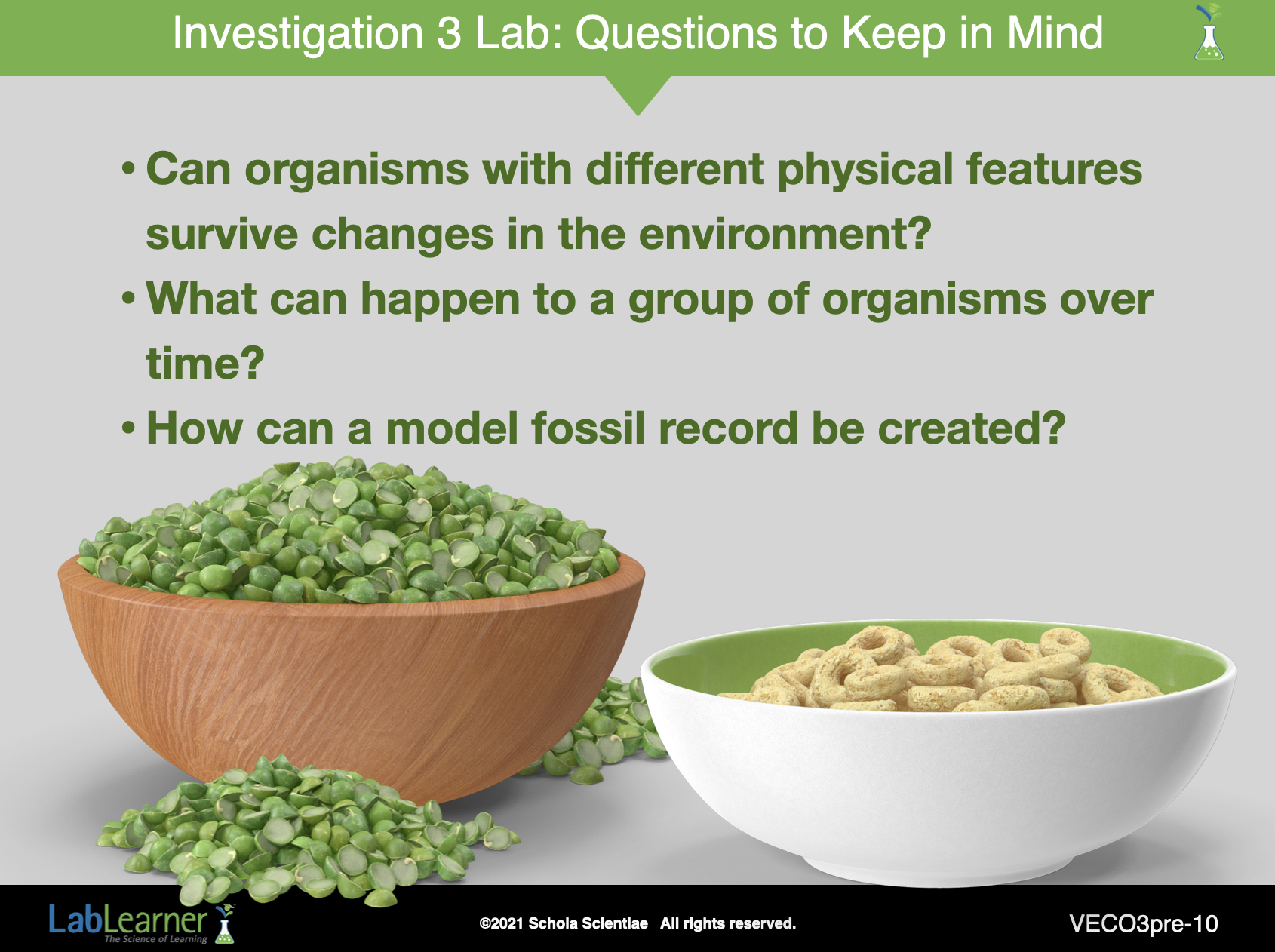
E. Provide closure to the lesson by posing questions that students will answer in the Lab. These questions are:
Can organisms with different physical features survive changes in the environment?
What can happen to a group of organisms over time?
How can a model fossil record be created?
______________________________________________
Student Video
Watch the two Investigation 3 Student Videos after the Share It presentation to prepare for the PreLab.