Teacher Portal:
Exploring Time and Sequence
Exploring Time and Sequence
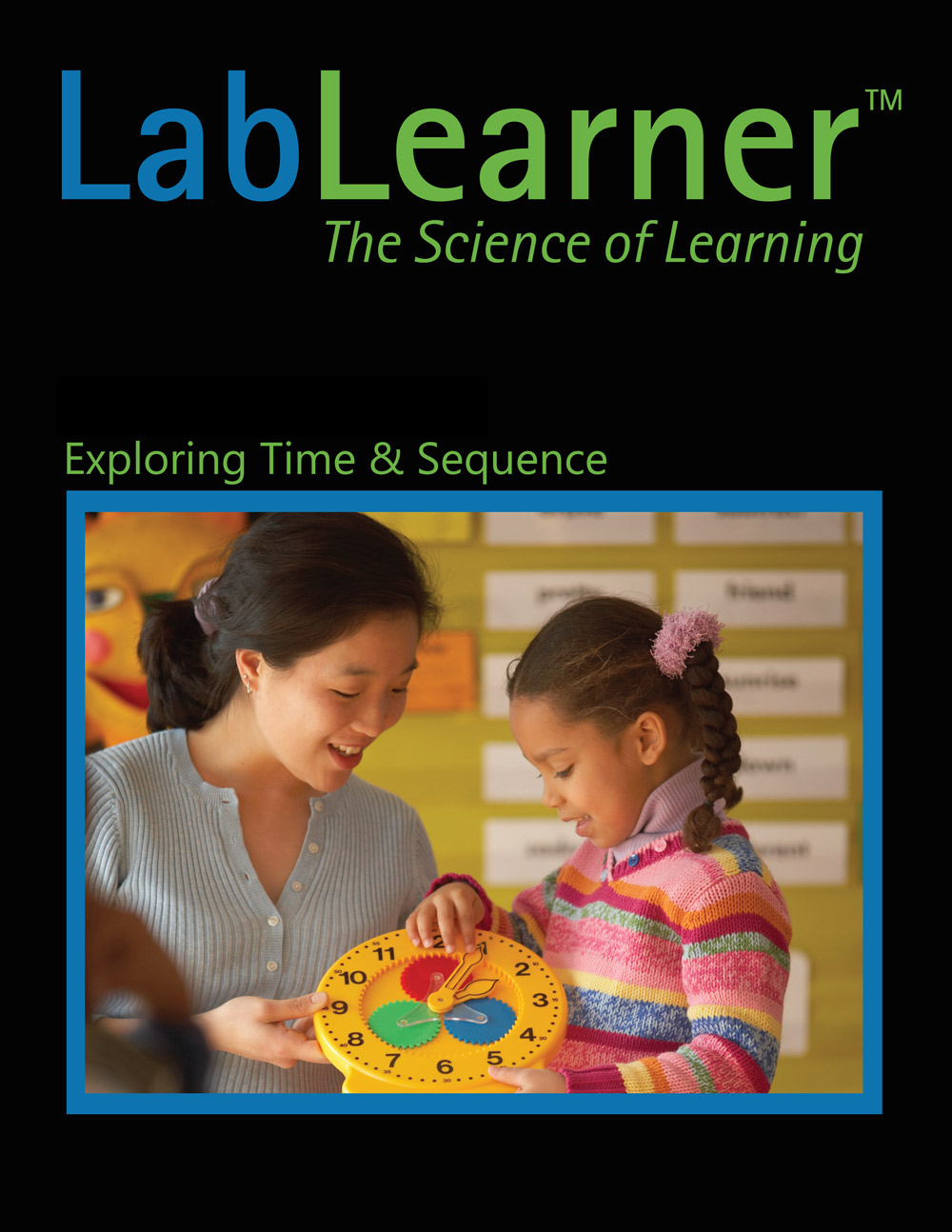 During this CELL, students will perform activities and conduct experiments that will introduce them to the concepts of time and sequence. Through their explorations, students will come to a better understanding that time is a measurement that can be used in the lab. It can be used to record how long it takes to perform a task or how long it takes for change to occur. In addition, they will have an opportunity to follow a specific sequence of steps in an experiment in order to obtain a specific result.
Students begin their investigation by adding three liquids or two liquids and one solid to beakers. After the addition of the first two substances, students are encouraged to make a prediction. They are asked to predict how the third addition will interact with the first two substances already in the beaker. As a result of their experiments, students learn that not all liquids are able to mix together, not all solids and liquids are able to mix together, and that the sequence in which steps of an experiment are performed may change the outcome of the experiment.
As a part of their investigations, students will also observe how objects change over time. Their observations will focus on ice cubes that are exposed and protected from heat, food coloring that is dropped in hot and cold water, and baking soda, and a piece of chalk that is added to vinegar. Students will use two different types of timers in this investigation: an egg timer and an hourglass timer. Through these experiments, students will discern that the time it takes for change to occur in objects and substances differ. Some changes occur over long periods of time and others occur over short periods of time.
Students end their investigations by exploring the concept of rate. As a part of their experiments, they will first compare the weights of two objects using a pan balance. The weights will be attached to a swing model and their effect on the swings’ rate of motion investigated. In order to do this, students will test how many swings are completed in a specific time period when both the heavy and light objects are placed on the seat of the swing. The swing model will also be shortened to test whether the length of the swing affects the rate of the swing’s back and forth motion. Through their experiments, students should discern that the weight attached to the swing does not change the rate of a swing’s back and forth motion, but the length of the ropes of the swing model does change its rate.
As students complete this CELL, their experiments, observations, and participation in class discussion will aid them in conducting investigations of the biological and physical world and in sharing the findings of these experiments. In addition, this CELL will promote students’ awareness of the use of time and sequence in the lab as well as in their daily life, building continuity between laboratory investigations and real-world applications and encouraging independent investigation.
___________________________________________________________________
Investigation 1: Temporal Sequence
Investigation One introduces students to the concept of sequence through an investigation of some of the properties of solids and liquids. By mixing together vegetable oil and water, cherry powder and water, and cherry powder and vegetable oil, students will discover that not all liquids mix together and not all solids and liquids mix together. In addition, they will combine each of the substances in different sequences, and observe whether the change in a sequence affects the results of the experiment. Through this investigation, students will come to realize the importance of understanding sequence and following a specified sequence of steps when performing experiments.
Investigation 1: Teacher’s Video (10:57)
Investigation 1: Student’s Video: Trials 1 and 2 (13:18)
Investigation 1: Student’s Video: Trials 3 and 4 (8:54)
___________________________________________________________________
Investigation 2: Passage of Time
In Investigation Two, students will add to their experience by observing change over time. Students will first observe a demonstration of two ice cubes: one ice cube that sits under a lamp and another that remains “shaded.” Students will then compare the appearance of each ice cube over a period of time. In the second set of experiments, students will drop food coloring into cold and hot water and observe differences in the time it takes for the dye to spread in each temperature water. In their third experiment, students will add baking soda and a piece of chalk to two beakers containing vinegar. Students will then observe differences in the amount of time it takes for a reaction to be completed. Their observations will enable them to realize that changes occur over different periods of time. In addition, students will utilize two different timers to measure time in the lab: an egg timer and an hourglass timer.
Investigation 2: Teacher’s Video (5:58)
Investigation 2: Student’s Video (19:04)
Click on the image below to open Investigation 2 CAP
___________________________________________________________________
Investigation 3: Exploring Rate
During Investigation Three, students will be introduced to the concept of rate and how it can be determined during a scientific experiment. Students will investigate the rate by counting the number of swings per time in a model of a playground swing, an example of a simple pendulum. While performing several simple tests, students will change the weight added to the seat of the swing and the length of the swing. In doing so, they will observe several concepts of a pendulum: that the mass of the object at the bottom of a pendulum does not affect its rate of oscillation (back and forth movement); but that the length of the string does produce changes in the rate of a pendulum’s motion. Students will apply their conclusions to their own lives, by discussing what they can do to make a swing move at a faster and slower rate.
Investigation 3: Teacher’s Video (7:31)
Investigation 3: Student’s Video (11:32)
Click on the image below to open Investigation 3 CAP
___________________________________________________________________