
Teacher Portal:
Exploring Time and Sequence
Exploring Time and Sequence: CAP – Investigation 3
 ZERO-IN
Italicized font represents information to be shared orally or physically completed with the students at this time.
Non-italicized font represents additional information included to support the teacher’s understanding of the content being introduced within the CELL.
BRANCH OUT
Explain to students that engineers use forces to push and pull and change the direction of moving things all the time when they design machines. In addition, many different occupations involve the physical application of force to push and pull objects such as loads of bricks and lumber at construction sites. We will also see that athletes use push and pull forces all the time when they play their sport.
PRINT IT
Use your browser to download a printable PDF as a help during the slide presentation and to make additional notes. In your browser, go to File > Print and then choose to save as PDF.
NAVIGATE IT
Once the slide presentation is launched
- use your left and right arrows to advance or go back in the slide presentation, and
- hover your mouse over the left edge of the presentation to get a view of the thumbnails for all the slides so that you can quickly move anywhere in the presentation.
- Click on the button below to launch the slide presentation for the CELL.
SHARE IT
Slide TIME 3-1:

This short CAP is simply to have students consider the pushes and pulls that they see in everyday life. This is of course a very early introduction to the concept of force. Force is a basic science concept that will be developed in your students’ science education for many years to come. At this point however, we would just like for students to be able to identify pushes and pulls and the way that applying a push or a pull (applying force) can change the direction of a moving object, cause an object to move or stop a moving object.
Slide TIME-3-2:
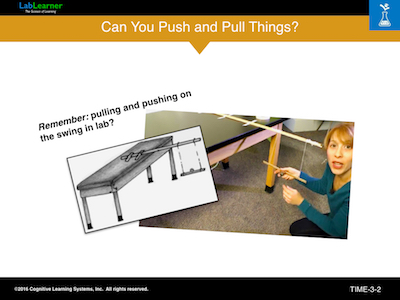
This slide is included to remind students of the simple swing simulation that they experienced in Investigation 3 lab. While in lab, the primary discussion was not about the forces involved in the swing’s motion, in this CAP we will build on the experience to simply introduce the notion of pushing and pulling force.
Slide TIME-3-3:
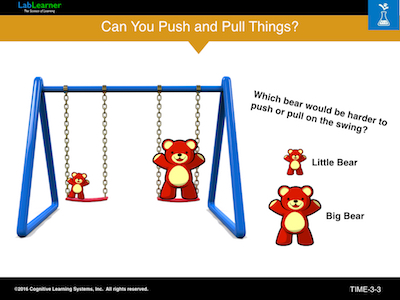
Young students are much more likely to think of how hard or easy something is to push or pull rather than how much force is applied to push or pull. In discussing this slide, students should be able to correctly suggest that the big bear would be harder to push or pull.
Note: The big bear would appear harder to push or pull on the swing because it would require more force to to be pushed or pulled. This concept is demonstrated in a simple experiment introduced on the next slide.
Slide TIME-3-4:
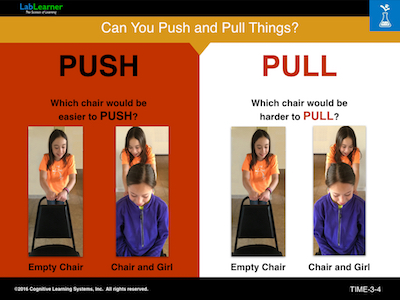
This simple experiment should be performed by pairs of students in the classroom. By using their muscles and own body weight, students will discovery the increased physical effort (force) to push or pull the chair with a student sitting in it as compared to the empty chair.
Note: Notice that the two questions are stated slightly differently (…easier to push versus …harder to pull) so that students can hear the words used in different combinations.
Slide TIME-3-5:
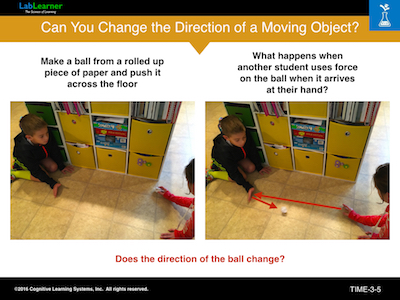
This is another fast and fun experiment. Here we simply want to show students that by apply a force (pushing the paper ball across the floor) and then the other student pushing the ball again when it comes near him or her, that the ball’s direction can be changed.
Slide TIME-3-6:
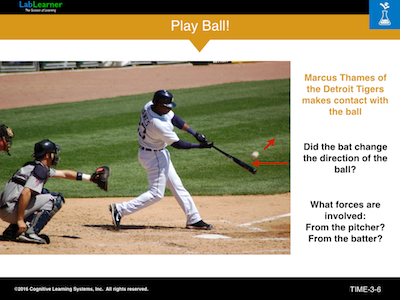
This final slide shows an example of pushing that occurs in the sport of baseball. The pitcher uses force to push the ball toward the batter. The batter uses force to push the ball in a different direction.
Perhaps you could ask students to think of other examples of pushes and pulls that they are familiar with. For example, pulling on a doorknob, kicking (pushing) a soccer ball, pushing the peddle on a bicycle and so on.