
Teacher Portal:
Investigating Sound
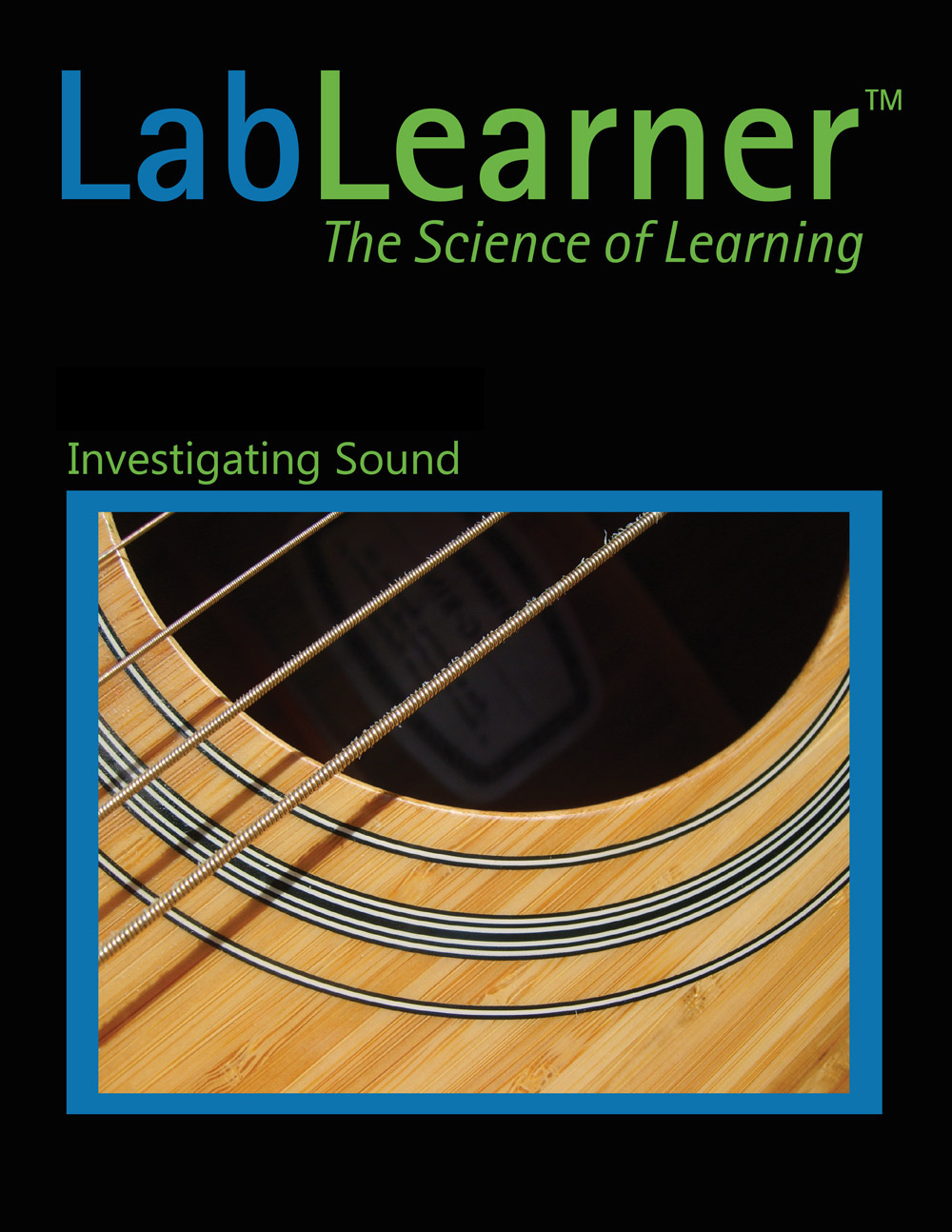 Investigating Sound
During this CELL, students will conduct several investigations focused on the properties of a sound and how a sound is produced and perceived as a sound. Through experimentation and observation, students will explore the process of how a sound begins as a vibration that travels through the three states of matter – solids, liquids, and gases – to reach the human ear, where the vibrations are transmitted as signals to the brain and translated as a sound.
Through various activities and experiments, students will discover that a sound is produced when an object vibrates. These vibrations are transmitted through matter surrounding the vibrating object as a sound wave. They will discover that a sound wave can move through gases such as the air we breathe, liquids such as water, and solids such as a table. This CELL gives students the opportunity to examine this process by creating models that duplicate how a sound is produced and heard.
Students will also investigate the properties of a sound. They will discover that the volume of a sound can be either loud or soft and change be changed by varying the amount of force applied to produce the sound. They will perform experiments that will enable them to understand that a sound can be muffled or amplified. Another property of sound – pitch – will be explored. Students will discover through various investigations that the properties of a vibrating object, such as its length, width, or tension, can determine the highness or lowness of its pitch. For example, students will observe that as water is added to a beaker the length of the vibrating column of air in the beaker shortens, thereby causing the column of air to vibrate faster and produce a sound higher in pitch.
This CELL will broaden students’ knowledge of how a sound is produced and heard, enabling them to have a greater understanding of and appreciation for the importance of the sounds they hear in their surrounding environment.
___________________________________________________________________
Investigation 1: Sound and Vibrations
In Investigation One, students will begin their study of sound by exploring that sound is caused by vibrations. They will create a model to simulate these vibrations by activating a ruler. The ruler will represent how a vibration produces a sound wave that can be heard by the human ear. Students will observe that when they vary the length of the activated ruler they change how the ruler vibrates. They will also observe, through the use of an activated tuning fork, that vibration can be felt.
Investigation 1: Teacher’s Video (7:21)
Investigation 1: Student’s Video (10:11)
___________________________________________________________________
Investigation 2: Sound and States of Matter
Students will continue their exploration of the sound in Investigation Two. They will create several models that allow them to hear sounds through the three states of matter – solids, liquids, and gases. Observing the models will help students to understand that vibrations can travel from a source, in this case, an activated tuning fork, to their ear where it is processed as a sound.
Investigation 2: Teacher’s Video (5:09)
Investigation 2: Student’s Video (10:47)
Click on the image below to open Investigation 2 CAP
___________________________________________________________________
Investigation 3: Sound and Volume
Investigation Three introduces students to a property of sound – volume. It provides them with the opportunity to discover that the volume of a sound can be changed by varying how hard the object producing the sound is struck. Students will also realize that how loud or soft the volume of the sound produced by an object can vary. Through the use of several models, students will understand that a sound can be muffled or amplified.
Investigation 3: Teacher’s Video (5:15)
Investigation 3: Student’s Video (10:49)
___________________________________________________________________
Investigation 4: Exploring Pitch and Sound
In Investigation Four, students will be introduced to another property of sound. Through the use of a demonstration in which a beaker is struck as water is added, students will observe that as an air column becomes shorter, the pitch it produces becomes higher. Students will discover that the length, width, and tension of an object will change the pitch produced by a vibrating object. They will observe that increasing the length or width of a rubber band lowers the pitch of the sound produced when they pluck the bands. They will also observe that increasing the tension of the rubber band causes its pitch to become higher. During another demonstration, students will also observe that as the length of an activated ruler increases, its vibrations became slower and lower in pitch.
Investigation 4: Teacher’s Video (13:42)
Investigation 4: Student’s Video (10:31)
___________________________________________________________________
Investigation 5: Applying the Properties of Sound
Investigation Five is designed to give students the opportunity to apply what they have learned during the previous four investigations. Students will observe a demonstration that shows how to construct a set of drums. They will explore the constructed drums to discover whether they can change their volume and pitch. They will construct a musical instrument that demonstrates one of the concepts of sound – volume, pitch, muffle, or amplify.
Investigation 5: Teacher’s Video (7:54)
Investigation 5: Student’s Video (7:13)
Click on the image below to open Investigation 5 CAP
___________________________________________________________________



Pre-Tests and Post-Tests
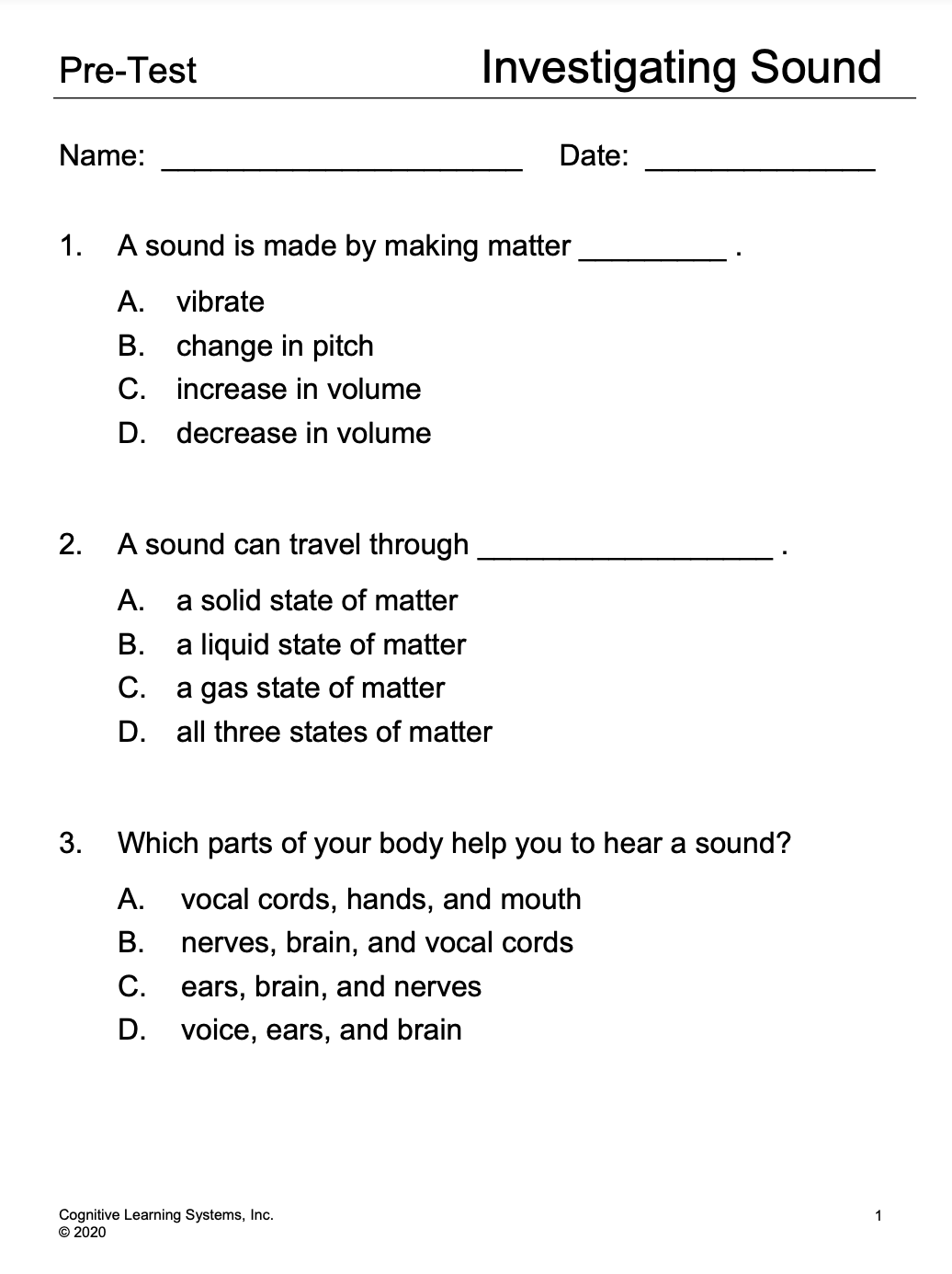
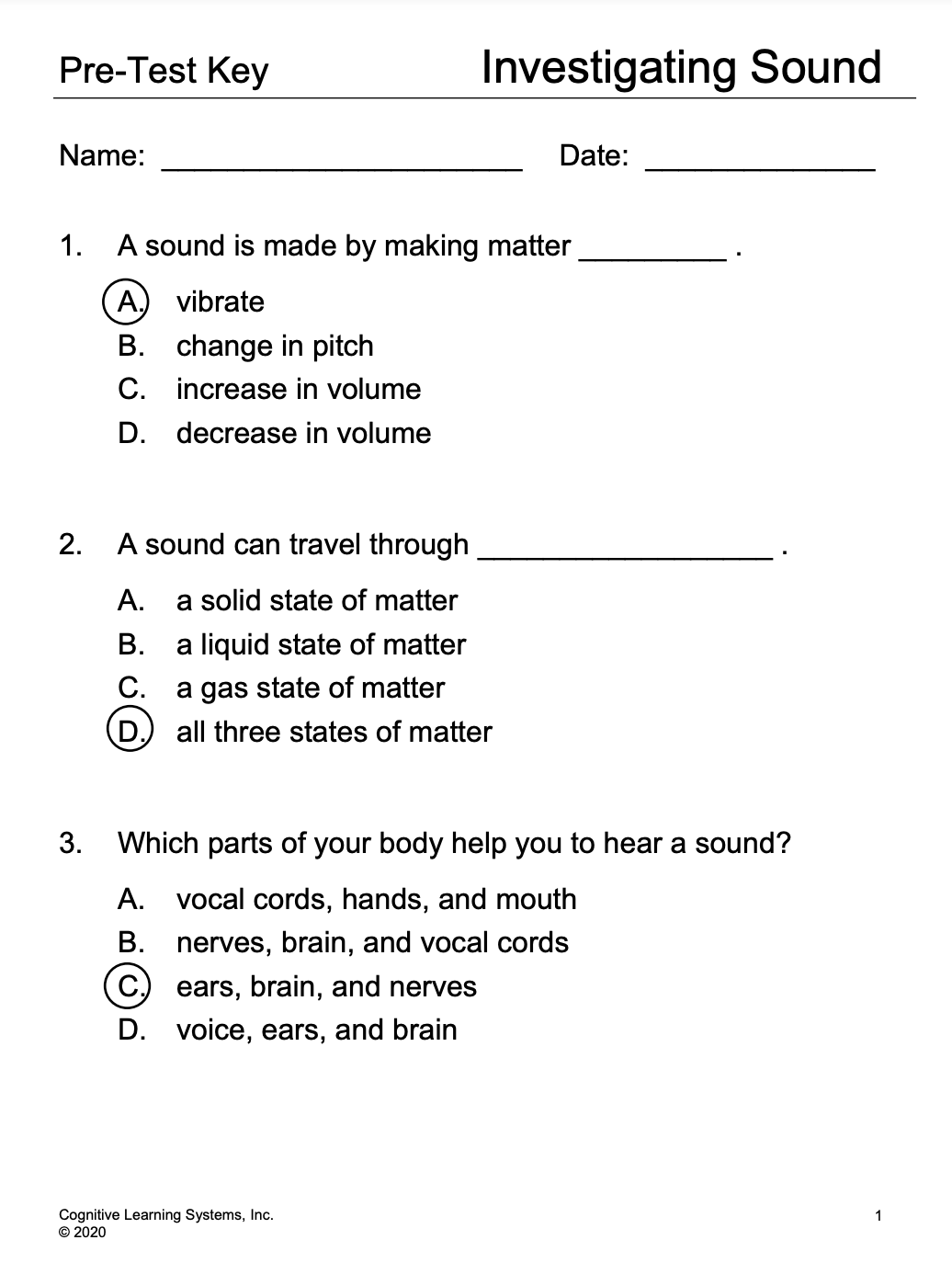
Pre-Test Key
Includes NGSS correlations
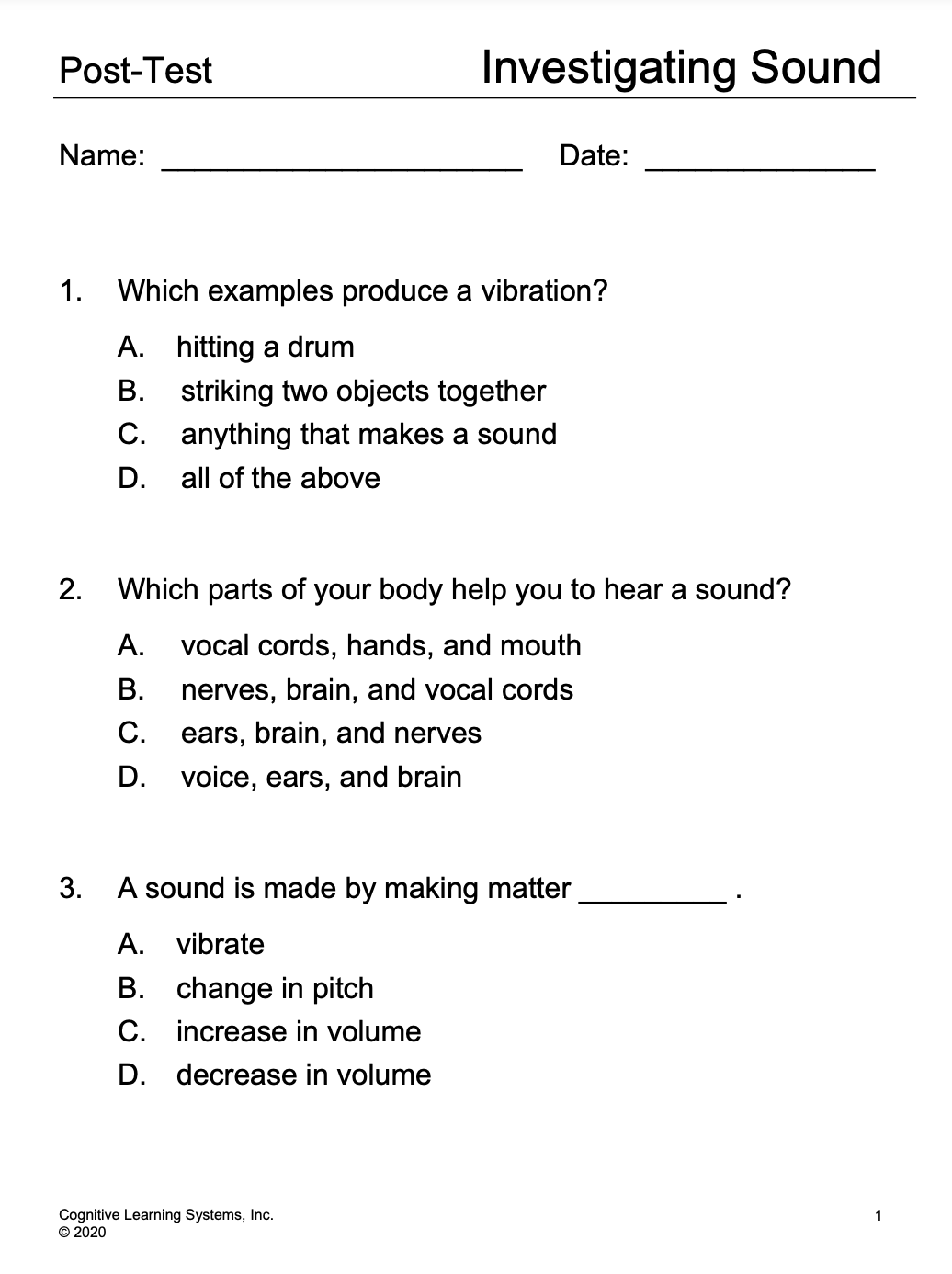
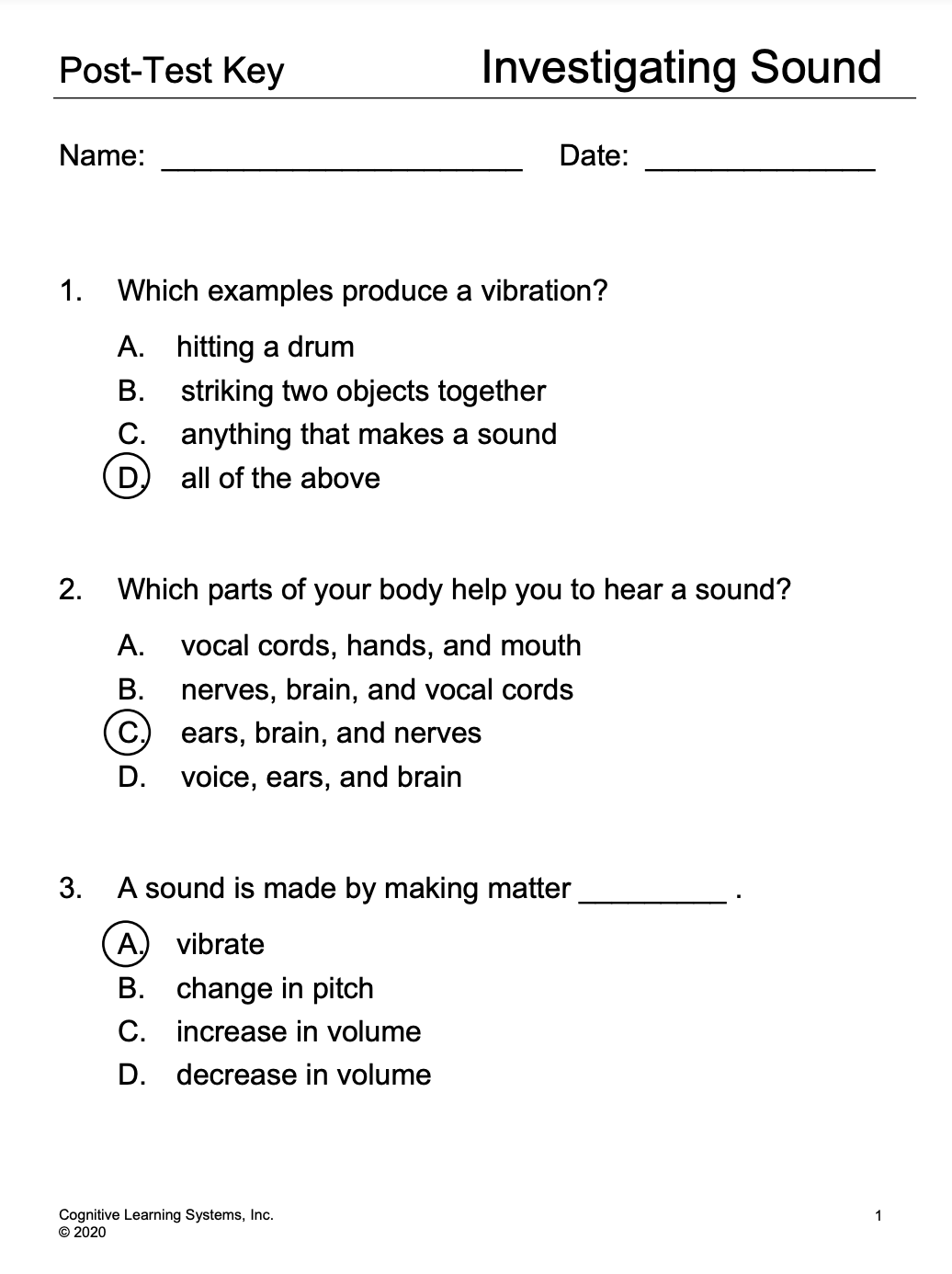
Post-Test Key
Includes NGSS correlations