
Teacher Portal:
Investigating Sound
 Investigating Sound: CAP – Investigation 2
ZERO-IN
Italicized font represents information to be shared orally or physically completed with the students at this time.
Non-italicized font represents additional information included supporting the teacher’s understanding of the content being introduced within the CELL.
BRANCH OUT
Explain to students that engineers use materials of all sorts to create new objects. Engineers often design tools and new inventions that help solve human problems. There are many different types of jobs that engineers perform and they all are interesting and important!
PRINT IT
Use your browser to download a printable PDF as help during the slide presentation and to make additional notes. In your browser, go to File > Print and then choose to save as PDF.
NAVIGATE IT
Once the slide presentation is launched
- use your left and right arrows to advance or go back in the slide presentation, and
- hover your mouse over the left edge of the presentation to get a view of the thumbnails for all the slides so that you can quickly move anywhere in the presentation.
- Click on the button below to launch the slide presentation for the CELL.
SHARE IT
Slide SOUND 2-1:
In this CAP we would like for students to solve a problem by constructing a tool. In lab, students performed experiments with sound. In this CAP they will build and test a megaphone as a means of increasing the volume of their voices.
Slide SOUND 2-2:
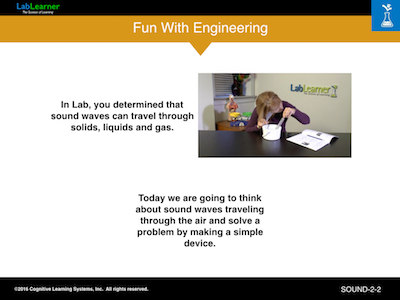
This slide is included to remind students of their recent lab experience in which they learned that sound waves travel through solids, liquids, and gases. Point out to students that in this CAP they will be concentrating on the sound that travels through the air and reaches our ears.
Slide SOUND 2-3:
This slide proposes a question to students, “Can we build a simple device that can make a sound easier to hear?” In this case, we are talking about making a sound louder, that is increasing its volume.
Slide SOUND 2-4:
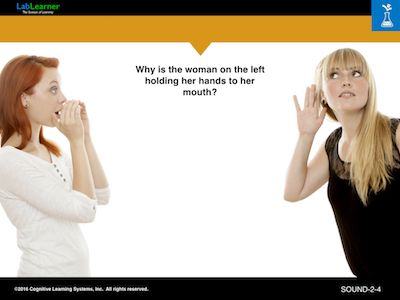
This slide shows the woman on the left cupping her hands to her mouth while the woman on the right puts her hand to her ear to hear better. In the next slide, the concept of a megaphone will be introduced. However, at this point, you might ask “Can you think of any tool or device that the woman on the left could use to make her voice louder?” Students may suggest using a microphone or a megaphone.
Slide SOUND 2-5:
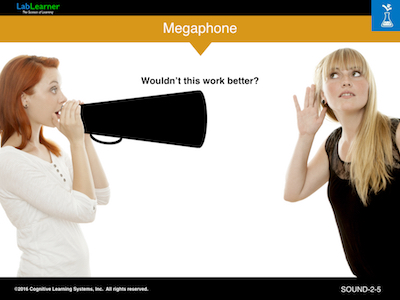
Interestingly, this slide depicts how a useful device may simply be an extension of a human structure. In this case, the megaphone essentially extends the size/area of the woman’s cupped hands. Can you think of other examples in which a device is used as an extension of the human anatomy? Potential answers include: a baseball glove to extend the size of a hand, a step-stool to make you taller, shoes to toughen the soles of our feet, a hat to help our hair protect us from too much sun, a club to extend and harden the arm for defense, and so on. Many inventions were conceived as simple extensions of the human body.
Slide SOUND 2-6:
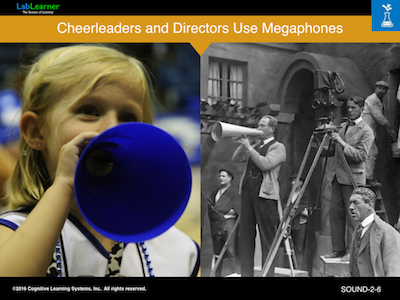
This slide and the next simply show examples of how megaphones are used (or have been used) and who uses them. Here we see a cheerleader and a film director using a megaphone.
Slide SOUND 2-7:

This slide shows additional examples of how megaphones are used. Here a lifeguard and a bugler use a megaphone. Students might remark that electronic devices such as microphones have replaced megaphones in some instances.
Slide SOUND 2-8:
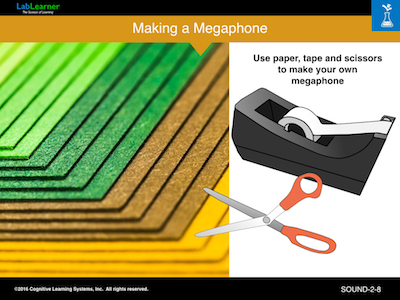
This slide presents the materials that students can use to build their own megaphones. The teacher can decide how much further instruction his or her students will need. Obviously, the less instruction provided, there greater the creative and problem-solving skills will be required on the students’ part.
Slide SOUND 2-9:
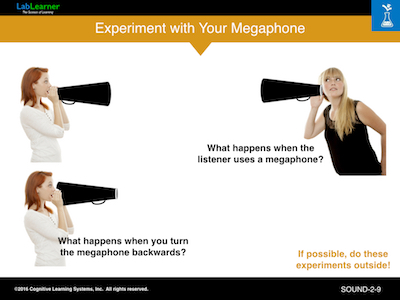
This final slide shows the megaphone in use. The students should experiment with their megaphones. The slide suggests two things to try: the speaker inverting the megaphone (which should decrease the speaker’s natural volume) and the listener using a megaphone (which should increase the volume to them). As noted, do these experiments outside if possible. This is to cut down the reflected sound that occurs indoors from ceilings, floors, and walls.