
Teacher Portal:
Investigating Sound

Investigating Sound: CAP – Investigation 5
ZERO-IN
Italicized font represents information to be shared orally or physically completed with the students at this time.
Non-italicized font represents additional information included supporting the teacher’s understanding of the content being introduced within the CELL.
BRANCH OUT
Explain to students that engineers use materials of all sorts to create new objects. Engineers use steel and concrete to build bridges and skyscrapers. They use circuit boards and wires to build the whole array of electronic devices that we have in the world today. There are many different types of jobs that engineers perform and they all are interesting and important!
PRINT IT
Use your browser to download a printable PDF as help during the slide presentation and to make additional notes. In your browser, go to File > Print and then choose to save as PDF.
NAVIGATE IT
Once the slide presentation is launched
- use your left and right arrows to advance or go back in the slide presentation, and
- hover your mouse over the left edge of the presentation to get a view of the thumbnails for all the slides so that you can quickly move anywhere in the presentation.
- Click on the button below to launch the slide presentation for the CELL.
SHARE IT
Slide SOUND 5-1:

In this CAP we would like for students to think about how the same materials can be recombined to create many different kinds of objects. This is a wonderful introduction to the field of engineering. Engineers use existing materials and techniques to make new and useful products. The difference between a scientist and an engineer are sometimes not obvious when it comes to the development of new products. Scientists are more likely to study the properties of materials to understand their physical attributes in very great detail. Engineers, on the other hand, are more likely to use the materials to create new objects of use to people. However, such differences between scientists and engineers are not always clear. Nonetheless, engineers are required to have a very good understanding of the scientific principles behind the materials they use.
Slide SOUND 5-2:
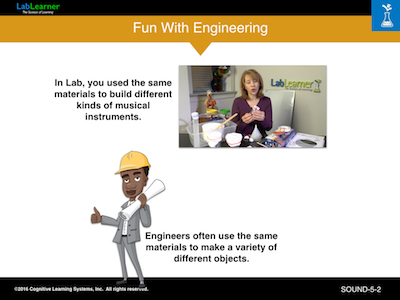
This slide is included to remind students of their recent lab experience in which they used various materials to build different musical instruments. As explained here, engineers do this type of activity all of the time. Engineers use available materials in different combinations to create new and useful products. In this CAP, students will see several ways in which engineers design new products.
Slide SOUND 5-3:
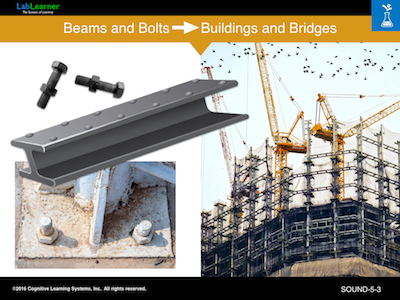
This is the first of three slides that highlight how engineers use materials in different combinations to create new objects. The left of this slide shows some of the building materials that engineers and architects may use to build enormous structures. The teacher may ask his or her students “What other types of structures or objects can be built from these same materials on the left?“. Typical answers may include bridges, communication towers, stadiums and so on.
Slide SOUND 5-4:
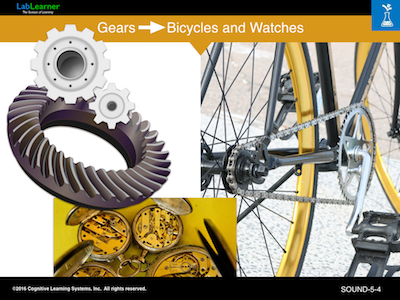
This slide shows another type of building material – gears. Most students will be familiar with the use of gears on a bicycle. Point out that watches and other mechanical devices rely on the use of gears as well.
Slide SOUND 5-5:
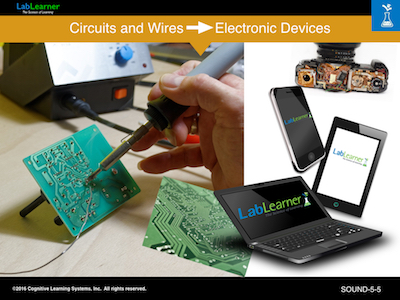
This is the third slide that shows how the same starting materials can be used to construct a whole array of different products. In this case, circuit boards, solder and wires are used in different combinations and designs to produces the wonderful electronic devices that we use everyday.
Slide SOUND 5-6:
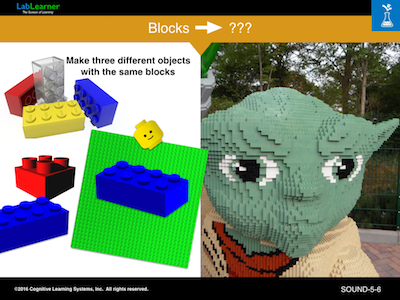
This is the first of two slides that introduce a quick activity that students can perform at their desks. Students work with building blocks all of the time. This is very similar to what engineers do. That is, they use similar materials to create objects that may be very different when built.
Slide SOUND 5-7:
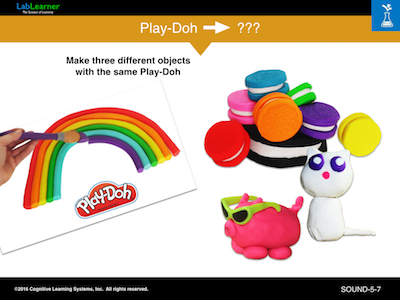
This final slide shows another type of material that most students will be very familiar with – Play-Doh (modeling compound). This is another case where the same starting materials can be used to make many different types of objects.
NOTE: It is not necessary for students to use both Play-Doh and building blocks in this activity. The teacher may wish to have certain groups of students use just one or the other. The important thing is to discuss building with either blocks or modeling clay in the context of engineering, as students will have countless times to recall this connection when they use these and other materials for play in the future.