
Teacher Portal:
Our Solar System
Investigation 4
Investigation Four: The Phases of the Moon
During Investigations One through Three, students explored the planets and their relationship to the Sun. Students have modeled rotation and revolution, made observations about the energy from the Sun, and explored the cause of the seasons on Earth. In Investigation Four, students will more closely explore the Moon and its movement around the Earth.
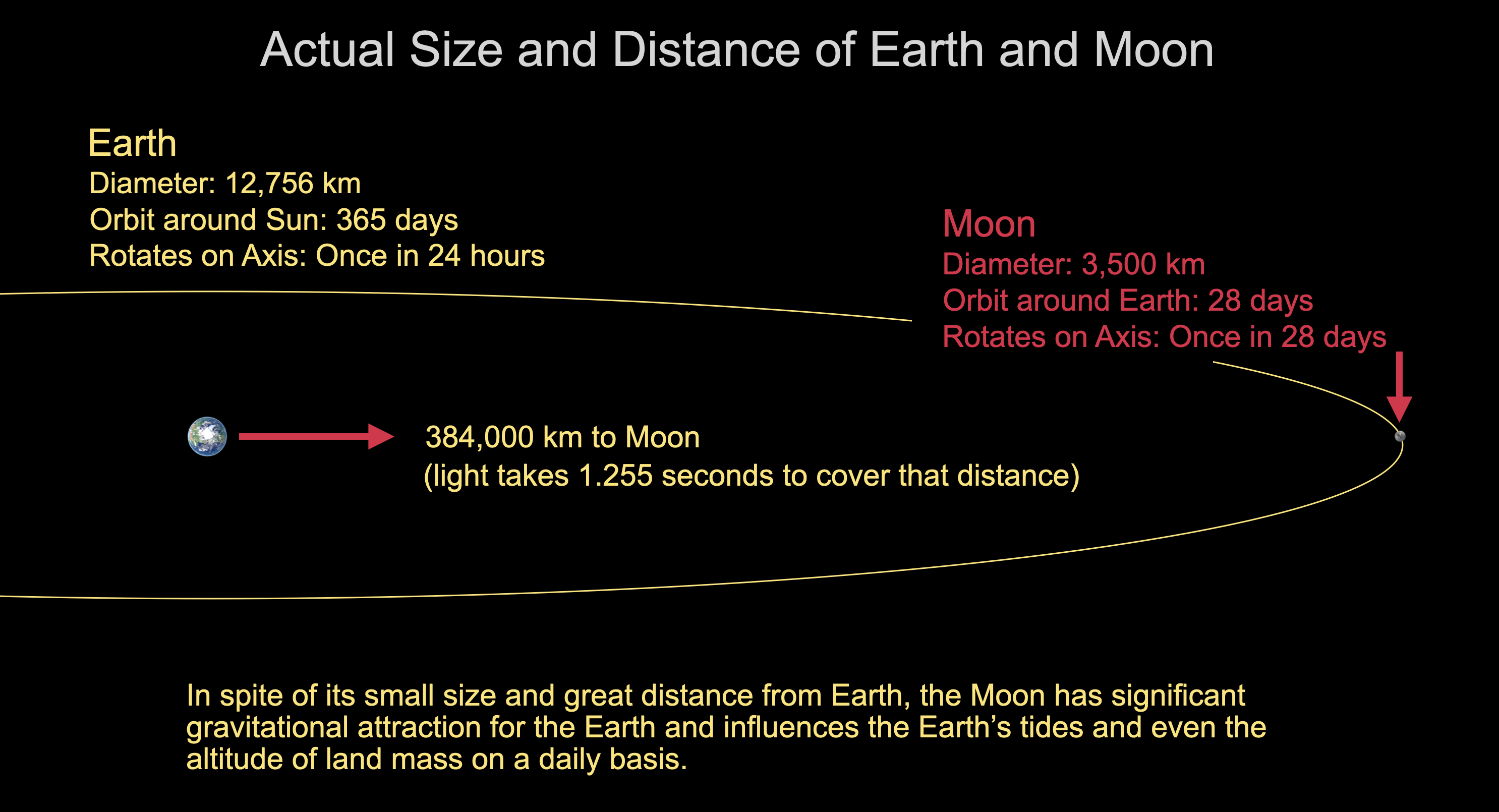
The Moon orbits the Earth, making it the Earth’s natural satellite. Although some planets have more than one moon, the Earth has only one. The Moon is often an object of great interest, in part because of its large, often-changing appearance, and in part 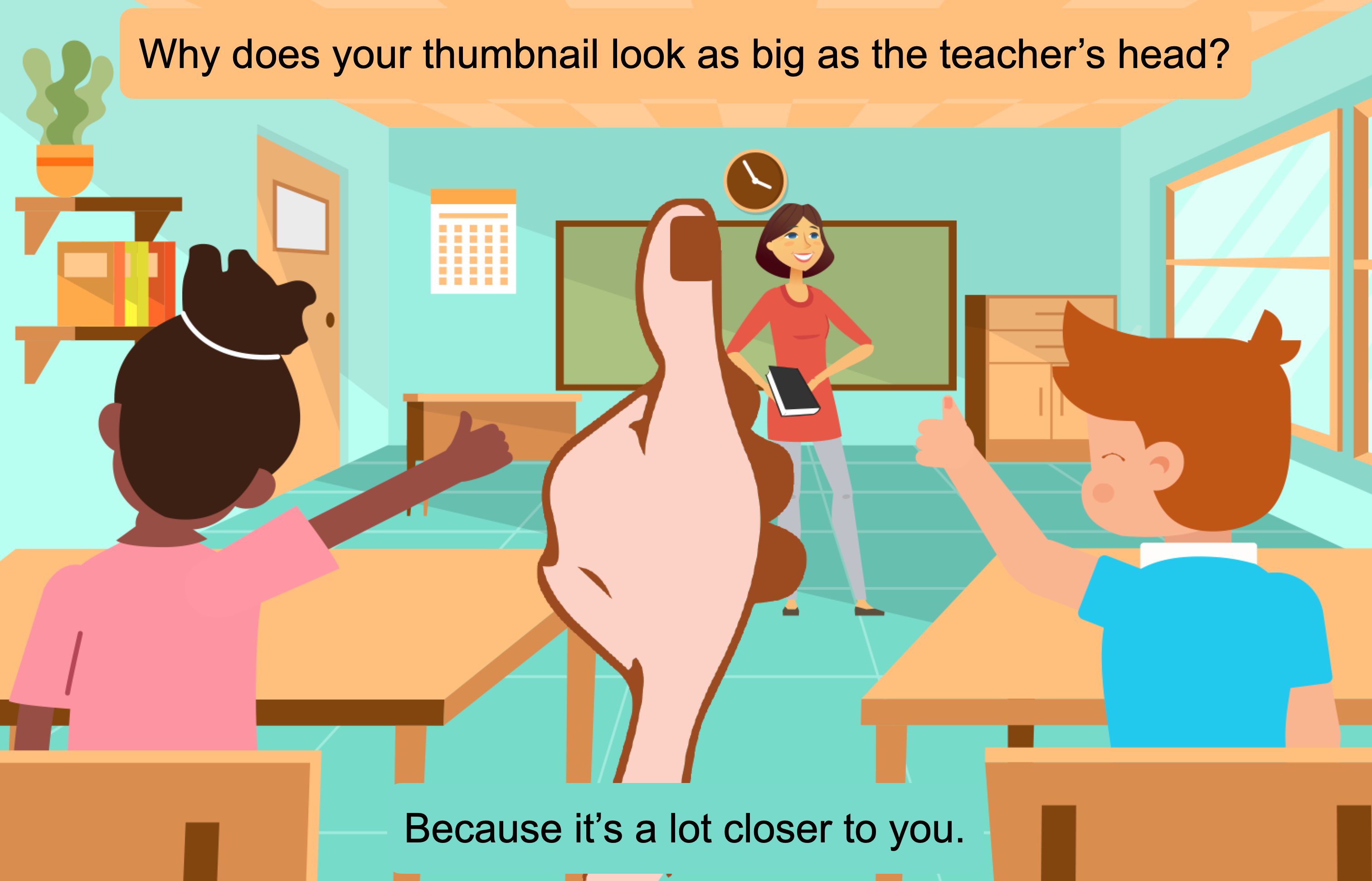 because of its relatively close proximity to the Earth. Although the Moon appears nearly as large as the Sun, it is in fact nearly a quarter of the Earth’s size at 3,500 km in diameter compared to the Earth’s 12,756 km diameter. The Sun, at 1,391,900 km in diameter, is many times larger than both the Earth and the Moon.
In spite of the small size of the Moon, however, the fact remains that it often appears nearly as large as the Sun. The Moon orbits the Earth at a distance of approximately 384,000 km. This distance, when compared to the 149,600,000 km from the Earth to the Sun, is quite small. Because the Moon is so close to the Earth, it appears nearly as large as the Sun, which is much farther from the Earth. The illustration above demonstrates how you can see an object differently if you compare a distant object to a closer one. Holding your arm out, your thumbnail may appear to be as large as something much bigger. This is because your thumb is much closer to you. It is for a similar reason that the Sun and the Moon may look about the same size to you. This, again, is because the Moon is so much closer to you.
The Moon’s Orbit Around the Earth
As the Earth rotates on its axis and revolves around the Sun, the Moon rotates and revolves around the Earth. The Moon completes one revolution around the Earth in 29.5 days. In that same period of time, it completes only one rotation. This is in contrast to the Earth’s rotation, which is completed in a much shorter time (24 hours) than its revolution (365 days).
Imagine a person circling once around you. If the person always faces a certain part of the room and does not turn, or rotate, as he or she circles, you will see the person’s front, left side, back, and right side. In contrast, the Moon moves around the Earth in such a way that only one side of the Moon, called the near side, can ever be seen from the Earth. Imagine the person circling you again. This time, he or she must always keep the front of his or her body toward you. In order to do this, the person must rotate slowly as he or she circles. If the person always faces you while circling you, he or she will have completed one full rotation in the time it took him or her to complete one circle, or revolution, around you. This illustrates the motion of the Moon around the Earth.
The Moon appears to shine on the Earth. However, the light from the Moon is a reflection of the light from the Sun shining on the Moon. The half of the Moon which faces the Sun is always illuminated by the Sun. However, the illuminated half is not always visible from the Earth. Thus, we see the Moon’s appearance changing throughout a 29.5-day revolution. These changes are called Moon phases.
In this Investigation, students will explore four phases of the Moon, the New Moon, First Quarter, Full Moon, and Third Quarter.
New Moon
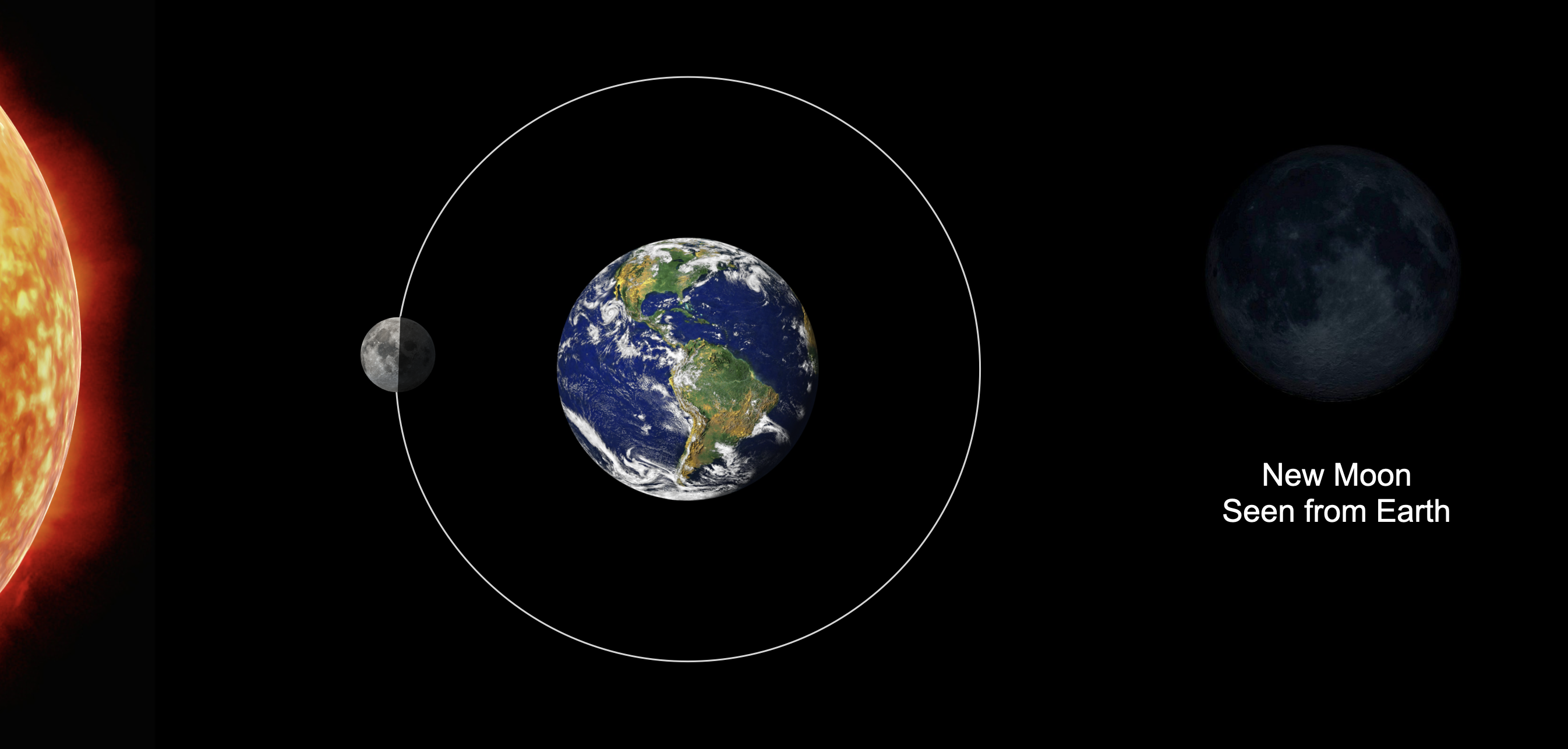
When the Moon is between the Sun and the Earth, the Sun illuminates the far side of the Moon (Figure 4.1). Thus, the Moon appears dark to us on Earth. This phase is known as New Moon.
First Quarter
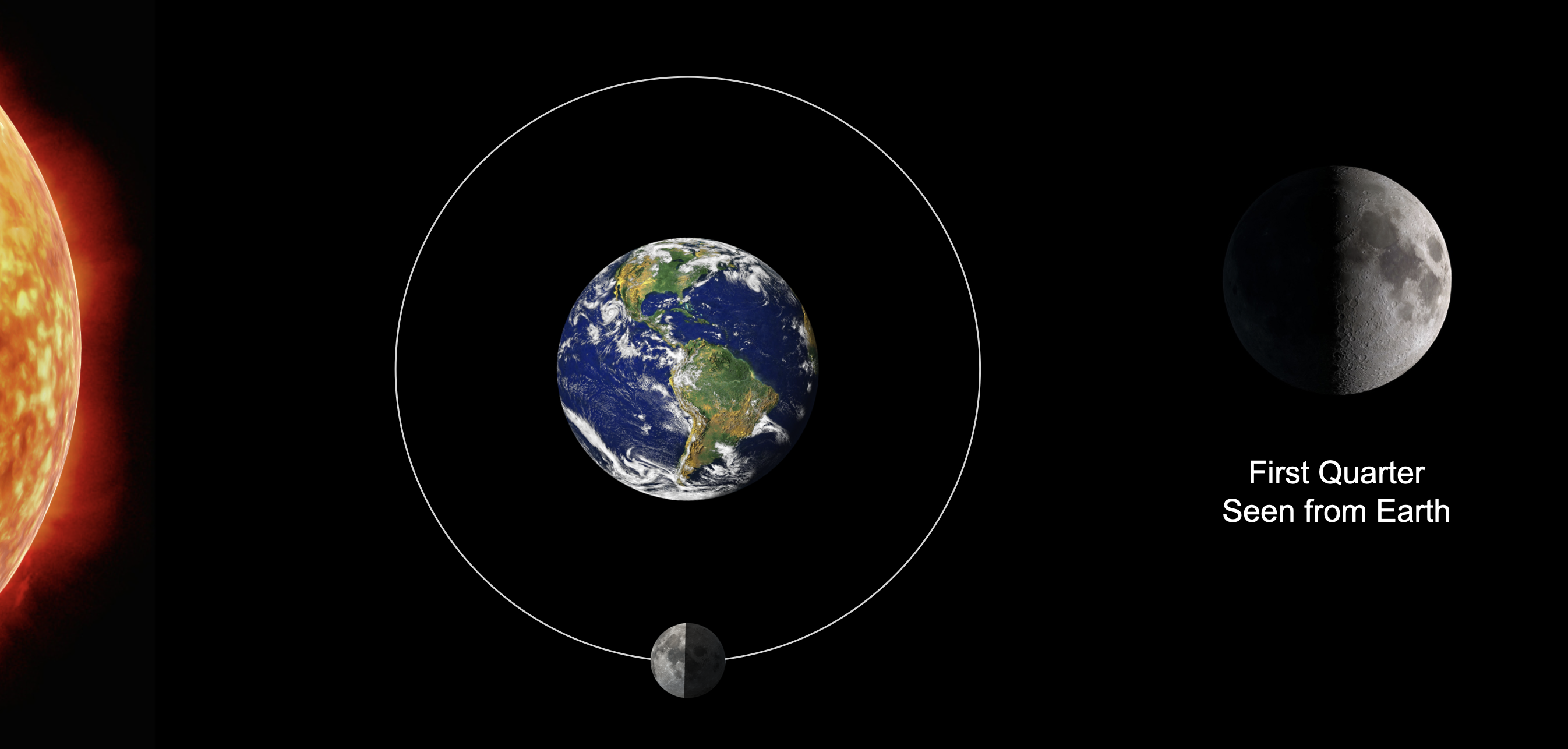
The Moon revolves around the Earth. Approximately seven days after New Moon, the Moon is beside the Earth (Figure 4.2). The Sun again illuminates half of the Moon. This time, however, half of the near side is lit and half of the far side is lit. Thus, we view the moon as being a “half Moon.” This phase is known as the first quarter, because one quarter of the whole Moon can be viewed from Earth.
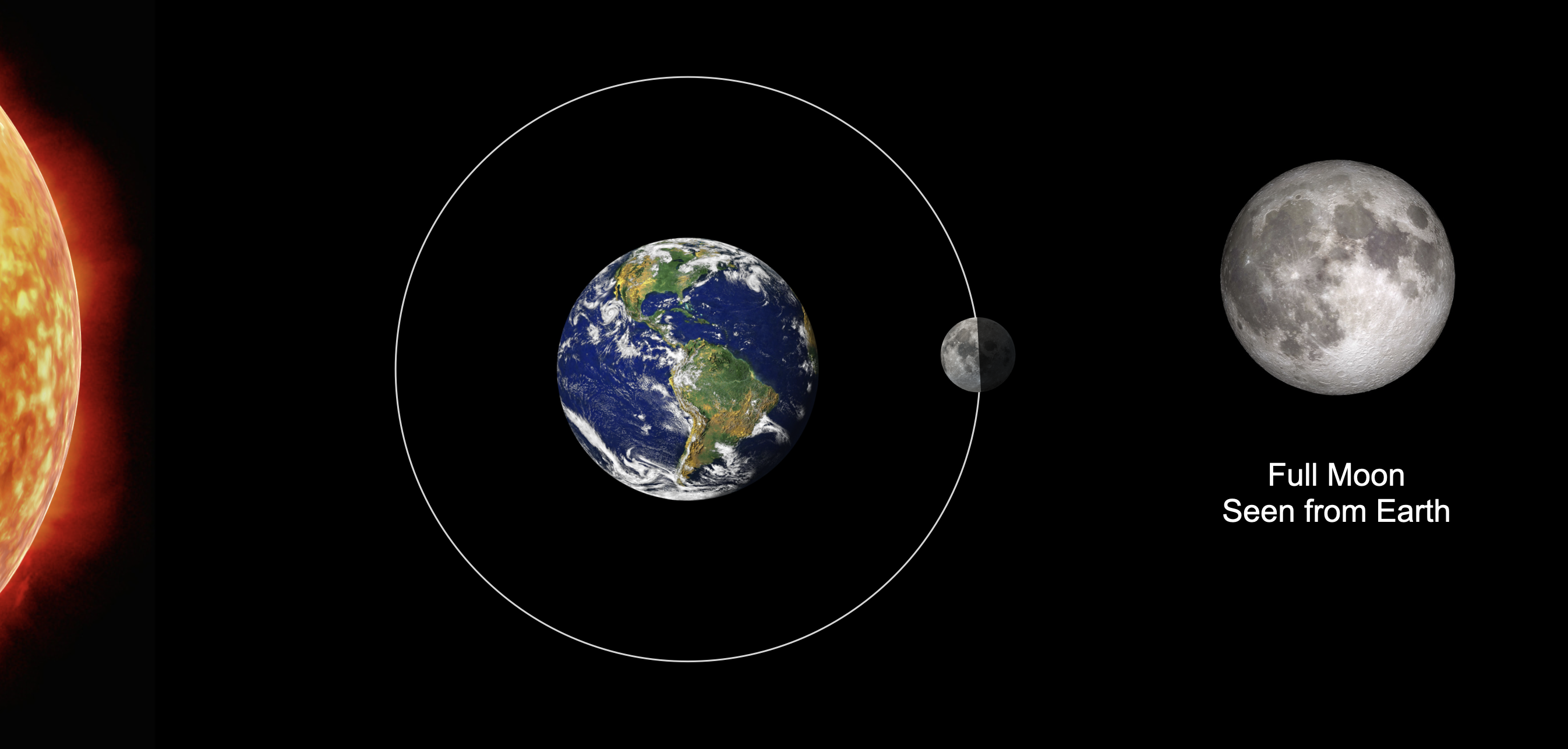
Full Moon
Approximately seven days later, the Moon is opposite the Earth from the Sun. The Sun again illuminates half of the Moon. This time, however, the half that is lit is the near side of the Moon. We view the Moon as being fully lit. This is known as Full Moon.
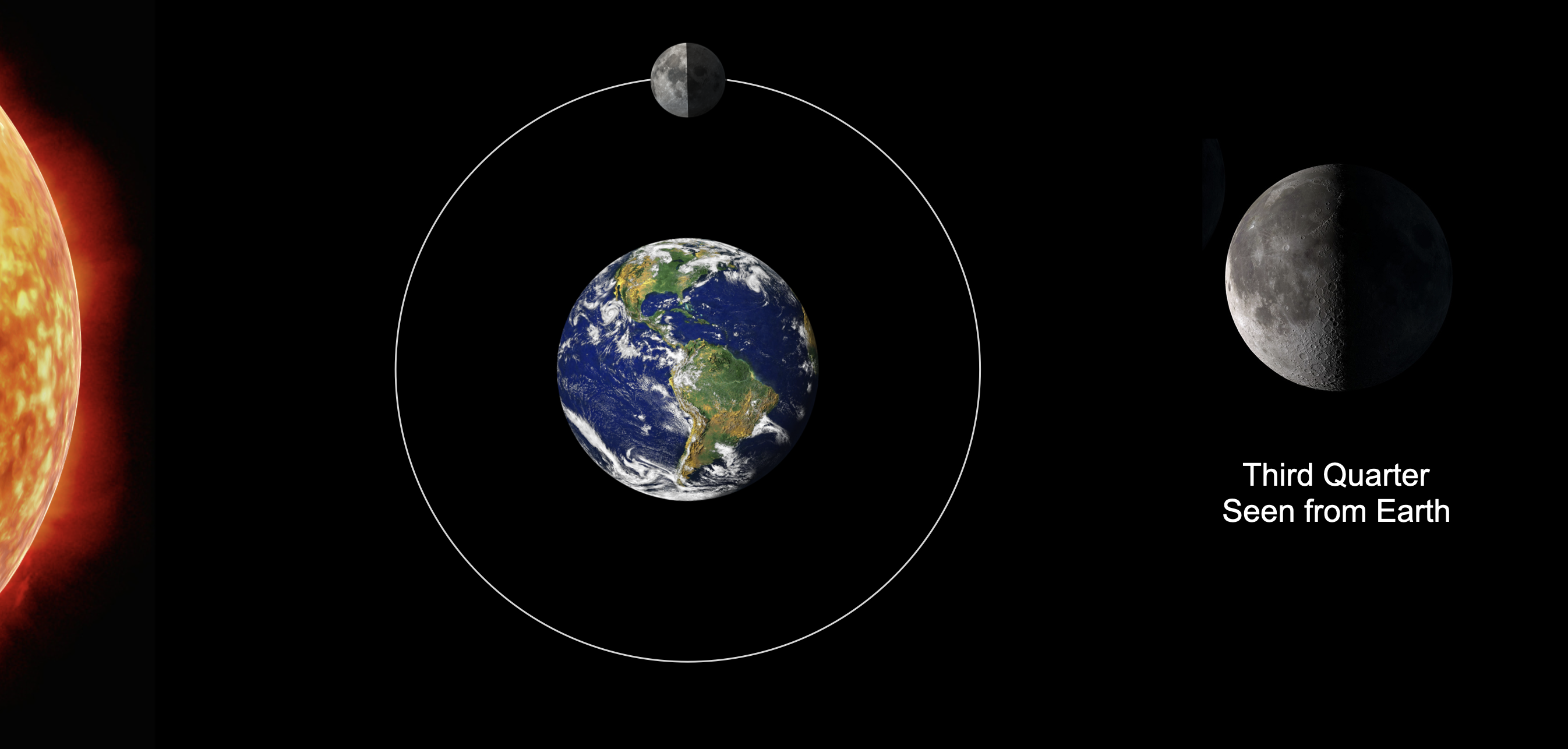
Third Quarter
Continuing its revolution, the Moon moves beside the Earth seven days later (Figure 4.4). The Sun illuminates half the Moon. Similar to first quarter, half of the near side is lit and half of the far side is lit. This appearance of a quarter of the moon being lit is known as third quarter.
Putting It All Together
The Moon revolves around the Earth in a counterclockwise direction. In addition, the Earth itself rotates on its own axis in a counterclockwise direction as it revolves around the Sun in a counterclockwise direction as well.
During Investigation Four, students will model the four major phases of the Moon. By conducting this exploration, students will be better able to understand the relationship between and the position of the Earth, Sun, and Moon.
Our Solar System: Investigation 4-Mathematics Concepts
Prelab
- grouping
- size and shape
- position
Lab
- whole numbers
- distance in meters
- position
- time (hours, days, months)
- ordinal numbers
- fractions
Postlab
- whole numbers
- position
- ordinal numbers
- fractions
- time (hours, days, weeks, months)
Our Solar System: Investigation 4 - Procedural Tools

Our Solar System: Investigation 4 - Cognitive Tools

Our Solar System:
Investigation 4 Quiz

