
Teacher Portal:
Microscopes and Magnification
Investigation 4
Microscopes and Magnification: Investigation 4
Investigation Three introduced students to the compound microscope, its working parts, and how the functions of its parts contribute to its overall function. Students learned the correct way to focus the microscope and identified both similarities and differences between the hand lens and the microscope.
 In Investigation Four, students will explore the capabilities of the compound microscope by viewing prepared slides. The microscope provides a greater power of magnification than the hand lens due to its three objectives, each of which differs in its power of magnification. This results in a much greater total magnification and a greater resolution of viewed images.
Another significant difference between the microscope and the hand lens is the presence of an additional lens in the eyepiece of the microscope. Coupled with the power of magnification afforded by the lenses in the objectives, the lens in the eyepiece dramatically increases the total magnification of the microscope.
Students will calculate the total magnification of an image by multiplying the power of magnification of an individual lens by the power of magnification of the eyepiece, however, a large total magnification results in a small field of view. By increasing the magnification of an object’s image, greater detail can be viewed but only a smaller portion of the total size of the object can be viewed. Students will discover that when higher power objectives are used, the total magnification increases but the field of view will decrease.
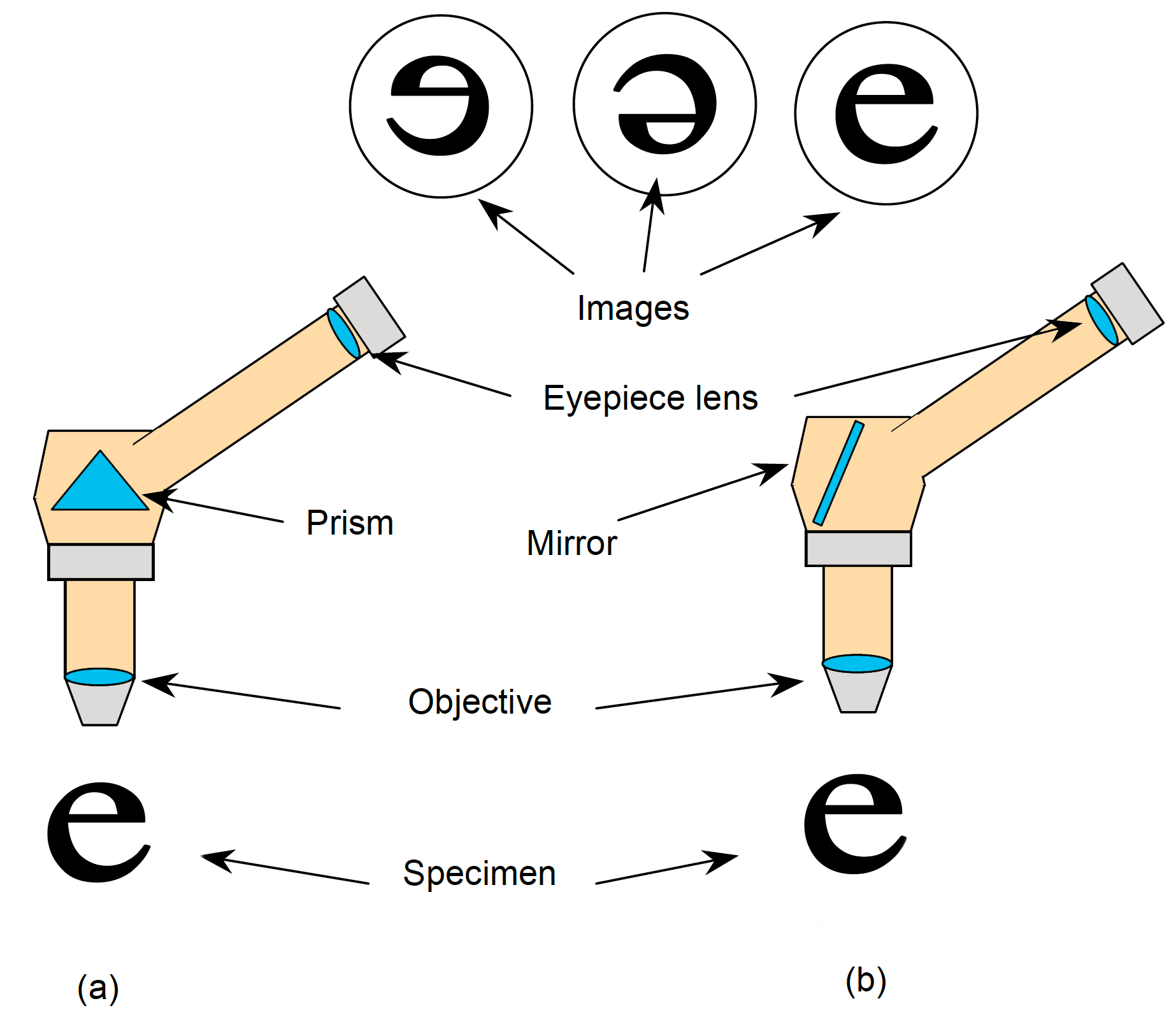
In the Figure above: (a) Diagram of a microscope using a prism between the objective and the eyepiece. (b) Diagram of a microscope using a mirror between the objective and the eyepiece. The appearance of the image seen in the eyepiece may differ depending upon how the light rays from the objective lens interacts with the prism or mirror.
Microscopes and Magnification : Investigation 4 - Mathematics Concepts
Prelab
- multiplication
- length/diameter in cm
- Inverse relationships
Lab
- width in cm
- whole numbers to the nearest tenth
- greater than/less than/equal to
- multiplication/division
- place value (ones, tens, hundreds)
- least to greatest
Postlab
- sequential order
- greater than/less than/equal to
- least to greatest
- multiplication/division
- comparing (non)measurable characteristics
- width in cm

Microscopes and Magnification: Investigation 4 - Procedural Tools


Microscopes and Magnification:
Investigation 4 Quiz

