Teacher Portal:
Forms of Energy
Forms of Energy: Investigation 1 - Potential and Kinetic Energy
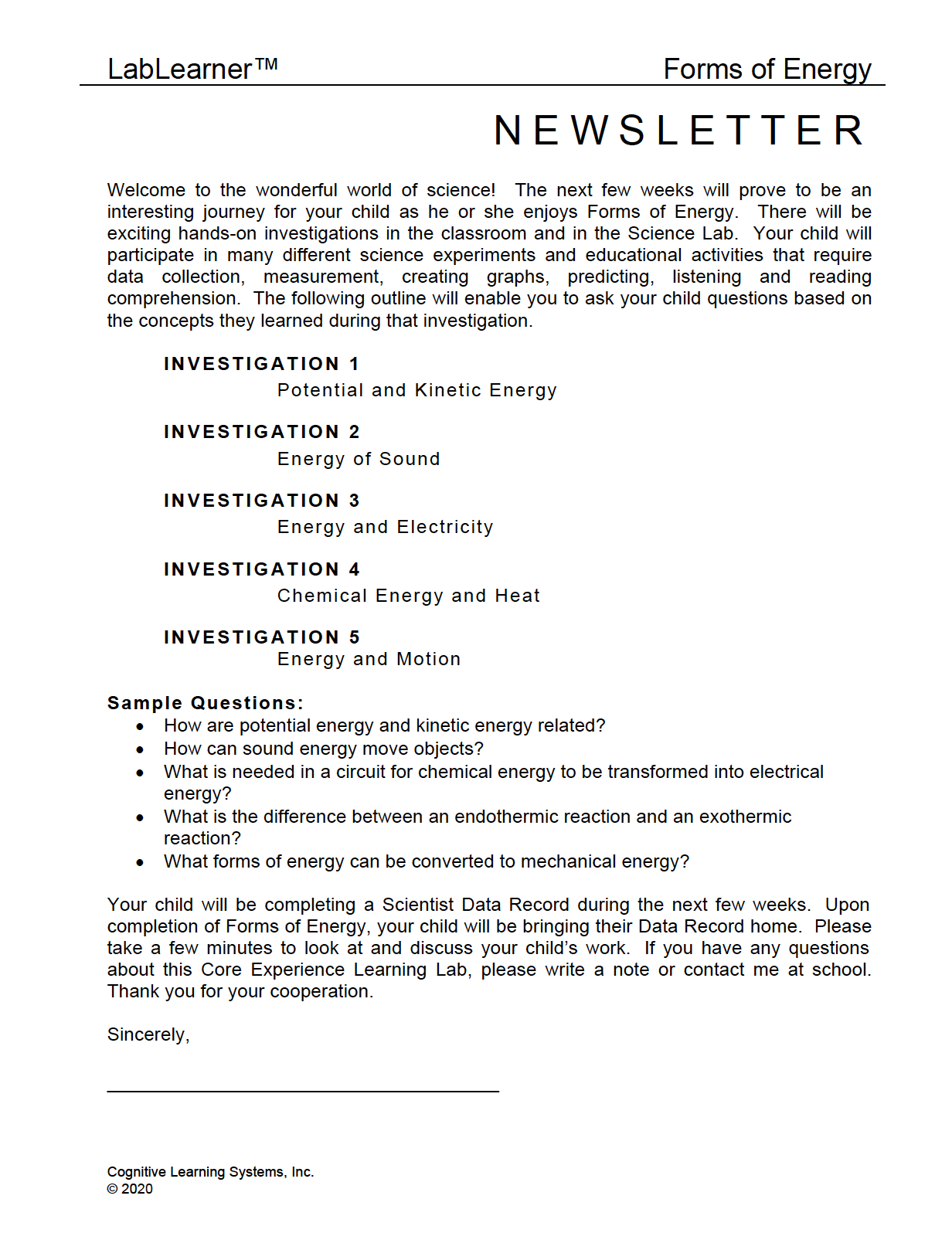
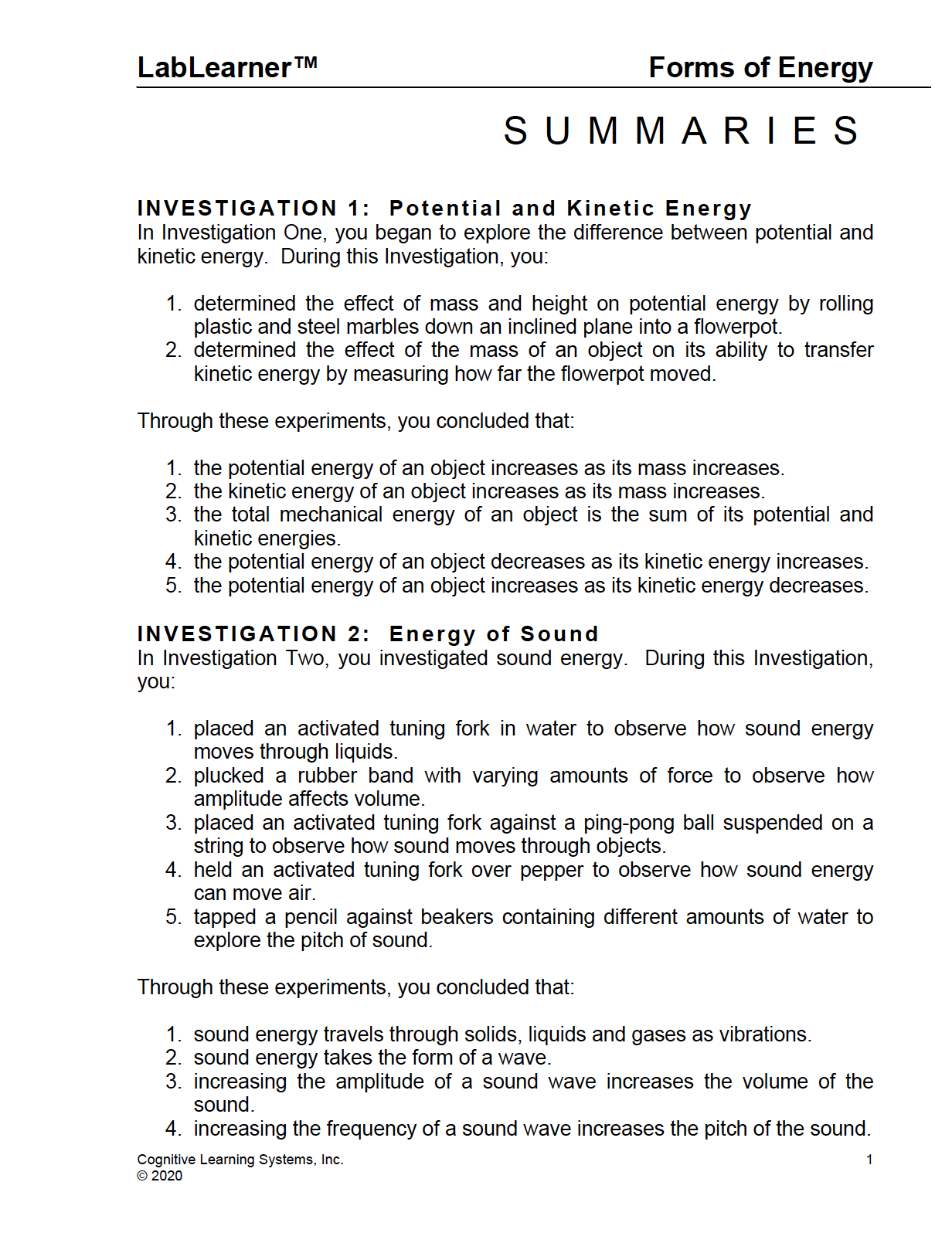
Investigation One introduces students to the relationship between potential and kinetic energy in the context of mechanical energy and investigates the effect of mass on potential and kinetic energy. Students will conduct a series of experiments to determine the effect of mass on the potential and kinetic energy of plastic and steel marbles by rolling each marble down an inclined plane into a plastic flower pot. Students will learn that the marble with the greater mass performs more work on the flower pot because it makes the flower pot slide further across the table. Students will discover through their experiments that the kinetic energy of an object increases as its potential energy decreases and that an object’s mechanical energy is the sum of its potential and kinetic energies.
Forms of Energy: Investigation 2 - Energy of Sound
In Investigation Two, students will explore how sound energy is produced by vibrations, and will study the nature of sound waves. Students will explore the transfer of sound energy through gas, water and solids by exploring how an activated tuning fork can generate mechanical energy through air, water, and a ping-pong ball. In addition, students will explore the nature of wave behavior by investigating amplitude and pitch, two properties that are unique to sound energy. Students will discover that as the amplitude of a sound wave increases, the volume of the sound increases. Students will also discover that increasing the frequency of a sound wave will increase its pitch.
Forms of Energy: Investigation 3 - Electricity and Energy
During Investigation Three, students will examine another form of kinetic energy: electricity. Students will create circuits to explore how chemical potential energy can be converted to electrical kinetic energy, and that electrical kinetic energy is transformed into light energy and heat in a light bulb. Students will then compare their circuits to that of a flashlight, and discover that while circuits do not require wires to function, they must contain an energy source and some form of conductor for electrons to flow.
Forms of Energy: Investigation 4 - Chemical Energy and Heat
Investigation Four gives students an opportunity to further explore the concept of chemical energy. Investigation Three introduced students to the conversion of stored chemical energy into electrical energy by the completion of a circuit. This investigation demonstrates to students that electrical reactions also result in energy transfers. Students observe the process of sugar caramelization as an example of an endothermic reaction, which is a reaction in which heat is absorbed by the reactants. Students will then dissolve powdered non-chlorine bleach in water and observe the difference in the water temperature before and after the addition of bleach. Students will discover that this reaction is exothermic through their observation of the increase in temperature of the water.
Forms of Energy: Investigation 5 - Energy and Motion
In Investigation Five, students will have an opportunity to investigate mechanical energy. Students will compare the effect of gravitational potential energy with the effect of the addition of the kinetic energy of moving air on the distance which a model car can travel. Students will then have the opportunity to explore how chemical energy can be transformed into mechanical energy as they use a reaction of baking soda and vinegar to generate a burst of carbon dioxide gas strong enough to remove a rubber stopper from the reaction vessel. Students will discover that the kinetic energy of the gas is converted into mechanical energy which is capable of propelling a model car when the reaction vessel is attached to the car.
Forms of Energy: Investigation 6 - Performance Assessment
This Performance Assessment is designed to allow students to solve a problem using the:
- concepts with which they have become familiar during the previous Investigations, and
- procedures used during the previous Investigations.