
Teacher Portal:
Our Senses
Investigation 1
Our Senses: Investigation 1
We constantly observe the world around us. We notice whether the rain is warm or cold and whether a flower is blue or red. We are aware of whether food has a pleasant or unpleasant odor, whether a food tastes salty or sweet, whether a noise is loud or soft. Such observations affect our evaluation of our environment, our understanding of the world around us, and our behavior in our environment. We are able to make these necessary observations by using our senses of hearing, sight, touch, smell, and taste.

Hearing
Our sense of hearing contributes to the way we perceive our environment. By listening to the sounds around us, we are aware of when a car is coming behind us, when a baby is upset, or when someone is trying to communicate with us. To hear sounds, we use our ears.
As you know, humans are not the only animals that have ears. Many other animals have ears and many animals can even hear much better than humans can. You may also have noticed that not all animal ears look the same. Ears come in many different sizes, shapes, and colors. Can you look at the pictures of ears below and guess what kind of animal has that type of ear?
Animal Ear Match
Can you guess which animals own each of the ears below?

Click here to see if you are right.

The Human Ear
Sound travels through matter as a soundwave, which is a form of energy. It is our sense of hearing and the structures of the body involved in hearing that translate a soundwave into recognizable sounds. The outer ear consists of the part of the ear visible on the outside of the head, the ear canal, and the eardrum. The shape of the ear funnels sound into the ear canal and sound waves reach the eardrum. The eardrum consists of a membrane called the tympanic membrane, which is stretched tightly so that it responds with great sensitivity to the vibrations of sound waves. As the sound waves reach the eardrum, the membrane begins to vibrate.
These vibrations are passed to the middle ear, which consists of three small bones called the hammer, anvil, and stirrup. As the eardrum vibrates, it passes the vibrations to the hammer, which causes the anvil to vibrate, which in turn causes the stirrup to vibrate.
Sound continues to travel from the middle ear into the inner ear. Within the inner ear lies the cochlea, a spiral-shaped structure filled with fluid. The vibrations from the stirrup cause waves in the fluid of the cochlea. Inside the cochlea is the organ of Corti, an organ containing tiny hair cells which move in response to the waves in the fluid, transmitting sound in the form of electrical impulses to the auditory nerve.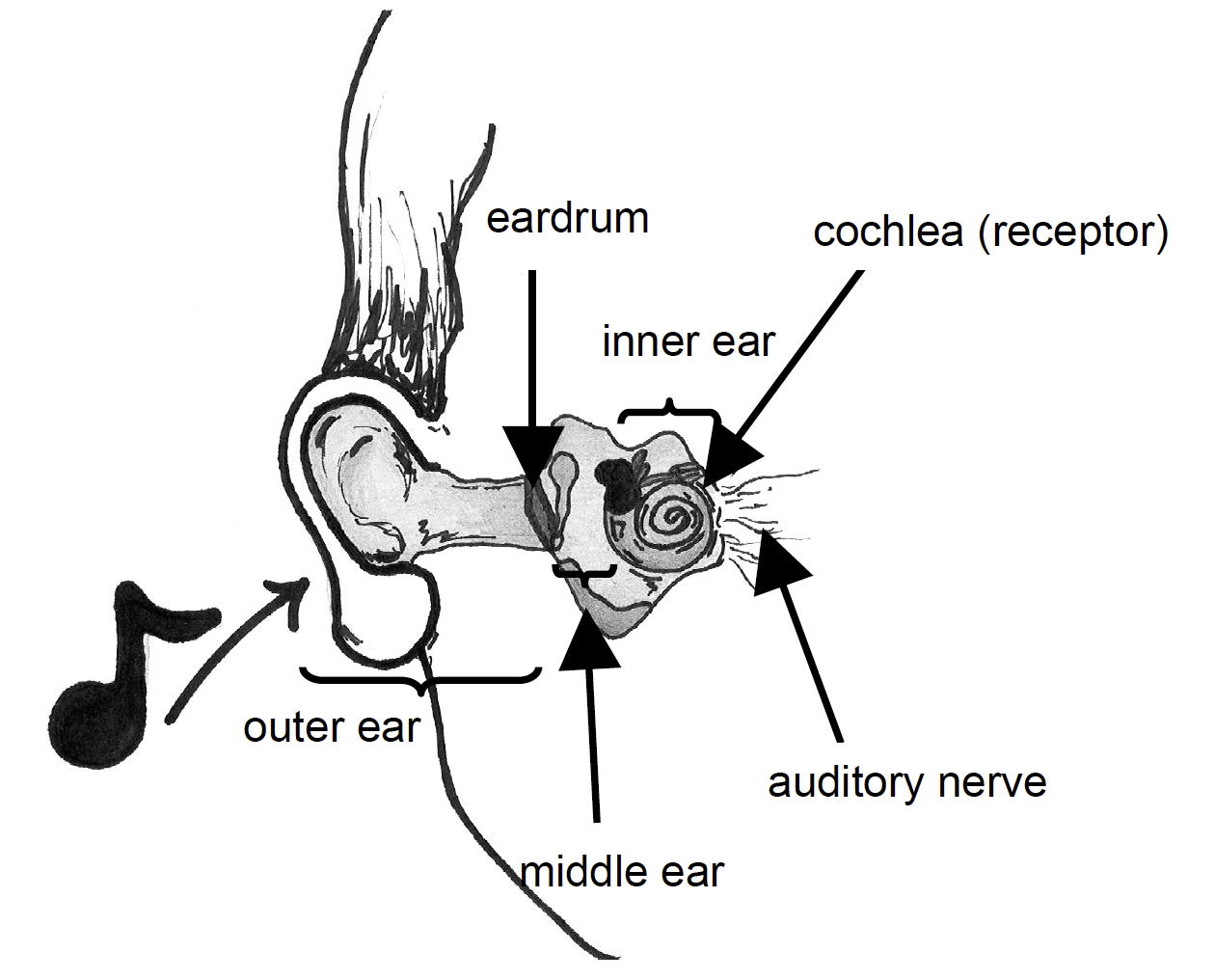
The electrical impulses travel through the auditory nerve to the parts of the brain responsible for processing the information. In this way, sound travels from its origin through the outer, middle, and inner ear, through the auditory nerve to the brain, where the information is processed so that we may respond to it appropriately.
Earlier, we looked at examples of different animal ears. We saw that ears can look quite a bit different from one animal to another. If you are really observant, you will notice that not all human ears look exactly alike either. For example, look at the slight differences between different human ears in the pictures below.

However, even though ears may look a bit different from each other on the outside, just like most everything else about human beings, the insides parts are identical and work in exactly the same way! However, not everyone’s hearing is as good at hearing different sounds. Doctors and audiologists perform hearing tests on people to test their hearing. Perhaps you have had a hearing test in the past.
Normal humans can hear a range of soundwaves, from very low sounds to very high sounds. The soundwaves of different sounds are measured as frequencies in units called hertz (abbreviated Hz). Humans can usually hear sounds that range from a low of about 20 Hz to a high of about 22,000 Hz. Many other animals, dogs, for example, can hear frequencies much higher than humans can. The video below plays a range of soundwave frequencies from 20 Hz to 22,000 Hz. Test to see what frequencies you can hear when you play the video.
In Investigation One, students will develop a beginning understanding of sound travel. They will use their sense of hearing to identify sounds in their classroom, to listen to an activated tuning fork, and to identify the location of the sound of the tuning fork.
Our Senses: Investigation 1 - Mathematics Concepts
Prelab
• counting whole numbers
Lab
• counting whole numbers
• tally marks
• data table
• sequential order
• problem solving
Postlab
• ordinal numbers
• problem solving

Our Senses: Investigation 1 - Procedural Tools

Our Senses: Investigation 1 - Cognitive Tools

Our Senses:
Investigation 1 Quiz

