
Teacher Portal:
The Human Body
Investigation 1 – PostLab
ASK WHY
The human body is organized into systems that are made up of many parts and that these systems each perform both individual and complementary functions that occur at the same time in the body.
BRANCH OUT
Biomedical research scientists study the function of normal and diseased body systems. They study the human body at the systems level, the cell level, and the molecular level. Great medical advances have come from the understanding of the human body discovered through biomedical research.
PRINT IT
Use your browser to download a printable PDF as help during the slide presentation and to make additional notes. In your browser, go to File > Print and then choose to save as PDF.
NAVIGATE IT
Once the slide presentation is launched
- use your left and right arrows to advance or go back in the slide presentation, and
- hover your mouse over the left edge of the presentation to get a view of the thumbnails for all the slides so that you can quickly move anywhere in the presentation.
- Click HERE to launch the slide presentation for the CELL.
SHARE IT
SLIDE BODY-1post-1
In this PostLab session, we will go over the experiences and results from the Lab for Investigation 1 and incorporate a more detailed discussion of the senses and how the brain is involved in interpreting information that is obtained through our senses.
Note: There are a large number of slides in this presentation. If time is a factor, a perfect stopping point is at the end of slide #16. Slides from #17 forward are devoted to a deeper discussion of the five senses and do not specifically review lab results. Another convenient place to stop is after slide #10.
______________________________________________
SLIDE BODY-1post-2
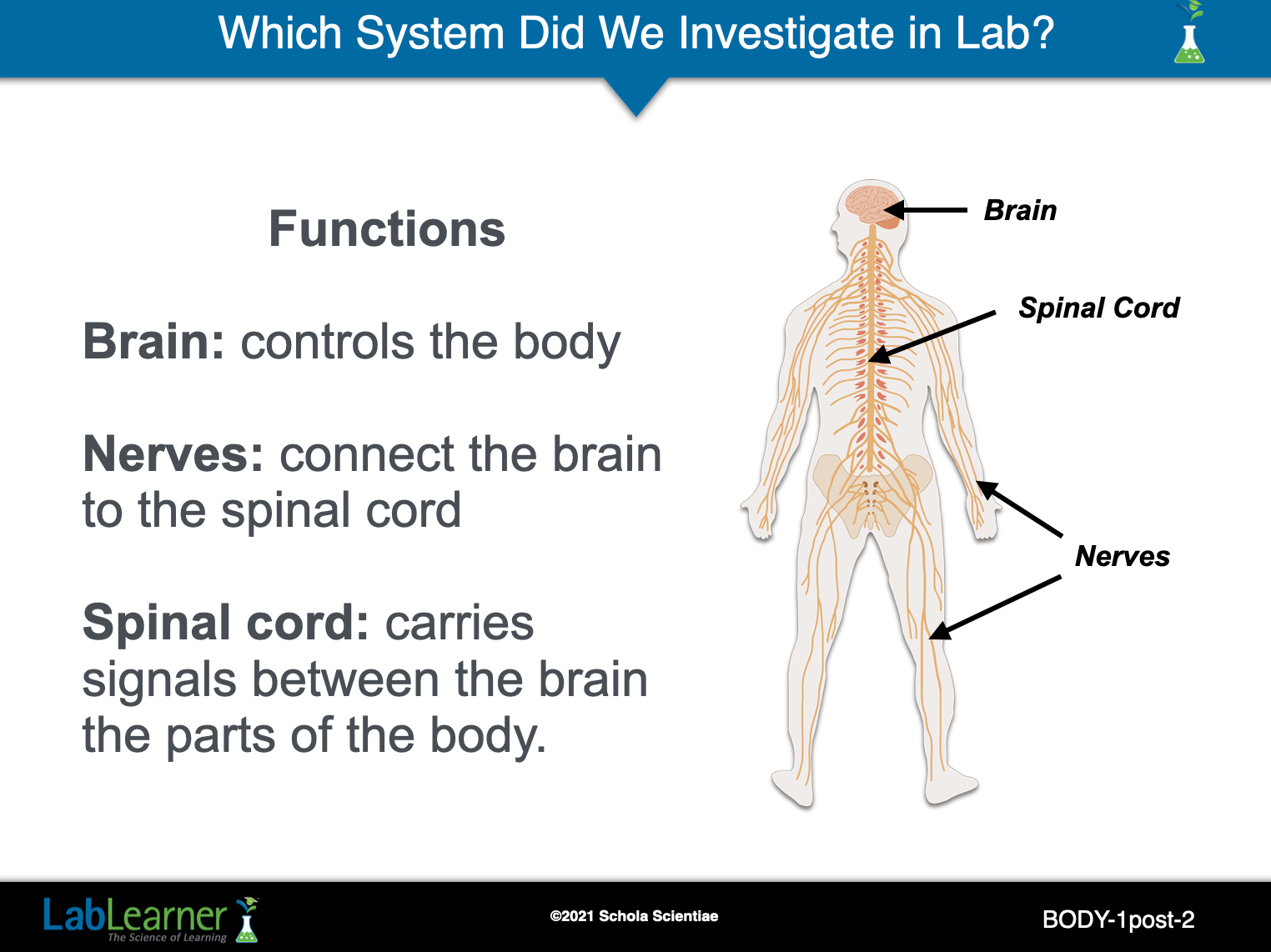
Describe to students the pathway of a signal from the brain to your hand. The brain sends a signal (electrical impulse) through the nervous tissue in the spinal cord to the nerves in a person’s arm. These nerves connect to others which eventually lead to the hand.
______________________________________________
SLIDE BODY-1post-3
Note: This slide is animated. The teacher may wish to practice prior to presenting to the class.
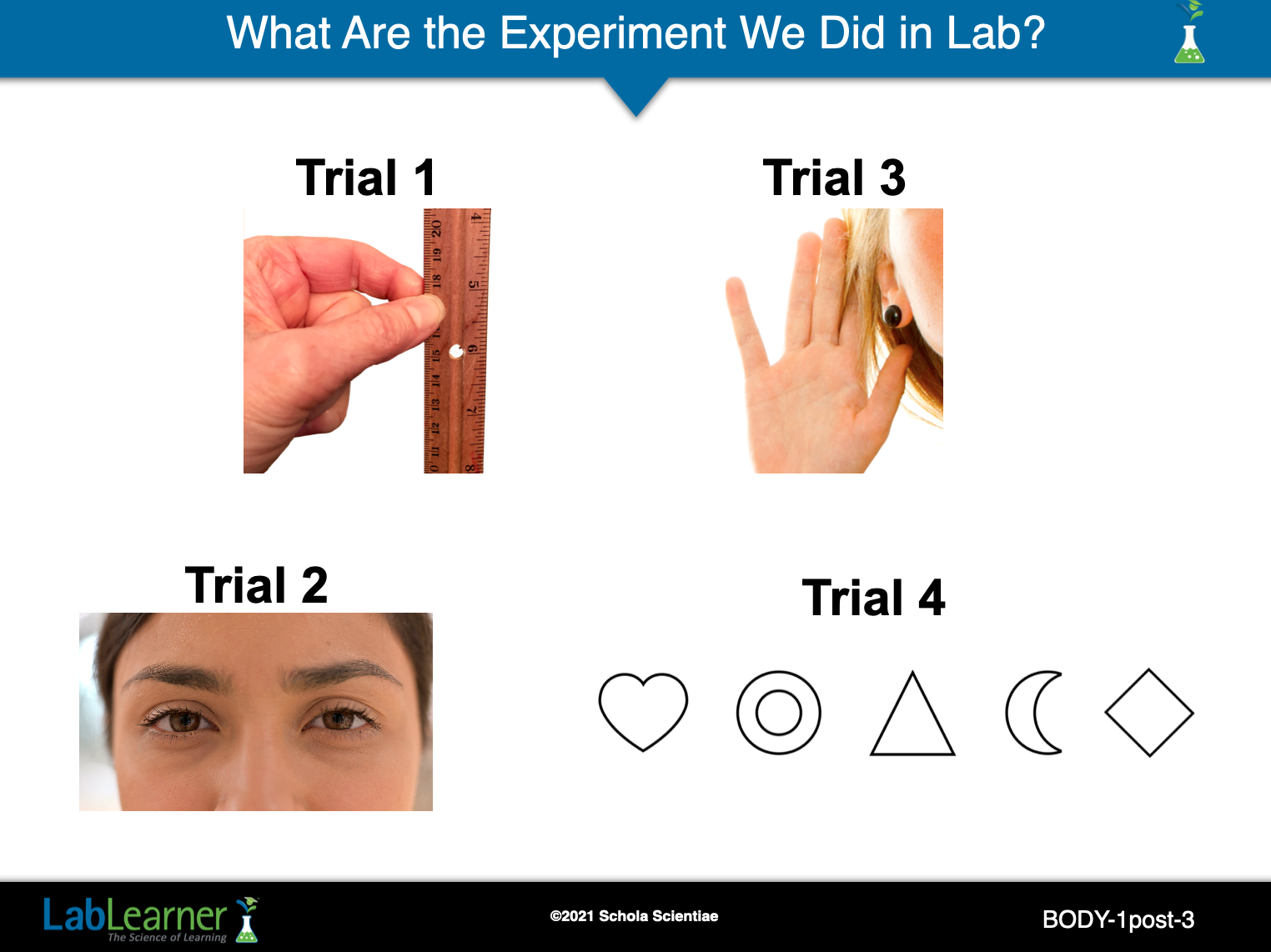
Ask students, “Describe one experiment performed in the lab.”
Student answers may vary. Students may describe the ruler drop experiment in which they took turns attempting to catch the ruler quickly as it dropped. They may also recall the blinking experiment where they counted the number of times their partner blinked in one minute. Students also performed two mental activities, one in which they listened to and tried to identify an object as it dropped, and one in which they attempted to remember a series of shapes presented to them at the beginning of the lab.
______________________________________________
SLIDE BODY-1post-4
Note: This slide is animated. The teacher may wish to practice prior to presenting to the class.
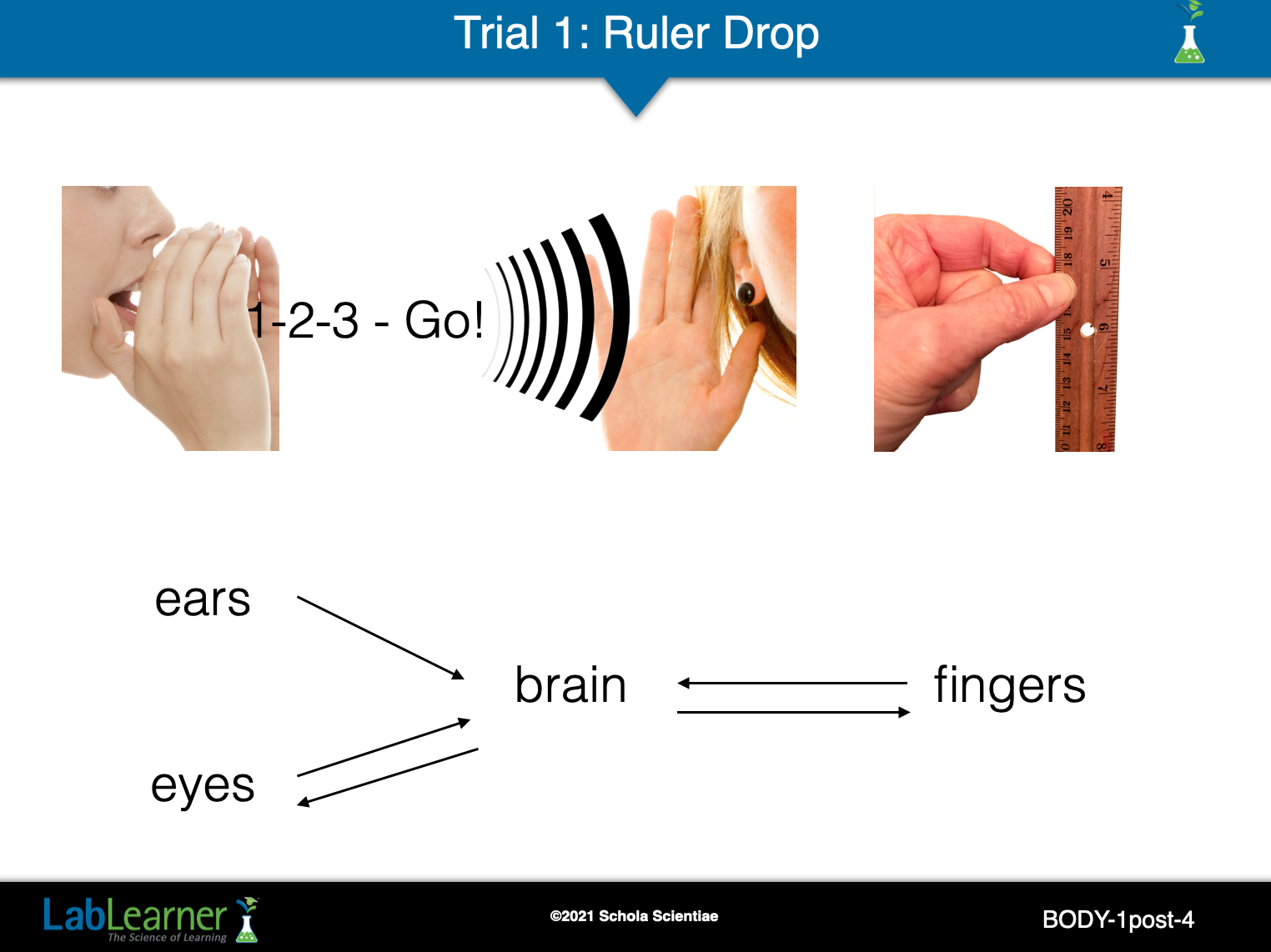
Ask students, “Do you remember what it was like to catch the ruler. What was the first signal that you listened for to get your body ready to catch the ruler?” Students listened for when their partner said “one-two-three-go.”
Tell students, “First, your mind and your hand got ready when you heard your partner start to count. What was the second thing that happened that told your body to catch the ruler?” Students watched for the ruler to start falling. As soon as it fell, they knew it was time to try to catch it.
Ask, “What did your body do so that you caught the ruler?” Students’ hands and fingers closed so that the ruler was pinched and could no longer fall.
Ask students, “How did you know when you caught the ruler and no longer had to reach for it?” Students could see that the ruler had been caught and could feel and see that the ruler was in their hand.
Next, ask students, “What parts of the body were used first in this trial?” The ears were used first to listen to the partner as he or she was counting. The ears allowed students to hear their partner say, “Go.” Invite a student to write the word ears on the left side of the board.
Now ask, “After you heard the counting, what part of your body was used?” The students’ brains interpreted the sound of the counting and told the body to get ready for the ruler. When the partner said, “Go,” the brain sent a signal to the hand telling it to close. Invite a student to write the word brain to the right of ears on the board. Students also may indicate that their eyes were used to see the ruler drop after hearing the counting. If students make this suggestion, ask a student volunteer to write the word eyes under the word ears on the board.
Ask the student volunteer to draw the path of the signal from the ears to the brain. This student can draw the path by using a piece of chalk or a marker to connect the parts of the body.
Next, walk through the process of how signals traveled in the body in Trial 1 using the diagram.
- Your brain sent a signal telling you to catch the ruler. The brain sent a signal to the arm and the hands, telling the hand to close and catch the ruler.
- After you caught the ruler, the nerves in your hand sent a signal telling the body that the ruler had been caught. The nerves in the hand and the arm sent the signal to the spinal cord and back to the brain.
Finally, ask students, “How did the signal move from the ears to the brain to the fingers and back to the brain? What part of the body communicates this signal? The nerves transport the signal.
______________________________________________
SLIDE BODY-1post-5
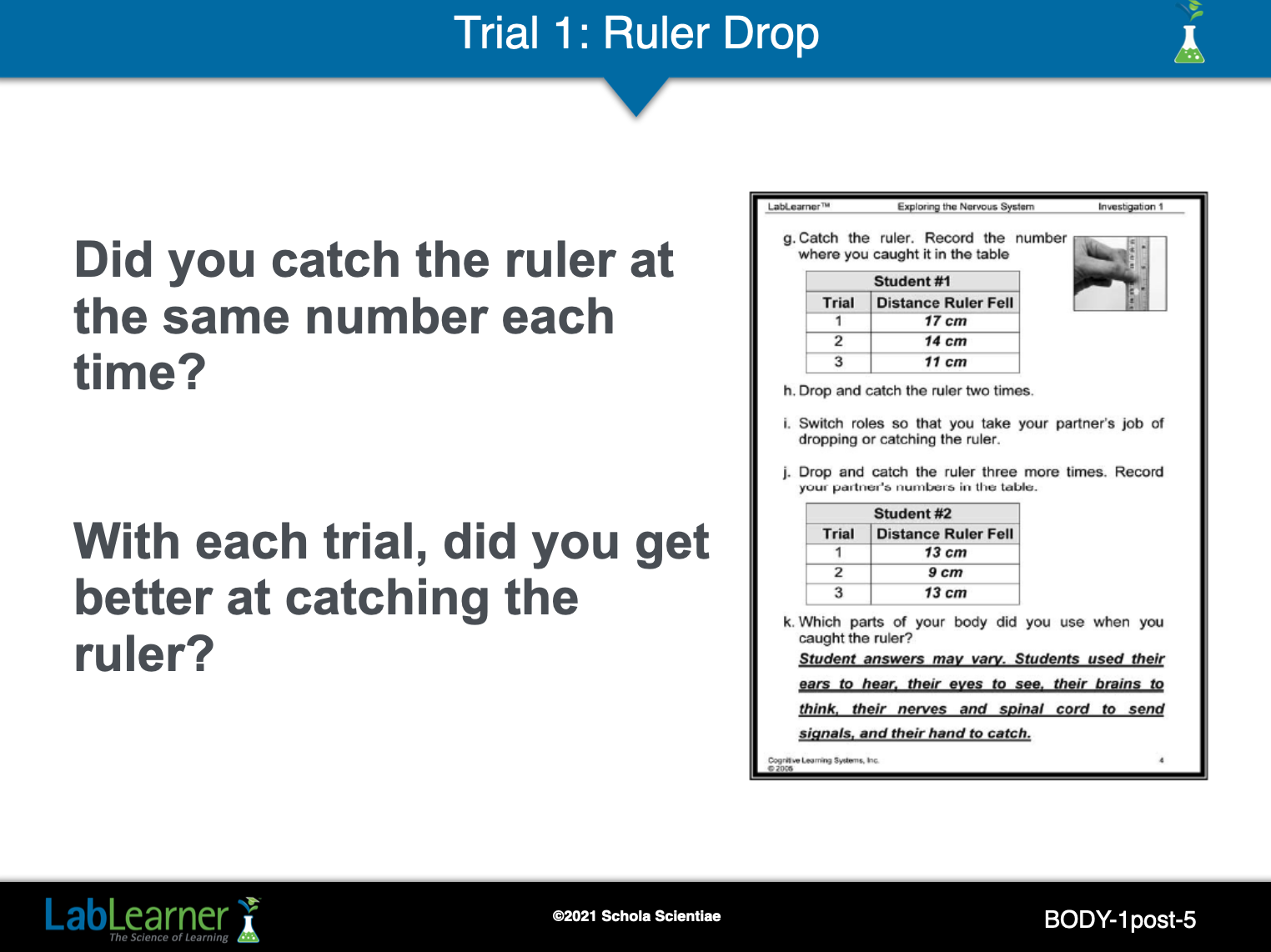
This slide takes a closer look at the results of the ruler drop experiment that was conducted in the lab. Ask students, “Did you catch the ruler at the same number each time?” Student answers will vary. Students likely caught the ruler at different numbers each time.
Next ask, “With each trial, did you get better at catching the ruler?” Student answers may vary. Some students may have improved with each trial.
Finally ask, “How might this improvement relate to the function of the nervous system?” Student answers may vary. Students improved because they practiced. Practice helps to decrease reaction time or the time between the counting (stimulus) and the grasping of the ruler (response). Practice helps the nervous system become better at its function.
______________________________________________
SLIDE BODY-1post-6
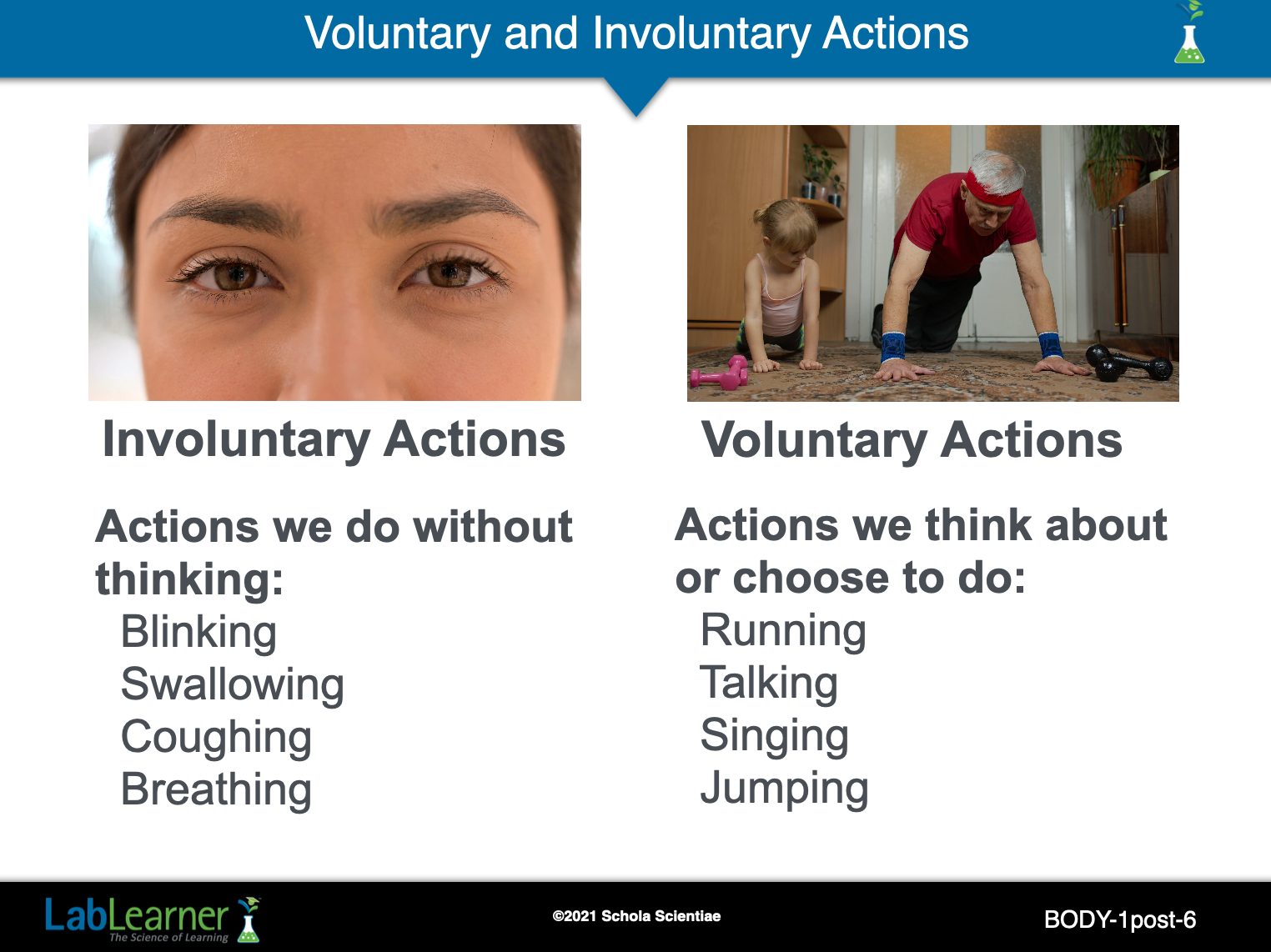
This slide begins a discussion of Trial 2 in which students investigated the involuntary action of blinking.
Tell students that the brain controls two different kinds of actions, voluntary and involuntary. Voluntary actions are those that we choose to do or think about doing. Involuntary actions are those that we do without thinking about them. We do not choose to do them; our bodies automatically do them. Blinking is an involuntary action.
Ask your students, “Can you think of other involuntary actions?” Actions such as swallowing or coughing are involuntary in the same way blinking is involuntary. Our bodies do them without needing to think about them, but we can also choose to swallow, cough, or blink if we would like. Sneezing is an example of an involuntary action that we cannot control. We cannot choose to sneeze when we want to.
______________________________________________
SLIDE BODY-1post-7
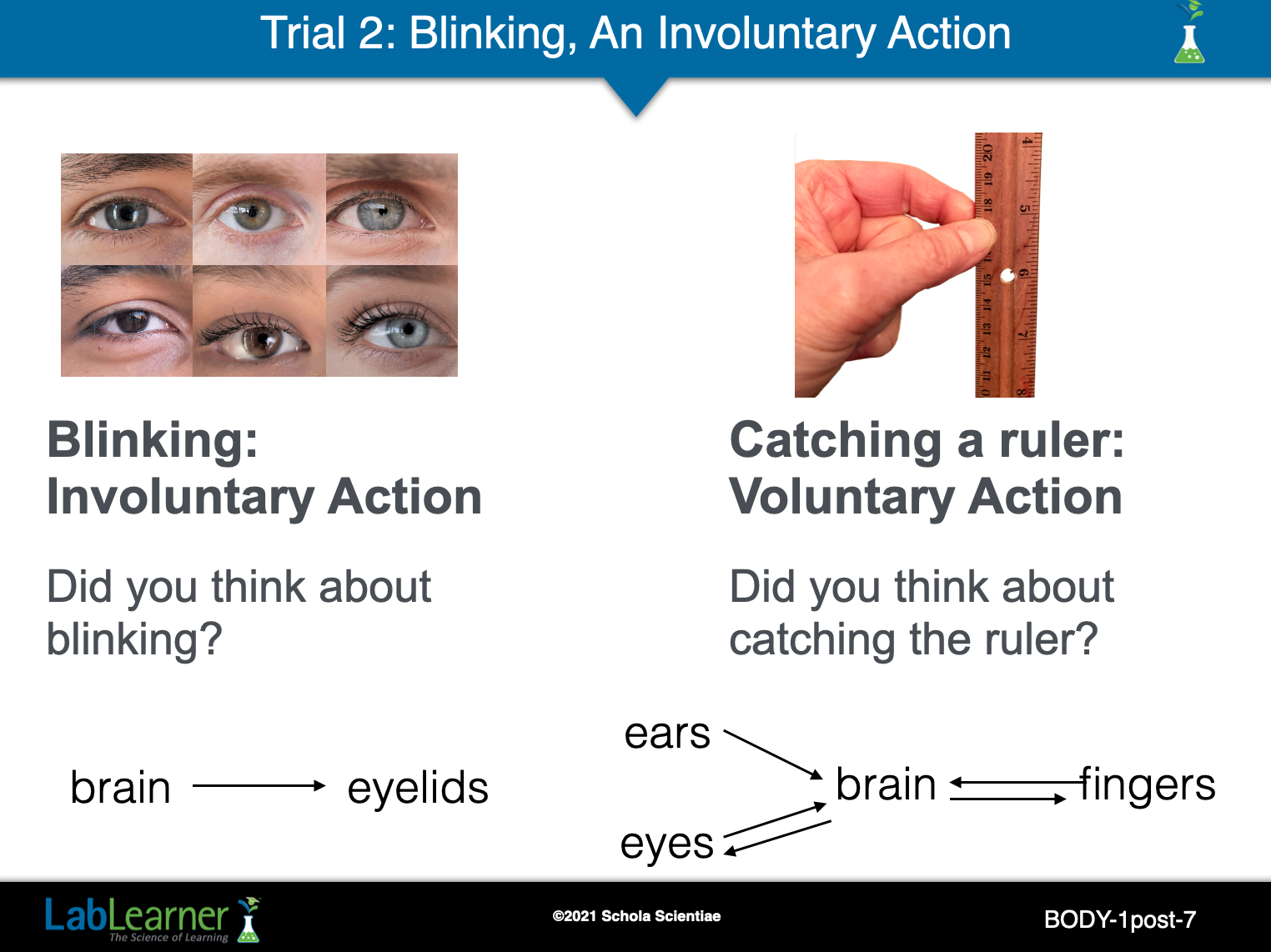
This slide compares the action of catching the ruler to the action of blinking.
Begin questioning the students, “When you wanted to catch the ruler, you had to think about catching it. When you blinked, did you have to think about blinking?” No, students did not have to think about blinking.
Focus on blinking. During the ruler drop activity, the signals moved through the nerves in a process with many steps. The blinking activity, however, required fewer steps. Ask students, “Which parts of the body were involved when you blinked?” The brain and the eyelids were involved in blinking.
Continue by asking, “When you blinked, where did the signal begin? What was the path of the signal?” The signal traveled from the brain, through the nerves, to the eyelids
Finally ask, “How did the signal move from the brain to the eyelids? Which part of the body communicates this signal?” Nerves.
______________________________________________
SLIDE BODY-1post-8
This slide addresses data collected in Investigation 2 lab.
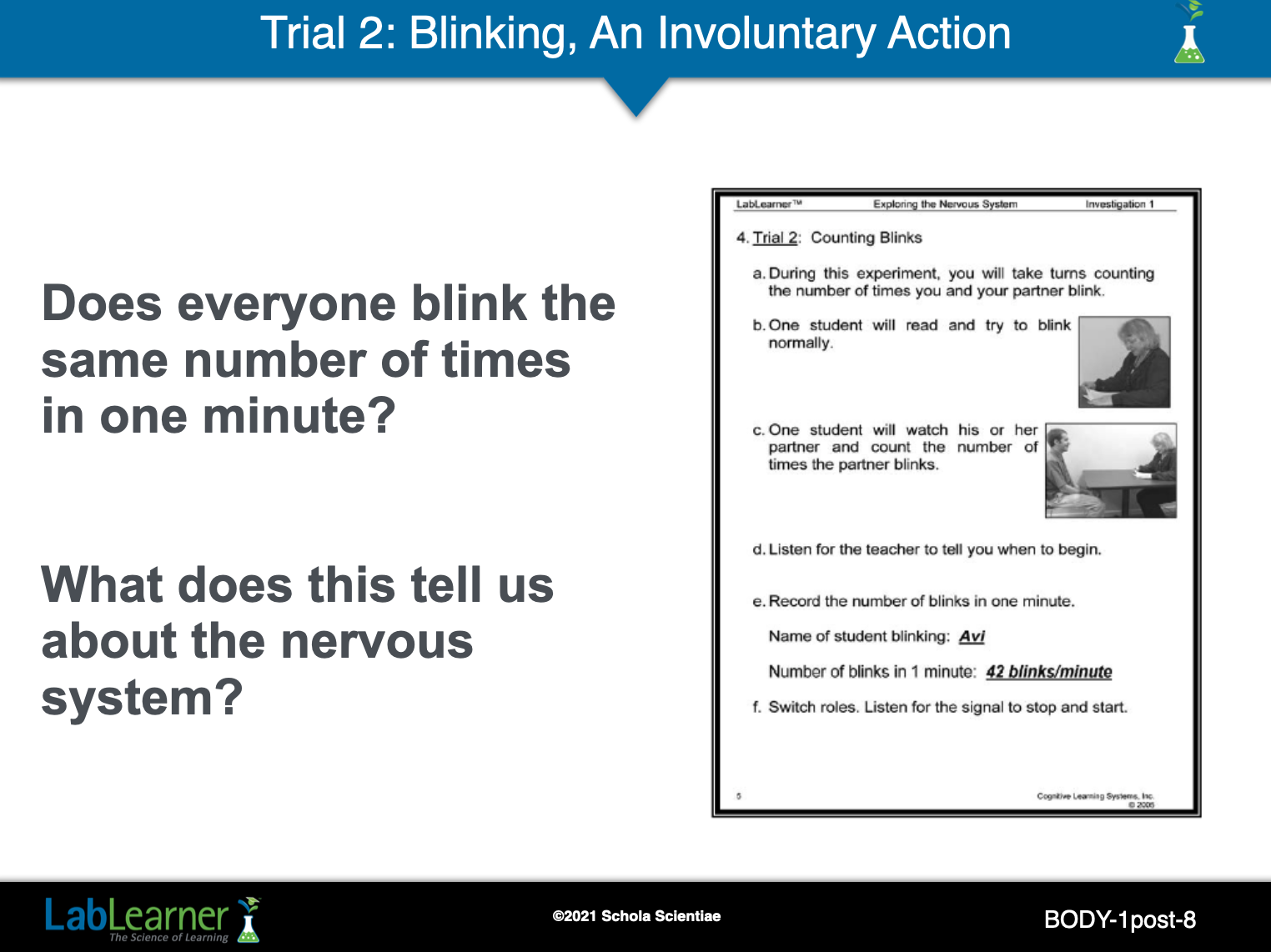
Say to the students, “Look at your Student Data Record. Does everyone blink the same number of times in one minute?” Although the number of times students blinked probably varied slightly, all of the students likely blinked a similar number of times.
Then ask, “What does this tell us about the nervous system?” Student answers may vary. The variation between the number of times each student blinked was minimal. Therefore, the movement of the signal which tells people to blink is similar in most people.
______________________________________________
SLIDE BODY-1post-9
Note: This slide is animated. The teacher may wish to practice prior to presenting to the class.
Begin by asking, “Do you think that the nervous system controls things other than the physical actions of the body?” Student answers will vary.
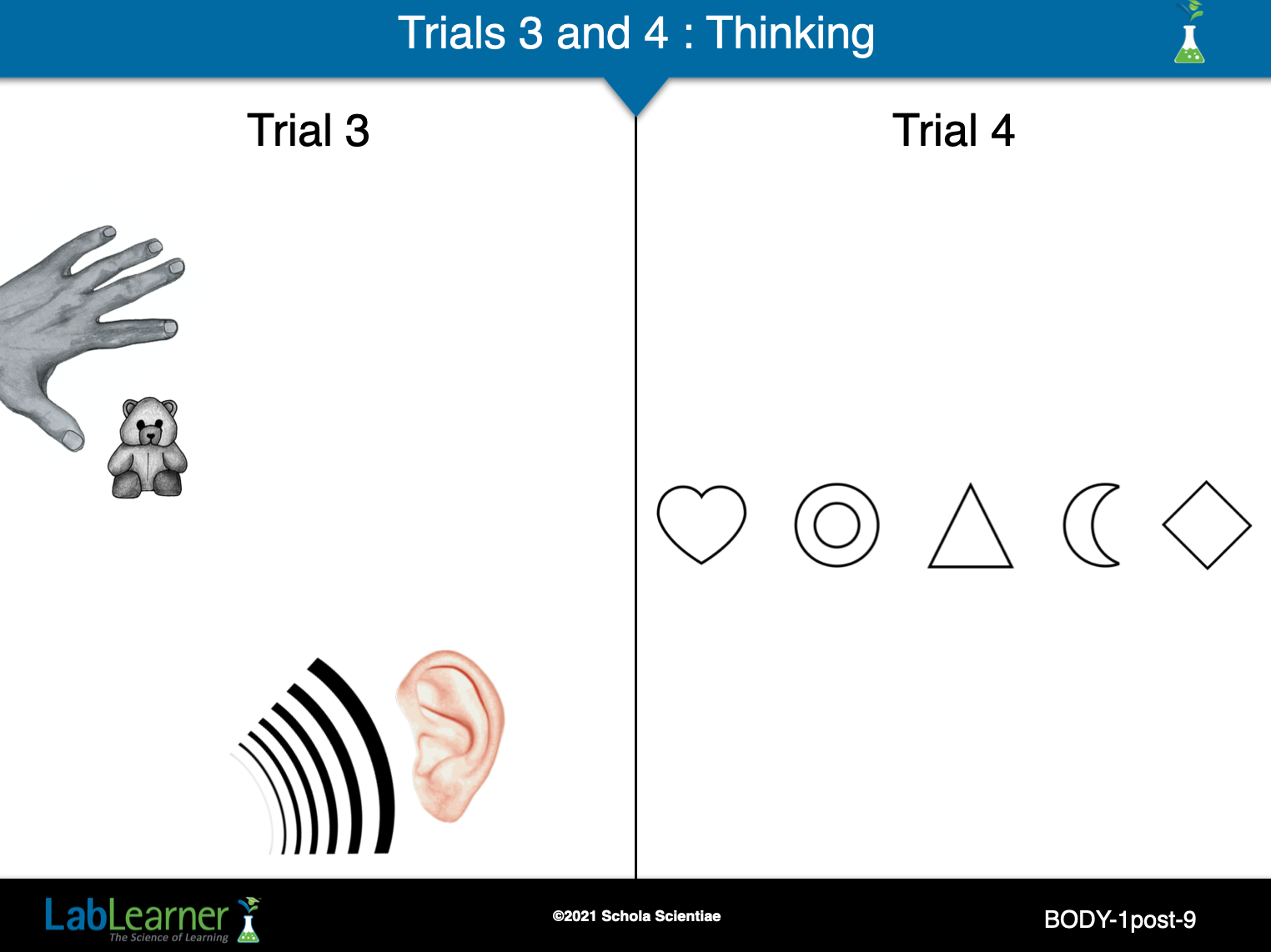
Trial 3: Follow-up by saying, “Think about Trials 3 and 4 performed in the lab. Both trials have one main element in common. When you listened to the noise the object made as it dropped, did you do something? Did your brain tell you to move—to blink, to catch a ruler, or to perform some other activity? No, when students listened to the object as it fell, they were thinking and processing but not moving. Some students may respond that they moved when they recorded their predictions, but encourage students to focus on the thinking process rather than the writing process.
Trial 4: Ask, “When you tried to remember the pattern of shapes, did you do something? Did your brain tell you to move or to perform an activity?” No, when students tried to remember, they were thinking and processing, but not moving.
- Tell students that during both trials, their nervous system was working. Their nervous system was allowing them to receive information and to think about it.
Then ask, “Which parts of your body did you use when you predicted the identity of the dropped objects?” Students used their ears to hear, their nerves to communicate signals, and their brains to think.
Then ask, “Which parts of your body did you use when you remembered the pattern of shapes?” Students used their minds, their brains, to recall the pattern.
______________________________________________
SLIDE BODY-1post-10
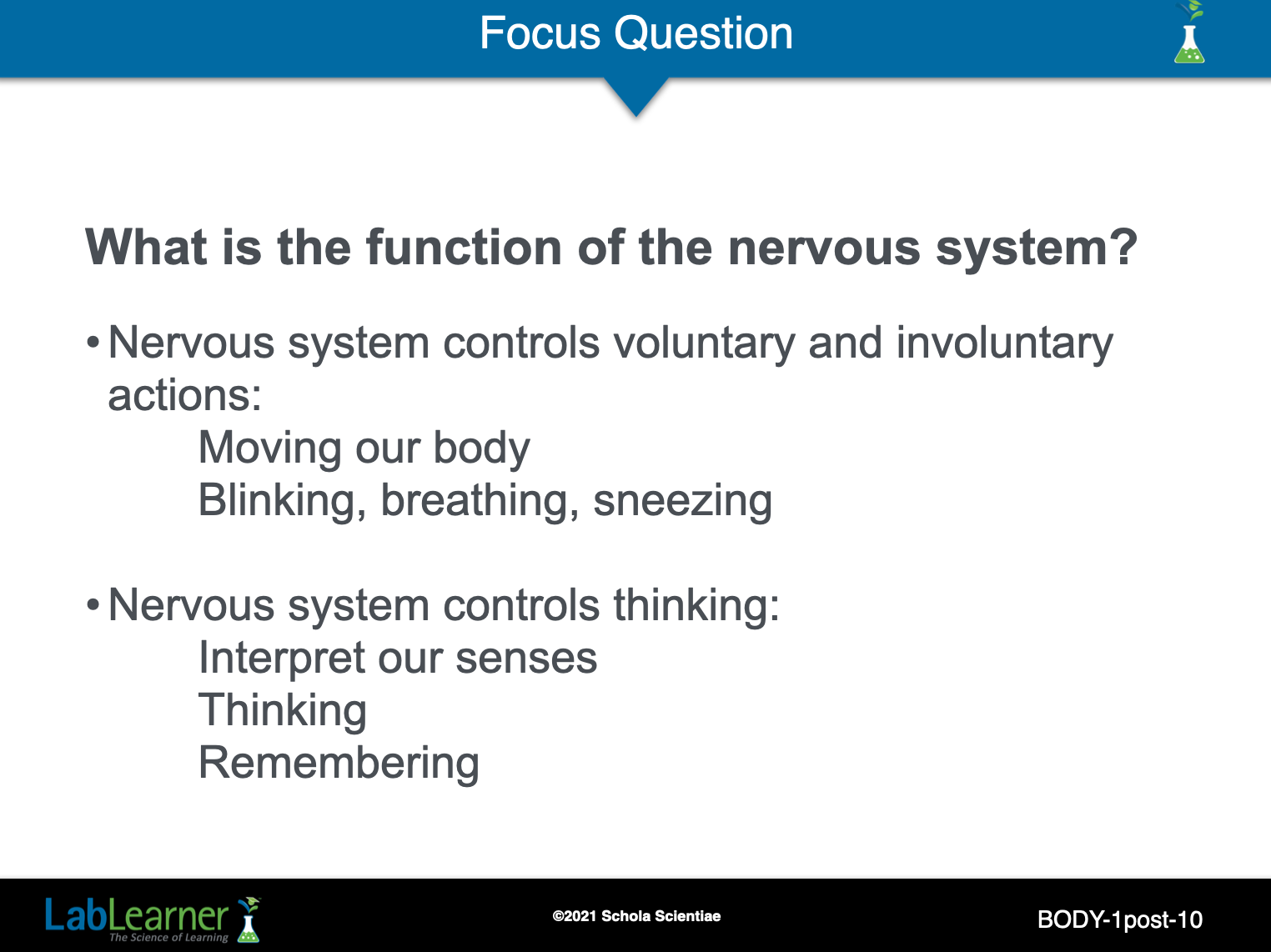
This is a summary slide. The first two trials showed that the brain and the nervous system guide our physical actions. Trials 3 and 4 showed other ways that the nervous system controls the body.
Students should now begin to understand that the nervous system controls the actions of the body, helps us to interpret and understand the world around us, and helps us to think about and recall information.
______________________________________________

SLIDE BODY-1post-11
This activity encourages students to apply their knowledge of the nervous system as you read a short story aloud to them. Begin by asking your students, “How often in your day do you think you use your nervous system?” Student answers may vary. Some students may respond by indicating that they use their nervous system whenever they move or think. Other students may feel that the nervous system is used all the time.
- Next, tell students that you are going to read a short story aloud to them. Instruct students to find the story in their Scientist Data Record. Ask them to follow along as you read the story to them.
- Tell students that listening to this story is a good time to use the Mind Movie Cognitive Tool. Explain to students that the Mind Movie is a tool that can be used to help a person draw a picture or create a movie that shows something with a lot of detail.
- Tell students that the story you will read to them is about a man named Mr. Freeman. While they listen to the story, students should try to picture Mr. Freeman in their minds, creating a movie with their imagination.
- Explain to students that after the story is finished, they will think about and answer questions about how Mr. Freeman used his nervous system. By picturing Mr. Freeman and his activities in their minds, students will be better able to answer the questions.
______________________________________________
SLIDE BODY-1post-12
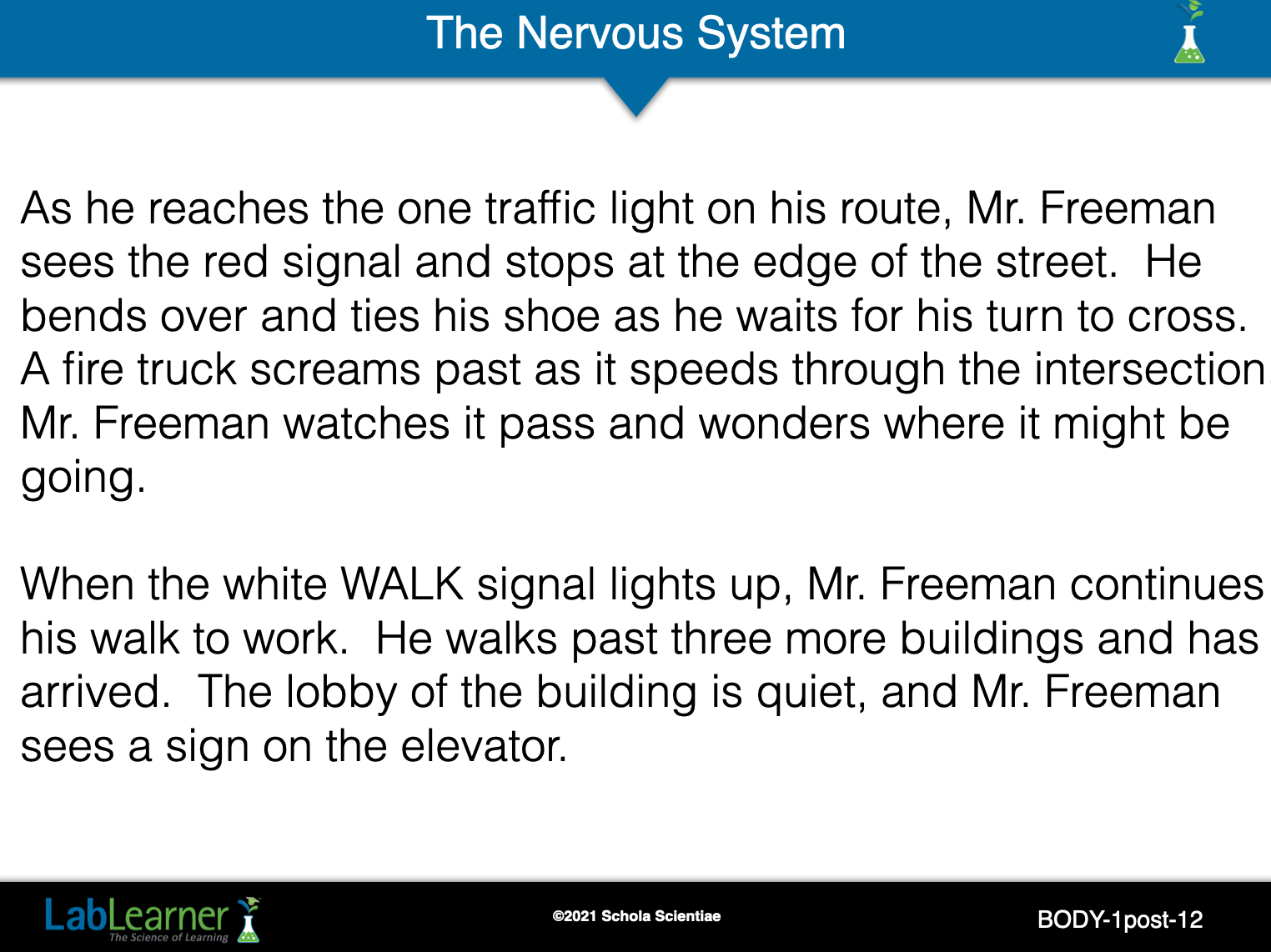
Continue to read the story aloud.
______________________________________________
SLIDE BODY-1post-13
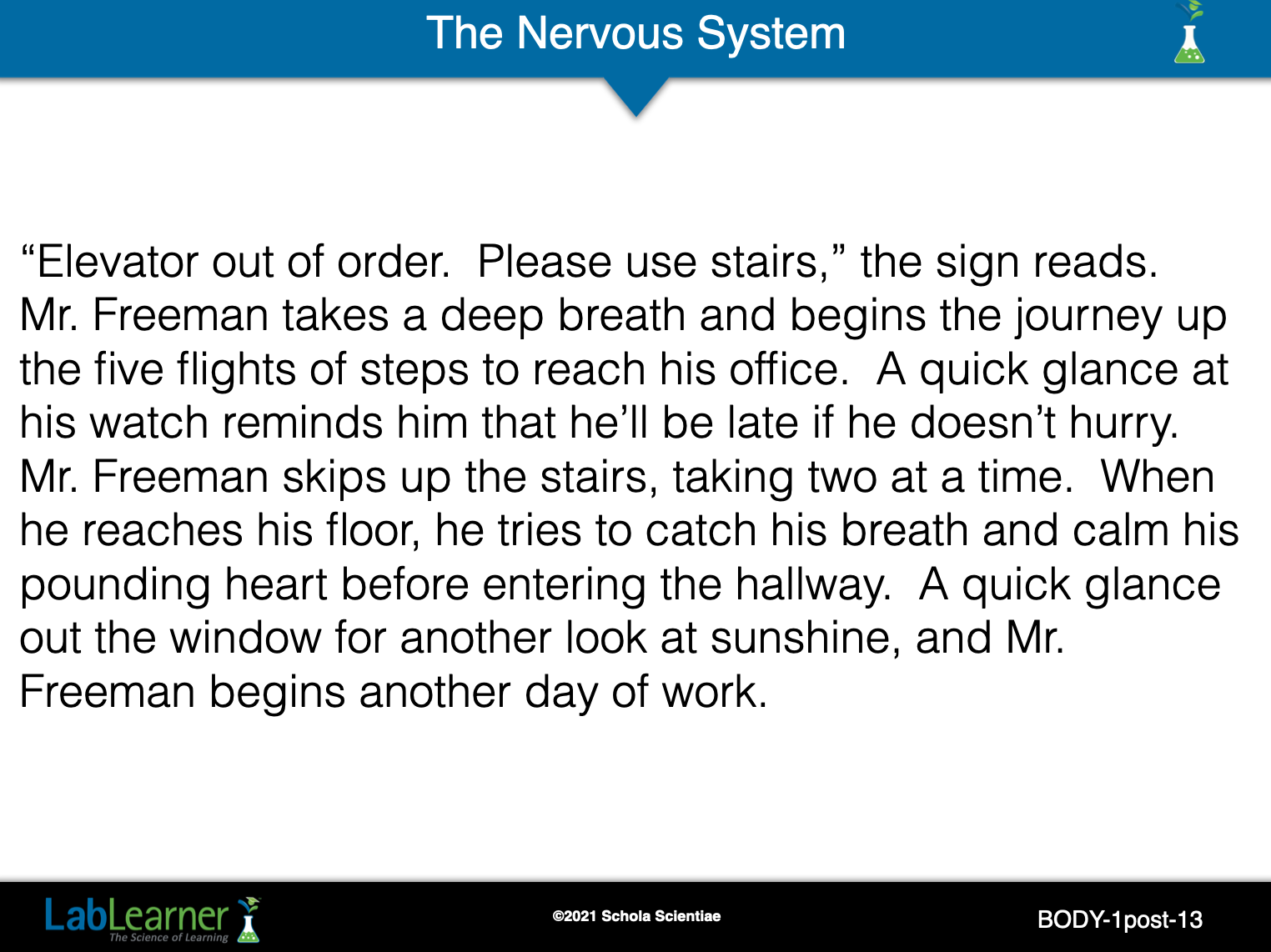
When you are finished reading the story about Mr. Freeman, ask students, “How did Mr. Freeman use his nervous system throughout his trip from the breakfast table to his office?” Student answers will vary.
Encourage students to realize that every time Mr. Freeman thought about something or made a decision, he used his nervous system. Every time Mr. Freeman made an observation he used his nervous system, and every time he moved he used his nervous system.
______________________________________________
SLIDE BODY-1post-14
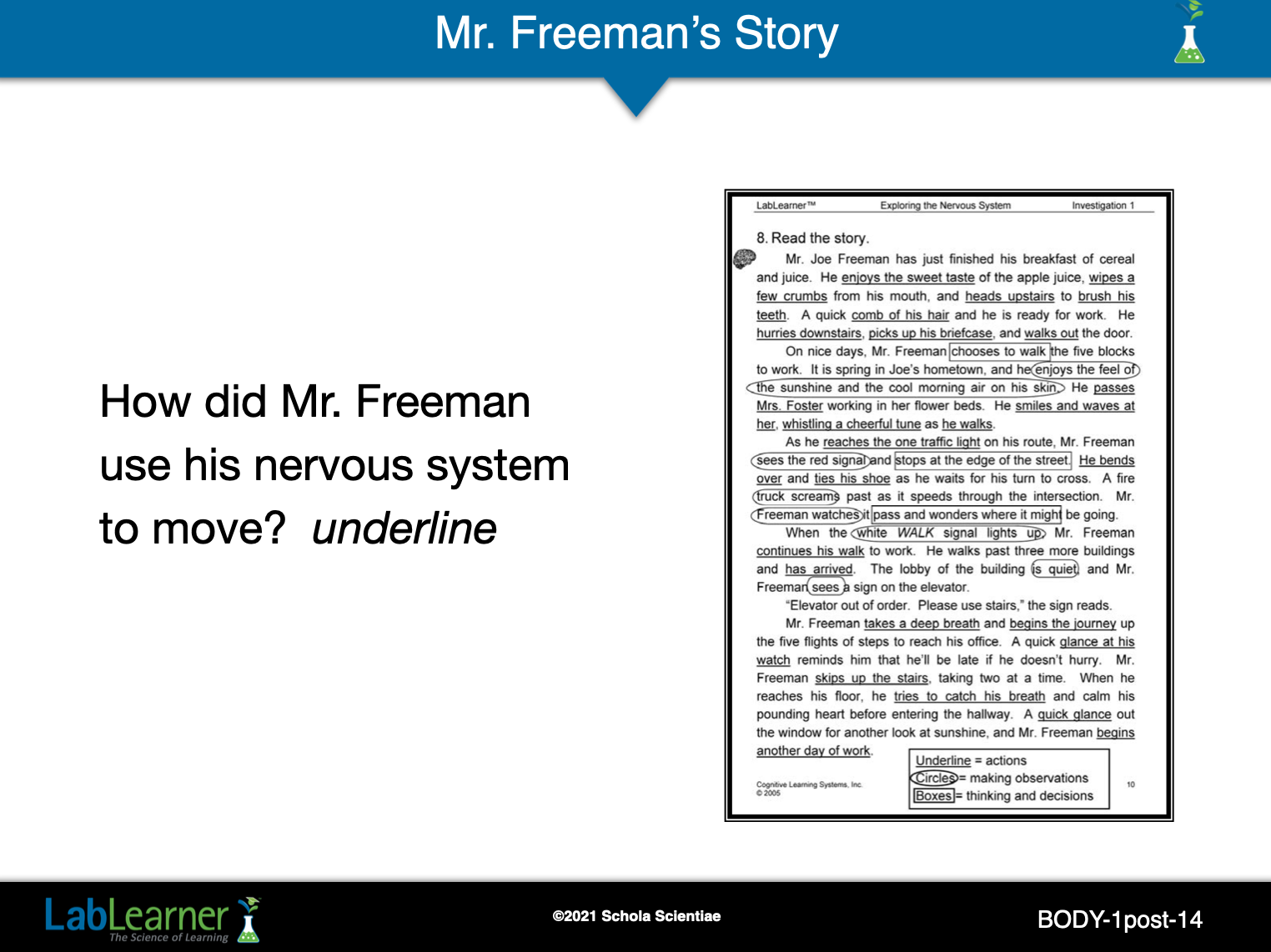
This is the first of three slides in which you will use the short story to highlight times when Mr. Freeman used his nervous system to either perform actions, make observations, or think and make decisions.
Ask, “How did Mr. Freeman use his nervous system to move?” Underline students’ responses from the story. Encourage students to also underline the phrases in their Scientist Data Record. Student answers may vary. Sample answers include: wiping his mouth, combing his hair, waving to Mrs. Foster, taking a deep breath, and skipping up the stairs.
______________________________________________

SLIDE BODY-1post-15
Next ask, “How did Mr. Freeman use his nervous system to make observations and gather information from his senses? Put a box around the times in which he uses his senses.” Student answers may vary. Sample answers include: feeling the sun and the cool air on his skin, seeing the red signal, hearing and watching the fire truck pass, seeing the white WALK signal, feeling the laces on his shoes, and tasting his breakfast.
______________________________________________
SLIDE BODY-1post-16
Next, ask, “How did Mr. Freeman use his nervous system to make decisions or to think? Circle the choices or decisions he makes.” Student answers may vary. Sample answers include: choosing to walk on the nice spring day, deciding to stop at the edge of the street, and wondering where the fire truck is going.
Finally, ask students, “Do you think that Mr. Freeman’s nervous system was ever not being used in this story?” Mr. Freeman’s nervous system was used constantly in the story. If his nervous system would have stopped working, he would not have lived.
______________________________________________
Note to Teacher: The following slides are available for discussion if time permits. They can either be presented in PostLab or saved for another time. These slides ARE NOT included in the Student Portal.
SLIDE BODY-1post-17
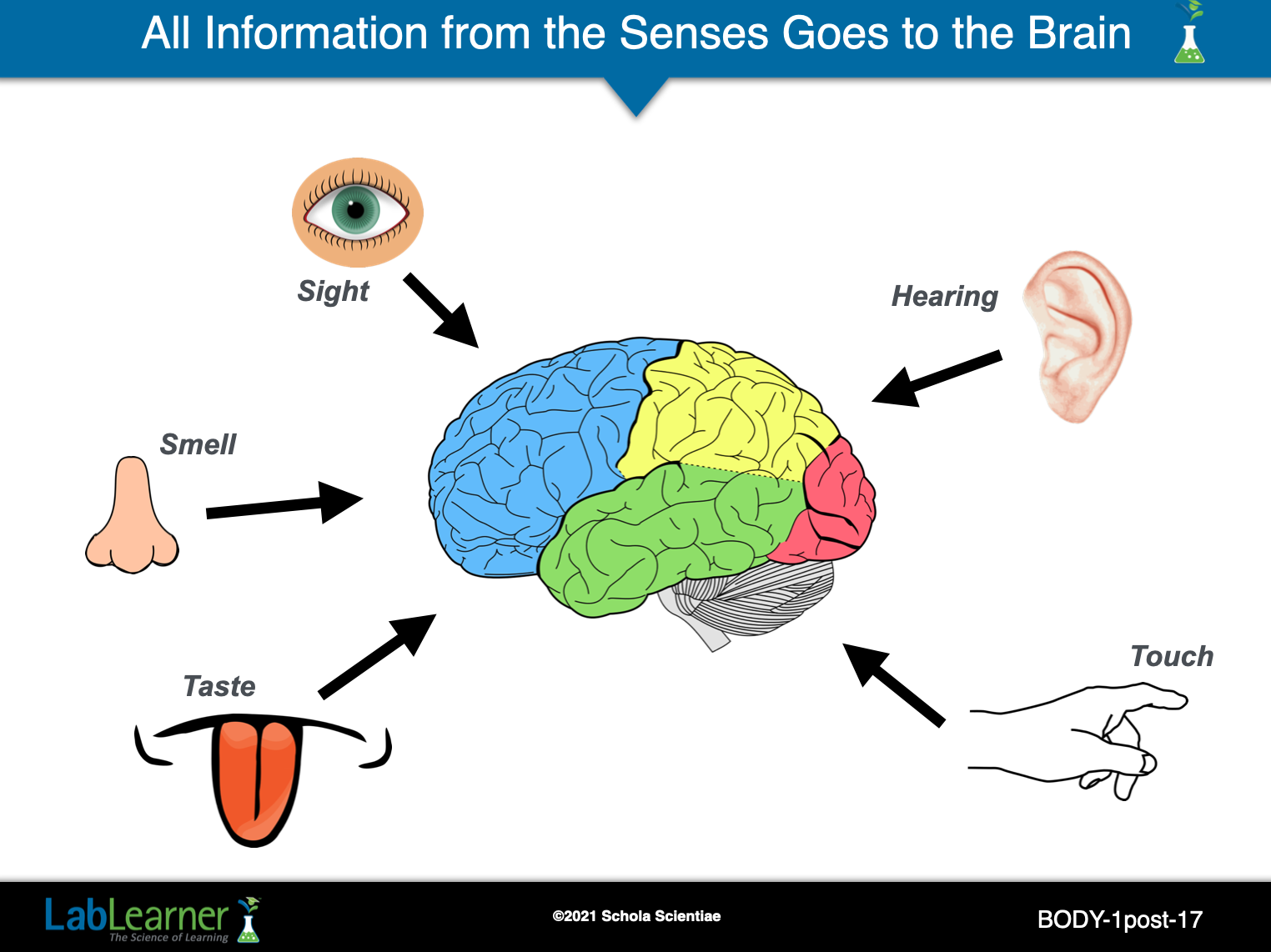
The last set of slides emphasizes the relationship between the senses and the nervous system.
In this slide, we begin our effort to impress upon students that the five senses are part of the nervous system and feed directly to the brain for interpretation. The remaining slides will do the same, one sense at a time.
This is a very basic concept. The eye does not know what it is looking at, for example. Nerve impulses from the eye to the brain are interpreted as the object our eyes are looking at. When the eyes are moved to look at other components of a scene, to understand it further, that is directed by the brain as well. Thus, our senses are each essentially tools that the brain uses to interact with and understand the world around us.
______________________________________________
SLIDE BODY-1post-18
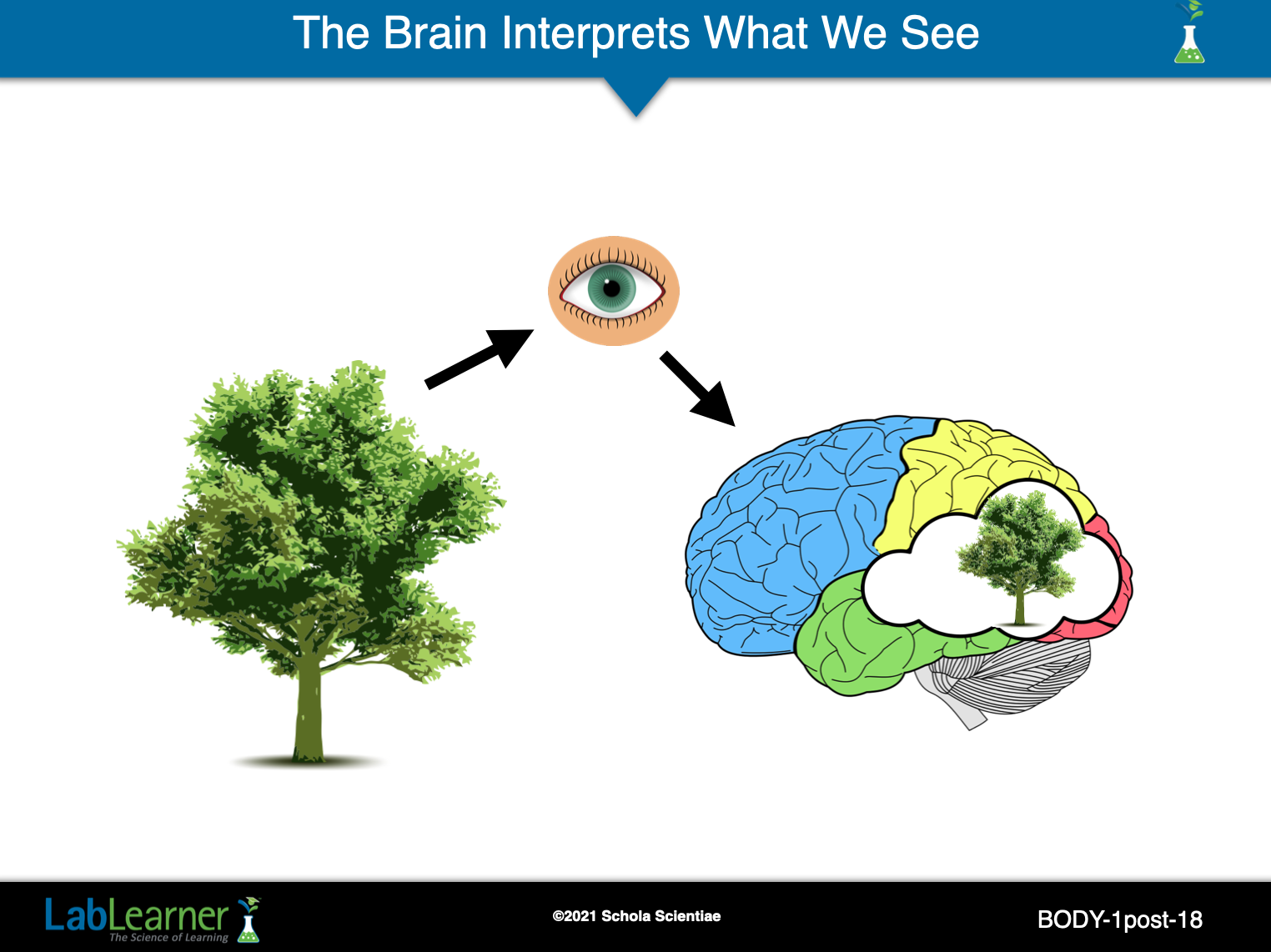
This slide focuses on the sense of sight. The eye transmits nervous signals to the brain that contain information about color, brightness, shape, movement, and so forth. This information, when received and processed by the brain, is interpreted as the object we are looking at, in this case, a tree.
Note to Teacher: While we will not discuss this issue with students at this age, remember that the visual information from our eyes to the brain is only the initiation of an enormously complex series of neurological events collectively called cognition. Thus, our brain is capable of knowing that we are looking at a tree but then, through cognitive processing, compares it to other kinds of trees we have seen before and may even associate memories of similar images and events surrounding them.
______________________________________________
SLIDE BODY-1post-19
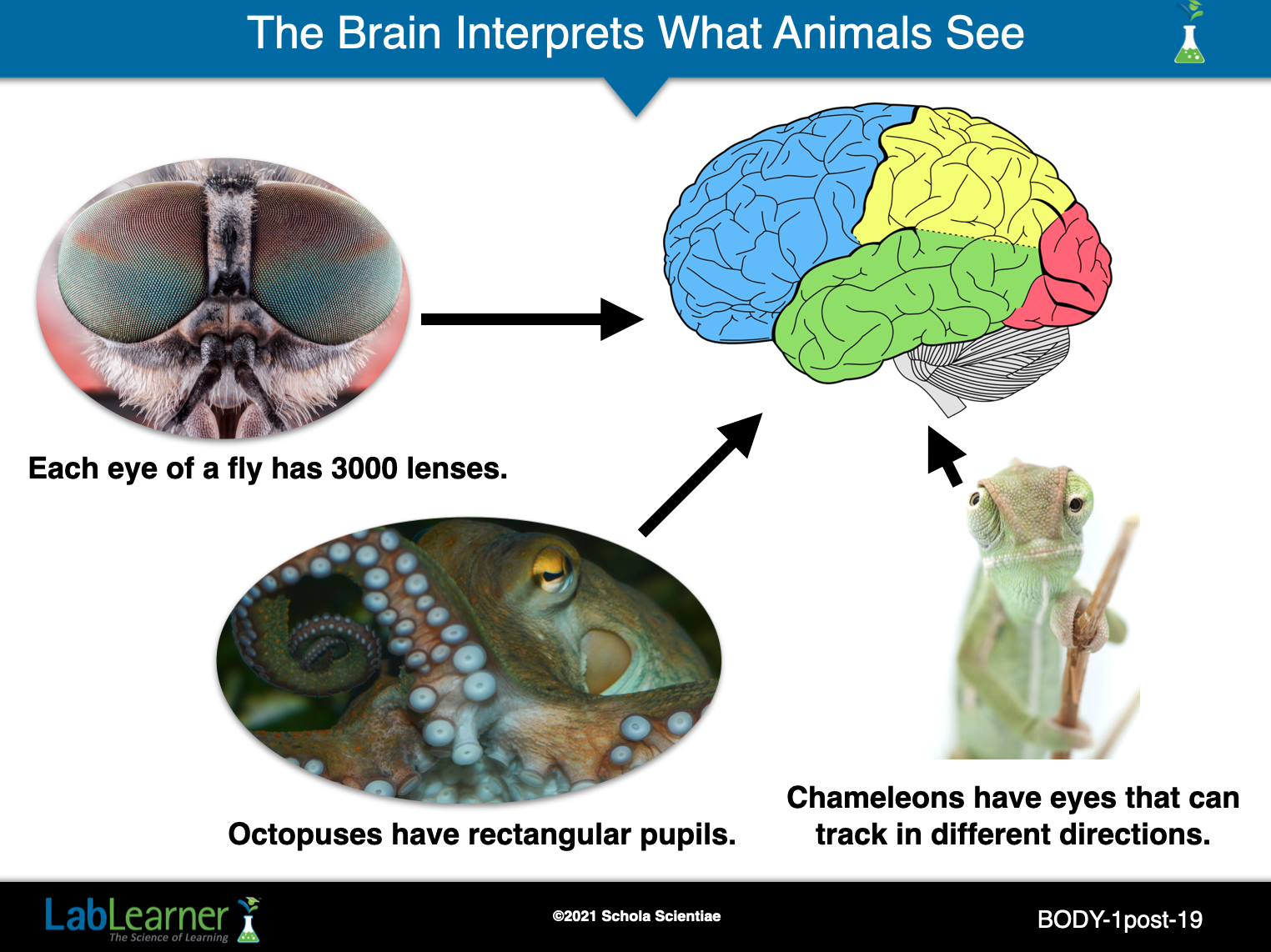
Discuss with students that just like humans, animals use their sense of sight to interact with the world. In these examples, information is transmitted to the brain for interpretation.
Flies, octopi, and chameleons have variations in their eyes to help them with specific functions necessary for survival. Flies, for example, have 3000 lenses around each eye, compared to just one lens in a human eye. This allows flies to see all around them, making them very hard to catch!
Octopuses have rectangular pupils in their eyes. A human eye has a circular pupil. Rectangular pupils may permit octopi to see almost all around them and see in dark areas. It may be interesting to remind students that octopuses are invertebrates, meaning they do not have a backbone like humans. However, octopuses have a nervous system that includes a brain.
Chameleons have eyes that can each move in different directions. Scientists used to think that the eyes moved independently. However, now we know that they can either look at two different objects at the same time or coordinate the eyes so they are both focused on the same objects. Scientists have discovered that each eye knows exactly what the other eye sees.
______________________________________________
SLIDE BODY-1post-20
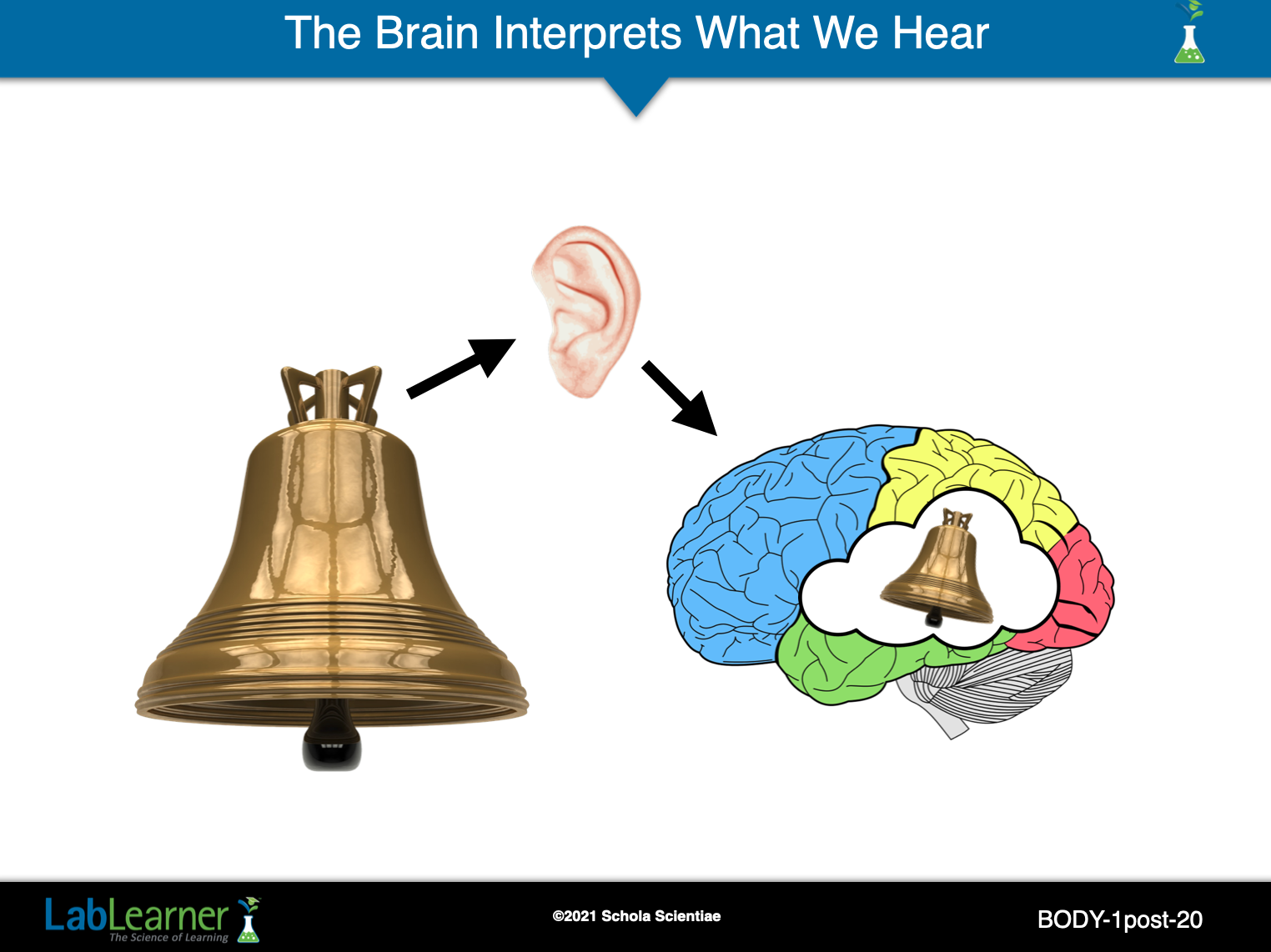
This slide is meant to impress upon students that hearing sounds in our surroundings, in this case, a bell is only interpreted as a bell by our brain. The ear itself has no idea or capacity to associate the sound waves it is collecting as the tone of a bell.
______________________________________________
SLIDE BODY-1post-21
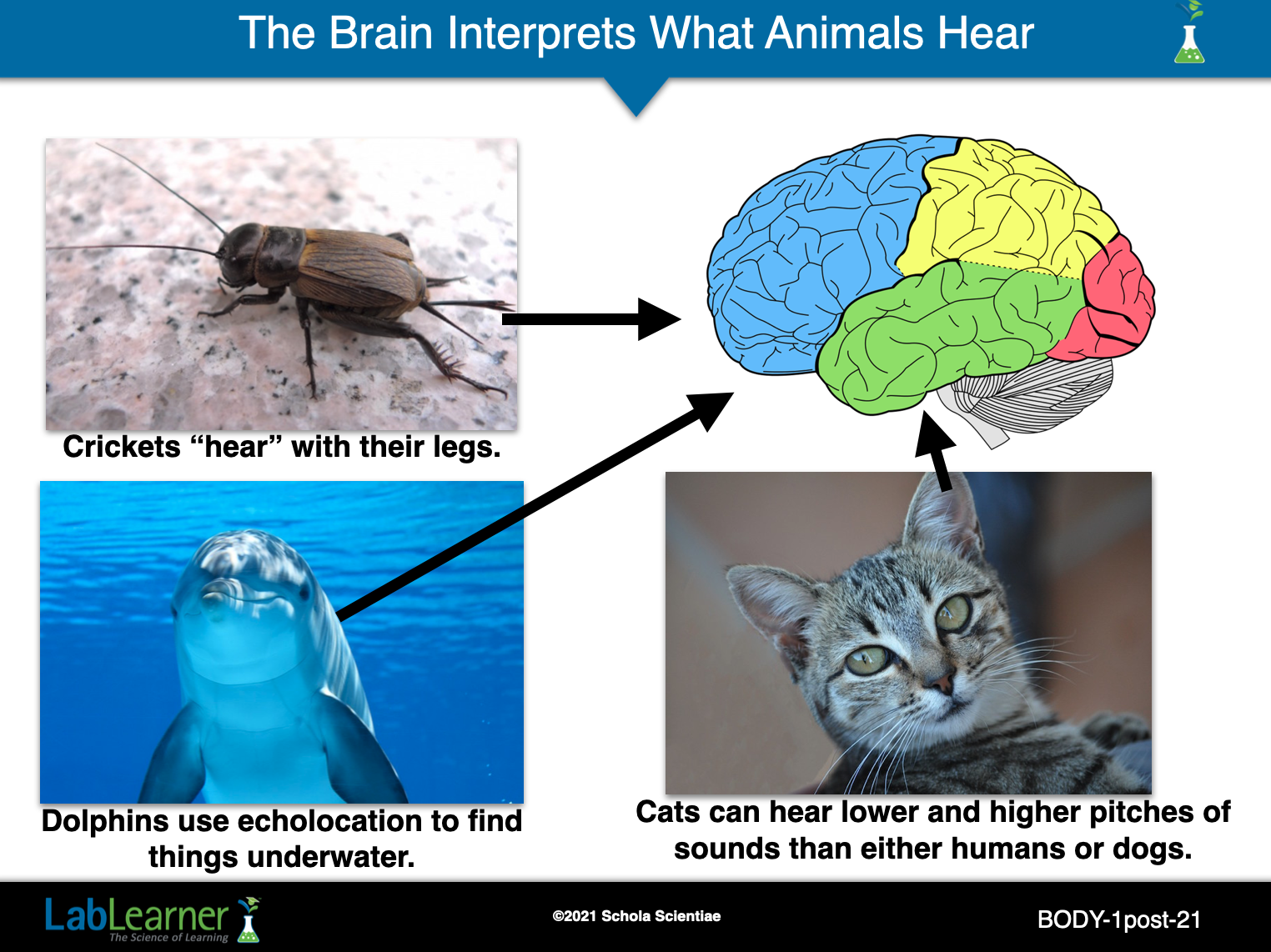
This slide emphasizes that animals also have a sense of hearing. In all of these examples, information is transmitted to the brain for interpretation.
Crickets have a thin membrane on their front legs. The membranes vibrate when sound waves are present, allowing crickets to “hear.”
Cats hear similar to the way humans hear. However, there is a big difference in what cats can hear. While humans hear high and low pitches or frequencies of sound, cats can hear sounds lower and much higher. Many people comment on dogs’ abilities to hear sounds higher than humans can hear. Humans hear frequencies as high as 23,000 Hz, while dogs hear sounds as high as 45,000 Hz. However, cats have them beat! They can hear sounds as high as 64,000 Hz.
Dolphins use echolocation to locate objects around them. They send out high-frequency sound waves, then listen for the echoes that occur when the sound waves reflect off of the objects. The reflected waves are detected by bones in the dolphins’ jaws. The sound waves pass from the jaws to the middle and inner ear. From there, information is transmitted to the dolphins’ brains for interpretation.
______________________________________________
SLIDE BODY-1post-22
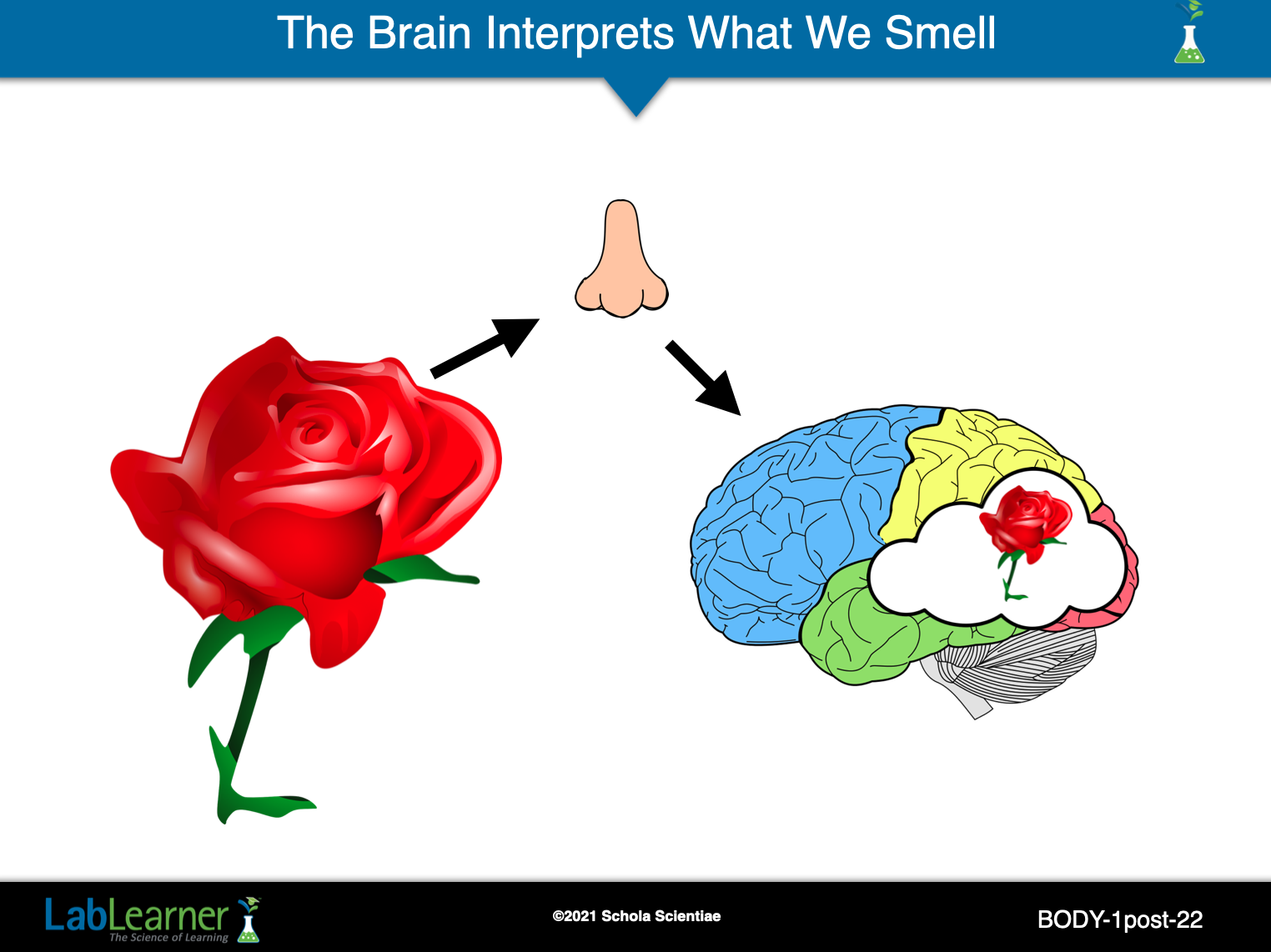
This slide focuses on the sense of smell.
______________________________________________
SLIDE BODY-1post-23
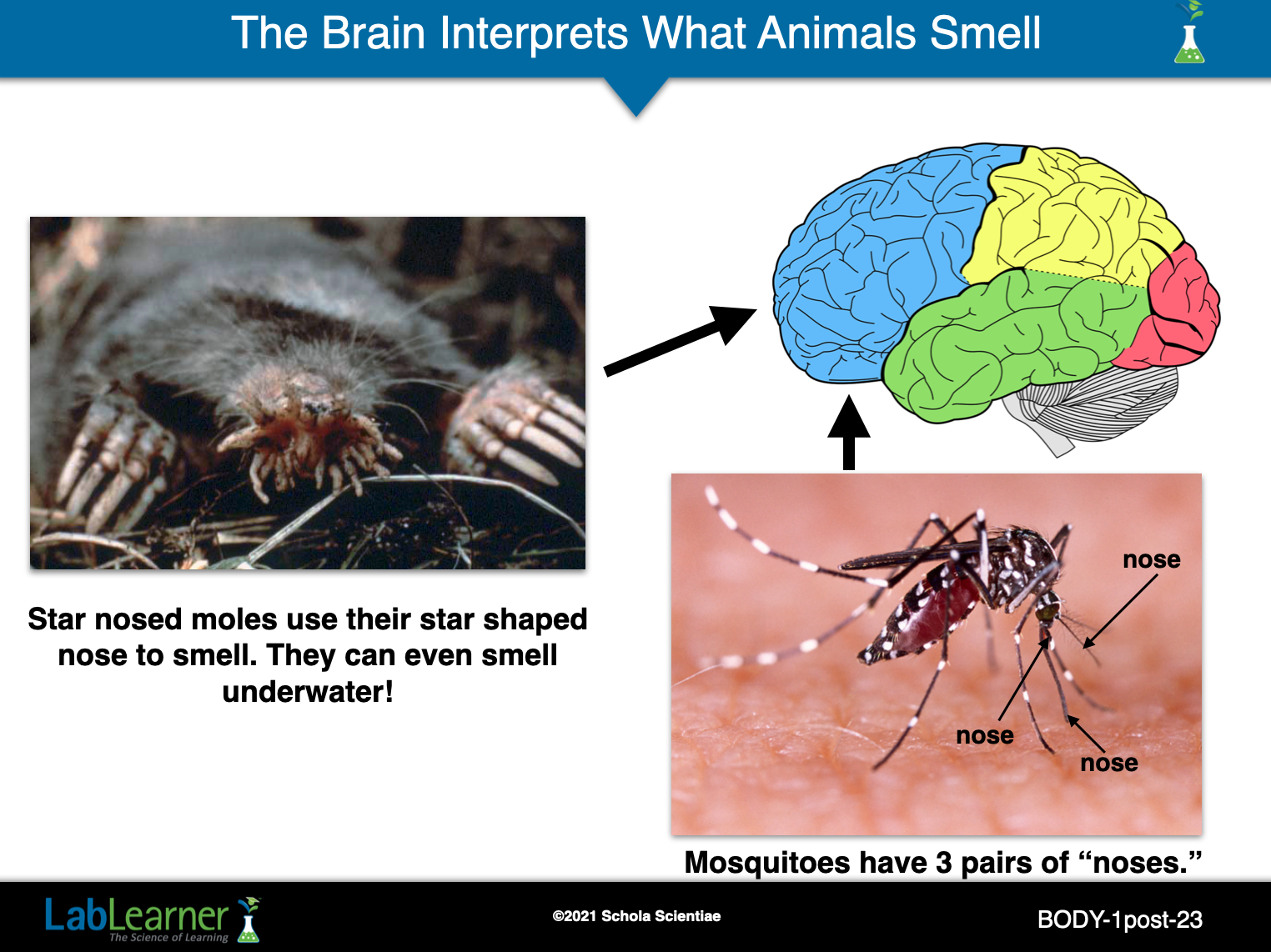
Share with students that animals such as moles and mosquitoes have a sense of smell similar in some respects to humans. Information from a mosquito’s or star-shaped mole’s nose is interpreted by the animal’s brain.
For many animals, the sense of smell is a more dominant sense than for humans and may be interpreted in the brain differently. For example, scientists think that a mosquito’s brain mixes smells and tastes to produce unique “flavors.” Female mosquitoes use their sense of smell to find humans. The carbon dioxide released by humans is one of the substances that female mosquitoes try to “sniff” out. Male mosquitoes don’t bite humans. Instead, they use their sense of smell to find nectar.
______________________________________________
SLIDE BODY-1post-24
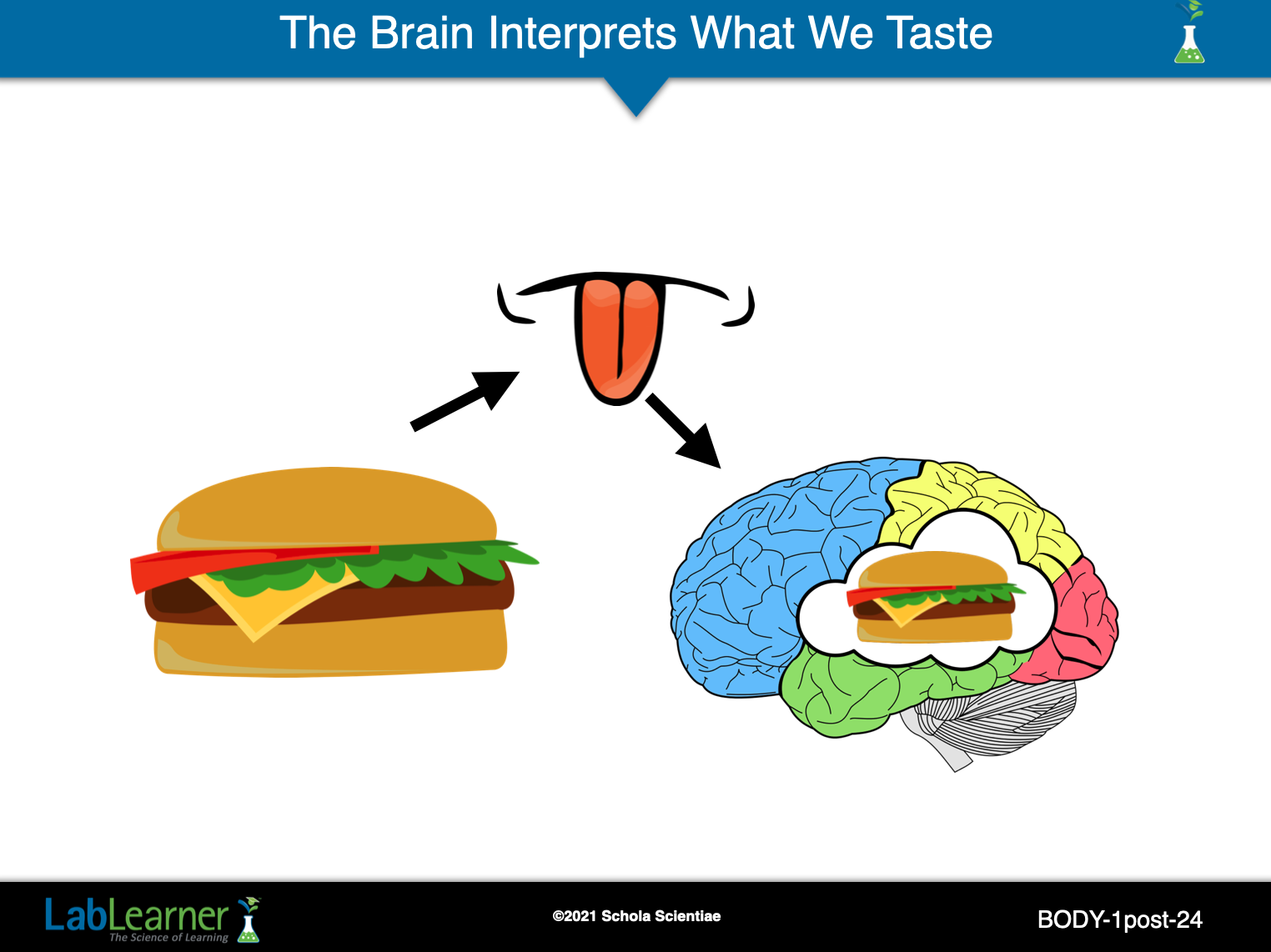
This slide focuses on the sense of taste.
______________________________________________
SLIDE BODY-1post-25
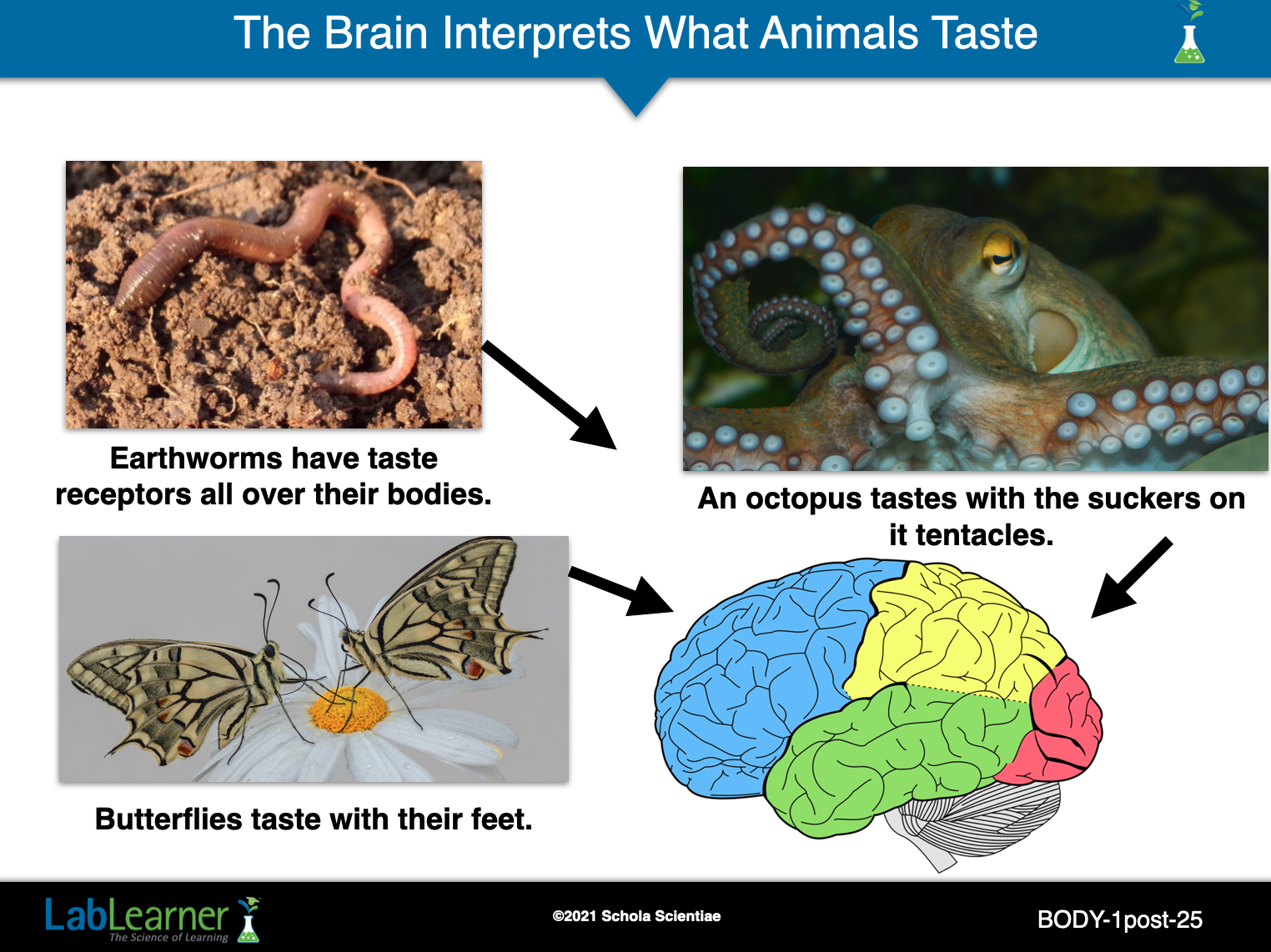
This slide emphasizes that animals can sense taste and that the sense of taste is transmitted to their brains for interpretation. Interestingly, this slide shows two invertebrates, animals without a backbone. Although earthworms and octopi are invertebrates, they each have a nervous system, which includes a brain.
In each example, students might be intrigued when they realize that the taste receptors for each organism are not located in the mouth.
______________________________________________
SLIDE BODY-1post-26
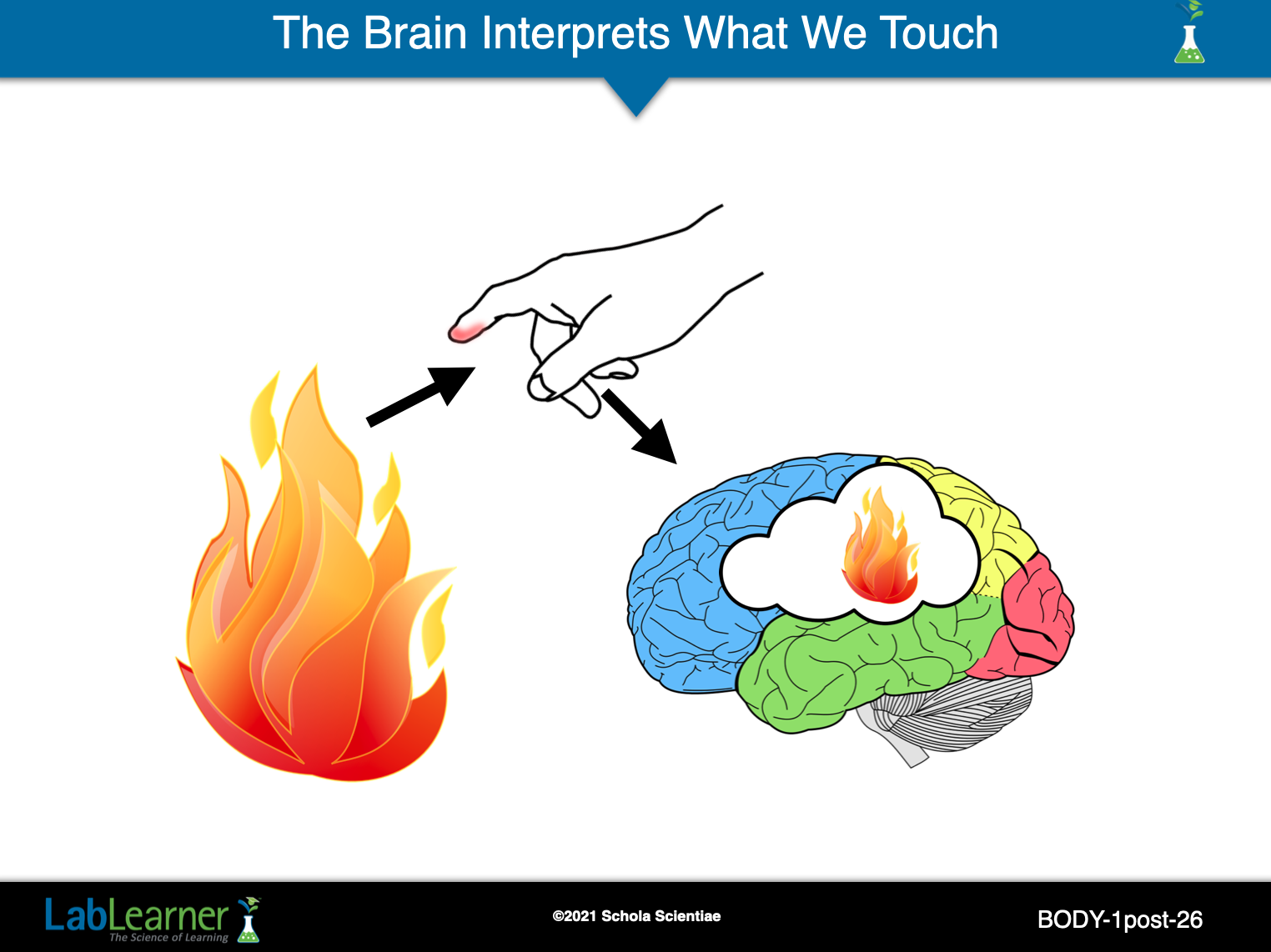
This slide focuses on the sense of touch.
______________________________________________
SLIDE BODY-1post-27
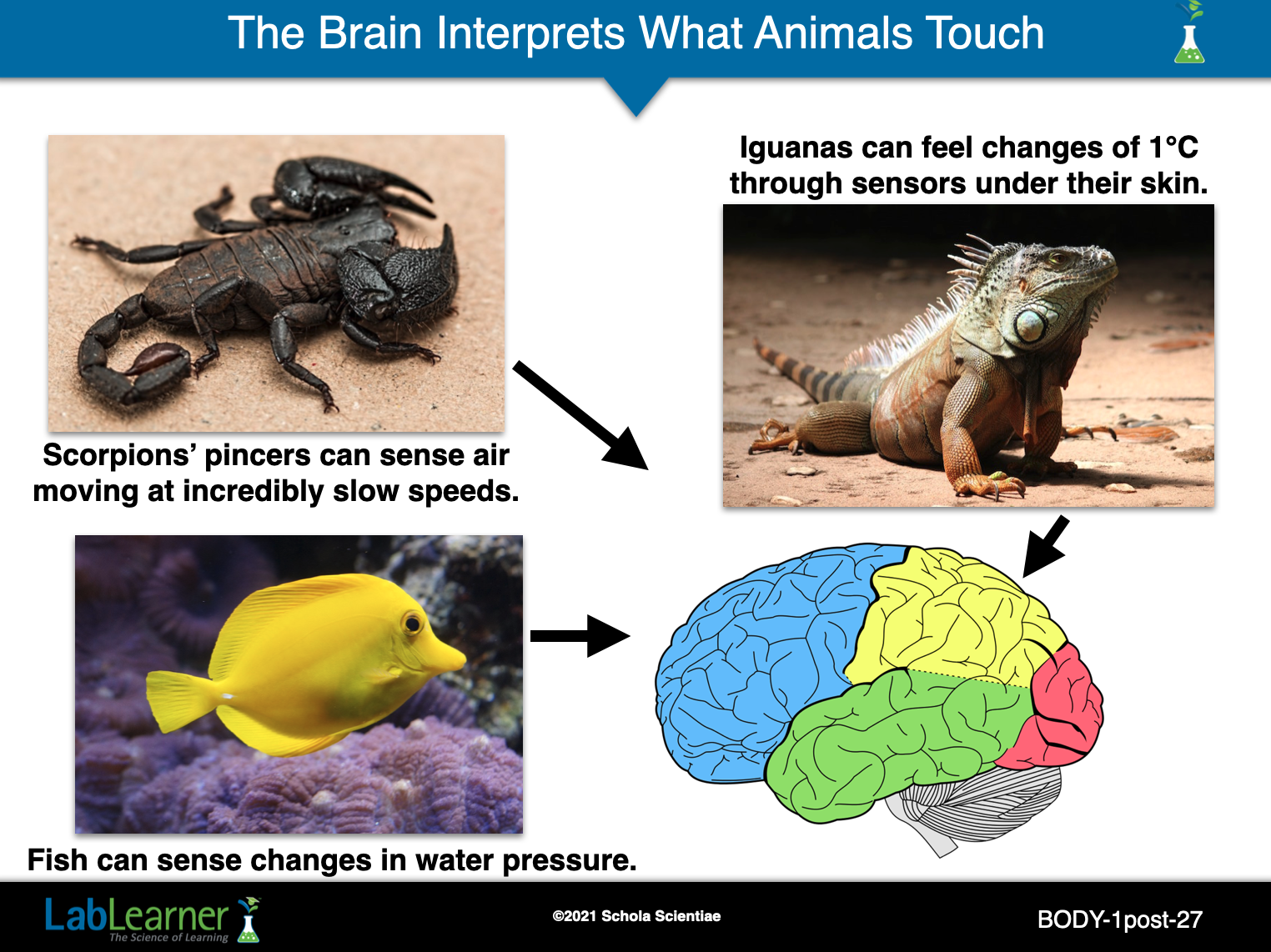
Just as humans have a sense of touch, so do other animals. Our sense of touch helps us to feel sensations such as temperature, pressure, and pain. Some of these same sensations are felt by other animals.
Much like our hands, the scorpion’s pincers are very sensitive. Hairs on its pincers allow it to sense the slightest movement of air, at speeds as small as 0.072 km/hr. To put that into perspective, the wind speed on a calm day, when branches are still and flags hang limp, is about 2-5 km/hr.
Iguanas require the temperature of sand to be 30°C (86°F) in order to lay their eggs. Otherwise, their eggs won’t hatch. It makes sense then, that they have sensors under their skin that can tell the difference between as little as 1°C!
Located along the head and trunk of fish are receptors that can sense pressure. This helps fish to move, change direction, and locate prey in the water.
______________________________________________
SLIDE BODY-1post-28
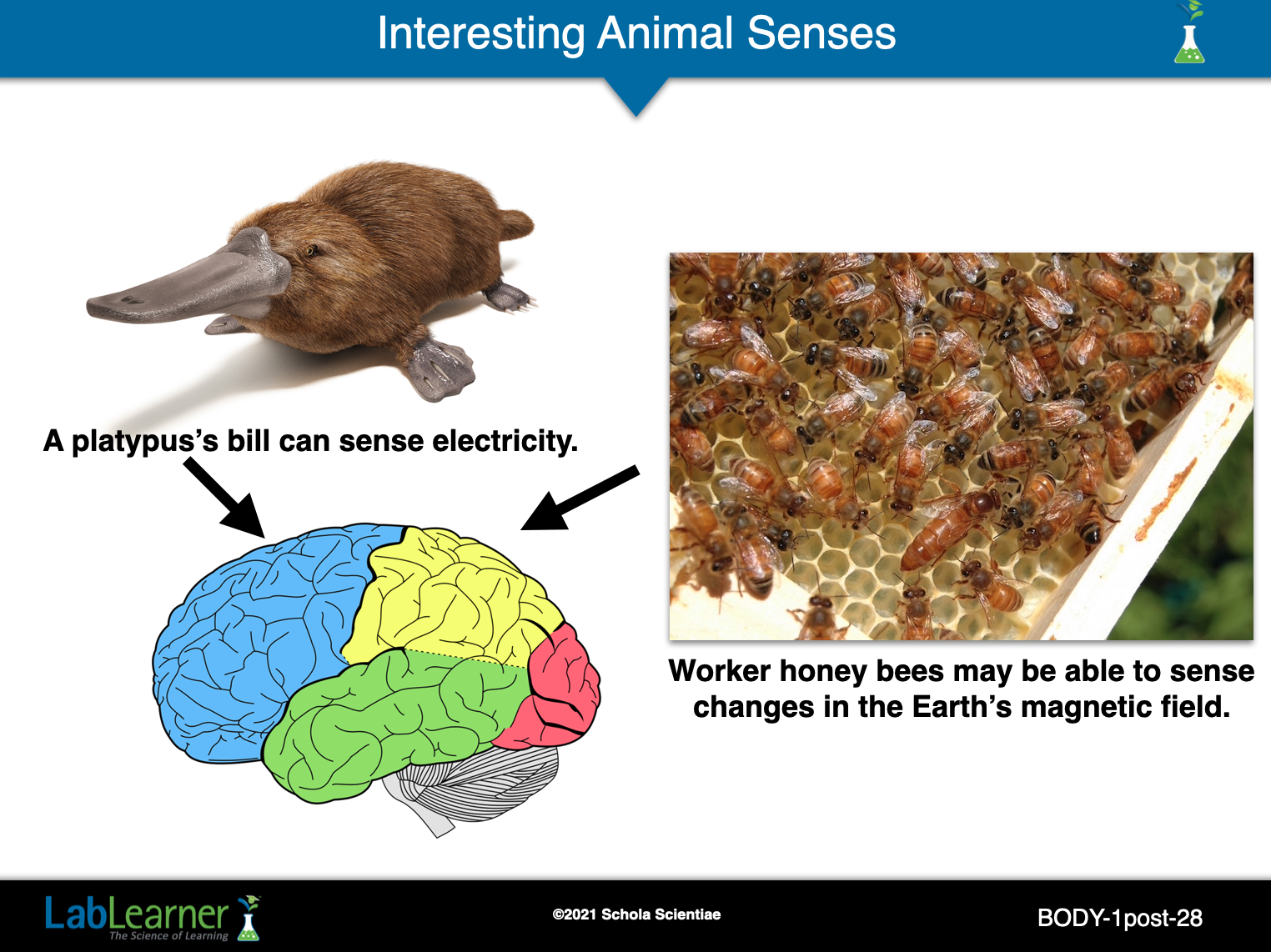
Students may find it interesting that some animals also have different senses than humans. For example, a platypus has electric sensors in its bill. These sensors can detect electricity as low as 0.05 microvolts. To give students an idea of just how low, it would take 30,000,000 microvolts to equal a 1 D cell battery.
Worker honey bees have iron oxide, a natural magnet, in their abdomens. Scientists think this natural magnet may give the bees the ability to detect changes in the Earth’s magnetic fields, helping them navigate.
______________________________________________
SLIDE BODY-1post-29
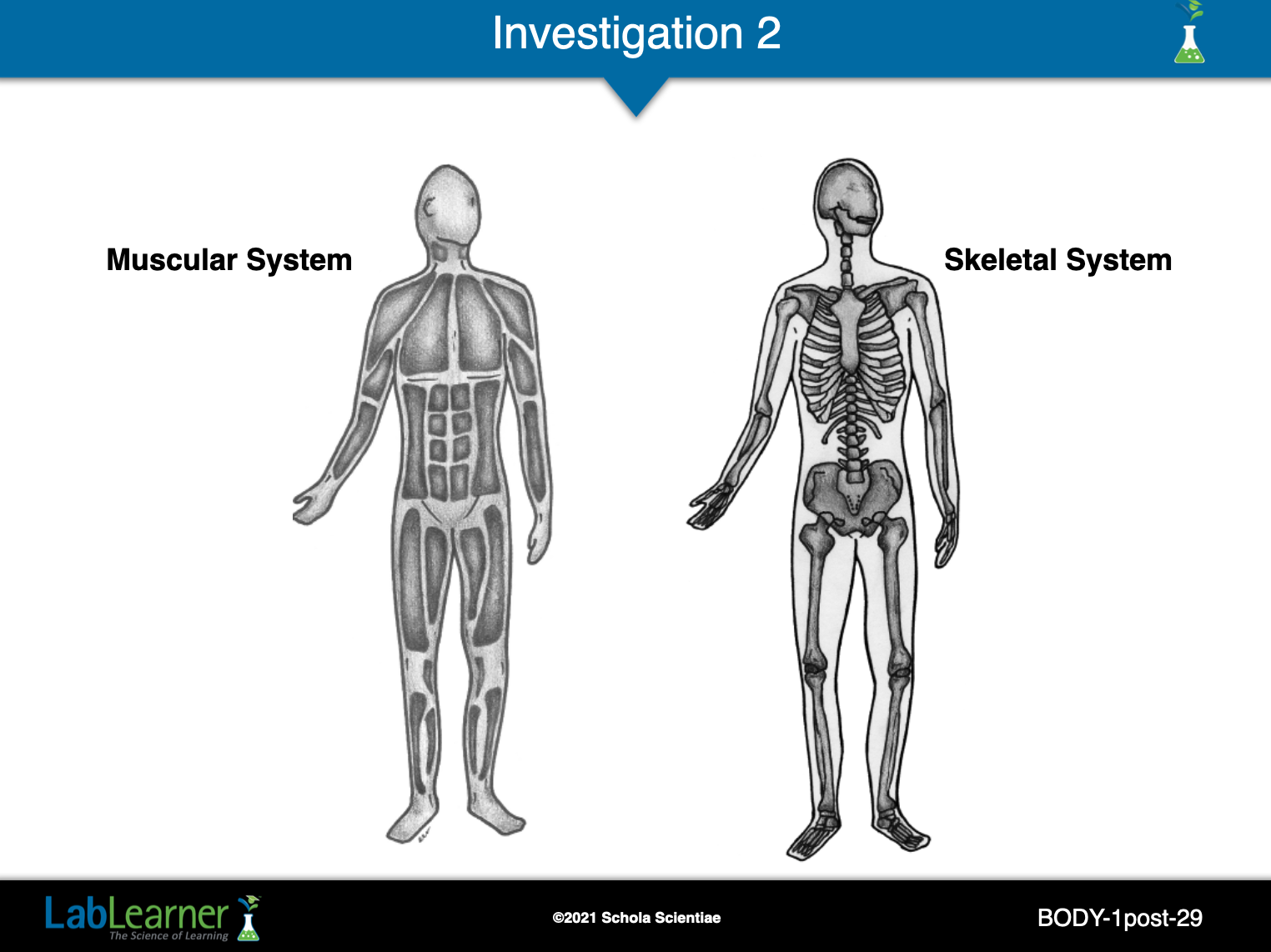
Tell students that the next investigation continues their exploration of body systems by introducing them to two systems: the skeletal system and the muscular system.
______________________________________________