Teacher Portal:
Acids and Bases
Performance Assessment
 ZERO-IN
 ZERO-IN
The italicized font represents information to be shared orally or physically completed with the students at this time.
The non-italicized font represents additional information included supporting the teacher’s understanding of the content being introduced within the CELL.
MINDSET
This Investigation is designed to:
- allow students to solve a problem using the concepts with which they have become familiar during the previous Investigations, and
- allow students to solve a problem using the procedures used during the previous Investigations.
DOWNLOAD IT – PRINT IT
By clicking the link below, the Performance Assessment Grading Rubric may be downloaded as a PDF (Portable Document Format) and printed. It is suggested that the teacher uses the printed rubric as a guide and to make additional notes during the assessment.
BE PREPARED
Teacher Preparation for the Investigation includes the following. This preparation should be done prior to students arriving in the lab.
Note: If spills occur, rinse the skin, piece of clothing, or table with water. Care should be exercised to prevent splashing any solution into the eyes.
- Prepare the 0.001N hydrochloric acid (HCl) according to the following procedure:
- Add 3 ml of 3N HCl to 997 ml of distilled water in a 1000 ml graduated cylinder. Cover with a piece of plastic wrap and invert to mix to prepare the 0.01N solution of HCl.
- Pour 100 ml of the 0.01N HCl into a 100ml graduated cylinder.
- Pour the remaining 0.01N HCl out of the 1000 ml graduated cylinder and rinse the cylinder with tap water.
- Dilute the 0.01N HCl by adding the 100 ml volume to 900 ml of distilled water in the 1000 ml graduated cylinder. Cover with a piece of plastic wrap and invert to mix to prepare the 0.001N solution of HCl.
- For each student group, pour 100 ml of the 0.001N HCl into a 400 ml beaker.
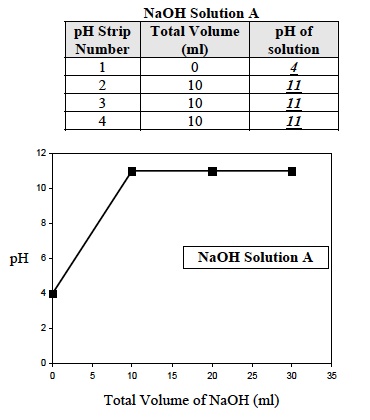
- For each student group, pour 100 ml of 0.1N (0.1M) NaOH into a 400 ml beaker labeled with the letter A.
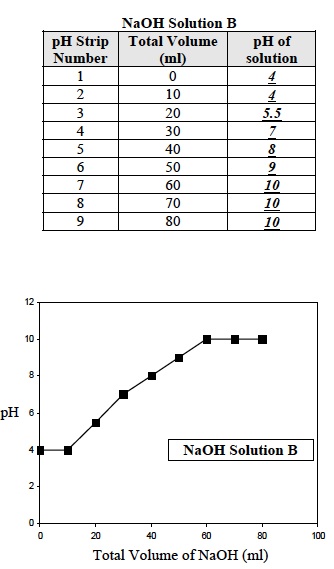
- For each student group, pour 100 ml of 0.005N (0.005M) NaOH into a 400 ml beaker labeled with the letter B.
- Place all materials at a central location (see list below).
Note: The teacher may choose to write the list of materials on the board or tell students orally what materials they need the day of the lab.
- Divide students into cooperative groups of five students.
Student Preparation for the Investigation includes having students gather the following materials. This preparation takes place on lab day after student lab groups have settled at their assigned lab tables.
Note: The materials are NOT listed in students’ SDRs. They are listed below for your reference.
- (1) pair of goggles per student
- (1) pair of gloves per student
- (1) hotplate/stirrer
- (1) stir bar
- (1) test tube rack
- (1) 15 ml centrifuge tube
- (1) dropper pipette
- (1) box of pH paper strips
- (1) lab marker
- (1) 100 ml graduated cylinder
- (1) piece of plastic wrap 30cm long
- (1) 400 ml beaker containing 100 ml of 0.001N HCl
- (1) 400 ml beaker containing 100 ml of 0.1N NaOH
- (1) 400 ml beaker containing 100 ml of 0.005N NaOH
- Direct one student from each lab group to collect the materials.
INVESTIGATE
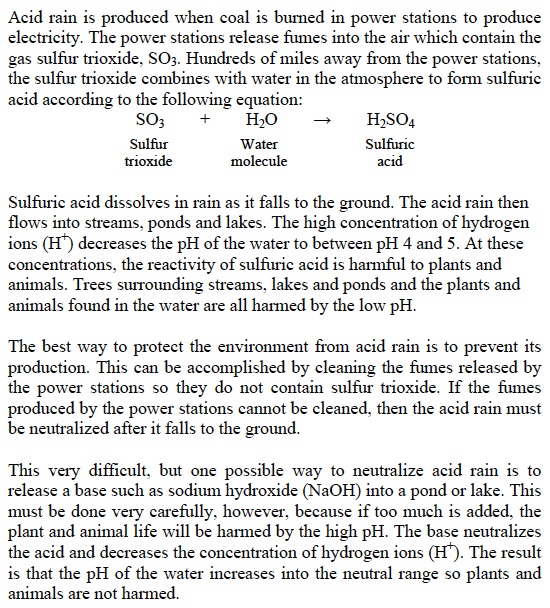
- Ask students to read the Background for the Performance Assessment, and discuss if necessary.
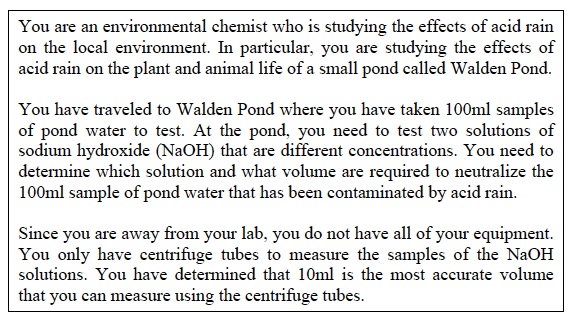
- Ask students to read the Goals of the Performance Assessment, and discuss if necessary.
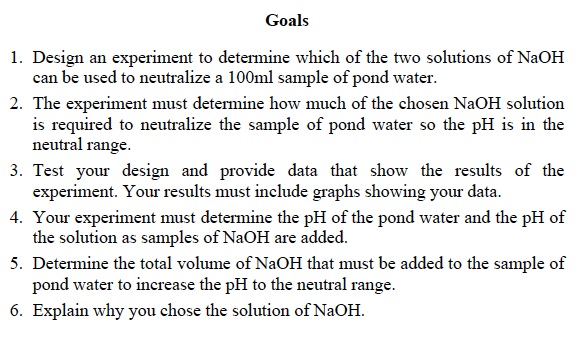
- Explain to students that the Performance Assessment requires only those procedures and skills that they have used in the previous Investigations.
- Instruct students to test the A sample of the pond water first and then the B sample.
- Allow students to conduct their experiments and encourage them to record their data carefully.
CLEAN UP
Let students know your expectations for cleanup. Ask them to clean up.
ANALYZE IT
Discuss the results of the Performance Assessment as a class, including
- all possible solutions to the posed problem,
- whether each student group met the goals of the Performance Assessment, and
- any procedural difficulties student groups had in meeting the goals.