
Teacher Portal:
Using and Making Models
Using and Making Models: CAP – Investigation 2
 ZERO-IN
Italicized font represents information to be shared orally or physically completed with the students at this time.
Non-italicized font represents additional information included supporting the teacher’s understanding of the content being introduced within the CELL.
BRANCH OUT
Explain to students that botanists are scientists that study plants and zoologists are scientists who study animals. Together, botanists and zoologists are called biologists.
PRINT IT
Use your browser to download a printable PDF as help during the slide presentation and to make additional notes. In your browser, go to File > Print and then choose to save as PDF.
NAVIGATE IT
Once the slide presentation is launched
- use your left and right arrows to advance or go back in the slide presentation, and
- hover your mouse over the left edge of the presentation to get a view of the thumbnails for all the slides so that you can quickly move anywhere in the presentation.
- Click on the button below to launch the slide presentation for the CELL.
SHARE IT
Slide MODELS 2-1:
Students have likely had experience thinking about how to model different animals or plants, whether through experiments or “playing pretend.” In this CAP we take a bit of a turn and describe to students how animals and even plants can change or modify their environment to suit their own needs. Animals and plants that change their environment for their own use are sometimes call ecosystem engineers. Man is the greatest ecosystem engineer alive today or has perhaps ever lived.
Slide MODELS-2-2:
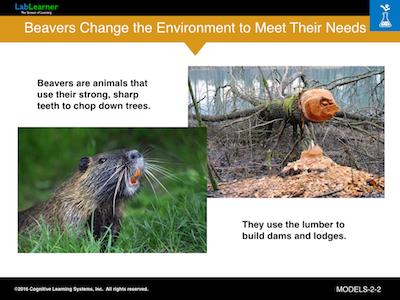
While many animals change the environment to meet their needs, we begin by observing the beaver. The picture on the left shows the beaver’s strong and sharp teeth. On the right, we can see the hundreds of bite marks left by the beaver who felled this tree. The teacher might perhaps ask his or her students, “Why do you think the beaver chops down trees?” Some students may think the beaver does this to eat the wood. However, this is not true, they use the lumber to build lodges and dams. Ask the students, “What do you think the beaver is going to do with the wood it has chopped down?”
We will see the answer to this question on the next slide.
Slide MODELS-2-3:
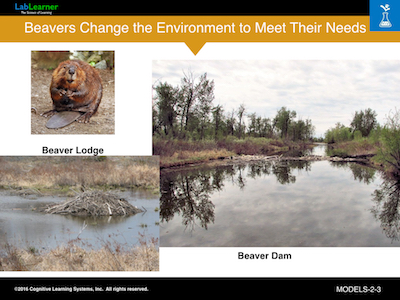
In this slide, we see that beavers use the logs and lumber they have harvested to build structures. On the left is a beaver lodge. Beavers use lodges for shelter. On the right is a beaver dam. Beavers dam streams which often cause the formation of a “beaver pond”. Fish can gather in the deep, slower-moving water and serve as a source of food for a beaver family. Beavers will also build their lodges in the ponds.
Slide MODELS-2-4:
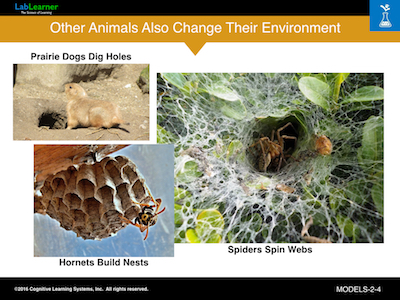
This slide and the following slide are simply to demonstrate that other animals change their environment to meet their needs. Here we see a prairie dog that has dug a hole or burrow, a spider’s web, and a hornet nest. The spider web serves as protection for the spider but also as a trap for catching insects for food. The hornet nest protects eggs and larvae until they mature.
Slide MODELS-2-5:
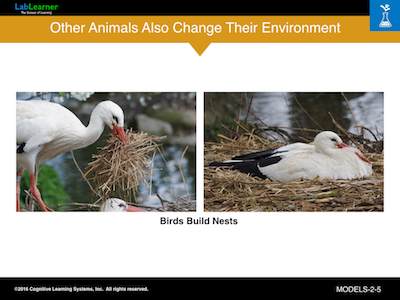
This slide shows that birds change their environment by building nests from various materials. Students will likely be most familiar with this form of environment modification by animals.
Slide MODELS-2-6:
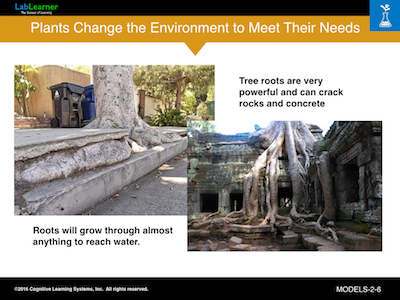
This slide shows that plants modify their environment to suit their needs as well. Most students have seen how tree roots displace or crack concrete sidewalks. Plants change their environment in many other ways but most of them involve invisible chemical reactions that young students need not be concerned with at this time.
Slide MODELS-2-7:
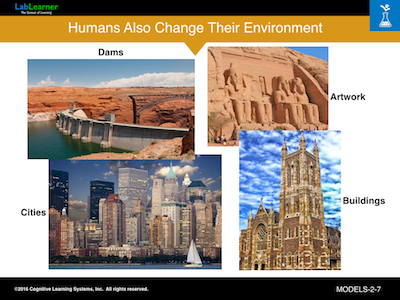
This final slide shows just a few ways in which man, the ultimate ecosystem engineer, changes the environment to suit his needs. The teacher may wish to ask his or her students if they can think of other ways in which humans change their environment.