
Teacher Portal:
Microscopic Explorations
Microscopic Explorations: CAP – Investigation 4
Non-italicized font represents additional information included supporting the teacher’s understanding of the content being introduced within the CELL.
BRANCH OUT
All plants and animals need the energy to survive. But where do they get their energy? All energy on Earth comes from the Sun. The important plant chemical reaction, photosynthesis, is carried out inside the chloroplasts of plant cells. The energy thus obtained from the Sun is used to build plant mass and provide energy for all of the plant’s functions. Animals, on the other hand, eat plants to obtain energy to survive, grow and reproduce.
PRINT IT
Use your browser to download a printable PDF as help during the slide presentation and to make additional notes. In your browser, go to File > Print and then choose to save as PDF.
NAVIGATE IT
Once the slide presentation is launched
- use your left and right arrows to advance or go back in the slide presentation, and
- hover your mouse over the left edge of the presentation to get a view of the thumbnails for all the slides so that you can quickly move anywhere in the presentation.
- Click on the button below to launch the slide presentation for the CELL.
SHARE IT
Slide MICRO4-1:
In this CAP, we will trace the flow of energy from the Sun to plants and then to animals of all kinds.
Slide MICRO4-2:
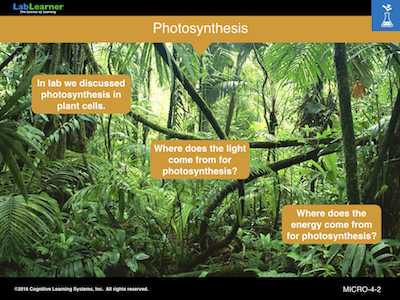
Photosynthesis, a chemical reaction that takes place inside plant cells, is one of the most important chemical reactions on Earth. In lab, we discussed that photosynthesis occurs in plant cell organelles called chloroplasts. This slide simply asks “Where does the light come from for photosynthesis?” and “Where does the energy come from for photosynthesis?” The answer to both questions, of course, is the Sun.
Slide MICRO4-3:
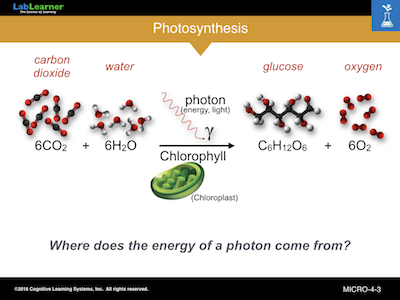
This slide shows the photosynthesis reaction. The ball and stick models show the chemical structures of the components and products of photosynthesis. The precise nature of these molecular models is too advanced for students at this level but is included only to show that we can build molecular models. Students will see such models again and again in middle school and beyond.
In the plant chloroplast, water and the gas carbon dioxide are converted into the sugar glucose and the gas oxygen. This accentuates just how important the photosynthesis reaction really is. Not only does it capture the Sun’s energy for use on Earth, but in the process, it produces the oxygen that animals need to survive. Before photosynthesis evolved, no animal life on Earth was possible.
Energy in the form of light is required for the photosynthesis reaction to occur. As indicated in the slide, light energy from the Sun comes in the form of photons. At this point, students may think of photons only as very small, subatomic-sized, packets of energy. They will learn much more about photons in several middle school CELLs.
Slide MICRO4-4:
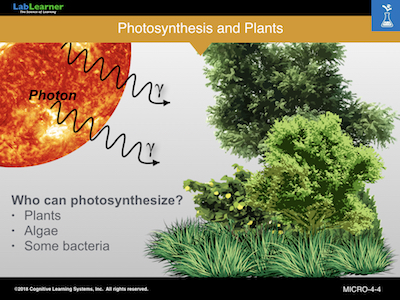
This slide shows that plants are able to collect light energy (photons) from the Sun. Not only do plants perform photosynthesis, but also microscope algae and some bacteria can as well. In fact, photosynthetic bacteria may well have been the first cells that were capable of producing atmospheric oxygen on Earth.
Slide MICRO4-5:
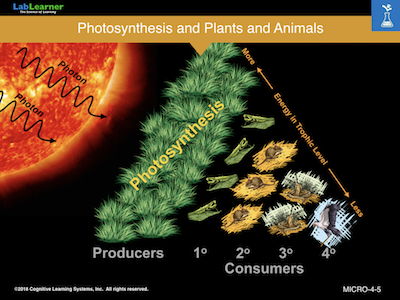
While plants are able to directly capture the Sun’s energy for their own growth and other energy needs, animals cannot do so. Instead, animals have evolved to eat plants and thereby obtain energy from them. Animals that eat plants for energy are called consumers. Plants, on the other hand, are called producers because they can produce useable energy in the form of the sugar glucose directly from the Sun through photosynthesis.
Not all animals eat plants. So where do they, the snake and bird of prey in this slide, get their energy? These types of animals are known as carnivores (meat-eaters) and get their energy by eating animals that feed on plants. Thus the energy from the Sun passes through plants to the animals that eat plants to animals that eat animals that eat plants. At any level in this chain, however, all of the energy comes originally from the Sun in the form of energetic photons of light.
Slide MICRO4-6:
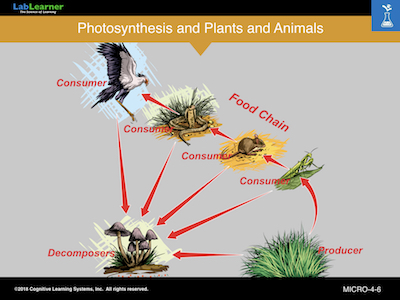
This final slide is included to complete the cycle of energy transfer through the food chain. As we have discussed, plants are producers since they produce the sugar glucose directly from the Sun through the process of photosynthesis. Consumers eat plants for their energy, either directly like the praying mantis in this slide, or indirectly as carnivores that eat animals that eat plants. Some animals, like the mouse in this case, eat both plants and animals and are called omnivores.
At the bottom left of this slide are the decomposers. These are both multicellular and unicellular organisms that break down the dead bodies of higher plants and animals. Decomposers, therefore, recycle the materials accumulated in plant and animal bodies. Just imagine how different the Earth would be if there were no decomposers!