
Teacher Portal:
Light and Optics
 Light and Optics: CAP – Investigation 4
Non-italicized font represents additional information included supporting the teacher’s understanding of the content being introduced within the CELL.
BRANCH OUT
Waves are important in science. Another important kind of wave are the light waves in the visible range of the wave spectrum. Students will study one form of wave or another throughout their science education.
PRINT IT
Use your browser to download a printable PDF as help during the slide presentation and to make additional notes. In your browser, go to File > Print and then choose to save as PDF.
NAVIGATE IT
Once the slide presentation is launched
- use your left and right arrows to advance or go back in the slide presentation, and
- hover your mouse over the left edge of the presentation to get a view of the thumbnails for all the slides so that you can quickly move anywhere in the presentation.
- Click on the button below to launch the slide presentation for the CELL.
SHARE IT
Slide LIGHT4-1:
In this CAP we will discuss waves. In particular, we will discuss light waves and how they can be used to communicate or transfer information.
Slide Light4-2:
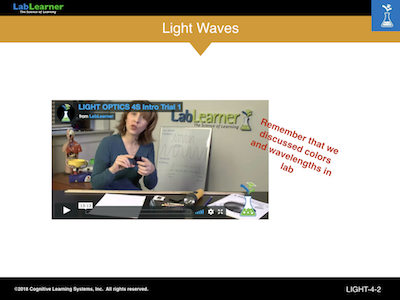
This slide will jog students’ memory of the lab for Investigation 4. As we will see, although the electromagnetic spectrum is very wide, the visible part of it, the part that we perceive as light, is only a very small part of it.
Slide LIGHT4-3:
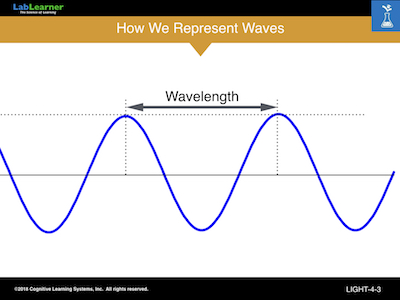
This slide shows how waves are represented in science. For our discussion in this CAP, we wish to point out one important characteristic of a light wave, its wavelength. The wavelength is the distance between one peak and another. This distance represents one complete cycle of the wave.
Slide LIGHT4-4:
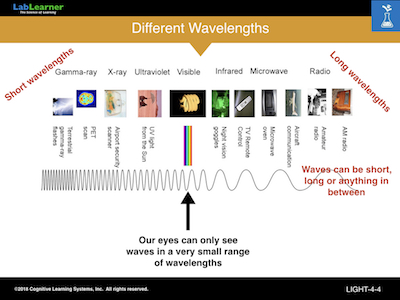
This slide shows the entire electromagnetic spectrum. Notice that very short wavelengths are to the left while long wavelengths are to the right. The slide is labeled with the names and examples of different wavelengths. At this point, we are only going to focus on a very small section of the complete electromagnetic spectrum, the visible spectrum. This extends from about 400nm to 700nm. An nm stands for a nanometer. A nanometer is a very small distance. It is 0.000000001 of a meter! Nonetheless, it is found in the middle of the electromagnetic spectrum. There are wavelengths many, much shorter, and longer than those found in the visible spectrum.
Students may recognize the prefix “nano” from the term nanotechnology. Nanotechnology is a technology that deals in dimensions at this small size. This size level is on a molecular scale.
Slide LIGHT4-5:
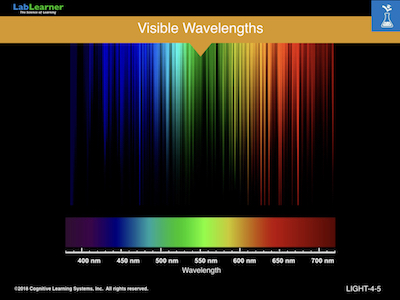
This colorful slide focuses on just the visible region of the electromagnetic spectrum. Depending on the wavelength, we perceive different colors. The visible wavelengths range from purple at around 400nm to red at 700nm.
Slide LIGHT4-6:
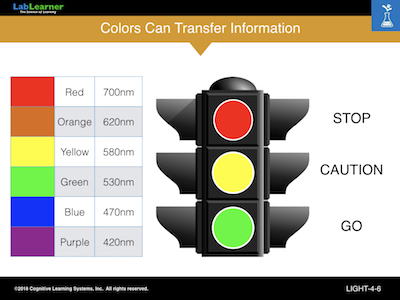
This slide and the following slide illustrate ways in which the wavelength of visible light can be used to communicate meaning or transfer information. The common traffic signal uses three different colors; red, yellow, and green. Most all students will recognize this form of communication with color. Red means stop. Yellow means caution. And green means go.
The teacher may ask students to think of other ways in which color may be used to communicate information. The next slide will give a few examples.
Slide LIGHT4-7:
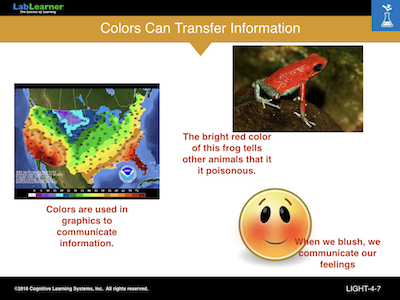
This final slide shows three additional ways in which color may be used to communicate information. The weather map uses bands of color to indicate temperature. The poisonous frog uses its bright red color to warn other animals to leave it alone. Finally, when we blush, the redness of our face may communicate a sense of embarrassment or shyness to those we are speaking to.