
Teacher Portal:
Light and Optics
 Light and Optics
During this CELL, students will conduct several Investigations that deal with light and optics. Students will investigate how transparent objects interact with light to both absorb and transmit light. It will become evident that there is an inverse relationship between absorption and transmission since light that is not transmitted by a transparent object is absorbed. Students will investigate how opaque objects interact with light to both absorb and reflect light.
Students will investigate how light is reflected according to the Law of Reflection using a mirror as the reflecting surface. By calculating the angles of incidence and reflection of light using a protractor, students will demonstrate that, according to the Law of Reflection, the angle of incidence is equal to the angle of reflection.
The Law of Reflection will be further investigated using a series of mirrors to reflect the image of an object that is hidden from direct view. Students will determine the optimal positioning of the mirrors to take advantage of the multiple angles of incidence and reflection so the image of the object is then brought into view.
Students will discover that a glass prism is able to refract white light into the individual colors of the Visible Spectrum. Each color of the Spectrum corresponds to a light wave of a different wavelength. Students will investigate how transparent, colored filters transmit the wavelengths that correspond to the color of the filter while absorbing all other wavelengths.
Students will investigate how they perceive the color of opaque objects. White light, containing all the wavelengths of the Visible Spectrum will be shown on objects of different colors. The different wavelengths of the Visible Spectrum are either reflected or absorbed depending on the color of the object. The wavelengths that do not correspond to the color of the object are all absorbed by pigments in the object. The wavelengths that correspond to the color of the object are reflected off of the object into the viewer’s eyes, allowing the viewer to perceive the color of the object.
___________________________________________________________________
Investigation 1: How Light Interacts With Objects
In Investigation One, students will observe that the amount of light that is transmitted or absorbed depends upon the shade of the object. A lighter shade transmits more light than a darker shade while a darker shade absorbs more light. Students will also investigate how transparent objects are able to reflect, transmit and absorb light, while opaque objects absorb or reflect but cannot transmit light
Investigation 1: Teacher’s Video (7:35)
Investigation 1: Student’s Video (12:01)
___________________________________________________________________
Investigation 2: Reflection
In Investigation Two, students investigate how surfaces reflect light by introducing the Law of Reflection. The Law of Reflection states that the angle of incidence is equal to the angle of reflection. Students will use a protractor to calculate both angles and prove that they are equal, satisfying the Law of Reflection
Investigation 2: Teacher’s Video Introduction (16:55)
Investigation 2: Student’s Video (16:41)
___________________________________________________________________
Investigation 3: Observing Reflection
Investigation Three, students will apply the Law of Reflection in order to view the image of an object that is hidden from direct view. Students will position several mirrors to indirectly view the reflected image. By applying the Law of Reflection, students will anticipate the multiple angles of incidence and refraction and position the mirrors so the image of the object can be viewed.
Investigation 3: Teacher’s Video (4:22)
Investigation 3: Student’s Video (4:37)
___________________________________________________________________
Investigation 4: The Visible Spectrum
In Investigation Four, students will be introduced to the concept that white light is not homogeneous but is composed of the many wavelengths of light waves that correspond to the colors of the Visible Spectrum. Students will use a glass prism to refract white light into the colors of the Visible Spectrum and investigate how transparent, colored filters are able to selectively absorb and transmit different wavelengths of light.
Investigation 4: Teacher’s Video (16:02)
Investigation 4: Student’s Video, Trial 1 (13:13)
Investigation 4: Student’s Video, Trials 2-4 (9:25)
Click on the image below to open Investigation 4 CAP
___________________________________________________________________
Investigation 5: Perception of Visible Light
Investigation Five introduces students to how we perceive the different colors of the Visible Spectrum. Students will investigate how opaque, colored objects absorb all wavelengths of the Visible Spectrum except those that correspond to the color of the object. The wavelengths that correspond to the color of the object are reflected off of the surface of the object into a viewer’s eyes which then perceive that specific color.
Investigation 5: Teacher’s Video (12:27)
Investigation 5: Student’s Video (15:09)
___________________________________________________________________
Investigation 6: Performance Assessment – Teachers Only (6:24)
Investigation Six consists of a performance assessment designed to evaluate students’ understanding of the science concepts addressed in the first five Investigations of the Core Experience. During this exploration, students will use the knowledge they have gained about the reflection, absorption and transmission of light of different wavelengths to design a “magic trick.”



Pre-Tests and Post-Tests
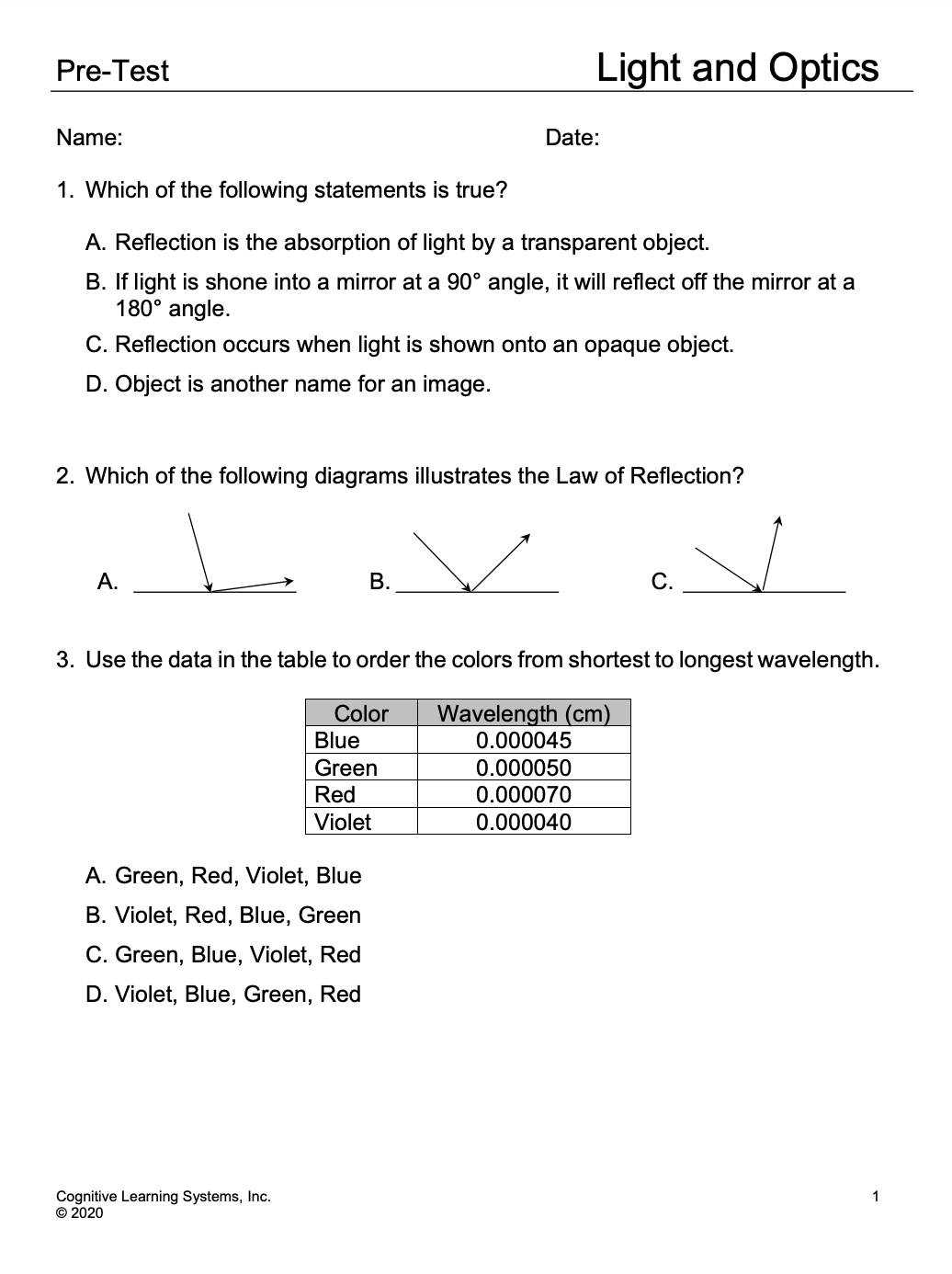
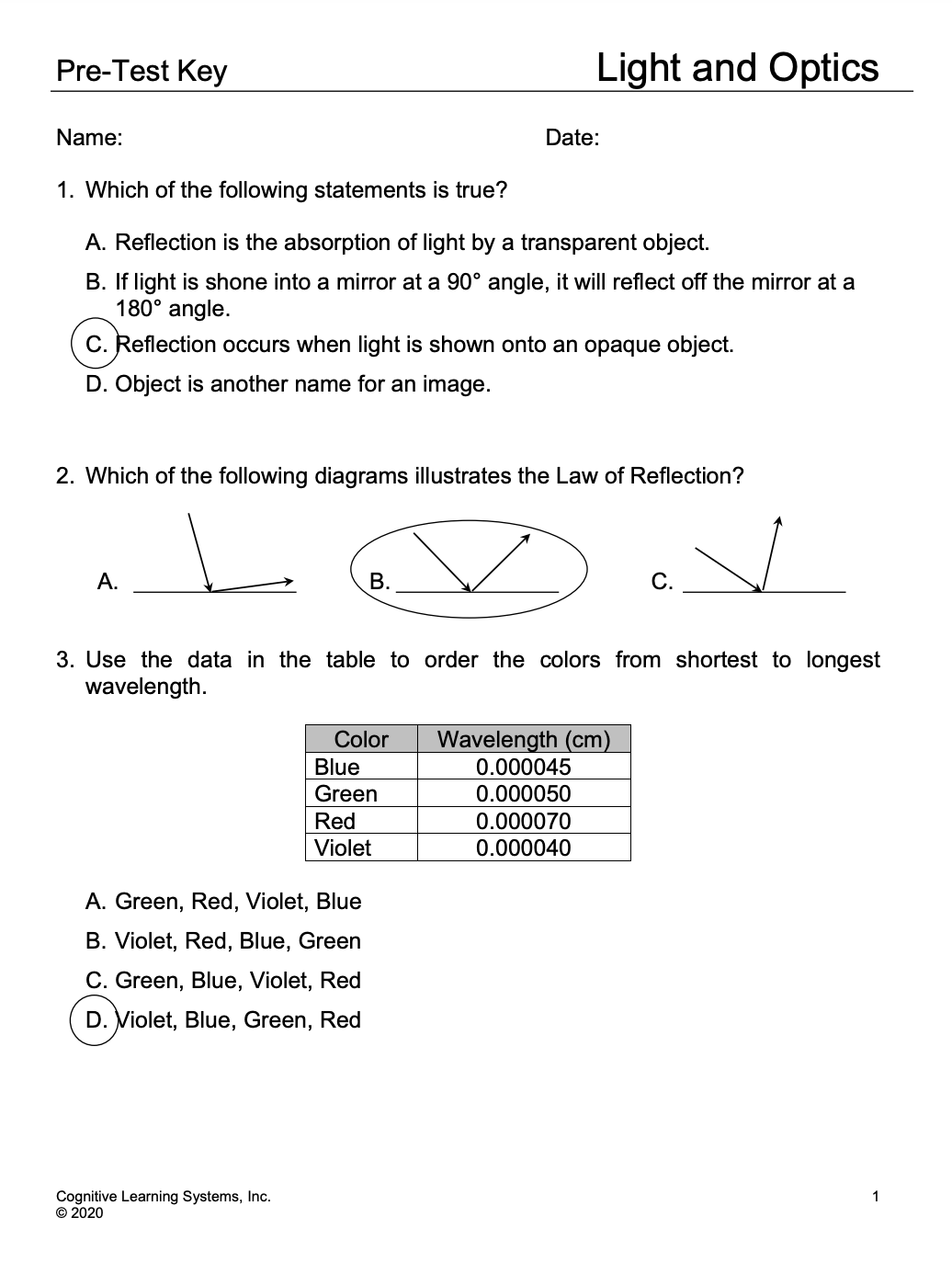
Pre-Test Key
Includes NGSS correlations
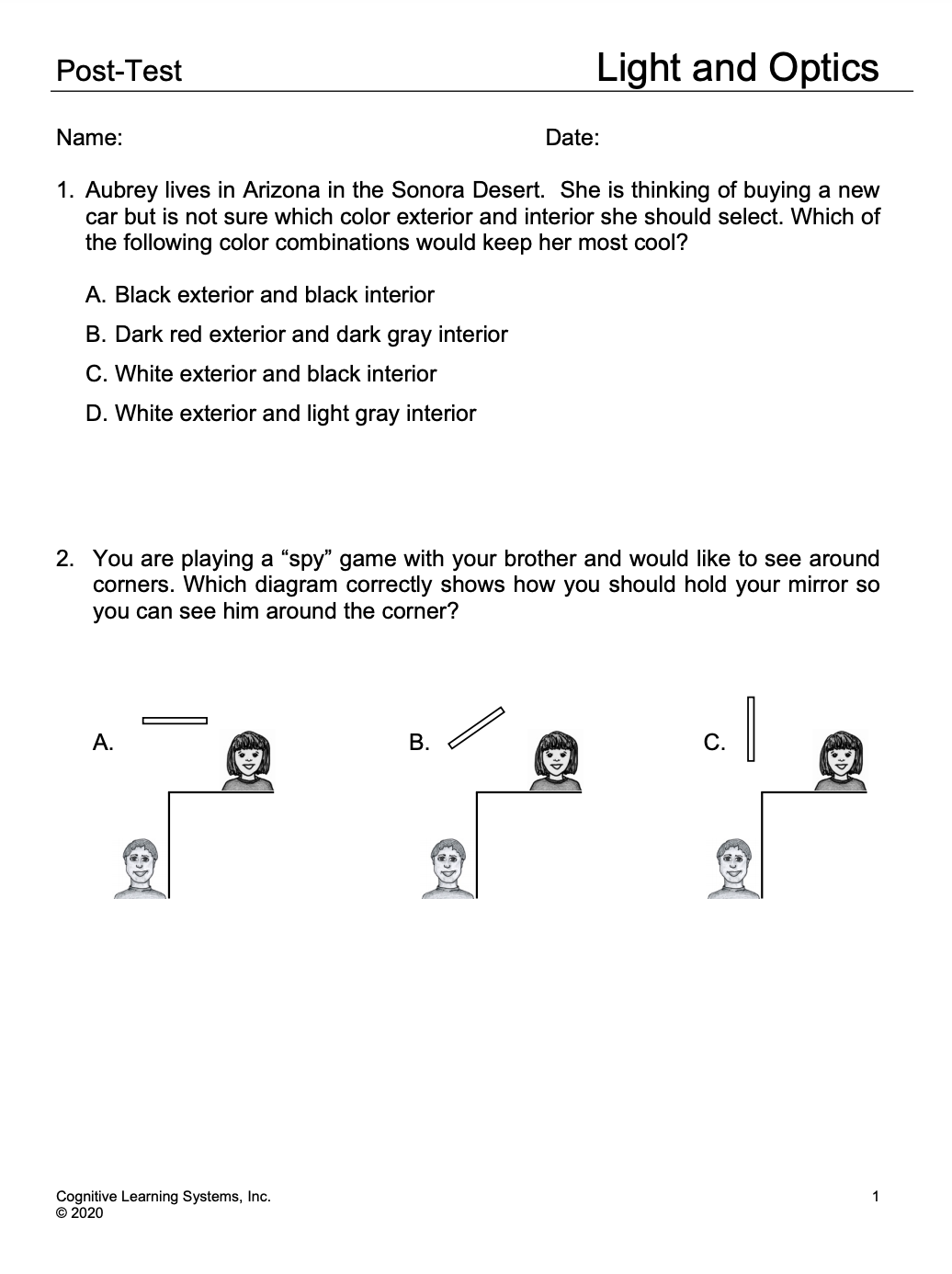
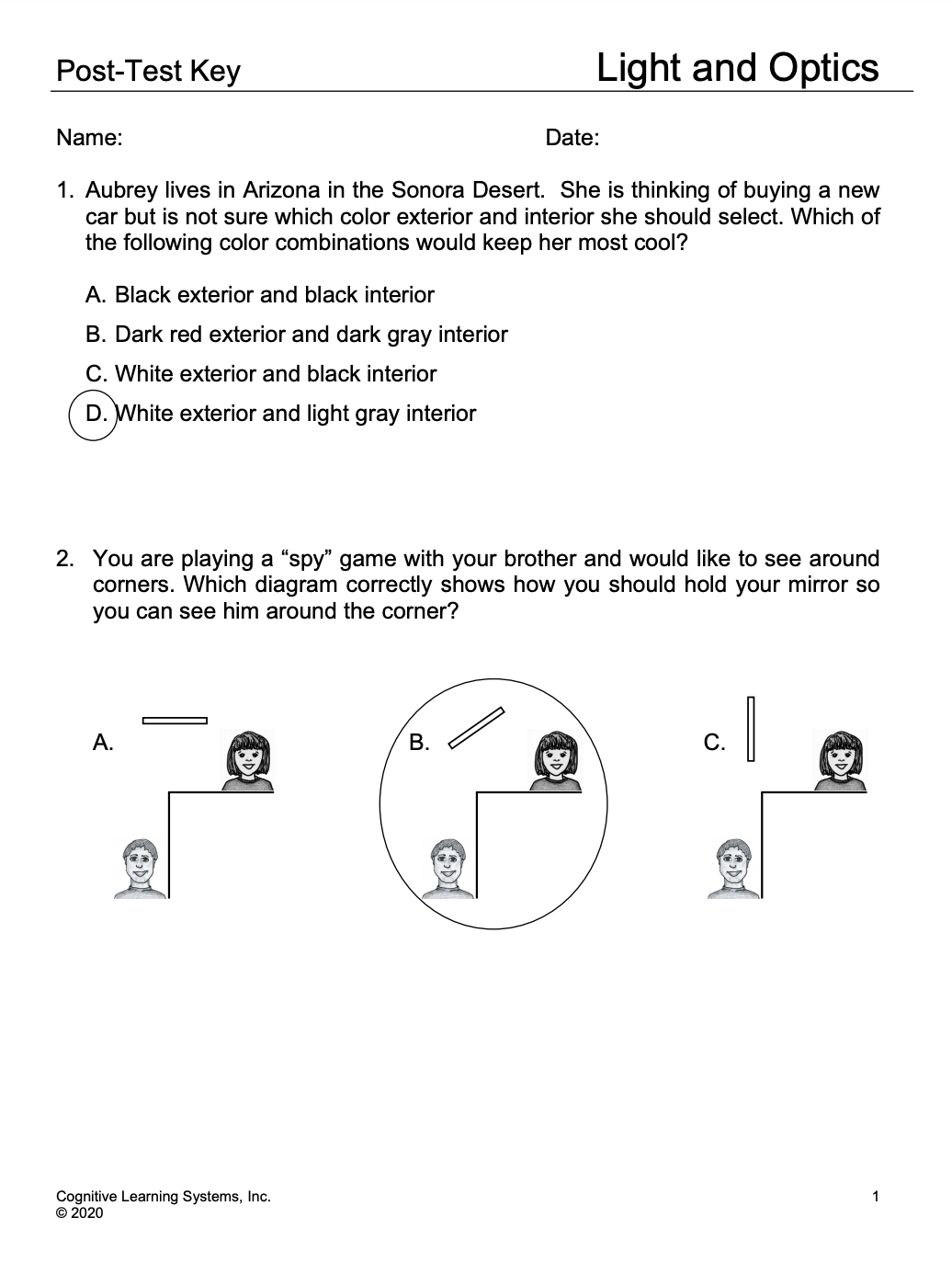
Post-Test Key
Includes NGSS correlations
LabLearner Links for Light and Optics


