
Teacher Portal:
The Human Body
 The Human Body: CAP – Investigation 5
ZERO-IN
Italicized font represents information to be shared orally or physically completed with the students at this time.
Non-italicized font represents additional information included supporting the teacher’s understanding of the content being introduced within the CELL.
BRANCH OUT
Explain to students that many different professionals need to understand the human body to do their jobs. The entire medical profession (nurses, doctors, medical researchers, medical technicians, and so forth) relies on a clear understanding of the human body. Coroners and CSI investigators also require knowledge of human anatomy.
On the other hand, botanists are scientists who study plants. Understanding plants is also extremely important for agriculture to provide food for the billions of people on Earth!
PRINT IT
Use your browser to download a printable PDF as help during the slide presentation and to make additional notes. In your browser, go to File > Print and then choose to save as PDF.
NAVIGATE IT
Once the slide presentation is launched
- use your left and right arrows to advance or go back in the slide presentation, and
- hover your mouse over the left edge of the presentation to get a view of the thumbnails for all the slides so that you can quickly move anywhere in the presentation.
- Click on the button below to launch the slide presentation for the CELL.
SHARE IT
Slide BODY 5-1:
In this CAP we wish to have students understand that both plants and animals have internal and external structures that function to support survival, growth, interactions with the environment, and reproduction.
Slide BODY 5-2:
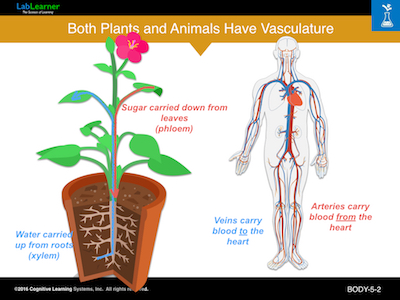
This slide shows that both plants and animals have a vasculature system to transport water and nutrients throughout their bodies. As noted on this slide, water taken up by plant roots is transported up and throughout the plant by vessels called xylem. Moving in the other direction, vessels called phloem carry sugar produced in leaves by photosynthesis down from the leaves and throughout the plant.
Animals have vasculature as well – veins and arteries. Arteries carry blood away from the heart while veins carry it back to the heart. Collectively, the vessels of the animal body are called the circulatory system.
Slide BODY 5-3:
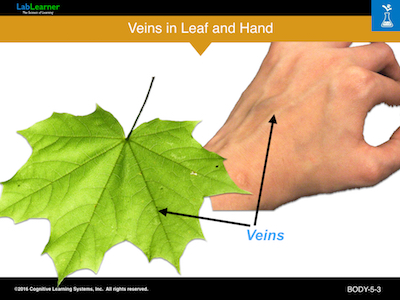
This slide shows a close-up of a leaf and the back of the human hand. These two structures clearly show the underlying vasculature.
Slide BODY 5-4:
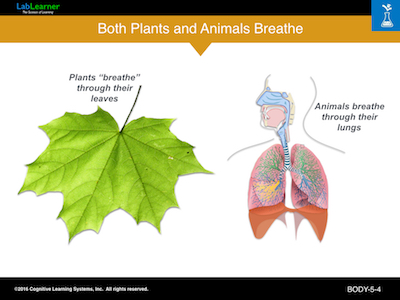
This slide points out that both plants and animals “breathe”. In animals, the lung is the major organ for breathing. The lung and associated structures in animals like humans are referred to as the respiratory system. Plants have a respiratory system as well. While humans breathe in oxygen and exhale carbon dioxide, plants do the opposite. They take in carbon dioxide and then produce oxygen through photosynthesis. The oxygen is released through small holes in the surface of lives call stomata.
Slide BODY 5-5:
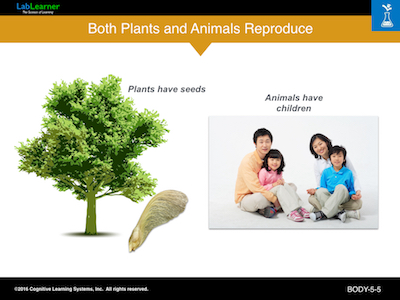
In this slide, we see that both plants and animals reproduce. Plants reproduce by producing seeds that, once fertilized, can grow into a new plant. Animals reproduce by producing eggs. Like plants, once fertilized an egg can grow into a new animal.
Slide BODY 5-6:
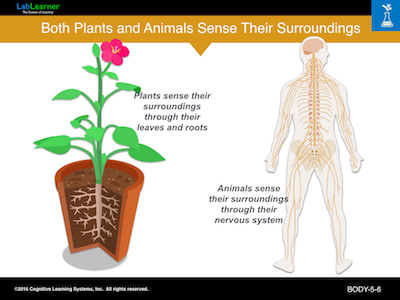
We typically do not think about plants responding to their surroundings but they certainly do. For example, roots can sense water and grow towards it. Leaves can sense the position of the Sun and turn their flat surfaces toward the Sun to collect more light. Sunflowers, for example, can be seen to point their open flowers directly toward the Sun as it moves through the sky each day.
In animals, a nervous system, consisting of the brain and nerves, is used to sense the environment and respond to the animal’s surroundings.
Slide BODY 5-7:
This final slide asks students to suggest other ways in which plants and animals are alike. The list is long but includes things like “they both grow”, “they both can move (animals more than plants)”, “they both eventually die”, “they both can be eaten by other animals”, etc.