Teacher Portal:
Work and Simple Machines
Investigation 3 – PreLab
 MINDSET
This Investigation is designed to:
- reinforce students’ use of the formula Work = Force x distance.
- introduce students to the concept that simple machines often make work feel easier.
- introduce to students the fixed pulley, a simple machine, and its components – the load arm and the effort arm.
- increase student understanding that the pulley makes work feel easier by changing the direction force is applied to a load, but that the amount of work done remains the same as that done without the pulley.
SCIENTIST’S GLOSSARY
- Effort: The action of applying a force.
- Effort arm: The part of a simple machine that supports the effort (i.e. where force is applied).
- Fixed Pulley: a simple machine that is attached to a surface and uses a stationary grooved wheel through which a rope, belt, chain, etc. runs.
- Force: The application of a push or pull. Force is represented mathematically as “F”.
- Load: An object(s) moved by a force.
- Load arm: The part of a simple machine that supports a load (i.e. where the load is attached).
- Simple machine: One of six devices that make work feel easier. Simple machines include the fixed pulley, lever, inclined plane, wedge, screw, and wheel and axle.
- Work (W): A measure of the distance (d) over which a force (F) is applied. Work is represented mathematically by the formula Work = Force × distance (W = Fd).
BE PREPARED
Watch the Investigation 3 Teacher Video (below) and Student Video (at end of PreLab SHARE IT) to prepare for the PreLab.
SET FOR SUCCESS
- Tell students that they will continue their study of the Work and Simple Machines CELL.
- Ask students to share the kinds of things they think they might learn in this Investigation.
Begin the PreLab Concept Slides to start students on their learning journey. Then watch the Pre-Lab Student Video as a class.
NAVIGATE IT
Once the slide presentation is launched
- use your left and right arrows to advance or go back in the slide presentation, and
- hover your mouse over the left edge of the presentation to get a view of the thumbnails for all the slides so that you can quickly move anywhere in the presentation.
- Click HERE to launch the slide presentation for the CELL.
SHARE IT
SLIDE VWORK3-pre-1
Begin the Investigation by reviewing the experiments students completed in Investigation One and Two, and conclusions they have drawn about the concept of force.
______________________________________________
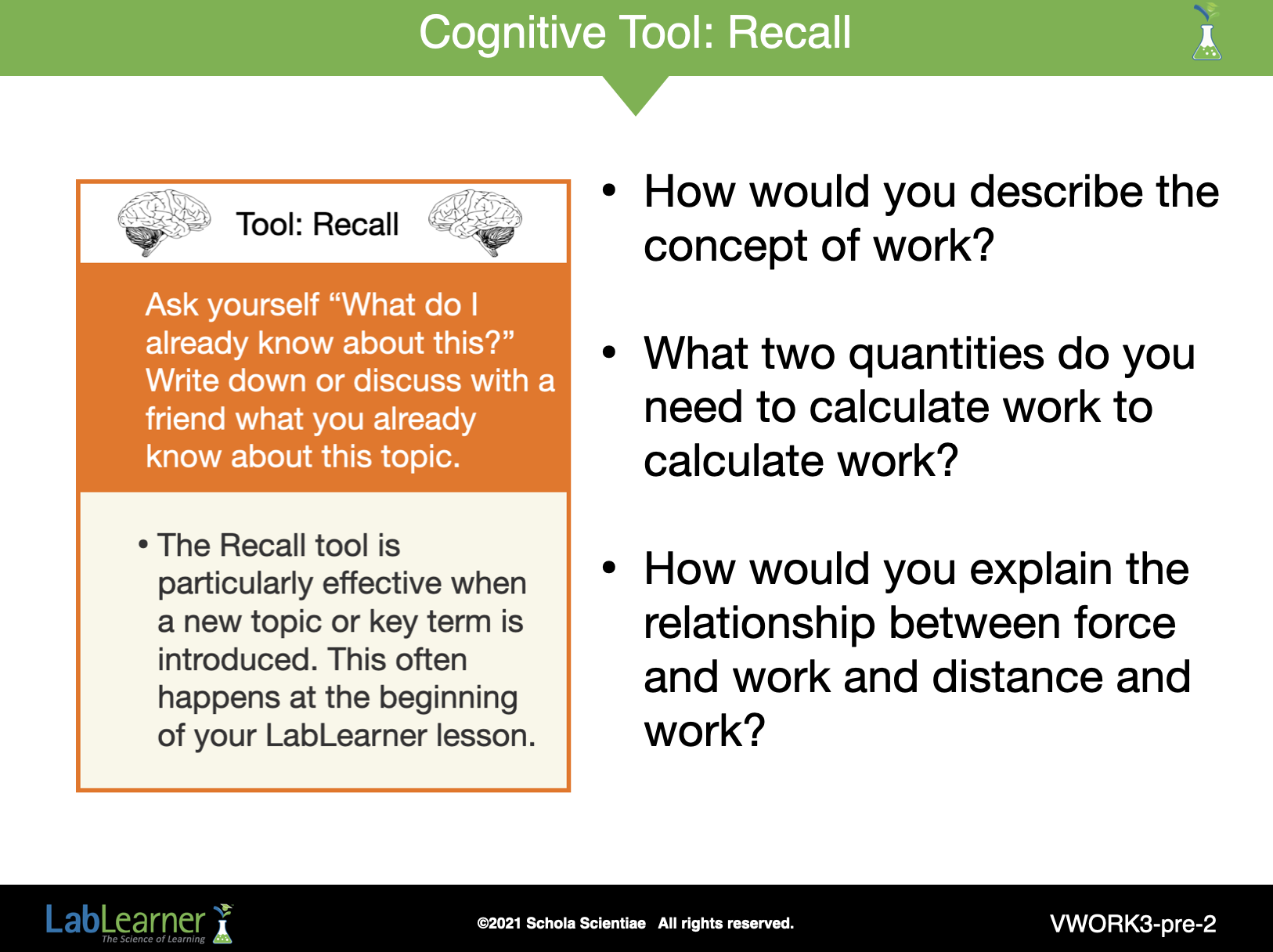
SLIDE VWORK3-pre-2
The following questions may help involve students in the discussion of the concepts:
How would you describe the concept of work? Work is a measure of the magnitude of a force applied to an object and the distance over which it is applied. Work varies with the amount of force applied and the distance over which it is applied.
What two quantities do you need to calculate work? Distance and force.
How would you explain the relationship between force and work, and distance and work? Students discovered that as the distance a load is lifted increases, the amount of work done increases. They also discovered that as the mass of a load increases, the amount of force exerted to lift the load increases, which in turn increases the amount of work done to lift the load.
______________________________________________

SLIDE VWORK3-pre-3
Note: Data for this problem are different than in the Student Data Record and Teacher’s Manual
Assess students’ current understanding of the concept of work by giving them a problem to solve.
1. Tell students that another student, Cindy, has injured her back. Cindy’s doctor tells her not to do more than 100 joules of work when lifting an object.
2. Divide students into pairs or cooperative groups to work through the problem.
3. Lead students through the problem by posing the following questions and information, stopping after each to allow groups to discuss and present their ideas.
a. What does Cindy need to know so she doesn’t do more than 100 J of work? If Cindy is to follow her doctor’s orders, she must know the distance she would lift or move a load and the amount of force she would exert to lift the load.
b. Cindy wants to bake a turkey in the oven, but she must be careful not to do more than 100 J of work when she lifts the turkey out of the oven. The distance she will need to lift the turkey, from the oven to the counter in her kitchen, is 50 cm.
c. Why is it important to know the distance Cindy must lift the turkey? As the distance Cindy must lift the turkey increases, the amount of work she does will increase.
d. The roasting pan and the turkey have a mass of 15.3 kg (15,300 g) and Cindy would exert a force of 150.0 N to lift them. How much work will Cindy do if she lifted the roasting pan and the turkey from the oven to the counter? 150.0 N × 0.5 m = 75.0 J
e. Would Cindy be able to lift the turkey without hurting herself? Why or why not? Yes. Lifting the turkey and roasting pan would require 75 joules of work. This is less than the 100 joules suggested by her doctor.
______________________________________________
SLIDE VWORK3-pre-4
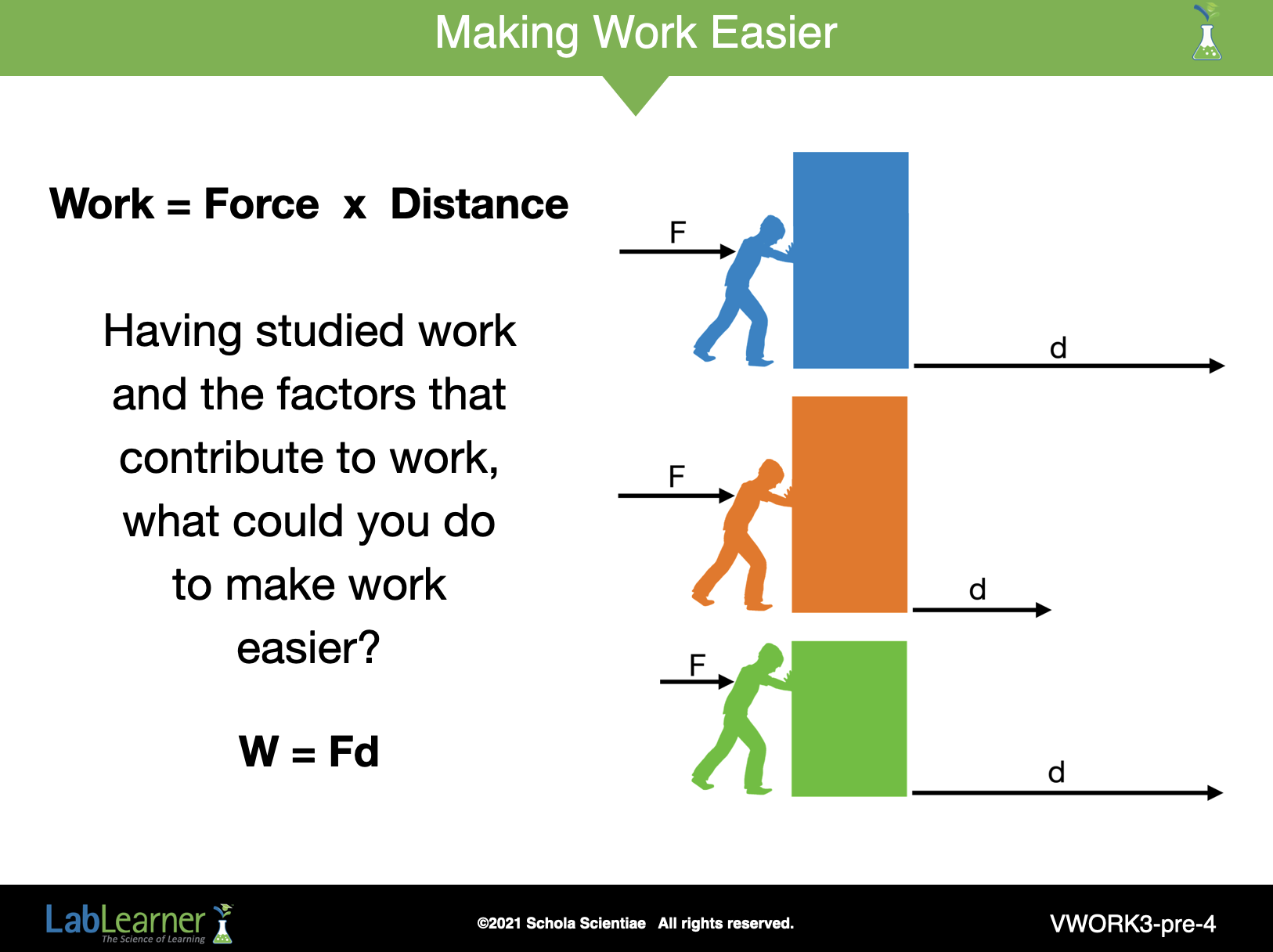
Ask students: Having studied work and the factors that contribute to work, what could you do to make work easier? Student answers will vary. Students may suggest that decreasing the force applied to a load or the distance to lift a load would decrease the work done to lift a load. A decrease in work may make work feel easier. However, students may also suggest that work may be easier by using a machine.
Initiate a discussion with students to introduce simple machines. Tell students they can refer to their Scientist’s Glossary as you ask the following questions.
______________________________________________
SLIDE VWORK3-pre-5
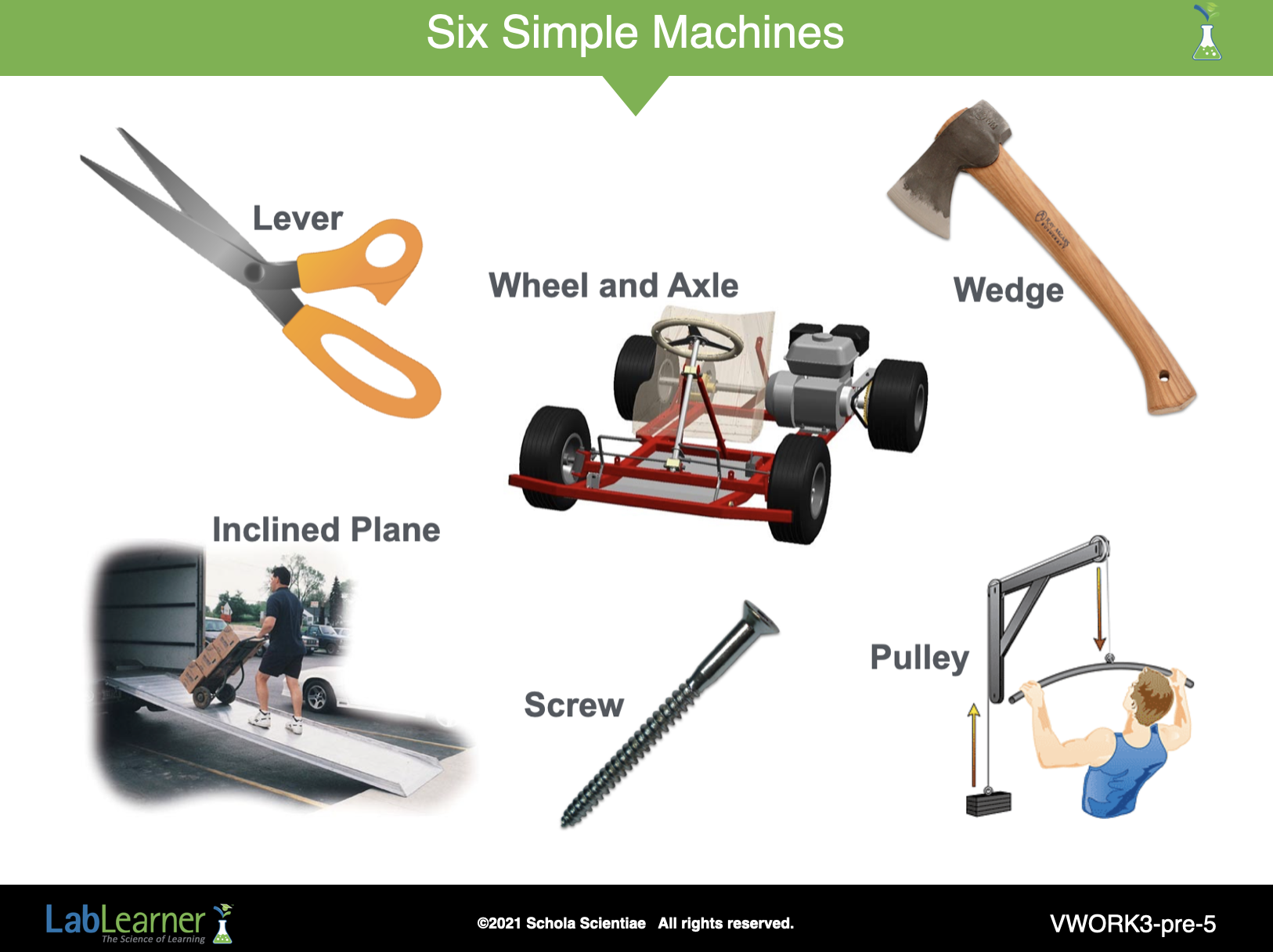
Where have you heard the term machine before? What do you think machines do? Student answers will vary. Students may refer to cars, washing machines, or refrigerators as examples of machines. They may describe the specific functions of each machine or suggest that machines make work easier or decrease work.
Affirm students’ examples of machines. Explain to students that one type of machine is a simple machine and that students will experiment with simple machines in Investigations Three, Four, and Five. Tell students that, just like force and work, a simple machine has a very specific scientific definition.
Using the Scientist’s Glossary as a reference, introduce a simple machine as a device that makes work feel easier. Explain that there are six simple machines: the pulley, lever, wheel and axle, screw, wedge, and inclined plane.
______________________________________________
SLIDE VWORK3-pre-6
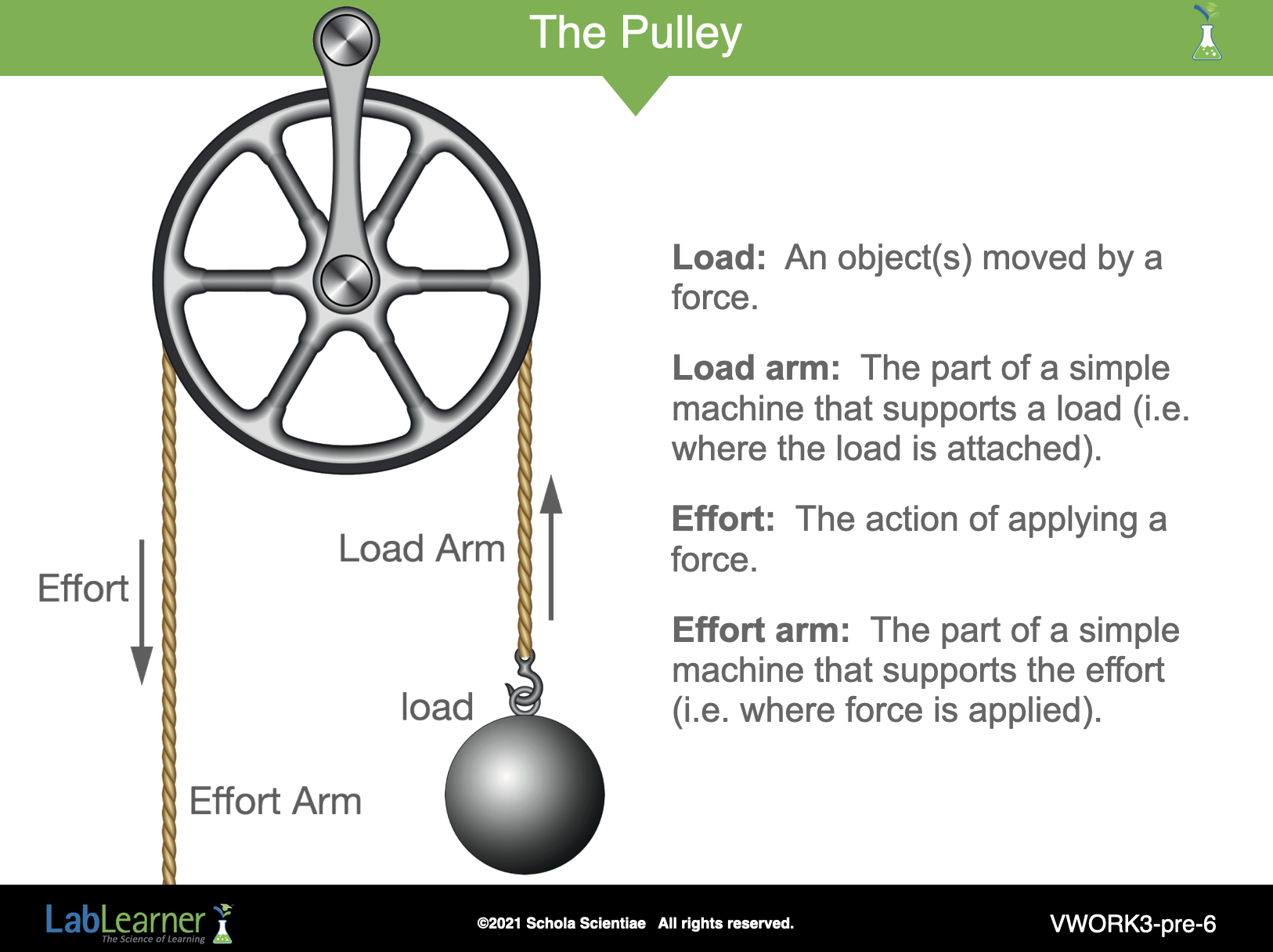
Tell students that this Investigation will use one simple machine, a fixed pulley.
Ask Students: Have you ever seen a fixed pulley? Could you describe a fixed pulley? What is a fixed pulley? Student answers will vary. A fixed pulley is a simple machine that is attached to a surface and uses a stationary grooved wheel through which a rope, belt, chain, etc. runs.
Discuss with the class the definitions for the terms effort, effort arm, load, and load arm. Draw an example of a simple fixed pulley on the board with a load attached and label the effort arm, load arm, and load. Explain the operation of a fixed pulley with the class, including the four terms in your discussion.
______________________________________________
SLIDE VWORK3-pre-7
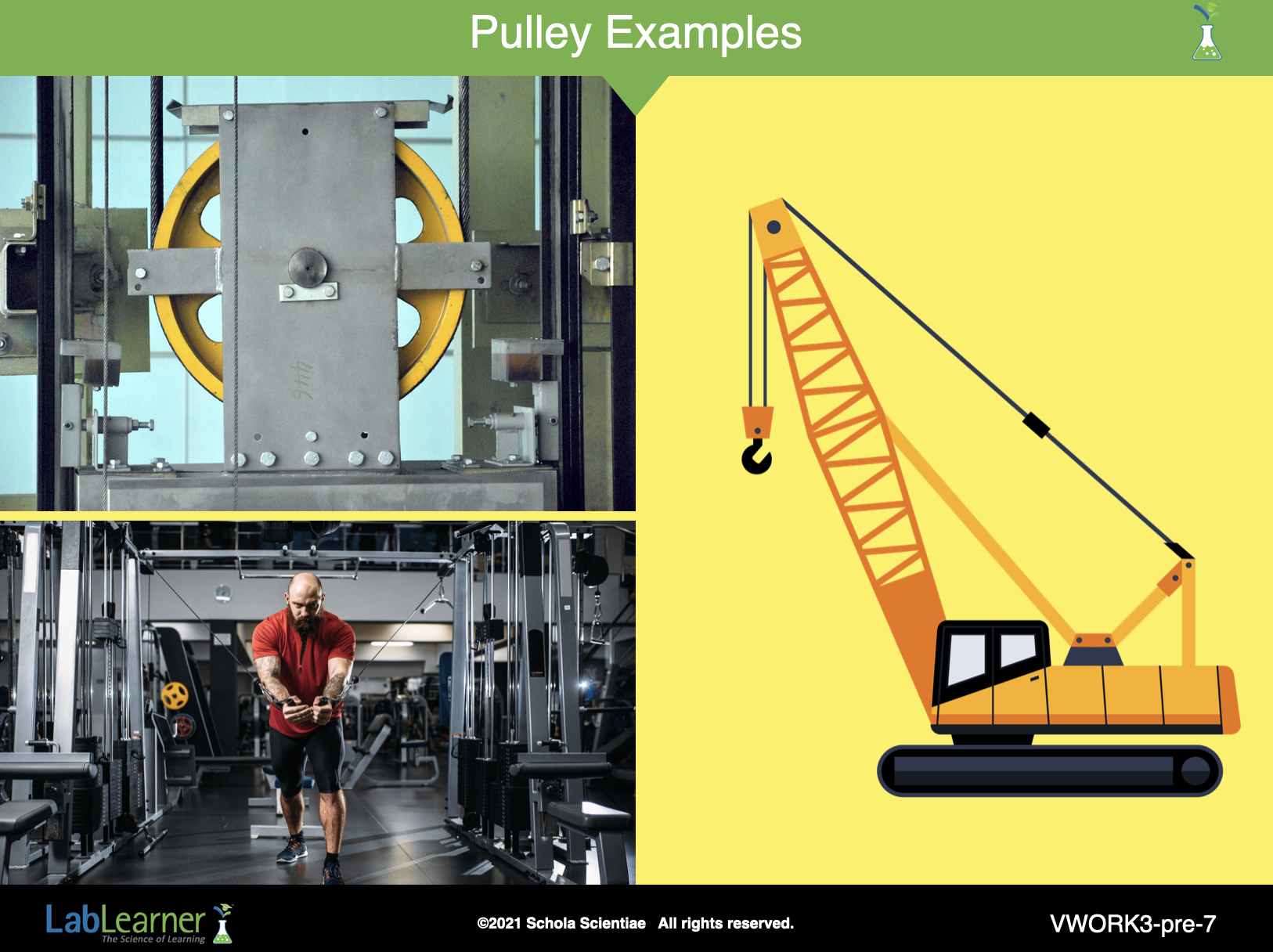
Ask students: Can you think of an example of a fixed pulley in your everyday lives? Student answers may vary. Examples are that pulleys are used with cranes, flagpoles to raise and lower the flag, elevators, to raise and lower window blinds, some curtains use pulleys to open and close them, etc. Use the examples to encourage students to think about how a pulley can be used.
In this slide, students may try to identify the pulleys in three examples:
Top Left: Elemator pulley
Bottom Left: Weight machine pulleys
Right: Crane pulleys
Explain to students they will examine how the pulley affects the work and force exerted on a load. As they perform their experiments, they should think about the following two questions:
- Does a pulley change the amount of work done to lift a load?
- Do simple machines decrease the amount of work done to move a load?
WATCH IT
Play the following Student Video in preparation for the lab. Discuss as necessary to answer student questions.