
Teacher Portal:
Our Solar System
Investigation 3
Investigation Three: The Earth and Its Seasons
During Investigations One and Two, students were introduced to the major parts of the Solar System and how they interact. Students modeled the movement of the planets around the Sun and used various models to explore the effect of the Sun’s radiant energy on the Earth. Investigation Three guides students through a continuation of the exploration of the effect of the Sun’s energy on the Earth.
The Earth follows a set path as it orbits around the Sun, rotating on its axis as it revolves. This path lies on a flat plane around the Sun and varies a little from year to year. Thus, every 365 days, the Earth can be found at the same location along its orbit around the Sun. As mentioned in Investigation Two, the Earth’s orbit is slightly elliptical, bringing the Earth slightly closer to the Sun at various points along its path. However, these differences are so slight compared to the relatively great distance between the Earth and the Sun, that it yields virtually no difference in the amount of energy from the Sun that reaches the Earth at any point along its orbit.
 Why Do We Have Seasons?
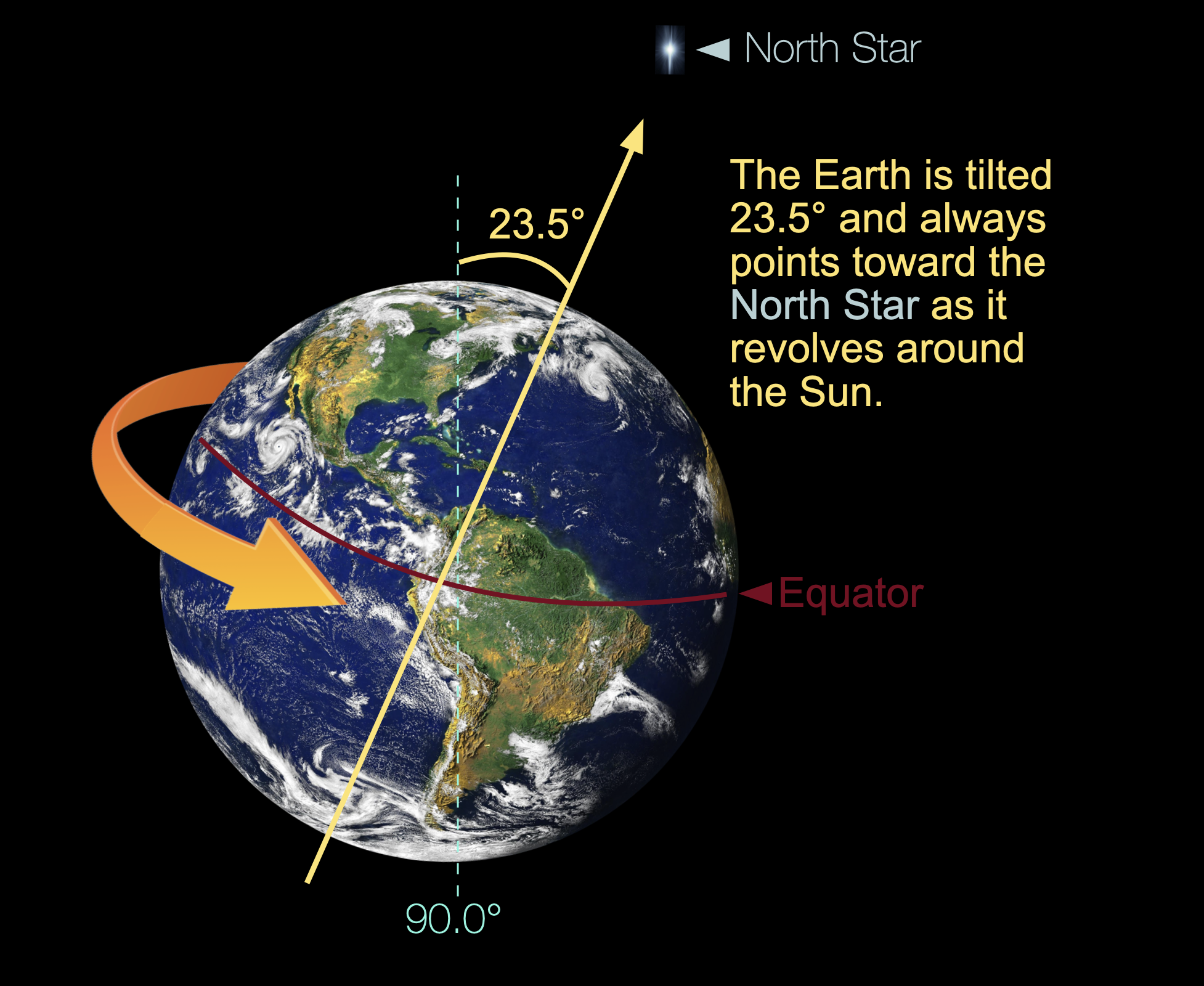
Although the Earth’s orbit is on a flat plane, the Earth’s axis is not perpendicular to its orbit. Rather, it is tilted 23.5° toward Polaris, the North Star (see Figure). The Earth maintains this tilt as it rotates on its axis and revolves around the Sun. Because of this tilt, the Equator is also tilted so that it remains perpendicular to the Earth’s axis rather than parallel to its orbit. The directions of North and South are determined relative to the Earth’s axis, and East and West are determined relative to the Equator.
Visualizing the Earth’s tilt is of vital importance when considering the seasons on Earth. For most areas of the Earth, the average temperature changes throughout the year as the planet revolves around the Sun. We experience these changes as multiple seasons. This change results in different levels of radiant energy from the Sun that reaches the Earth.
Recall that the Earth is tilted 23.5°. This tilt remains constant, causing the Northern Hemisphere to at times be tilted toward the Sun, while at other times, the Southern Hemisphere is tilted toward the Sun. The orientation of the Earth relative to the Sun causes variations in the amount of radiant energy from the Sun that reaches specific areas of the Earth. Thus, the tilt of the Earth is responsible for changing seasons (see illustration below).
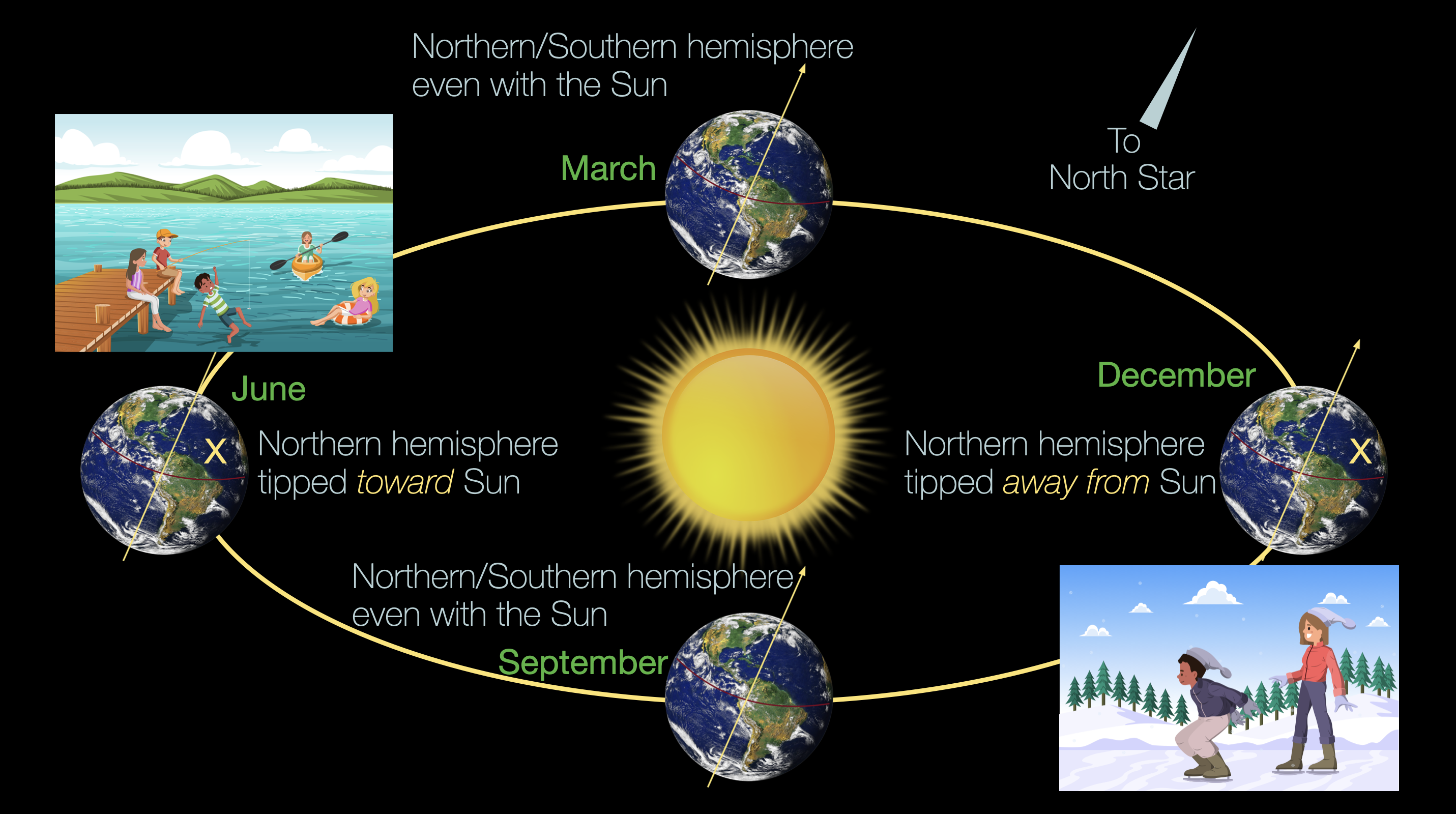
When either the Northern or Southern Hemisphere is tilted toward the Sun, that hemisphere receives more direct radiant energy. This change causes temperatures in that hemisphere to increase. At the same time, the opposite hemisphere is tilted away from the Sun, receiving less direct radiant energy. Its temperatures are decreased. Thus, when the Northern Hemisphere experiences Summer, the Southern Hemisphere experiences Winter. When the Southern Hemisphere experiences Summer, the Northern Hemisphere experiences Winter. The Sun can be viewed almost directly overhead during Summer, while it is low in the sky during Winter. Thus, more direct sunlight is equated with Summer, while less direct light is equated with Winter.
During Investigation Three, students will construct a model of the Earth and Sun to illustrate how the directness of sunlight (radiant energy) relates to seasons. Students will observe that the tilt causes changes in how direct sunlight reaches the Earth, modeling that the tilt of the Earth causes seasonal changes.
Our Solar System: Investigation 3-Mathematics Concepts
Prelab
- grouping
- angles
- time (seconds, minutes, hours, days, months, years)
Lab
- counting whole numbers
- least to greatest
- length in cm
- temperature in Celsius
- data table
Postlab
- least to greatest
- geometry
- distance
- problem-solving
- time (seconds, minutes, hours, days, months, years)
Our Solar System: Investigation 3 - Procedural Tools

Our Solar System: Investigation 3 - Cognitive Tools

Our Solar System:
Investigation 3 Quiz

