
Teacher Portal:
Properties of Matter
Investigation 4
Investigation Four: Weight and Density
Investigations One provided the opportunity for students to explore the properties of each state of matter. Investigations Two and Three introduced students to the specific properties of volume and density. In Investigation Four, students will continue to learn about specific properties by exploring weight.
Weight is a measure of how heavy an object is. It can be measured with scales or compared with balances. Weight can be measured as grams (g) and kilograms (kg). It is a measure that involves both a substance’s mass and the force of gravity on that mass.
Mass Versus Weight
It is important to note that weight is not the same as mass, although weight and mass are directly related. Mass is the amount of matter in an object and can be measured with a balance, like either a pan balance or a triple beam balance. Weight, on the other hand, is a measure of the force of gravity on that mass and can be measured with a spring scale. A person’s weight on Earth is more than his weight on Mars because the force of gravity on Earth is stronger than the force of gravity on Mars.
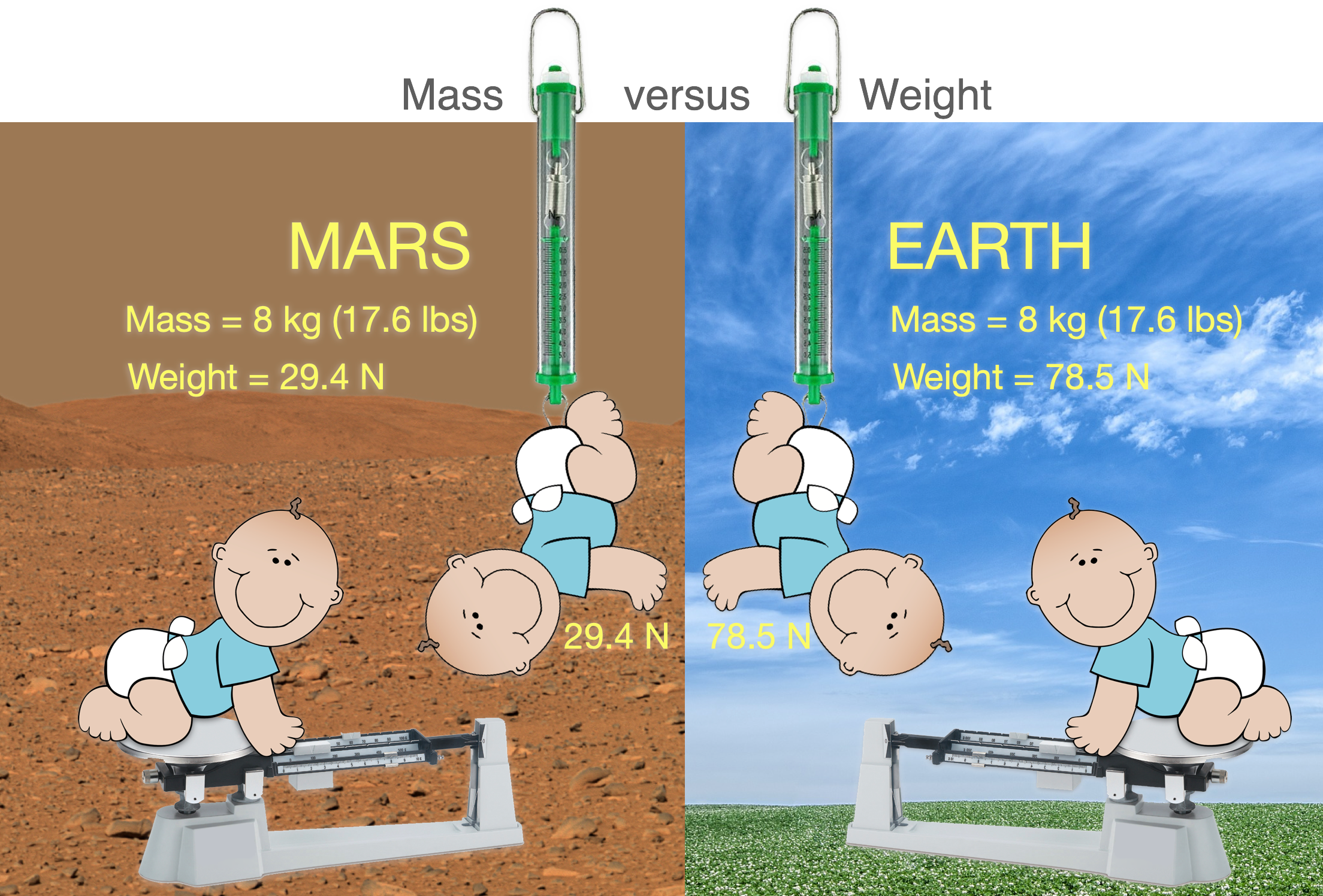
A person’s mass, however, is the same on both Earth and Mars. In other words, the amount of molecules the person is made up of has not changed. However, weight and mass do correlate. For example, a person who weighs 73 kg on Earth is ten times heavier than a 7.3 kg bowling ball. Even though that person will weigh less in pounds on Mars, he or she will still be 10 times heavier than the weight of the bowling ball on Mars. The force of gravity (measured by weight) is different on Mars, but the mass (amount of molecules) of the two objects and the force of gravity that Mars exerts on those objects do not change.
Density: Floating and Sinking
Two objects of the same size can have different weights because the mass or amount of molecules, in the objects, is different. Also, two objects of different volumes can have the same weight if they have the same mass. These concepts are illustrated below:
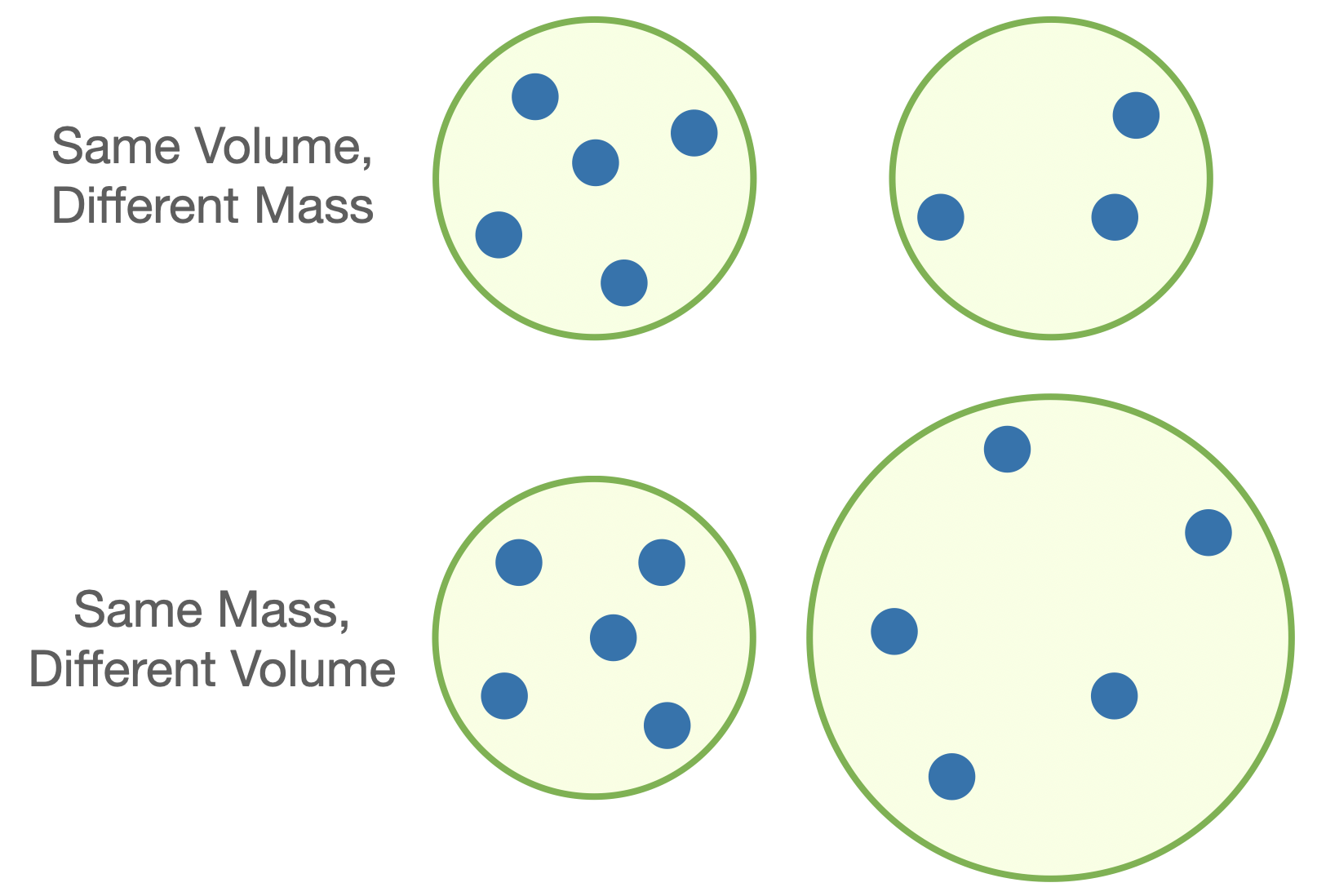
In this Investigation, students will discover that weight does not determine floating and sinking. Weight is related to density in that weight correlates with mass. However, it is density that determines floating and sinking.
Investigation Four provides students with the opportunity to test how the weight of objects affects floating and sinking. Students will design their own experiments to compare the weights of different objects. Then students will test whether the objects sink or float. Through evaluation of their findings, they will conclude that weight is not the same as density and does not determine floating and sinking.
Properties of Matter: Investigation 4 - Mathematics Concepts
Prelab
• classifying groups
• comparing (non)measurable characteristics
• data table
• least to greatest
• weight in kg and pounds
• volume in liters
Lab
• counting whole numbers
• continuum scale
• least to greatest
• greater than/less than/equal to
• data table
• volume in mL
• place value (ones, tens, hundreds, thousands)
Postlab
• least to greatest
• bar graph
• data analysis
• skip counting by 5’s
• place value
• comparison
• continuum scale
• greater than/less than/equal to
Properties of Matter: Investigation 4 - Procedural Tools

Properties of Matter: Investigation 4 - Cognitive Tools

Properties of Matter:
Investigation 4 Quiz

