Student Portal:
Light and Optics
Investigation 3 – PreLab
 PRINT IT
Use your browser to download a printable PDF as help during the slide presentation and to make additional notes. In your browser, go to File > Print and then choose to save as PDF.
MINDSET
This Investigation is designed to:
- apply the Law of Reflection by using mirrors to view a hidden object
- demonstrate the Law of Reflection in a familiar context.
- allow students to manipulate the angles of incidence and refraction, in anticipation of a specific result.
- encourage students to utilize problem solving skills and strategies.
SCIENTIST’S GLOSSARY
1. Angle: The exact direction that light strikes or is reflected off of an object.
2. Reflection: The bouncing of light off an object.
3. Refraction: When light passes through a transparent object and is bent or redirected in a different direction.
4. Angle of incidence: The angle at which light strikes an object.
5. Angle of reflection: The angle at which light bounces off an object.
6. Image: A representation of an object formed by light refracted by a lens or reflected by a mirror.
7. Law of Reflection: The angle of incidence equals the angle of reflection.
BE PREPARED
Watch the Investigation 3 Teacher Video and Student Video below to prepare for the PreLab.
SET FOR SUCCESS
- Tell students that they continue the Light and Optics CELL.
- Tell students that they will focus on the reflection of light in this Investigation
- Ask students to share the kinds of things they might learn in this Investigation.
Begin the PreLab Concept Slides to start students on their learning journey. Then watch the Pre-Lab Student Video afterward as a class.
NAVIGATE IT
Once the slide presentation is launched
- use your left and right arrows to advance or go back in the slide presentation, and
- hover your mouse over the left edge of the presentation to get a view of the thumbnails for all the slides so that you can quickly move anywhere in the presentation.
- Click HERE to launch the slide presentation for the CELL.
SHARE IT
SLIDE VLIGHT3-pre-1
In Investigation Three, students will continue their study of light and optics. In PreLab, students will play a game to promote consolidation of the basic concepts of the transmission, absorbance, reflection, and refraction of light.
______________________________________________
SLIDE VLIGHT3-pre-2
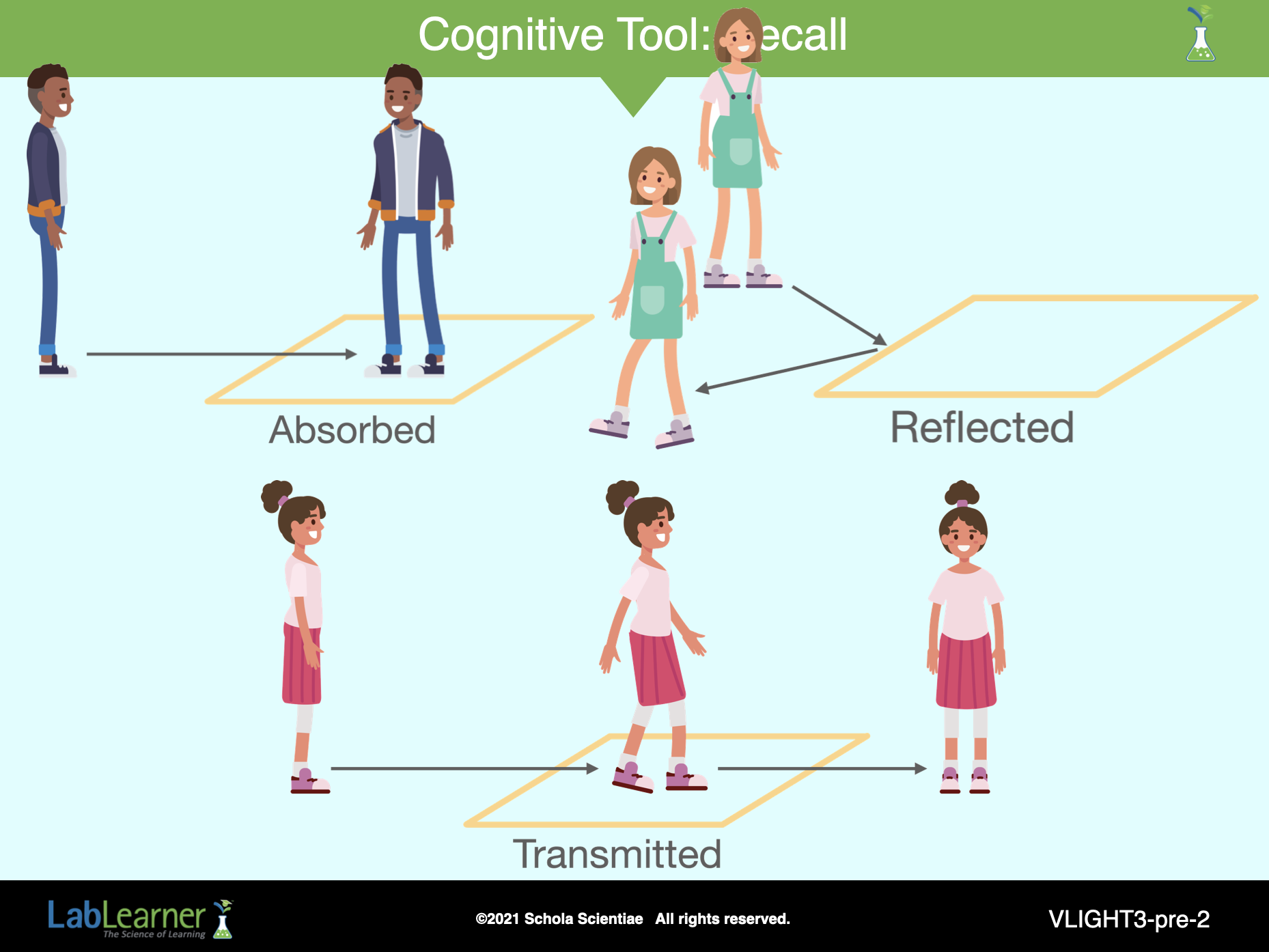
- Begin the Investigation by reviewing the concepts from Investigations One and Two. Use the activities from Investigation One, below, to briefly review absorption, transmission and reflection. Ask for student volunteers or simply refer to the slide as a means of review.
- Demonstration of the absorption of light.
- Demonstration of the transmission of light.
- Demonstration of the reflection of light.
______________________________________________
SLIDE VLIGHT3-pre-3
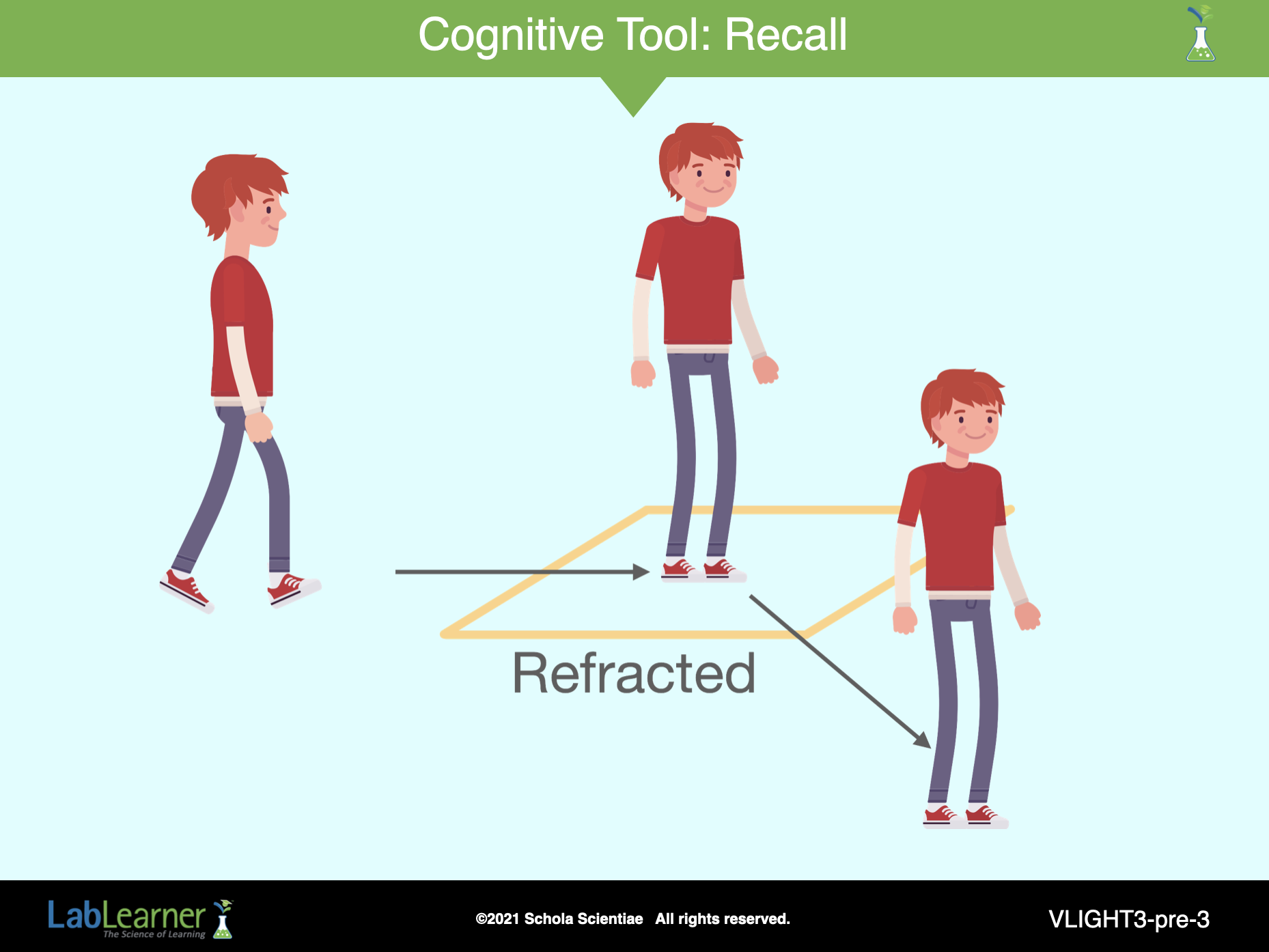
B. Inform students that light can interact with objects in one more additional way, refraction.
- Ask students to read the definition of refraction in their Scientist’s Glossary.
Refraction: When light passes through a transparent object and is bent or redirected in a different direction.
2. Explain that when light travels through a transparent object its path through the object is bent, so that it exits the object in a different direction.
a. Place the masking tape on the floor to create a square approximately one by one meter. The tape should be placed on the floor in a visible part of the classroom.
b. Instruct a student volunteer to stand several meters away from the square outlined in tape on the floor.
c. Ask the student volunteer to enter the square from one side and then exit from one of the sides of the square on either side of the side that they entered.
d. Inform students that light entered the object with a certain path but its path was bent by the object, so it exited from the object on a different path.
______________________________________________
SLIDE VLIGHT3-pre-4
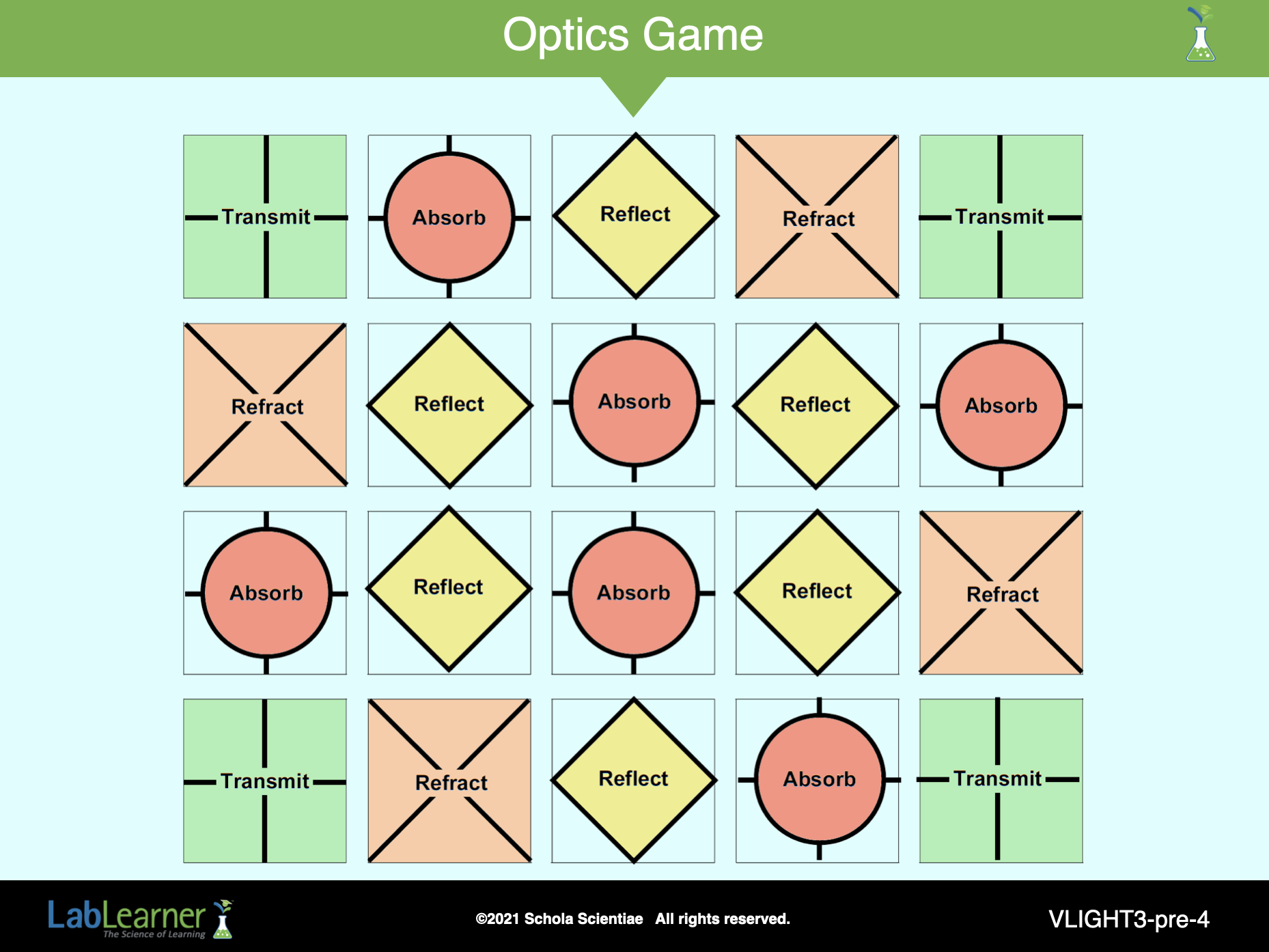
C. Inform students that to further review the absorption, transmission, reflection and refraction of light, the class will now play the Optics Game. Divide the class into pairs.
1. Ask students to remove the Optics Game Sheet and the Optics Answer Sheet from their Student Data Record and place them on the table in front of them.
2. Hand out one marker per pair of students.
3. Inform students that they will move their marker around the Optics Game Sheet in response to questions that you will ask them. Each student will record their answers on the Answer Sheet which will be checked for correctness by the other student in the pair.
4. There will be 1 point and 2 point questions. Students will move their markers 1 square for a correct answer to a 1 point question and 2 squares for a correct answer to a 2 point question.
______________________________________________
SLIDE VLIGHT3-pre-5
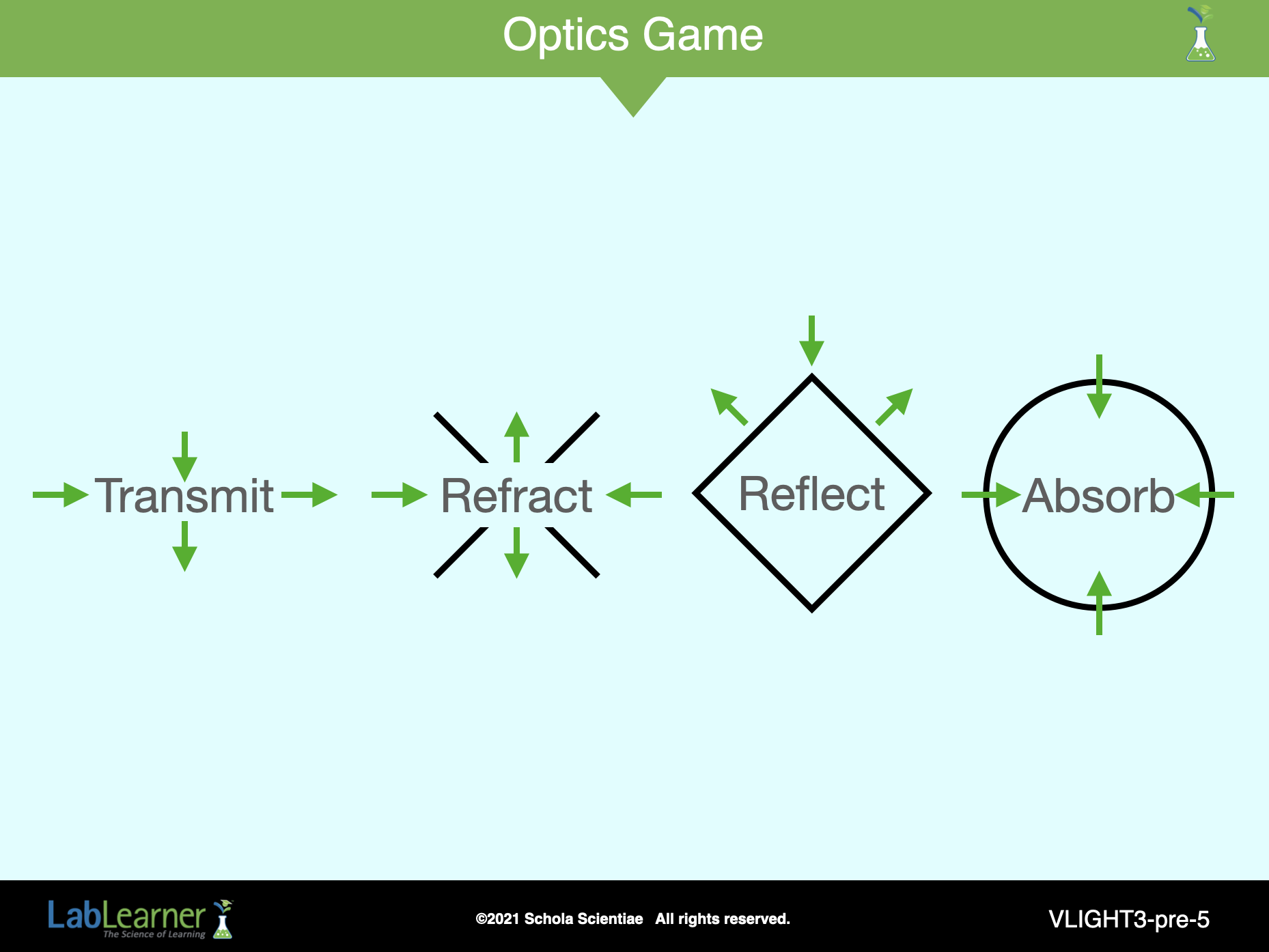
5. Refer to the shapes on the slide to help instruct the students in how to move their markers.
a. Markers that land on a Transmit square enter and then exit in the same direction according to the arrows.
b. Markers that land on a Refract square enter and then exit at 90 degrees according to the arrows.
c. Markers that land on a Reflect square enter and then exit at 45 degrees according to the arrows.
d. Markers that land on an Absorb square enter and cannot exit, effectively ending the game for that student.
6. The object of the game is to be the last person in the class with a marker that is not stuck in an Absorb square.
7. Instruct students to start the game by placing their markers on one of the Transmit squares in the corners of the Optics Game Sheet.
8. Use the 1 and 2 point questions below or make up your own:
- Which will absorb the most light, a dark shade or a light shade. Dark shade. 1
- Which will reflect more light a light shade or a dark shade. Light shade. 1
- What is the name of the instrument used to measure the degree of an angle? Protractor. 1
- Is a windowpane opaque or transparent? Transparent. 1
- T or F: When light strikes an opaque object it always bounces directly and straight back. F 1
- What do we call the angle at which light strikes a surface? The angle of incidence. 1
- What is light? Light is a form of energy that is visible to the human eye and allows us to see things around us. 2
- T/F: Only liquids can absorb light. F 1
- Which object would reflect more light, a piece of sandpaper or a piece of glass? A piece of glass. 1
- Which of the following is NOT a natural light: the Sun, a fire, a laser, a firefly? Laser. 1
- The Sun and the Moon. Which emits light and which reflects light? The Sun emits light, the Moon reflects light. 2
- How did we show that light contains heat energy? By shining it on a dark piece of paper. 2
- Can a transparent object reflect light? Yes, seeing yourself when looking out a window at night. 2
- What is a word that means the opposite of opaque? Transparent. 1
- What do we call the angle at which light bounces off a surface? The angle of reflection. 1
- Which do you think would get hotter if you shined a bright light on it, a white sheet of paper or a black sheet of paper? A black piece of paper. 1
- Name something in the room that is transparent. 1
- Name something in the room that is opaque. 1
- Which transmits more light, a light liquid or a dark liquid? A light liquid. 1
- Which liquid will absorb more light, a dark liquid or a light liquid? A dark liquid. 1
- If light strikes a reflective surface at 22 degrees, what will be the angle of reflection? 22 degrees 1
- Why was the black paper warmer than the white paper after being exposed to the lamp? Dark shades/colors absorb more energy. Light colors/shades reflect light energy. 2
- What is the Law of Conservation of Energy? Energy cannot be created or destroyed, but it can change forms. 2
9. Continue the game for at least two rounds to allow both students from each pair to play one round. Instruct students to record answers on the back of their Optics Game Sheet.
______________________________________________
SLIDE VLIGHT3-pre-6
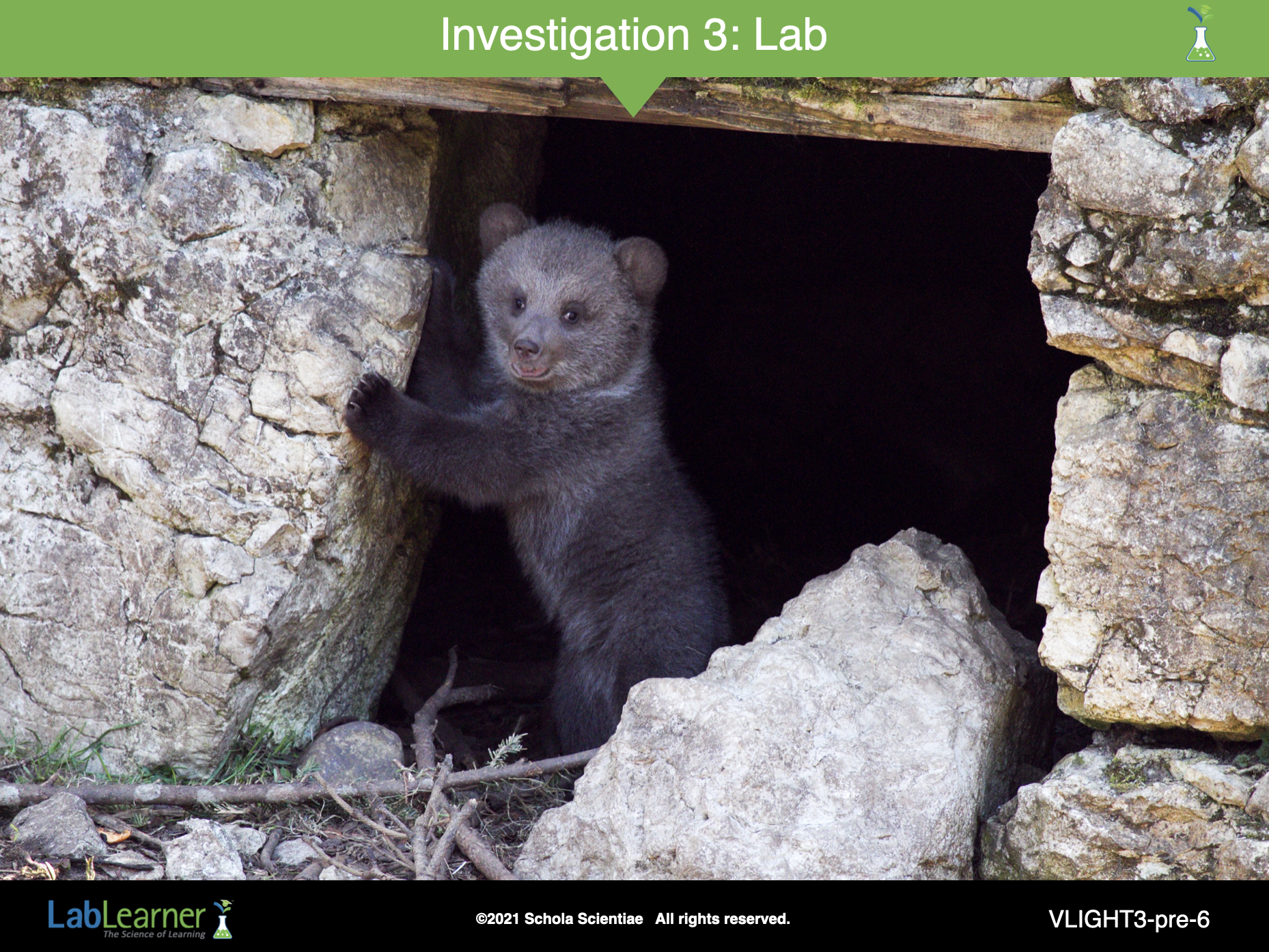
D. Inform students that in the Lab, they will use their knowledge of reflection to solve a problem. In doing so, students will explore these questions:
Can light be reflected more than once?
Do the Laws of Reflection apply when light is reflected several times?
Student Video
Watch the Investigation 3 Student Video after the Share It presentation to prepare for the PreLab.
KEYS