Teacher Portal:
Light and Optics
Performance Assessment – Lab
 BE PREPARED
Materials
Class materials:
- 1 wood block
- 1 small, 4 gram bear
- 1 small mirror 1 ball of clay, 2 centimeters in diameter
- 1 flashlight
- 1 set of colored filters
Individual materials
- 1 Scientist Data Record
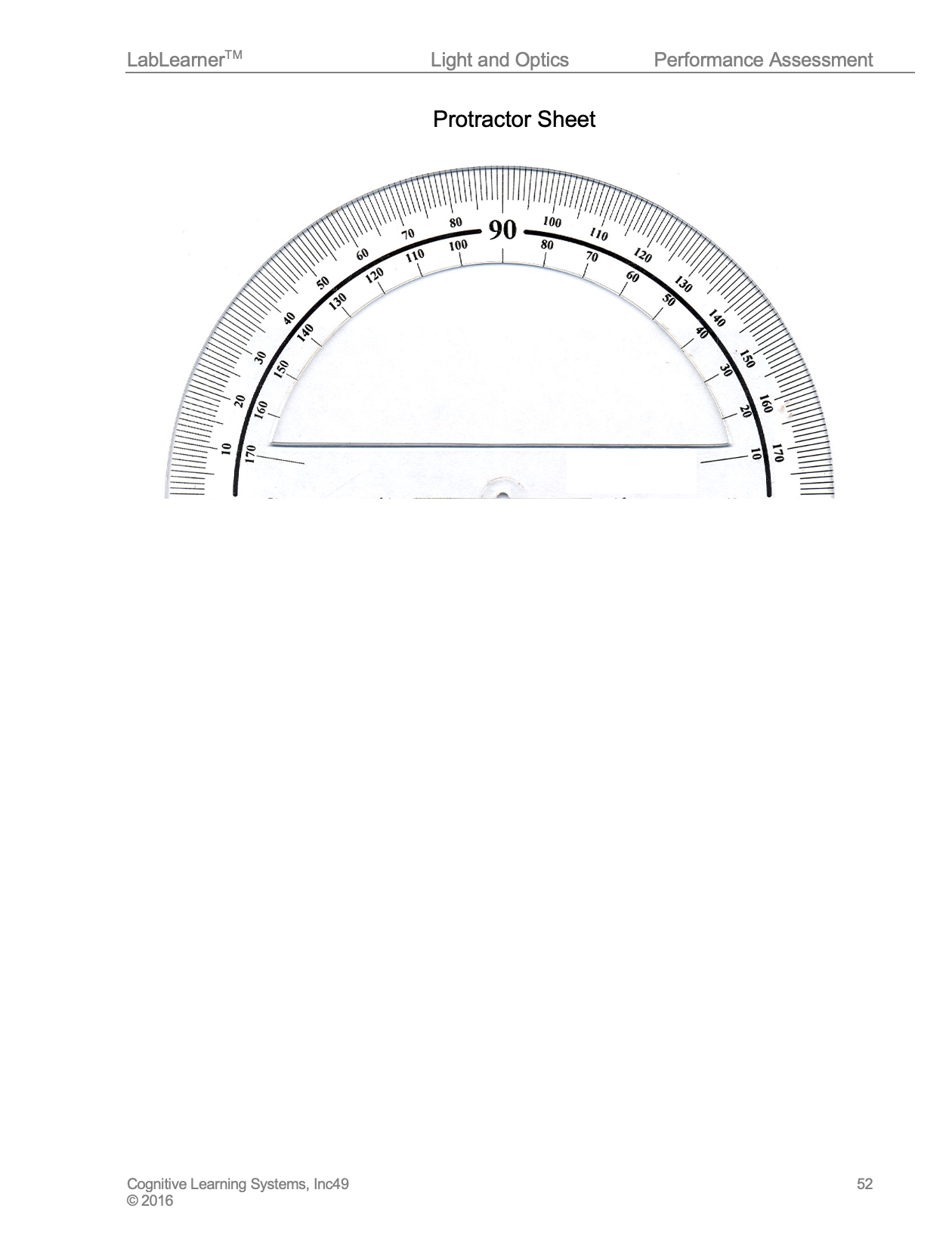
- 1 Protractor Sheet from the Student Data Record
TEACHER PREPARATION
1. Place all materials at a central location.
2. Divide the class into groups of three students
INSTRUCTION
1. Instruct each student group to obtain the following materials from the distribution point: one (1) woodblock, one (1) small, 4 gram bears, one (1) small mirror, one (1) ball of clay, 2 centimeters in diameter, one (1) flashlight and one (1) set of colored filters.
Emphasize that the Performance Assessment requires problem-solving. Problems can often be solved if you use what you already know about the topic. Encourage students to ask themselves questions to guide them through the performance assessment:
1. What do I know about absorption, transmission, and reflection of light? How can I use my knowledge of these properties of light to solve the problem?
2. What do I know about the Law of Reflection?
3. What do I know about calculating angles of incidence and reflection?
4. Is there anything in this problem that is similar to what I did in my Investigations?
PROCEDURE
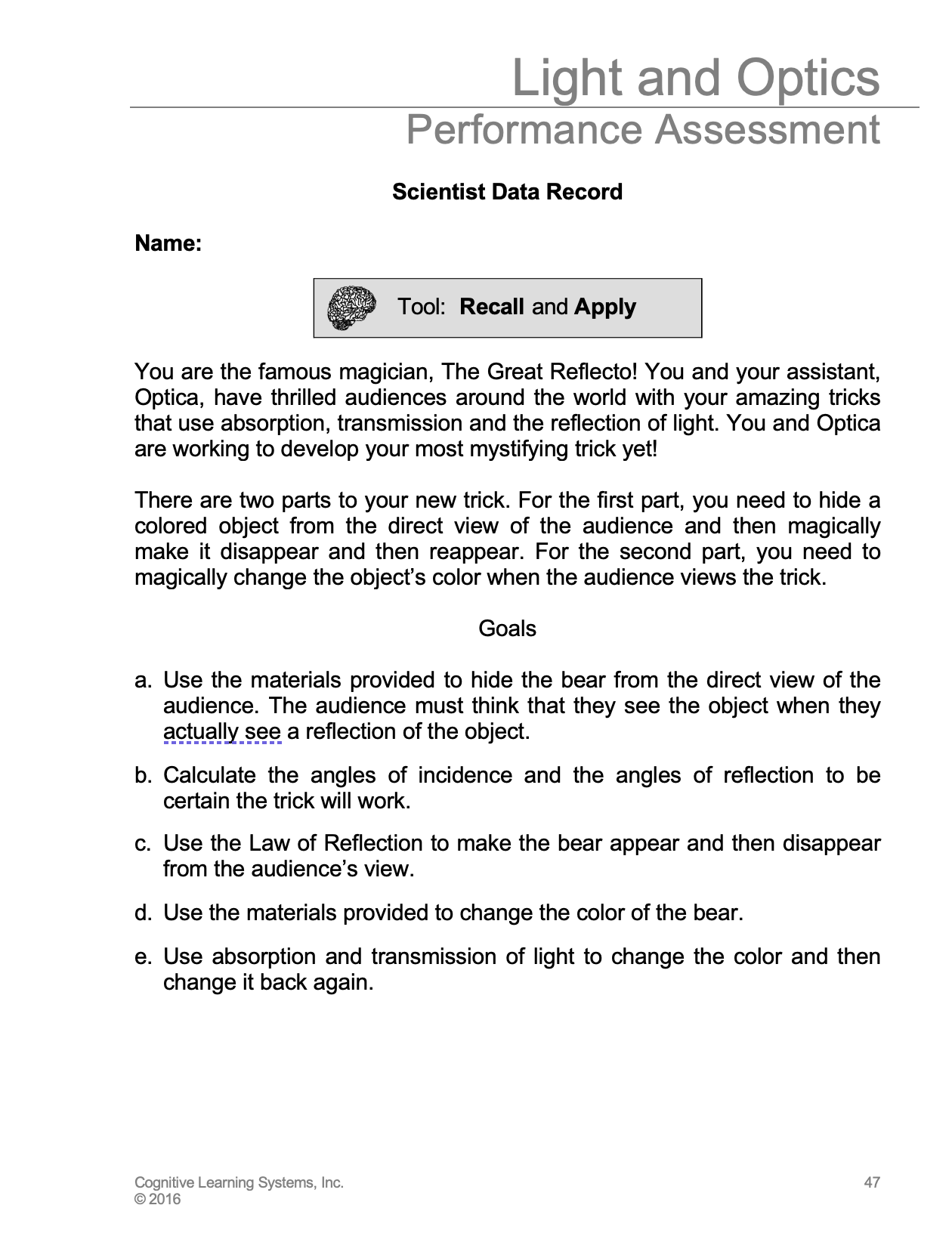
1. Begin the Performance Assessment by reading the opening paragraph from the Student Data Record aloud as students follow along. Briefly review the contents of the paragraph and outline the goals of this project to the class. Read aloud the goals from the list in the Student Data Record:
“You are the famous magician, The Great Reflecto! You and your assistant, Optica, have thrilled audiences around the world with your amazing tricks that use absorption, transmission, and the reflection of light. You and Optica are working to develop your most mystifying trick yet!
“There are two parts to your new trick. For the first part, you need to hide a colored object from the direct view of the audience and then magically make it disappear and then reappear. For the second part, you need to magically change the object’s color when the audience views the trick.”
Goals
-
- Use the materials provided to hide the bear from the direct view of the audience. The audience must think that they see the object when they actually see a reflection of the object.
- Calculate the angles of incidence and the angles of reflection to be certain the trick will work.
- Use the Law of Reflection to make the bear appear and then disappear from the audience’s view.
- Use the materials provided to change the color of the bear.
- Use absorption and transmission of light to change the color and then change it back again.
2. Inform students that they will design a magic trick that has two parts. In the first part, an object is hidden from the direct view of the audience, and reflection is used to make it magically disappear and then reappear to the audience. The second part uses absorption and transmission of light to change the color of the object.
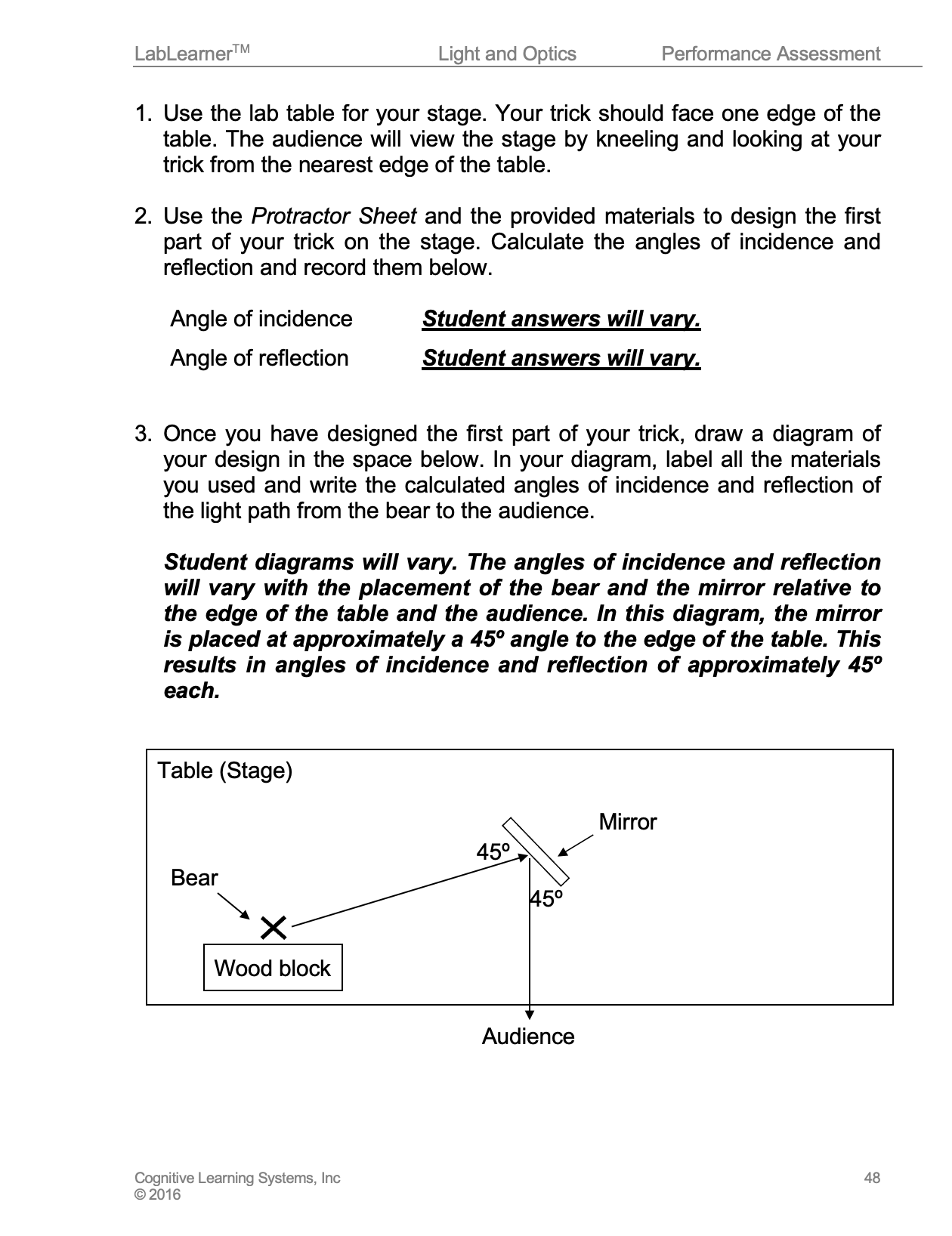
3. Before students begin the Performance Assessment, walk through each step in the project. Make certain that students understand that the lab table will serve as their stage and that the audience will view the stage by kneeling down and looking at the trick from the nearest edge of the table.
4. Students should design the first part of their trick using the Protractor Sheet found in their Student Data Record. Students should calculate angles of incidence and reflection to be certain that the design is functional. Students should then record the angles of incidence and reflection in Problem 2 in their Student Data Record.
5. Students should draw a diagram of their design of the trick in Problem 3 in their Student Data Record.
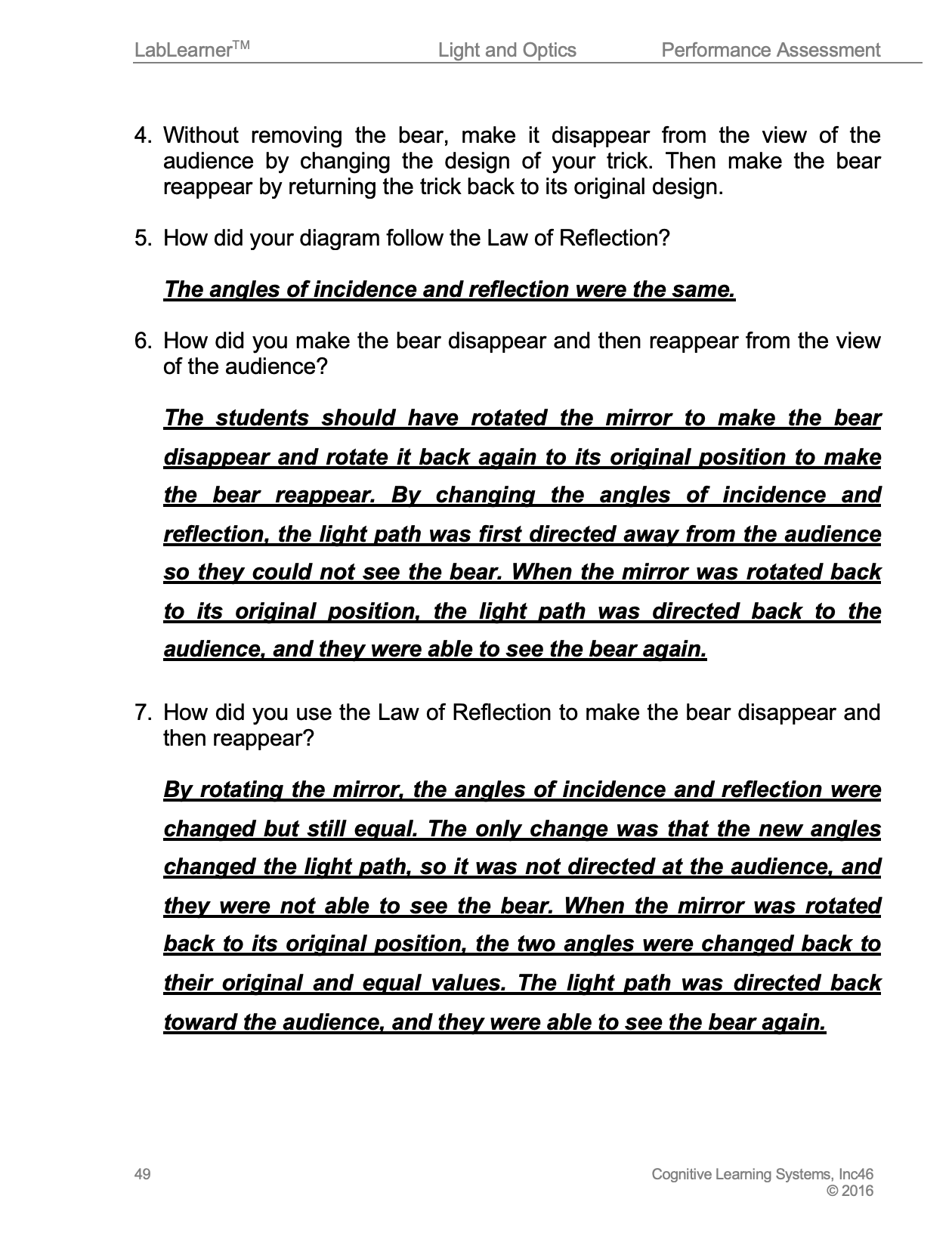
6. Students should perform the first part of the trick and answer Problems 5 through 7 in their Student Data Record.
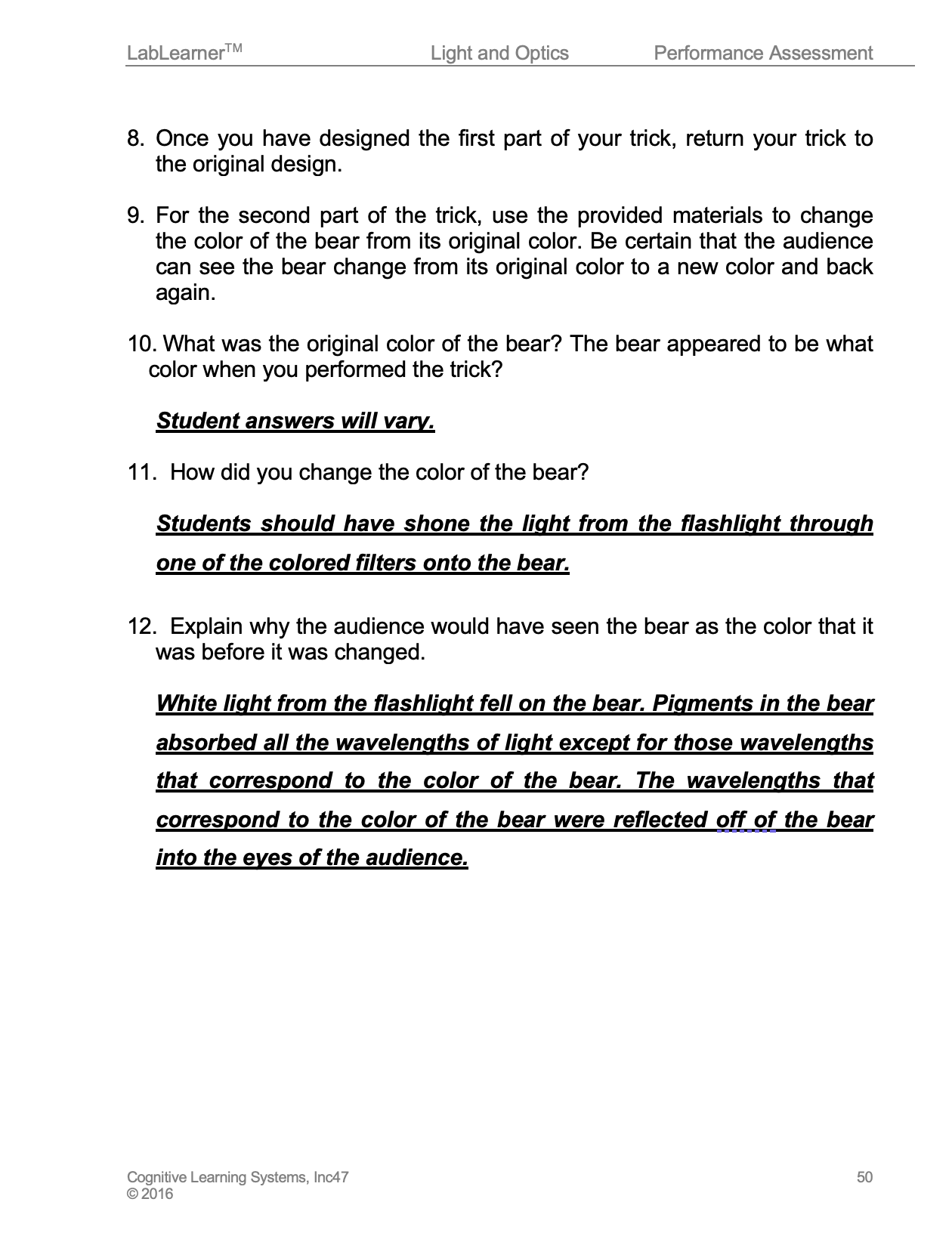
7. Students should then design and then perform the second part of their trick.
8. Students should answer Problems 10 through 13 in their Student Data Record.
CLEAN UP
Let students know your expectations and instruct them to clean up their lab bench after the Performance Assessment.
KEYS: PERFORMANCE ASSESSMENT