
Teacher Portal:
Forms of Energy
Investigation 3 – PreLab
 PRINT IT
Use your browser to download a printable PDF as help during the slide presentation and to make additional notes. In your browser, go to File > Print and then choose to save as PDF.
MINDSET
This Investigation is designed to:
- reinforce the concept that energy has properties and promote the understanding that electrical energy has different properties from mechanical energy and sound energy.
- reinforce the concept of potential energy as stored energy and demonstrate that a battery is an example of stored chemical energy that can provide electrons.
- reinforce the concept of kinetic energy as energy in motion and promote the understanding that electricity is a form of kinetic energy.
- demonstrate to students that electricity is the flow of electrons in a path and that different types of matter differ in their ability to conduct electricity.
SCIENTIST’S GLOSSARY
- Artificial light: Light produced by electrical sources.
- Battery: A device that stores chemical energy and can be used to produce electrical current.
- Bulb: A device consisting of a filament, base, and tip that uses electricity to produce visible light.
- Circuit: A continuous path along which an electrical current can move.
- Current: A flow of electrons along a path.
- Electricity: An event that occurs when electrons move through or between objects or materials.
- Electrons: Tiny particles found outside the nucleus of an atom. Electrons have a negative charge.
- Law of Conservation of Energy: A principle which states that energy is neither created nor destroyed, it simply changes form.
- Light energy: A form of energy that travels in a wave.
- Natural light: Light that comes from natural sources such as the sun.
- Parallel circuit: A circuit that allows electrons to follow several different paths.
- Series circuit: A circuit that directs electrons to follow along a single path.
BE PREPARED
Watch the Investigation 3 Teacher Video and Student Video below to prepare for the PreLab.
SET FOR SUCCESS
- Tell students that they continue working with the Forms of Energy CELL.
- Tell students that they will focus on a certain type of kinetic energy – electric energy.
- Ask students to share the kinds of things they might learn in this Investigation.
Begin the PreLab Concept Slides to start students on their learning journey. Then watch the Pre-Lab Student Video afterward as a class.
NAVIGATE IT
Once the slide presentation is launched
- use your left and right arrows to advance or go back in the slide presentation, and
- hover your mouse over the left edge of the presentation to get a view of the thumbnails for all the slides so that you can quickly move anywhere in the presentation.
- Click HERE to launch the slide presentation for the CELL.
SHARE IT
SLIDE VFENERGY3-pre-1
This is the third Investigation in the Forms of Energy CELL. In this Investigation, students will learn about electric energy. This is likely one of the first forms of energy that students think of because it powers so many of the appliances and other devices around them.
It is easy to overlook the fact that electric energy is kinetic energy because, in many circuits, there is no obvious movement involved. However, electric current is simply a flow (movement) of a massive amount of subatomic particles called electrons through the wires and printed circuit boards of our many electric devices.
______________________________________________
SLIDE VFENERGY3-pre-2
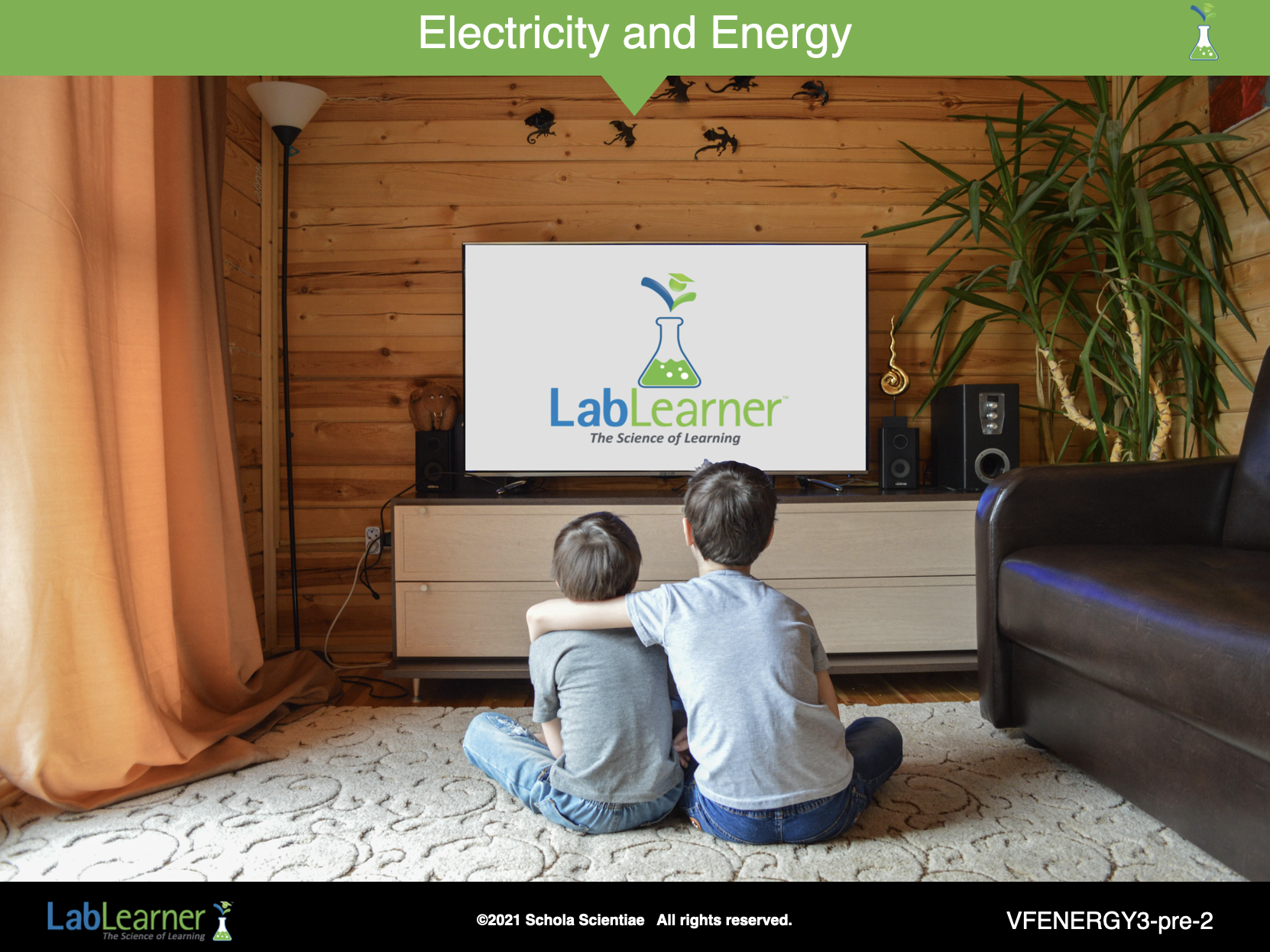
Begin the investigation by reviewing the concepts learned in their previous investigations.
Ask students: What are some of the forms of sound energy that you encounter every day? Student answers will vary. Examples may include but are not limited to people talking or singing, street noises, doors closing, radios or televisions playing, and animal noises.
Encourage students to imagine a television that is plugged into a wall outlet. Ask students: What happens when you turn on the television’s switch? Sound and light come out of the television.
Ask students: What does the Law of Conservation of Energy state? Energy is neither created nor destroyed, it simply changes form.
Ask students: If energy cannot be created, where do the sound and light energy from the television come from? Students should indicate that televisions require electricity to produce sound and light energy.
Ask students: Do all televisions have to be plugged into an electrical outlet? Where do these televisions get the energy to produce sound and light if they are not plugged in? Not all televisions have to be plugged into an electrical outlet. Many televisions use batteries for electrical energy, and some may even use solar energy. This is the type of energy used to produce sound and energy on a smartphone or other mobile device.
______________________________________________
SLIDE VFENERGY3-pre-3
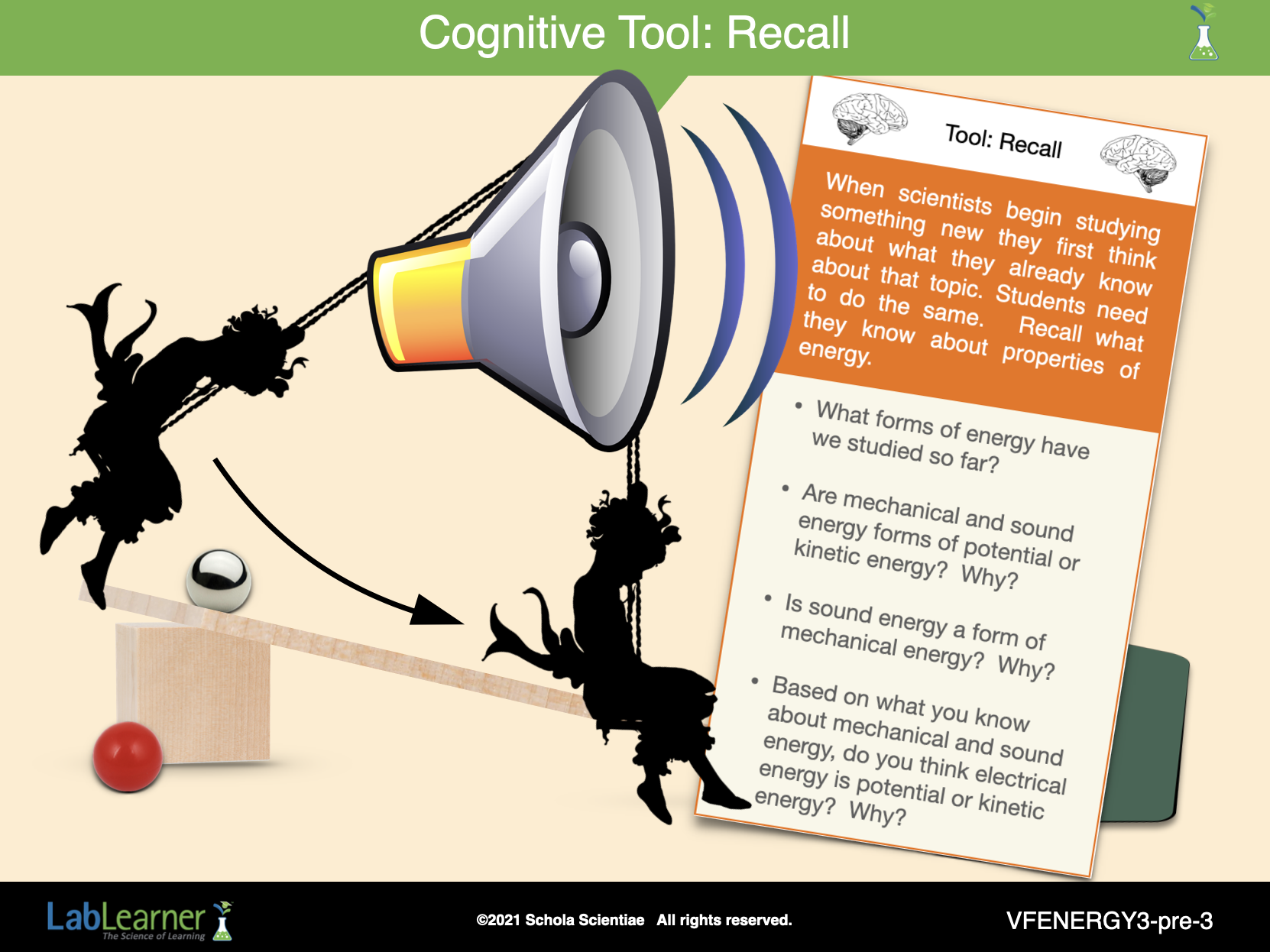
Applying what they already have learned about energy will help students understand the concepts associated with electrical energy. Encourage students to Recall what they have already learned about energy in Investigations One and Two by asking the following questions:
Ask students: What forms of energy have we studied so far? Mechanical, potential, and kinetic energy.
Ask students: Are mechanical and sound energy forms of potential or kinetic energy? Why? Mechanical and sound energy are forms of kinetic energy because they are forms of energy in motion.
Ask students: Is sound energy a form of mechanical energy? Why? Student answers may vary. Sound energy is capable of doing work, such as making air, water and objects move. The energy that can do work is mechanical energy.
Ask students: Based on what you know about mechanical and sound energy, do you think electrical energy is potential or kinetic energy? Why? Student answers may vary. Some students may suggest that electrical energy is potential energy because it does not do anything until a switch is turned on. Other students may suggest that it is kinetic energy because it makes appliances and lights work, or can make toys move. Explain to students that they will explore these ideas during this investigation.
______________________________________________
SLIDE VFENERGY3-pre-4
Continue the discussion by assisting students to understand the nature of electrical energy.
Direct students’ attention to their Scientist’s Glossary. Ask for student volunteers to read the definitions for the terms electricity and electrons.
Electricity: An event that occurs when electrons move through
or between objects or materials.
Electrons: Tiny particles found outside the nucleus of an atom. Electrons have
a negative charge.
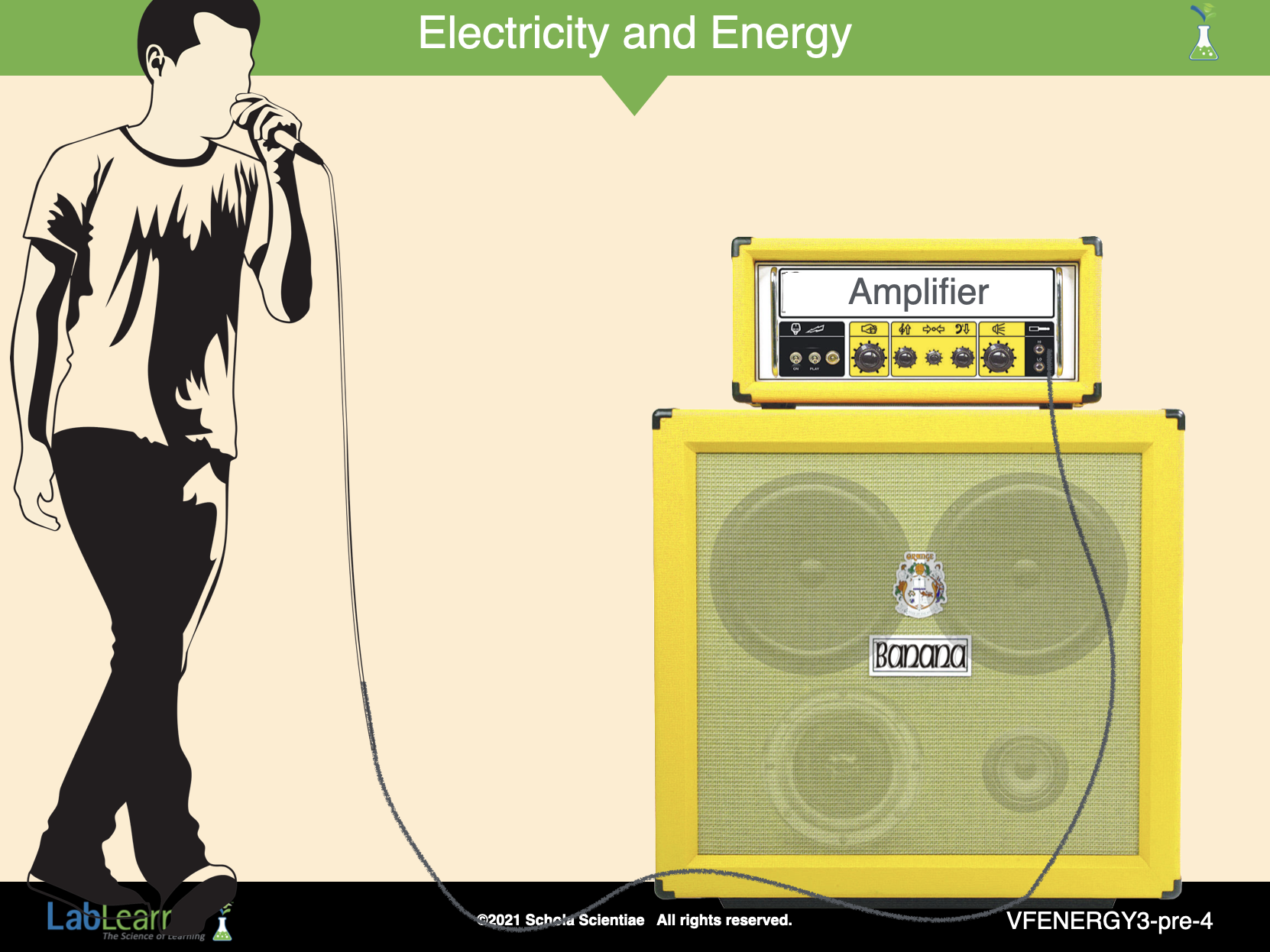
Remind students of their discussion of the television. Ask students: What type of energy does a television change electrical energy into? A television changes electrical energy into sound and light energy.
Ask students: Do you think sound energy could be changed into electrical energy? Student answers may vary.
Ask students: Can you think of anything that can change sound energy into electrical energy? Cell phones and microphones can change sound energy into electrical energy.
Choose an item from the examples provided by the students. Ask students: How do you think a _______ works? Encourage students to answer in terms of energy conversion.
Student answers may vary. Microphones and telephones work by using a special piece of equipment called a receiver to capture sound energy and convert it to electrical energy. The electrical energy is then converted back to sound energy and transmitted through an amplifier to the listener’s ear. Remind students that the volume of sound is determined by the amplitude of a sound wave. An amplifier is a piece of equipment that can control the amplitude of a sound wave. Students should notice that the words amplifier and amplitude have the same root.
______________________________________________
SLIDE VFENERGY3-pre-5
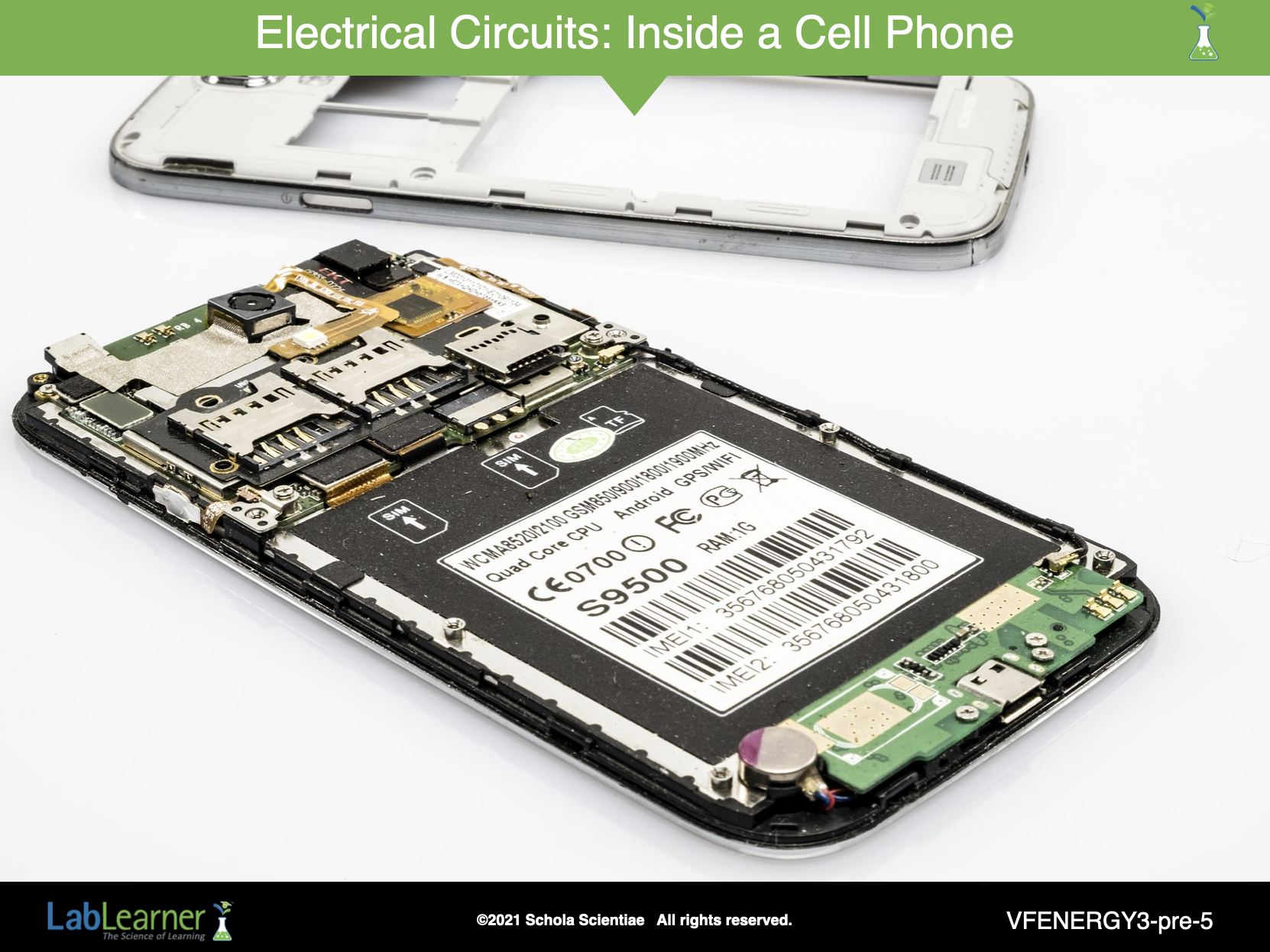
Continue this portion of the investigation by reviewing the concept of circuits with students.
Ask students: When electricity flows, how does it flow? Do you see a term in your Scientist’s Glossary that describes how electrons move? Students should indicate that electricity flows in a current along a path.
Ask students: Can you think of an example of a path that electrical current flows through? Students should suggest that a wire is an example of a path that current flows through.
Direct students’ attention to the term circuit in their Scientist’s Glossary. Ask students: What do you need to make a circuit? Student answers will vary.
Explain to students that circuits can be complete or incomplete. Ask students: What do you think the difference is between a complete and an incomplete circuit? Student answers may vary. Students should suggest that a complete circuit is one that has all its parts, while an incomplete circuit is missing components. A complete circuit is one in which the path is continuous between the negative and positive terminals of the energy source. An incomplete circuit is one in which the path is not continuous.
______________________________________________
SLIDE VFENERGY3-pre-6
Use the following activity to demonstrate the difference between a complete and an incomplete circuit.
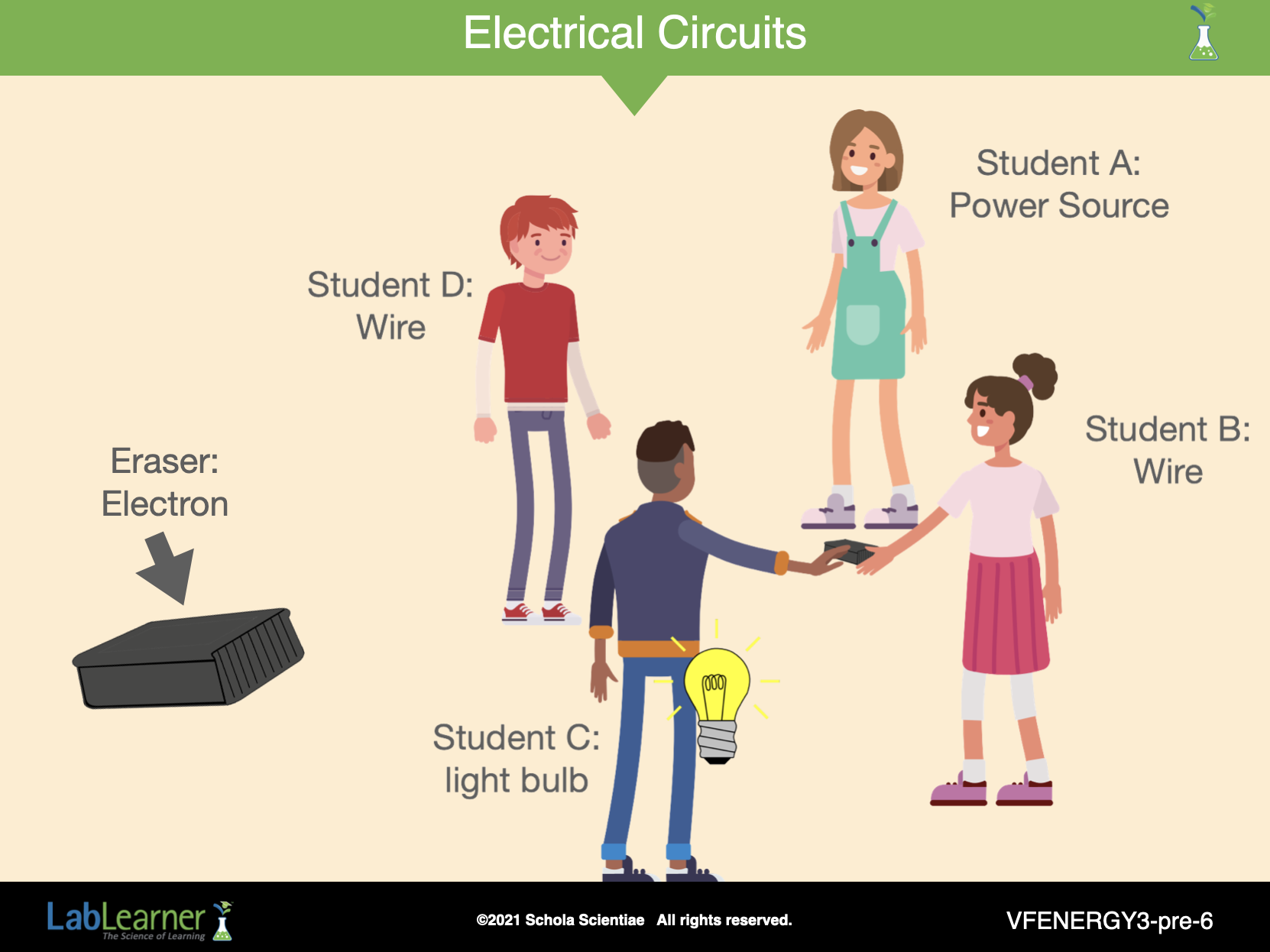
a. Ask for 4 students to stand in a circle. Students should be far enough apart that their fingertips just touch when their arms are extended out to their sides.
b. Explain to the class that the students represent the parts of a circuit.
c. Assign student A to be the power source, students B and D to be wires, and student C to be a light bulb.
d. Hold up the blackboard eraser and explain to students that the eraser represents an electron that flows in the circuit.
e. Hand the eraser to student A and explain to the class that electrons leave the power source and travel through a wire to any device that might be in the circuit, in this case a light bulb. The electron moves through the device and goes back to the power source through another wire.
f. Direct student A to start the eraser around the circuit by handing it to student B. As the eraser is moving from hand to hand,
Ask students: Is this circuit complete or incomplete? How do you know? Students should indicate that the circuit is complete because each student should be able to pass the eraser to the next student.
(Continued on next slide)
______________________________________________
SLIDE VFENERGY3-pre-7
(Continued)
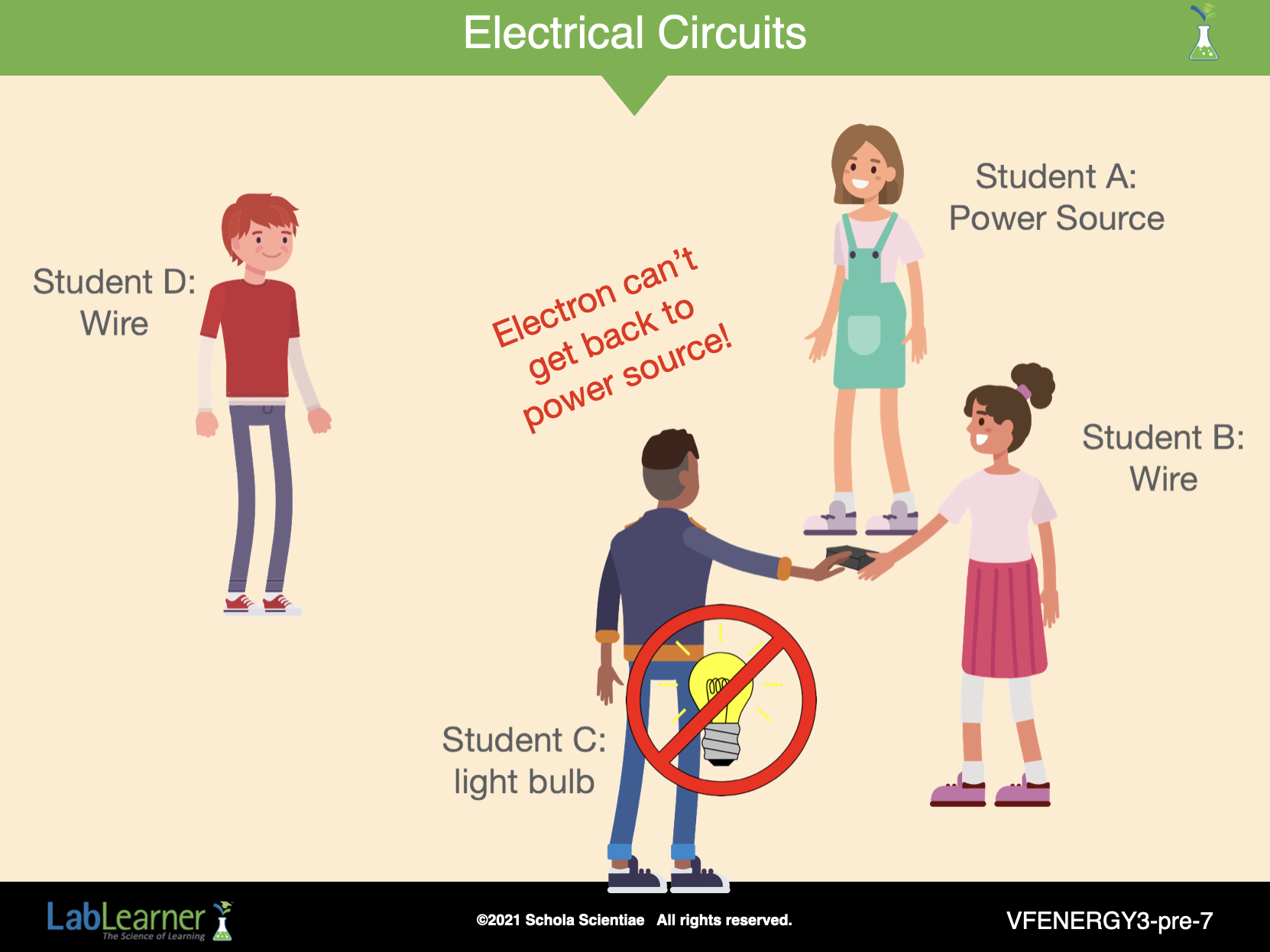
g. Once the eraser has reached student A again, stop the students and ask student D to step out of the circle. Do not let the remaining three students move closer to one another. Students A and C should be far enough apart that they cannot pass the eraser between their outstretched hands.
h. Ask students: Is this a complete or incomplete circuit? What do you think will happen to the electron? Student answers may vary. However, students most likely will suggest that the circuit is incomplete because student C will probably not be able to pass the eraser to student A.
i. Direct student A to begin passing the eraser around the circle again. The eraser should end up in student C’s free hand.
j. Direct students’ attention to the fact that the eraser could not be passed back to student A. Ask students: What is the difference between a complete and an incomplete circuit? An electron can flow freely through a complete circuit, but cannot flow through an incomplete circuit.
______________________________________________
SLIDE VFENERGY3-pre-8
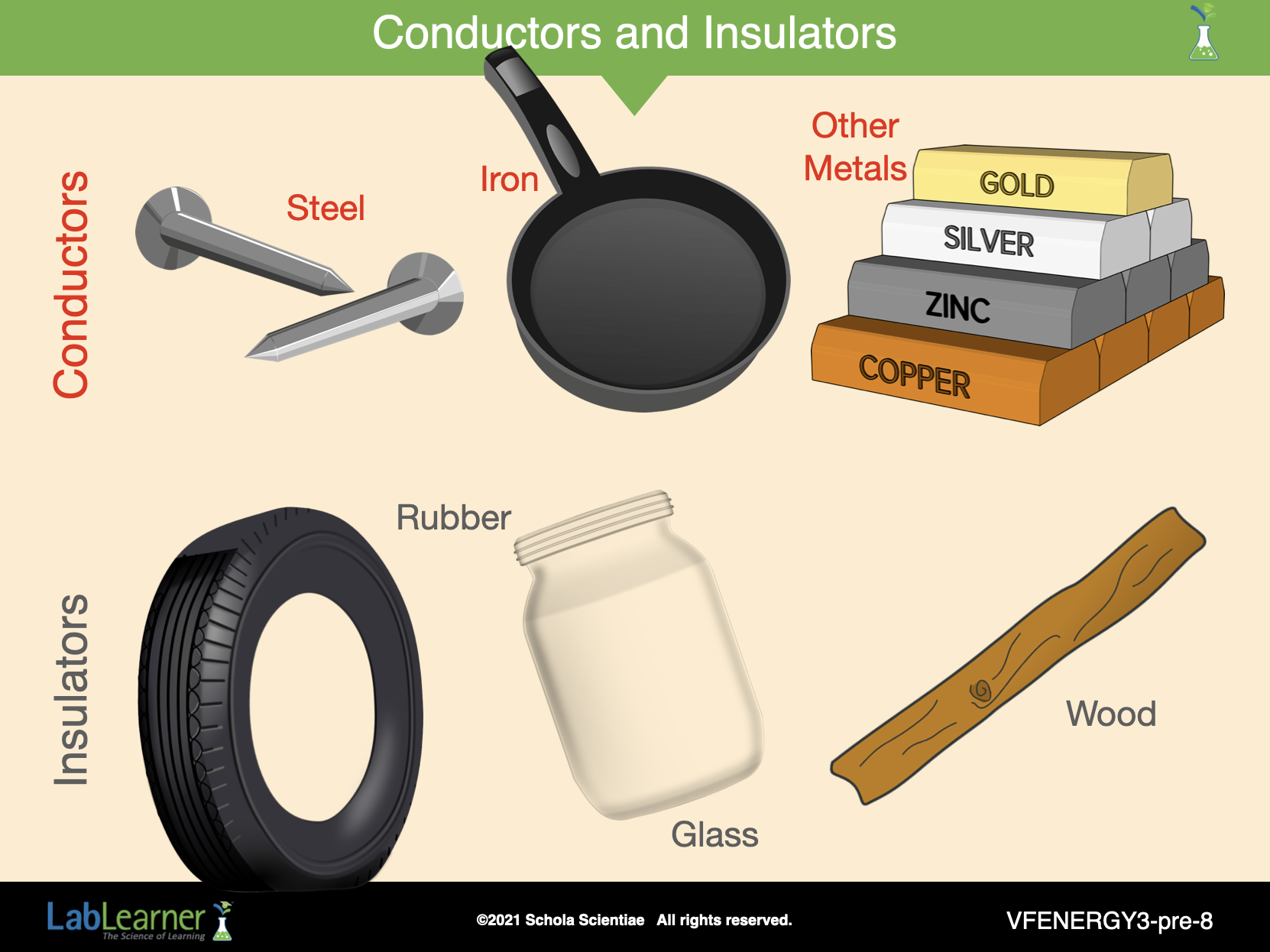
Continue the discussion of circuits and electricity by engaging students in a discussion about conductors and insulators of electricity.
Ask students: Have you heard of a conductor in relation to electricity? What do you think a conductor of electricity is? Student answers may vary. Conductors are materials through which electricity flows freely.
Ask students: Can you think of materials that would be good conductors of electricity? Students should suggest that metals tend to be good conductors of electricity. Students may also suggest that water is a good conductor of electricity because they may have been warned not to have electrical appliances in the bathtub or pool. Water by itself is only a fair conductor of electricity. However, when combined with salt from the body or bath water additives it can become a very good conductor. Reinforce for students that water and electricity should not be mixed.
Ask students: What is an insulator of electricity? Can you think of some examples of materials that are insulators? Student answers may vary. Insulators are materials that do not conduct electricity easily. Examples would be plastic, wood, and glass.
- Explain to students that electrical devices are designed from a mix of materials that are conductors and insulators so that the electricity follows the proper path through the device.
______________________________________________
SLIDE VFENERGY3-pre-9
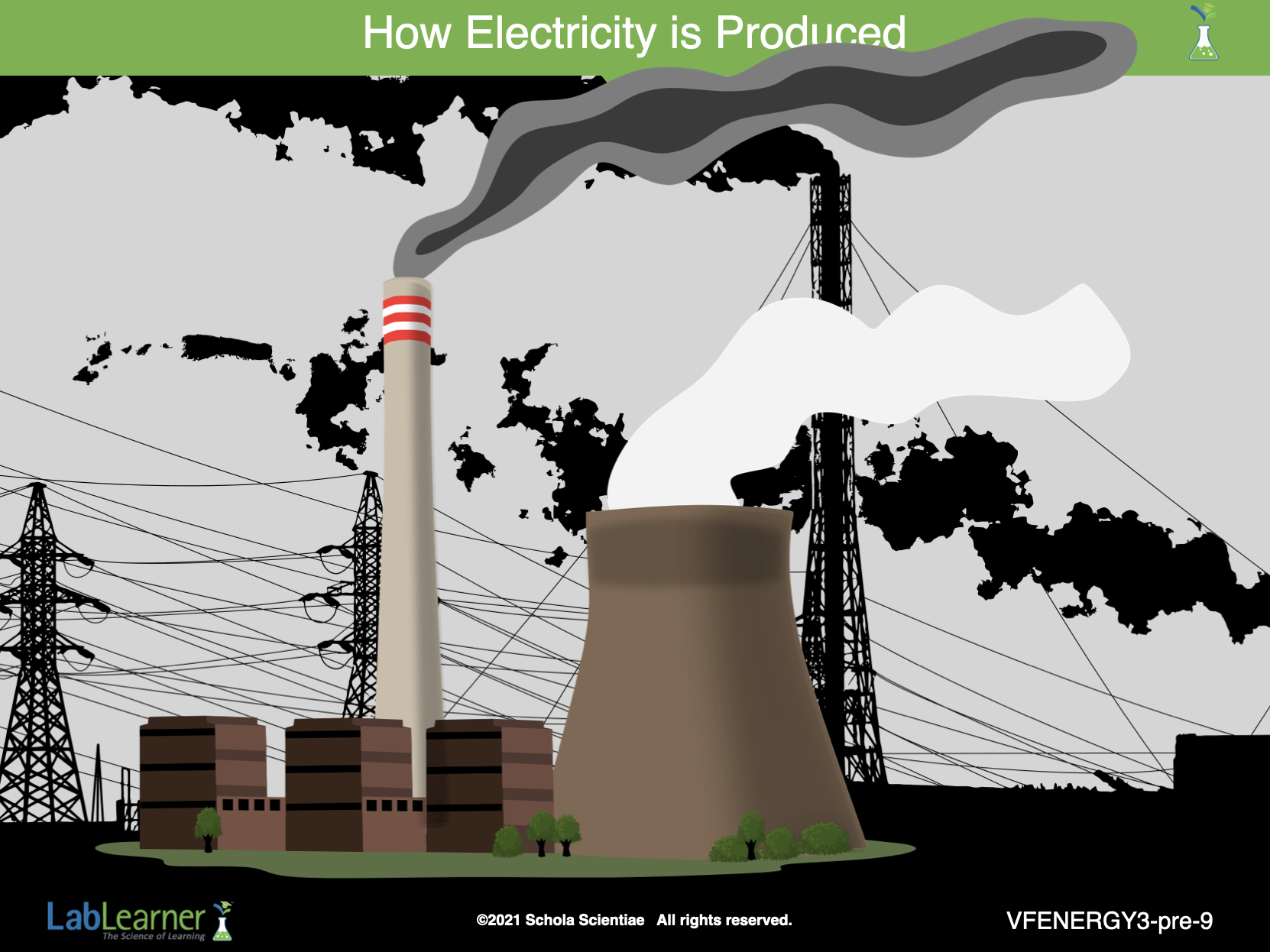
Conclude this portion of the investigation by encouraging students to think about how electrical energy is produced for our use.
Ask students: How do you think energy is produced? Student answers may include batteries, building circuits, wires, electrical outlets, power plants, water, wind, and the sun.
We have purposely accentuated the potential negative impact of current electricity production on the environment. However, such forms of electricity production will first be supplemented with cleaner forms of energy production, and then eventually entirely replaced by clean and renewable forms of electricity.
- Remind students that they have discussed how electrical energy can be converted to sound energy.
Ask students: Do you think electrical energy can be converted to other forms of energy? Student answers will vary. Tell students that they will answer this question as they conduct their experiments in the lab.
______________________________________________
SLIDE VFENERGY3-pre-10
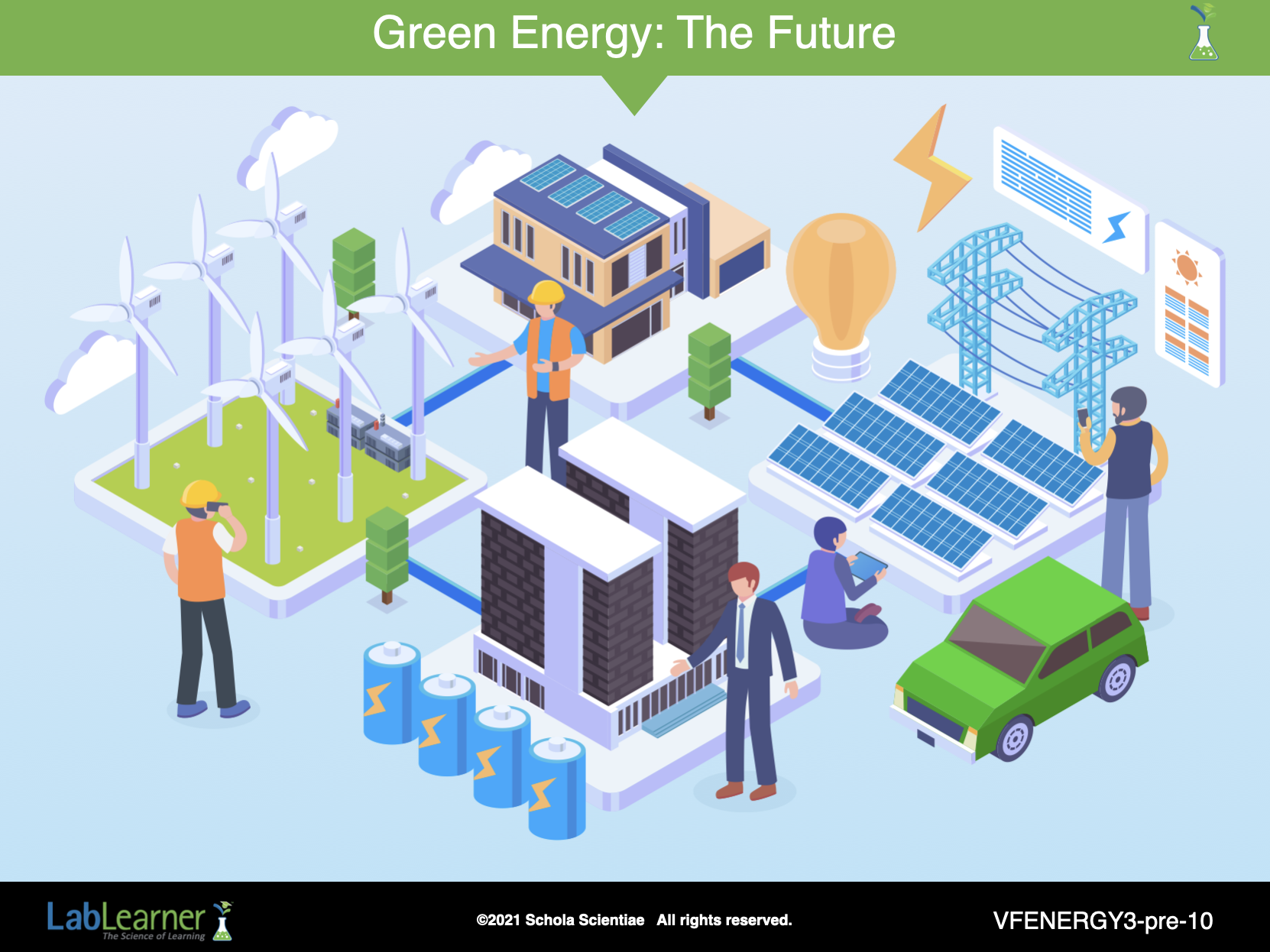
This final slide is included to introduce students to the future of energy production. Much of the technology being developed today is with the thought of green energy in mind. Green forms of energy will have much less impact on our environment. Chances are that some LabLearner students will become the very scientists and engineers that help create and improve green energy production!
Student Video
Watch the Investigation 3 Student Video after the Share It presentation to prepare for the PreLab.