Teacher Portal:
Forms of Energy
Investigation 3 – PostLab
PRINT IT
Use your browser to download a printable PDF as help during the slide presentation and to make additional notes. In your browser, go to File > Print and then choose to save as PDF.
NAVIGATE IT
Once the slide presentation is launched
- use your left and right arrows to advance or go back in the slide presentation, and
- hover your mouse over the left edge of the presentation to get a view of the thumbnails for all the slides so that you can quickly move anywhere in the presentation.
- Click HERE to launch the slide presentation for the CELL.
SHARE IT
SLIDE VFENERGY3-post-1
In Investigation Three, we explored the concept that energy has properties, and promoted the understanding that electrical energy has different properties from mechanical energy and sound energy.
We also reinforced the concept of potential energy as stored energy and demonstrate that a battery is an example of stored chemical energy that can provide electrons.
______________________________________________
SLIDE VFENERGY3-post-2
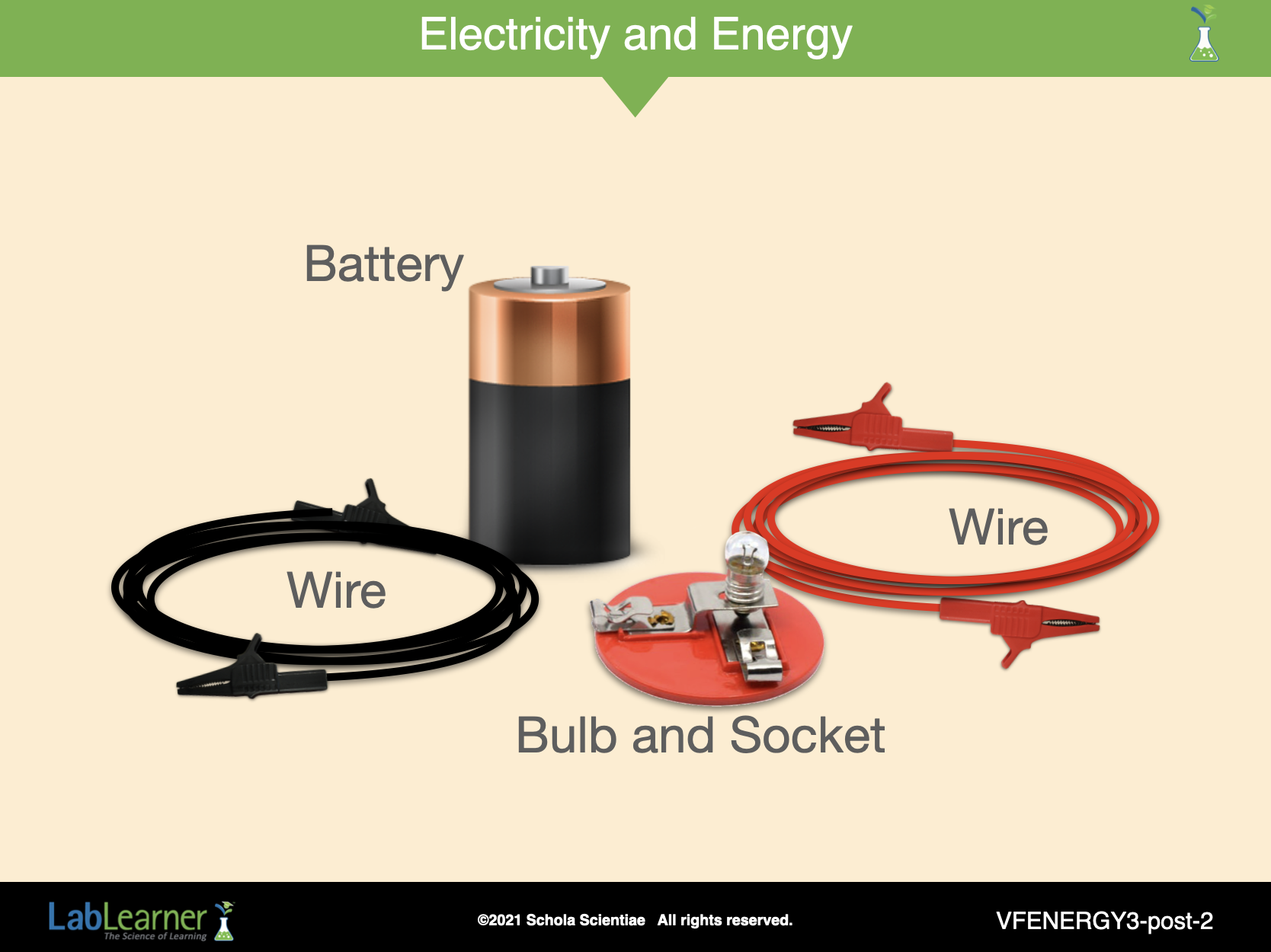
Begin this part of the Investigation by encouraging students to consider the role of the battery in their experiments. The following questions may be useful in prompting student discussion:
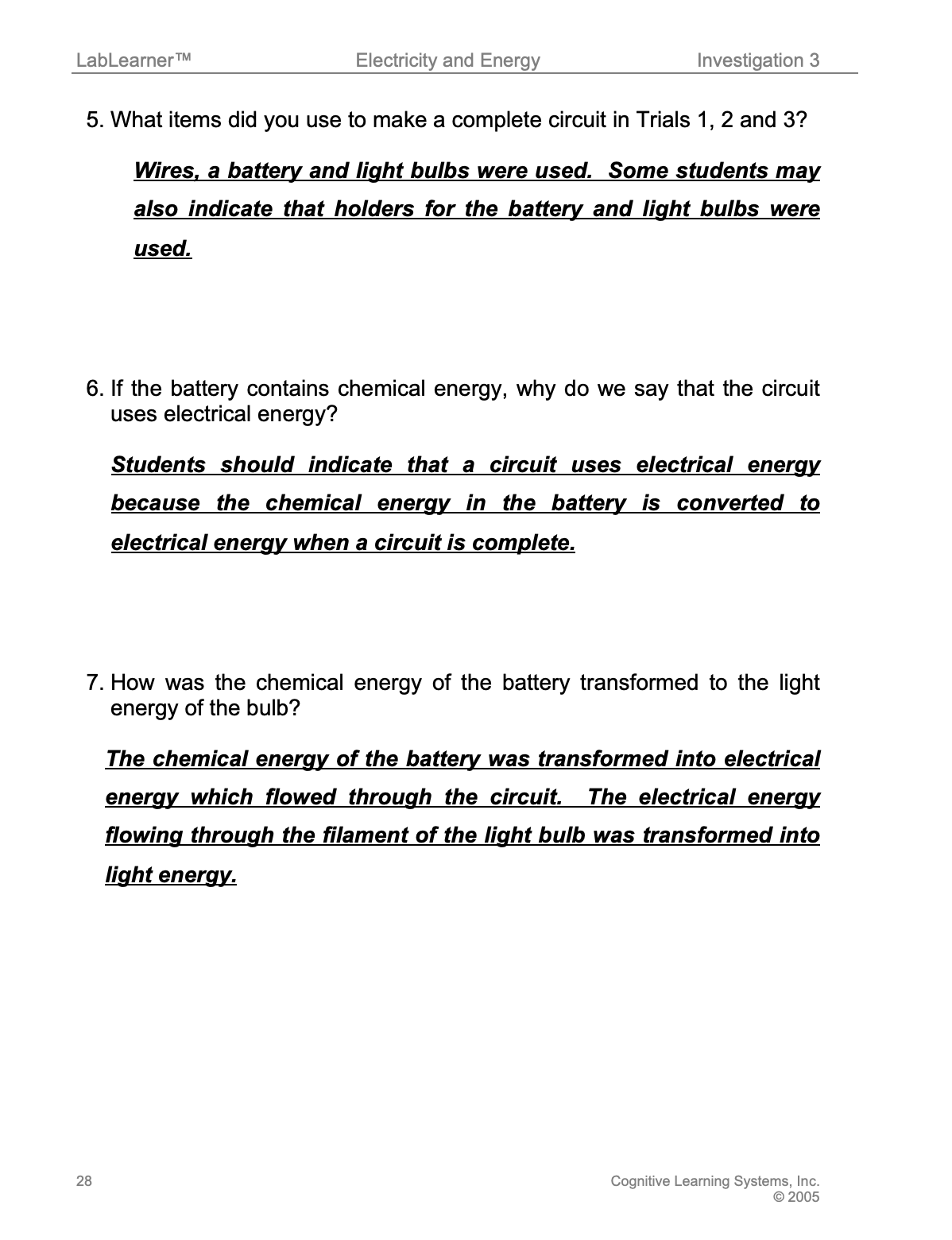
Ask students: What items or materials did you need to make complete circuits in Trials 1 through 3? Wires, a battery, and light bulbs were used. Some students may also indicate that holders for the battery and light bulbs were used.
- Direct students to record their answers in problem 5 of their Scientist Data Record.
Ask students: What was the purpose of the battery? The battery provided energy for the circuits.
Ask students: What form of energy does the battery have? Is it potential or kinetic energy? A battery contains chemical energy. It is potential energy because it is stored energy.
Ask students: If the battery contains chemical energy, why do we say that the circuit uses electrical energy? Students should indicate that a circuit uses electrical energy because the chemical energy in the battery is converted to electrical energy when a circuit is complete.
- Direct students to record their answers in problem 6 of their Scientist Data Record.
Ask students: Is electrical energy a form of potential energy or kinetic energy? Why? How could you tell? Electrical energy is kinetic energy because the electrons move through the circuit. Students should indicate that they could tell electrons are moving through the circuit because they could see the light bulb glow when the circuit was completed.
- If students have difficulty with this concept, explain that matter is made up of very, very small particles called atoms. Electrons are small particles that can be found surrounding the middle of an atom, called a nucleus. Atoms can lose and gain electrons. This is what is meant by a flow of electrons when the concept of electricity is described as kinetic energy.
Ask students: How was the chemical energy of the battery transformed to the light energy of the bulb? The chemical energy of the battery was transformed into electrical energy which flowed through the circuit. The electrical energy flowing through the filament of the light bulb was transformed into light energy.
- Direct students to record their answers in Problem 7 of their Student Data Record.
______________________________________________
SLIDE VFENERGY3-post-3
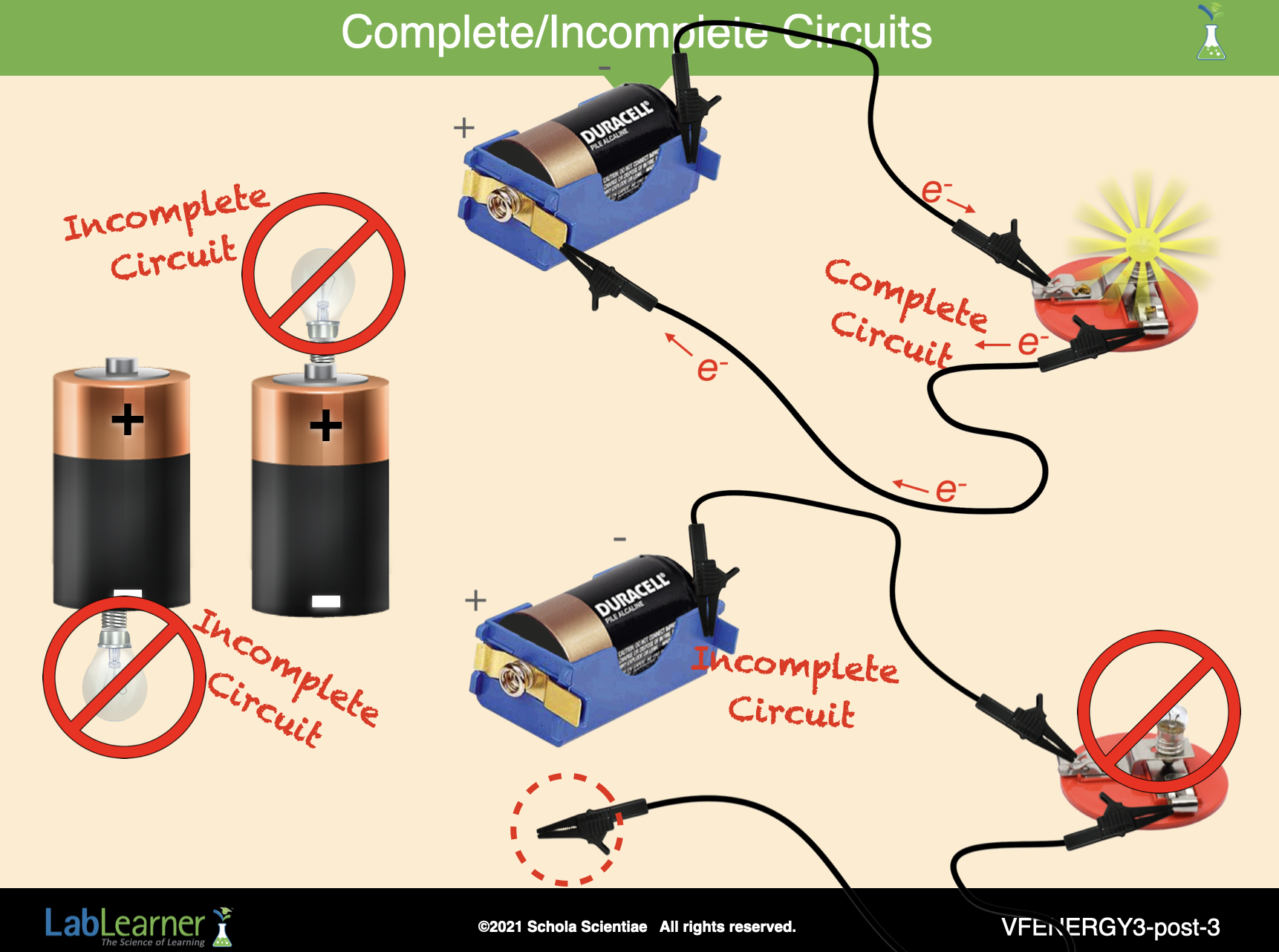
Continue the discussion by focusing students’ attention on the roles of the wire and the light bulb in the circuits.
Remind students that when they tried to produce light with just the battery and the bulb they were not able to make the bulb glow.
Ask students: Why didn’t the bulb work when you placed it against the terminals of the battery? Student answers may vary. The bulb did not work because a complete circuit was not made.
Ask students: What was the purpose of the wire in the circuit? The wire served as a conductor. It provided a path for the electrons to travel through the circuit.
Ask students: What would have happened if you had used shoelaces instead of wire? Why? The circuit would not have been complete because shoelaces are not a conductor of electricity.
Ask students: What was the purpose of the light bulb? The light bulb indicated that electrical energy was flowing through the circuit.
Ask students: How did you know if the circuits were complete? The light bulb glowed if the circuit was complete. If the light bulb did not glow, the circuit was incomplete.
______________________________________________
SLIDE VFENERGY3-post-4
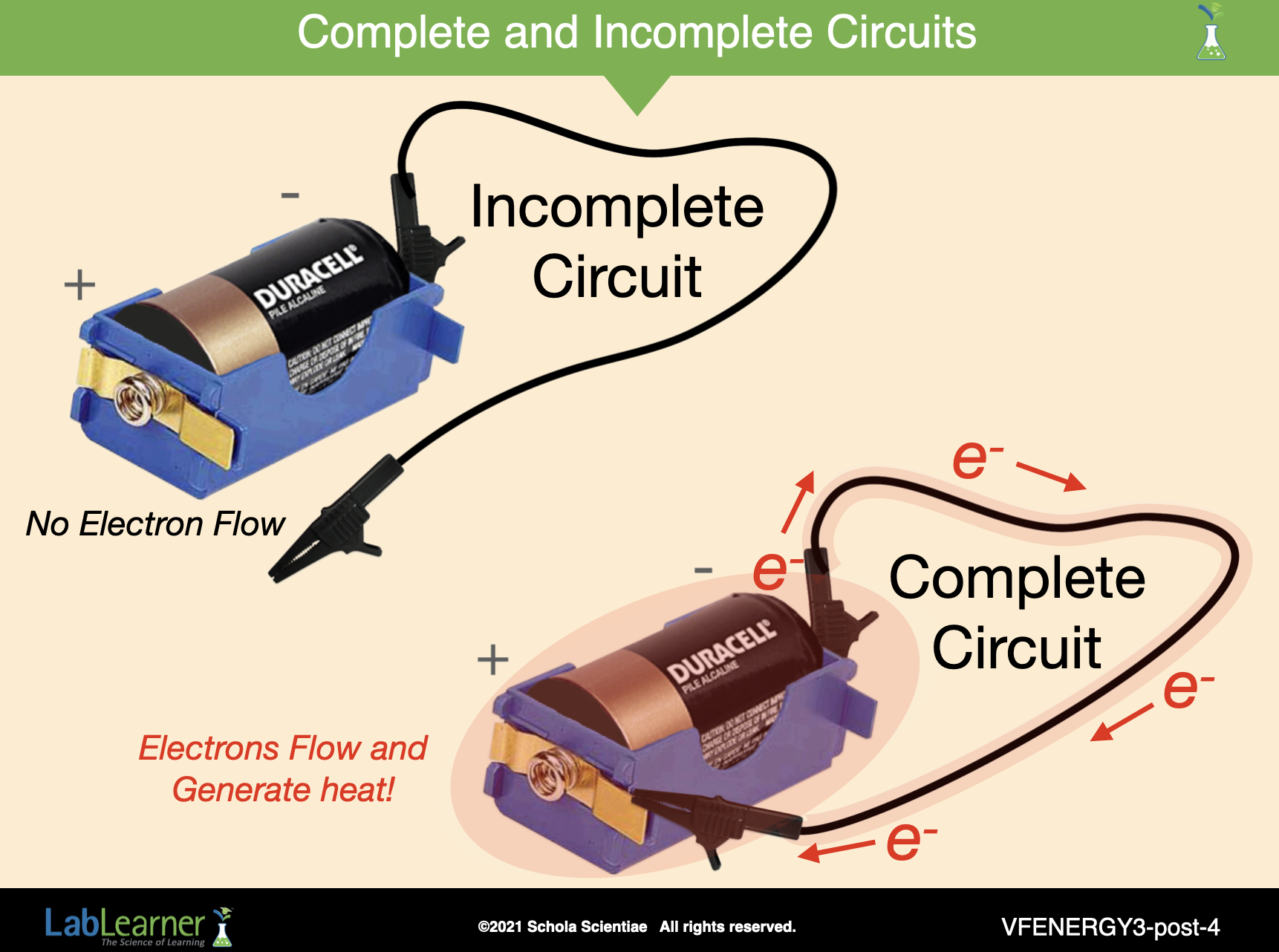
Continue the discussion by encouraging students to consider whether or not energy flows through a circuit if a light bulb is not present.
Ask students: Do you think the battery would have produced electrical energy if the light bulb had not been part of the circuit? Student answers may vary.
Ask students: Would your circuit have an energy source without the light bulb? The circuit would have had an energy source because the battery is the energy source.
Ask students: Would the electrons still have had a conductor to travel through without the light bulb? Wire is a conductor, so the electrons would still be able to move through the circuit.
Ask students: Would the energy source and the conductor have been enough to complete a circuit? A complete circuit could have been created with just a battery and wire.
Ask students: If you had created a circuit from the battery and a piece of wire, how would you know if the circuit was complete? Student answers will vary.
If a circuit had been created with only a battery and wire, the circuit would be complete and the chemical energy of the battery would be converted into electrical energy. However, without some method to test the circuit, it would be impossible to see that the electrical energy was moving through the circuit because the movement of electrons cannot be seen by the human eye.
We would need proof that could be observed through another sense such as hearing or touch. In fact, it would be possible to detect that electricity was flowing through the circuit by touching the battery or the insulation of the wire. Without the presence of any other device in the circuit the electrons would move so quickly that they would generate heat, just as they generate heat as they pass through the filament of a light bulb. This would cause the battery and the wire to become hot fairly quickly as well as drain the battery. Therefore, students were not asked to create this type of circuit in the lab.
______________________________________________
SLIDE VFENERGY3-post-5
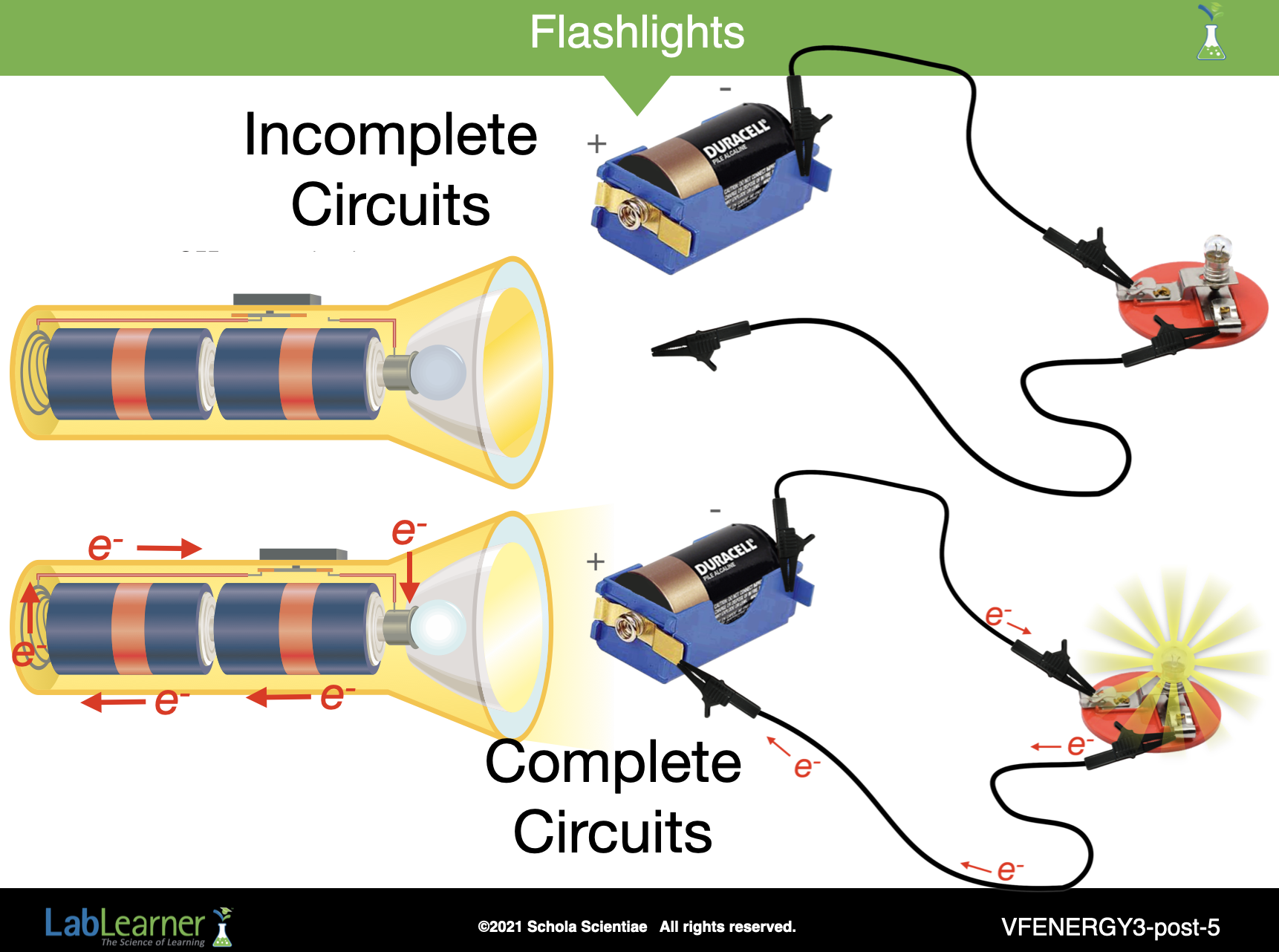
Direct students’ attention to the slide as needed during the discussion to highlight the similarities and differences between the circuit and flashlight.
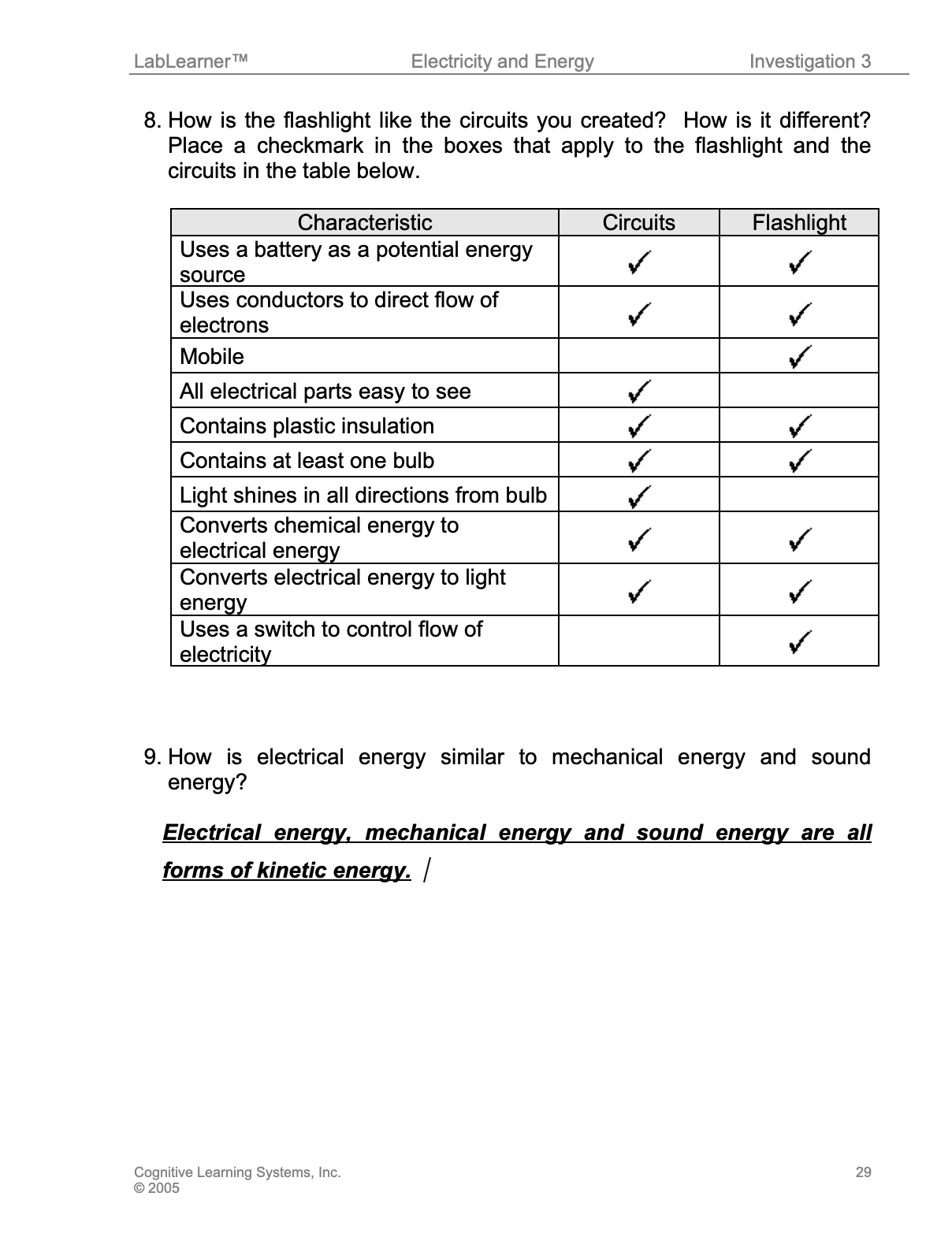
Ask students: What type of energy does a flashlight use? How does it compare to the energy used in the circuits you created? A flashlight uses electrical energy from batteries. Both the flashlight and the circuits used batteries to supply the electrical energy, but the flashlight used more batteries than the circuit
Ask students: What two things do you need for a circuit? Does the flashlight have these things? A circuit requires a source of energy and a conductor to complete the circuit. The flashlight uses batteries as its source of energy, and the metal parts of the flashlight serve as its conductors.
Remind students that they saw proof of the electrical energy because they saw the flashlight glow.
Ask students: Why could you not feel the electricity when the flashlight was on? Student answers may vary. The electricity could not be felt because all of the parts which served as conductors were surrounded by plastic, which is an electrical insulator.
Ask students: What does the plastic case resemble in your circuits? Why is it important? The plastic flashlight case resembles the plastic coating on the wire, which is called insulation. Insulators are important parts of an electric circuit because they can not only protect the person using the circuit, but also make sure that the electrical energy stays on the proper path.
Ask students: Which had a greater amount of electrical energy: the circuits you created or the flashlight? How do you know? Students should indicate that the flashlight had greater electrical energy than the circuits. Their reasons for this statement may differ. Some may indicate that they believe the flashlight has greater electrical energy because it used more batteries. Others may suggest that the flashlight has greater electrical energy because the light is brighter from the flashlight.
While light intensity can be indicative of the amount of electrical energy in a circuit, the flashlight also contains a reflector that directed all of the light emitted by the bulb in one direction. The bulbs in the students’ circuits emitted light in all directions, which would make the light seem less intense. However, the intensity of the light emitted by the flashlight was also due to the number of batteries because the flashlight used two batteries while students’ circuits only used one. Thus both answers are acceptable within the context of the experiment.
Direct students to use the answers to these questions to complete the Table in Problem 8 of their Student Data Records.
______________________________________________
SLIDE VFENERGY3-post-6
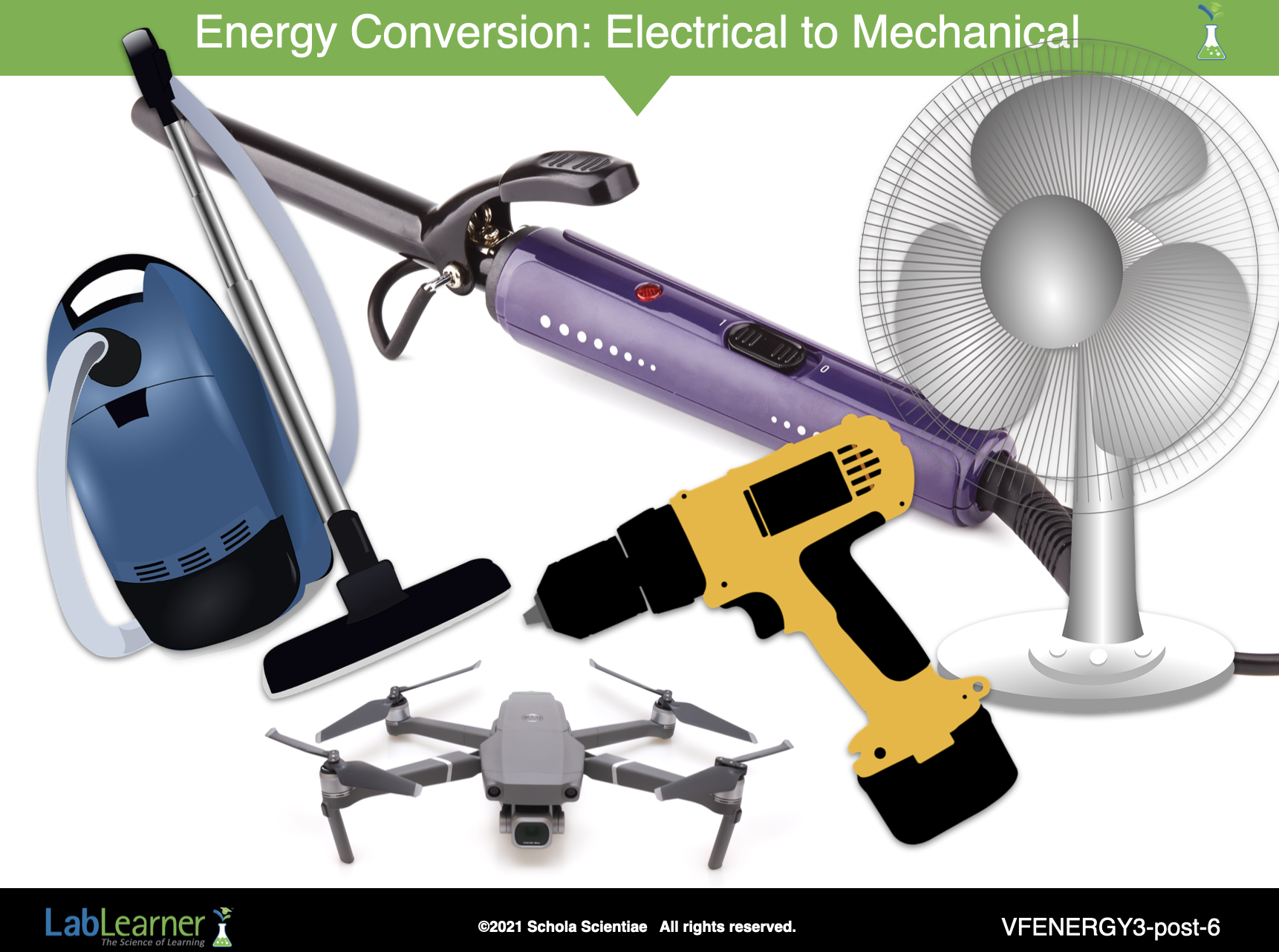
Conclude this portion of the investigation by encouraging students to think about how electrical energy relates to the types of energy they explored in Investigations One and Two.
Ask students: How is electrical energy similar to mechanical energy and sound energy? Electrical energy, mechanical energy, and sound energy are all forms of kinetic energy.
Direct students to record their answers in Problem 9 of their Student Data Record.
Ask students: Do you think electrical energy can be converted to mechanical energy? Can you think of any examples in your home? Student answers may vary. Electrical energy can be converted to mechanical energy. Examples of electrical energy being converted to mechanical energy in a home environment include kitchen appliances, clothes washers and dryers, vacuum cleaners, hairdryers, electric tools (saws, drills, screwdrivers, routers), printing devices, and stereo equipment. Students may also describe various electrical toys such as radio-controlled cars or other battery-operated items.
Ask students: Can you think of ways other than light bulbs where electrical energy is converted to light energy? Electrical energy is converted to light energy in digital timers and computer and television screens. In addition, some electrical stoves convert electrical energy to heat by generating infrared light, and microwaves are light waves.
Explain to students that electrical energy can be generated from other forms of energy. Ask students: Can you think of examples of other forms of energy that can be converted to electrical energy? Student answers may vary.
Mechanical energy can be converted to electrical energy by such methods as water or steam-driven generators in electrical plants. Some students may have experience with bike headlights that are powered by pedaling the bike. Nuclear energy also can be converted to electrical energy. Students may suggest solar-powered landscaping lights as an example of solar radiation (light) being converted to electrical energy or have experience with calculators that use light energy for power.
Remind students that in their experiments electrical energy was generated by converting chemical energy from a battery.
Ask students: Do you think chemical energy can be converted to other forms of energy? Student answers will vary. Explain to students that they will explore this idea further in their next Investigation.
KEYS: POSTLAB