
Teacher Portal:
Forms of Energy
Investigation 3 – Lab
 BE PREPARED
Supplies and Equipment:
Class Materials:
- 1 wire cutter
- 1 spool of wire
Group Materials:
- 1 flashlight
Pair Materials:
- 1 battery holder
- 1 D-cell battery
- 2 light bulb holders
- 2 light bulbs
- 2 20 cm pieces of wire
Individual Materials:
- 1 Student Data Record
Teacher Preparation:
- Use the wire cutter to cut or locate thirty (30) pieces of wire 20 cm long.
- Use the wire cutter to strip approximately 1 cm of insulation from each end of the wire pieces.
- Place all materials at a central distribution point.
- Divide students into pairs.
Instruction:
- Direct one student from each pair to obtain the following from the distribution center: one (1) battery holder, one (1) D-cell battery, two (2) light bulbs, two (2) light bulb holders and four (4) 20 cm pieces of wire.
- Direct one student from each table to obtain one (1) flashlight from the distribution center.
GET FOCUSED
Investigation Three introduces students to the relationship between kinetic energy and electric energy.
Students will conduct a series of experiments to determine the properties of electric energy.
INVESTIGATE
Trial 1
Students will begin their exploration of electrical energy by investigating how a light bulb and battery are designed in order to understand how electricity flows through a simple circuit. Students will then be given the opportunity to design and test various ways to construct a complete simple circuit using a battery, wires, and a light bulb.
Through the design and testing process, students will discover that creating a complete circuit with these materials requires that the light bulb be connected to both the positive and the negative end of the battery at the same time. In addition, students will discover that they can determine if a circuit is complete by whether or not light is produced.
 As students complete this trial, they will answer the following questions:
-
-
- Can electrical energy be seen?
- What is a complete circuit?
-
a. Begin this trial by directing students to examine a light bulb.
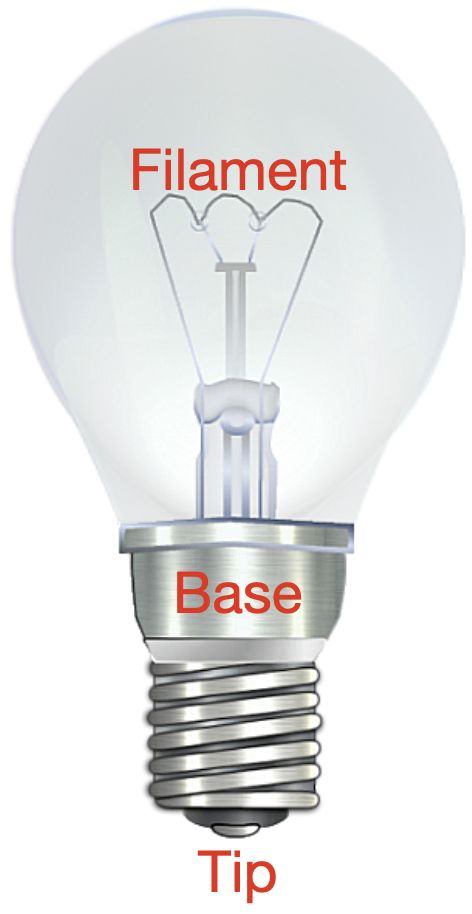
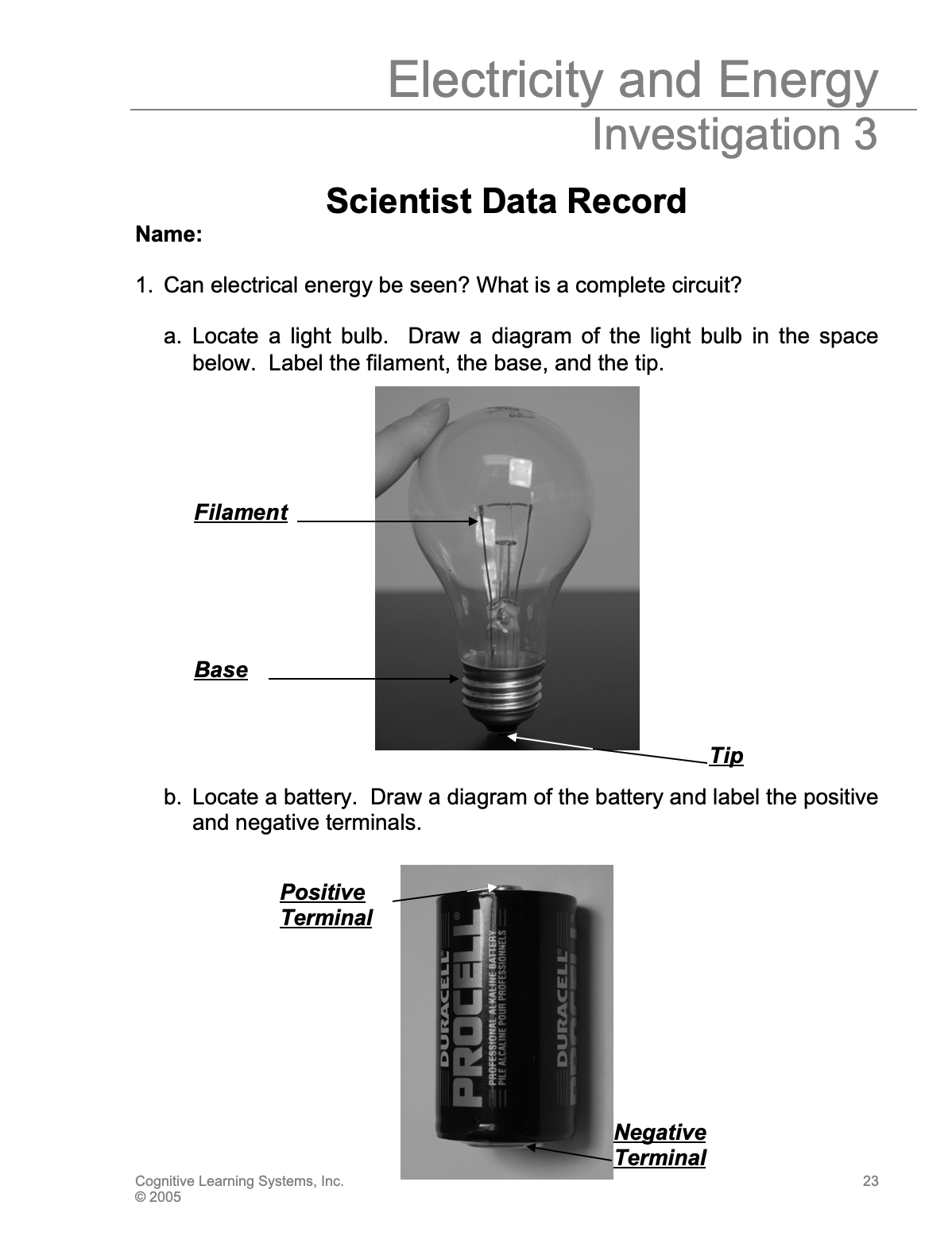
b. Direct students to sketch the light bulb in problem 1a of their Scientist Data Record. Ask students: Where is the base? Where is the tip? Where is the filament? Students should indicate that the base is the metal collar at the base of the light bulb. The tip is the point on the bottom of the light bulb. The filament is the coiled wire inside the light bulb.
c. Direct students to label the base, tip, and filament in their sketch in Problem 1a in their Student Data Record.
d. Ask students: How do you think a light bulb can complete a circuit? What path does the electricity take? Student answers may vary. Encourage students to think about these questions as they continue with the trial.
______________________________________________________
e. Direct students to study a battery. Ask students: How does a battery provide electricity? Student answers may vary.
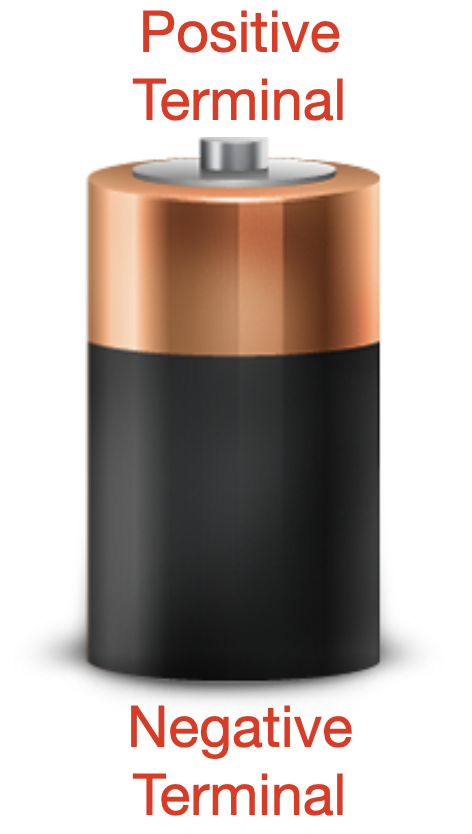 f. Remind students that opposite charges attract one another. Explain to students that there are two chemicals in the battery. The chemical at the negative terminal releases electrons, which have a negative charge. The electrons flow from the negative terminal through the circuit to the positive terminal because they are attracted to the positive charge there. The two chemicals are separated by a filter inside the battery.
g. Ask students: What do you think happens when the negative terminal no longer has electrons to send through the circuit? Student answers may vary. When a negative terminal no longer can send electrons through the circuit, the battery is said to be dead.
h. Direct students to sketch their battery in Problem 1b and label the positive and negative terminals.
NOTE: A battery “dies” because the chemicals inside the battery have reached equilibrium. The voltage of a battery indicates the difference in potential energy between the terminals of the battery. Whenever the battery is used to provide electricity, the transfer of electrons through the circuit from the negative terminal to the positive terminal causes the potential difference to decrease. Once the potential difference reaches “0” electrons no longer flow when the battery is included in a circuit because there is no longer a positive charge to attract them. Students are not expected to know this information but may find it to be of interest.
i. Direct students to test the light bulb against each terminal to see if they can create a complete circuit as directed in Steps 1c and 1d and indicate whether or not the light bulb glowed.
j. Ask students: Why do you think the bulb did not glow when you pressed it against the battery terminals? Student answers may vary. The bulb did not glow because the circuit was not complete. The bulb must be connected to both terminals at the same time in order for electricity to flow.
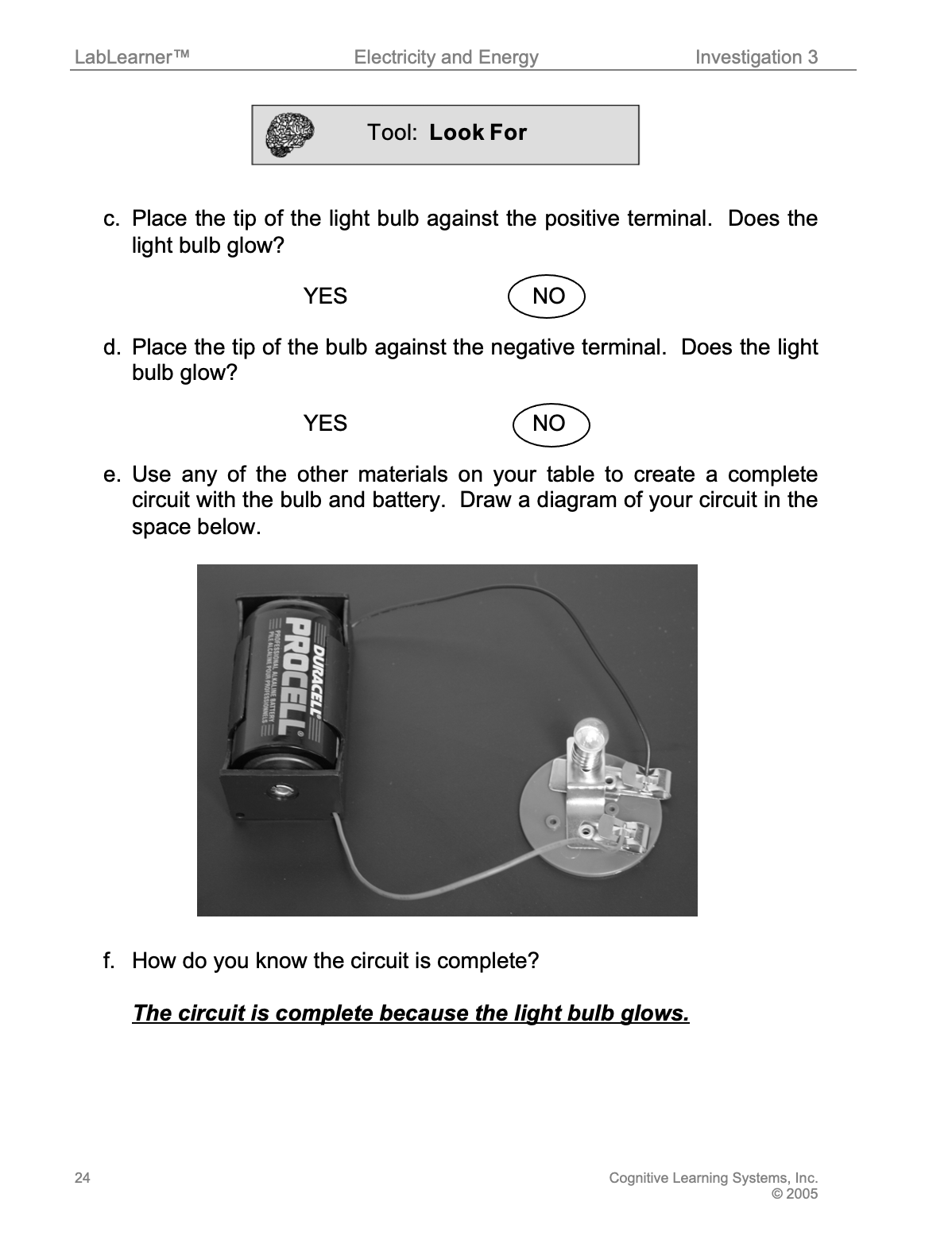
k. Direct students to use any of the materials on their table to create a simple circuit. Explain to students that they may not need all of the materials available to create a working circuit. Assist students as necessary.
l. Provide approximately 5 minutes for students to complete their circuits.
m. Direct students to draw a diagram of their simple circuit in Problem 1e.
n. Instruct students to dismantle their circuits and answer Problem 1f.
Trial 2
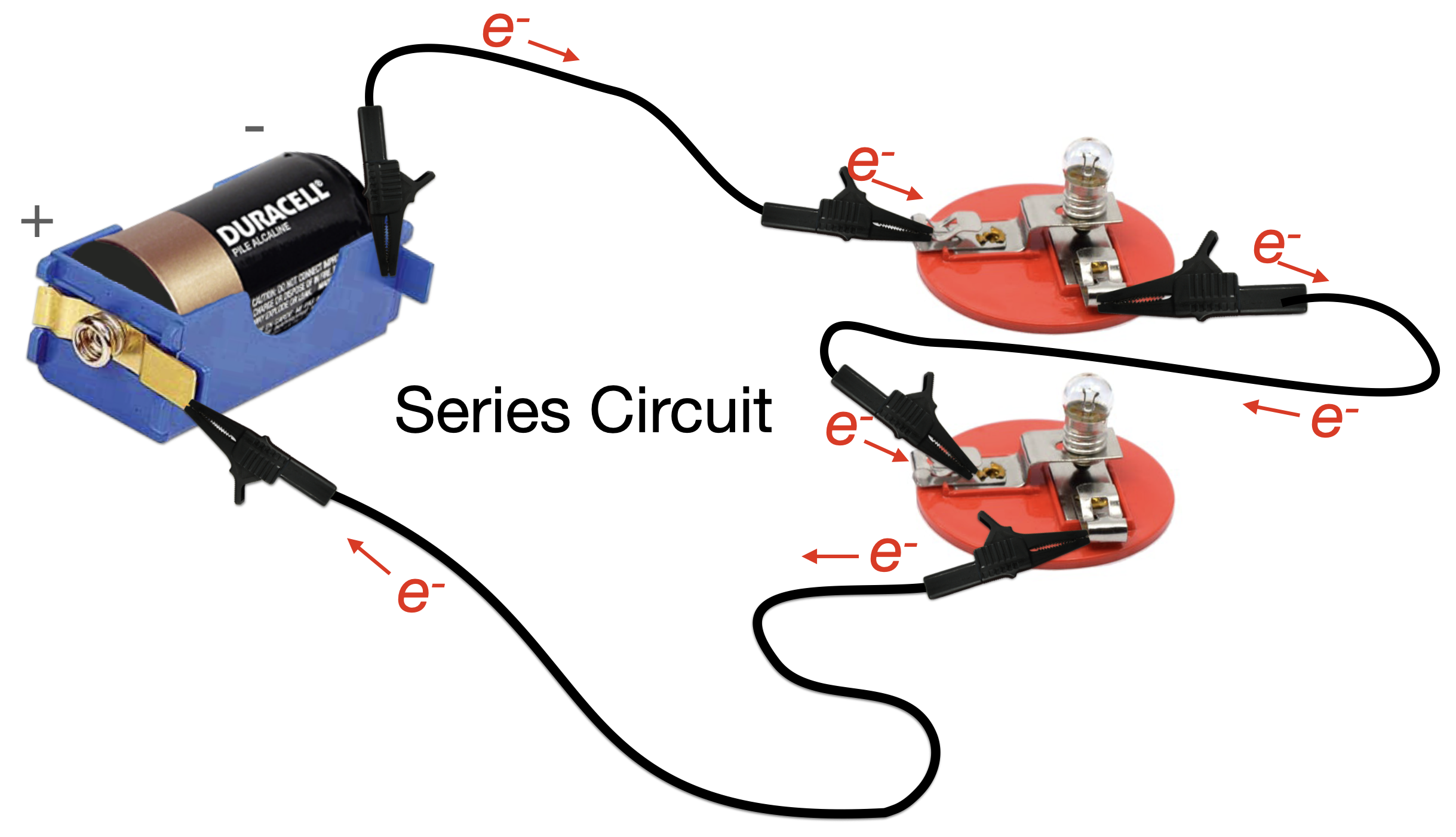
Trial 1 introduced students to the basic materials needed to create a circuit. Electricity must flow in a continuous path for a circuit to function. Students used the light bulb as an indicator that their circuits were complete. In Trial 2, students will create a series circuit to further explore the concept that electricity is a flow of electrons. In order for both bulbs in a series circuit to glow, the electrons must enter the first bulb, flow through the filament, and exit the bulb in order to then pass into the second bulb. This trial demonstrates that the electrons flow through the first bulb rather than the energy being consumed.
The trial also allows students to observe multiple conversions of energy from one form to another. As students complete this trial, they will answer the following question:
-
-
- How does electricity flow in a series circuit?
-
a. Begin this trial by asking students: Why do you think the light bulb glowed during Trial 1? Student answers may vary. The bulb glowed because electrons were flowing through the filament.
b. Listen carefully to student responses. Key phrases such as “burn electricity” or “use up all the electricity” may indicate students harbor a misconception that the electricity is actually consumed by the light bulb. This view may be created in part by hearing adults refer to energy consumption in reference to appliances or vehicles. Additionally, students may have difficulty accepting that electrons are in motion because the electrons themselves cannot be observed moving or entering the positive terminal of the battery.
c. Encourage students to express their views of electricity. Address student misconceptions by explaining that the light they see and the heat they feel are the results of electrons moving through the bulb’s filament. It may be helpful to engage students in the following brief activity:
-
-
- Direct students to rub their palms briskly together for 10 seconds. Ask students: How do your hands feel? Students should indicate that their palms feel much warmer than before they rubbed them together.
- Explain to students that when electrons move through the tiny filament, they rub against the filament’s molecules, producing heat. The heat makes the filament glow, producing the light that they see. The electrons must move through the filament in order for it to produce light.
-
d. Ask students: What do you think will happen if you put another light bulb in the circuit? Why? Student answers will vary.
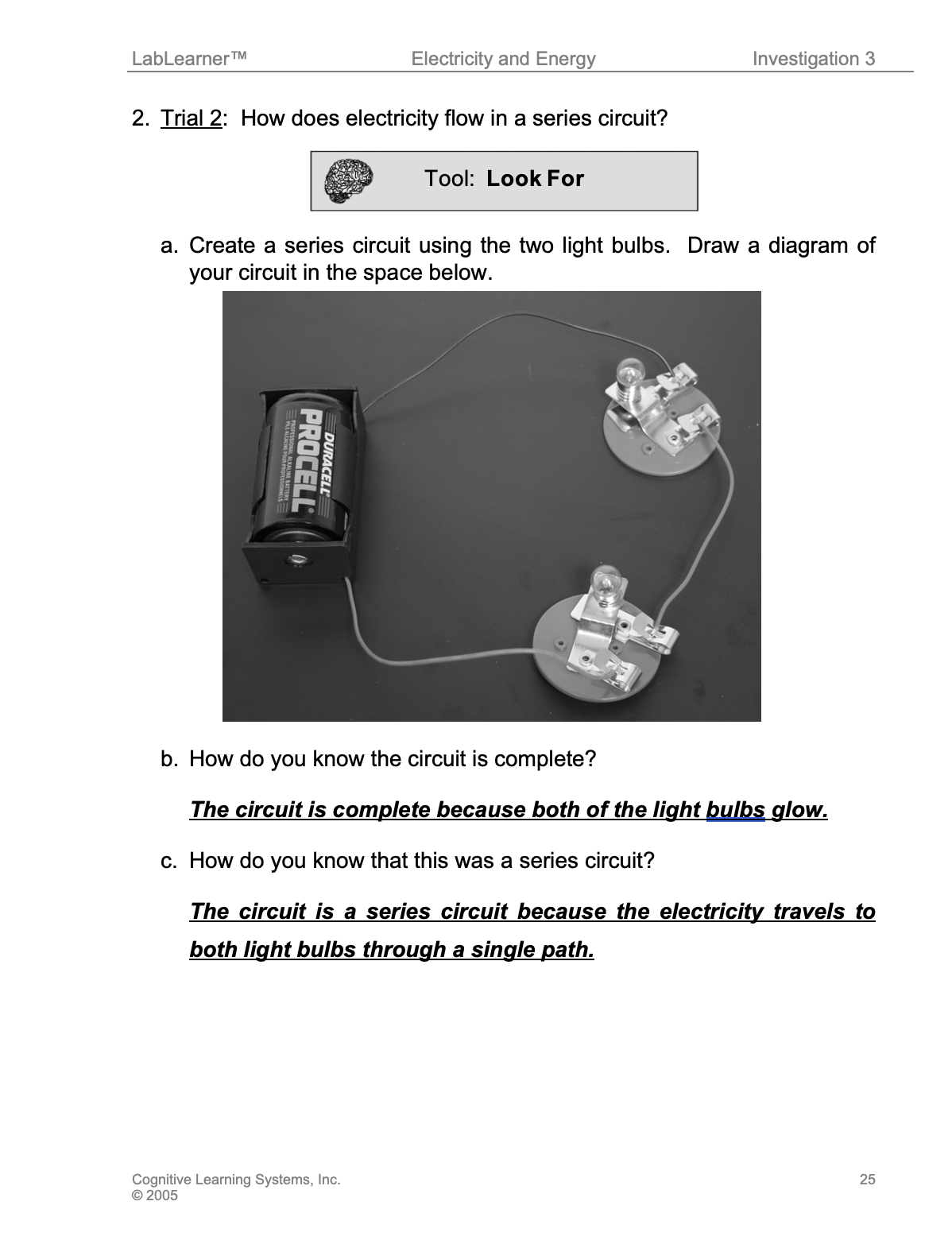
e. Direct students to create a series circuit as instructed in Problem 2a of their Student Data Record and draw a diagram of their completed circuit. Provide approximately 5-10 minutes for students to create their circuits.
f. Direct students to answer Problems 2b and 2c based on their results.
Trial 3
In Trial 2, students created a series circuit. This allowed students to see that electricity must flow through the light bulbs’ filaments in order for the bulbs to produce light, rather than the light bulbs consuming the electricity.
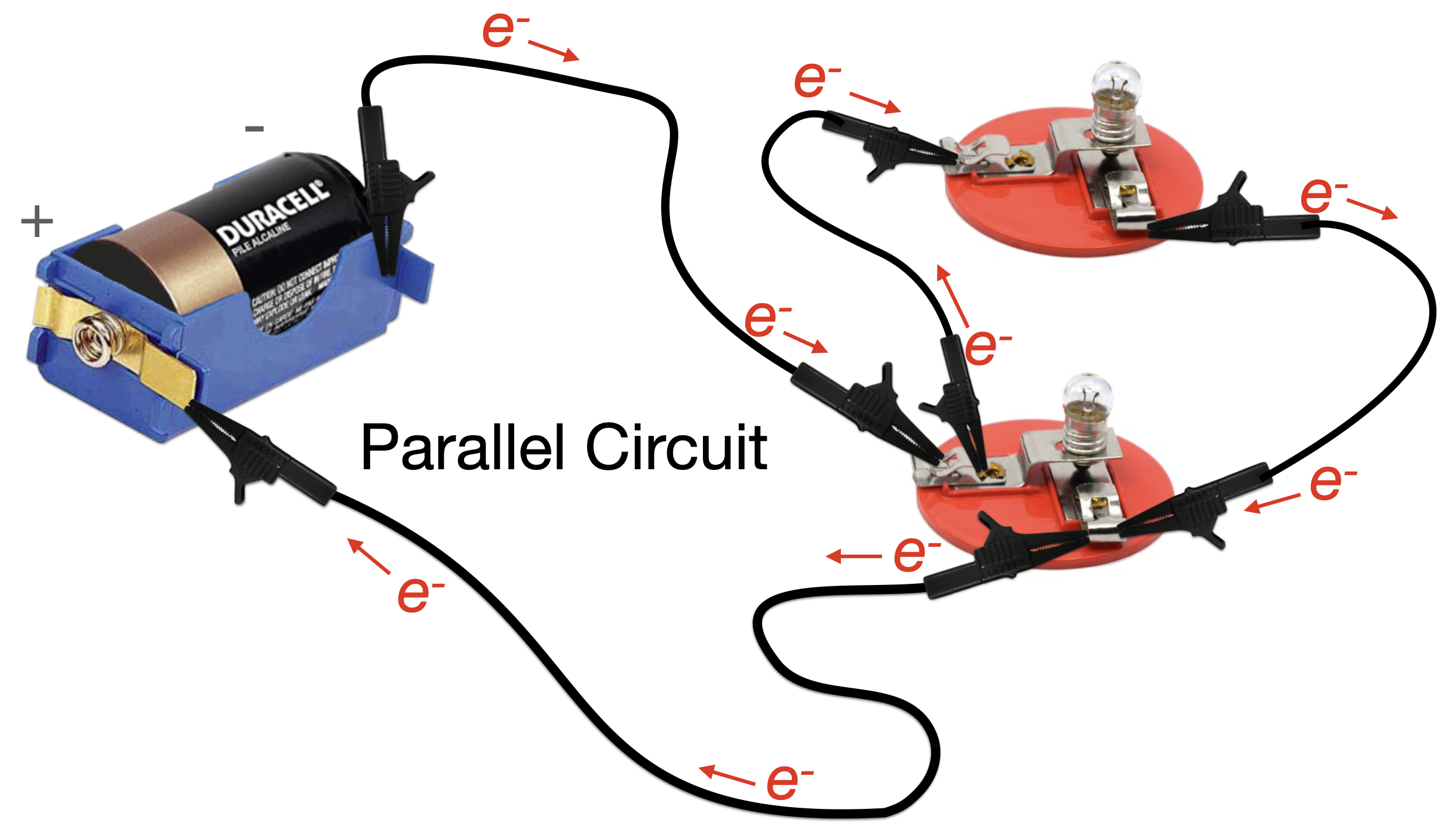
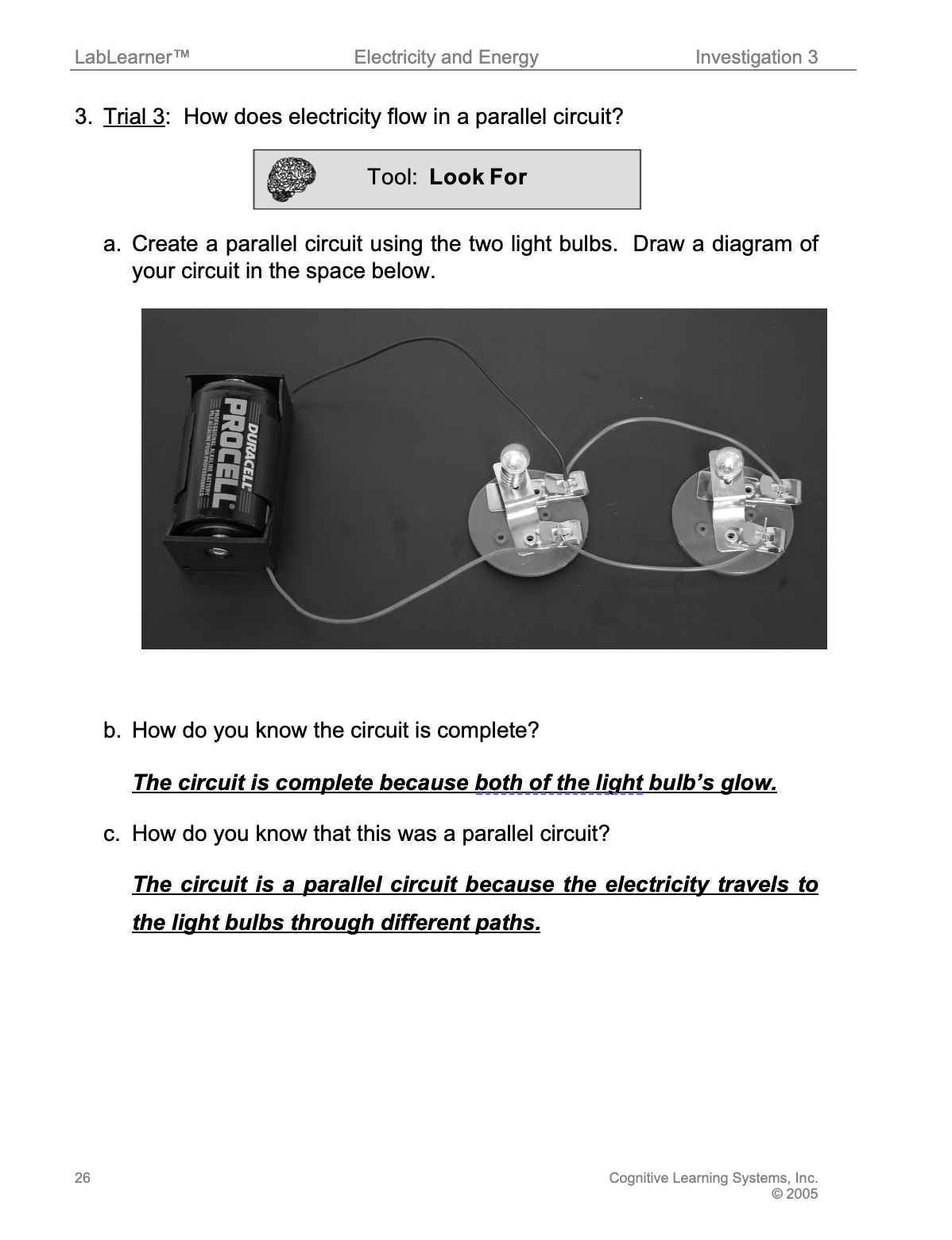
In Trial 3, students will explore the ability of electricity to flow through multiple paths. In a parallel circuit, there is a direct path from the battery to each light bulb. Thus, each bulb is connected directly to the battery.
Electricity must flow through the first light bulb in a series circuit before it can reach the second bulb because the electricity has a single path through the circuit. As students complete this Trial, they will answer the following question:
-
-
- How does electricity flow in a parallel circuit?
-
g. Ask students: How does electricity flow in a series circuit? In a series circuit, the electricity flows through a single path.
h. Ask students: Do you think electricity flows differently in a parallel circuit? Student answers will vary.
i. Direct students to create a parallel circuit as instructed in Problem 3a of their Student Data Record. Provide approximately 5 – 10 minutes for completion of the circuits.
j. Direct students to use their results to answer Problems 3b and 3c.
Trial 4
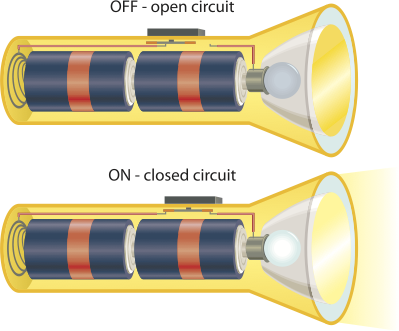
In Trials 1 through 3, students investigated the flow of electricity through circuits that required wires and used a single battery. In Trial 4, students will consider whether wires must be present to have a complete circuit. Students will disassemble a flashlight and compare the components of the flashlight circuit to the components of the circuits they created with wires.
Students will discover that batteries make electricity portable and convenient. Students will also discover that a flashlight is a circuit encased in an insulating material, providing them an opportunity to consider the importance of insulators and conductors. As students complete this trial, they will answer the following question:
-
-
- How does a flashlight work? Does a circuit need wires to be complete?
-
CLEAN UP
Ask students to clean up their bench after finishing their investigations.
KEYS

CLEAN UP
Let students know your expectations for clean-up. Ask them to clean up.