
Teacher Portal:
Examining Exercise
Investigation 4
Investigation Four:
Adopting a Healthy Lifestyle
Investigations One through Three introduced students to the concepts that physical fitness involves multiple body systems, and that the cardiovascular, respiratory, and musculoskeletal systems are interdependent on one another. All three systems depend on an adequate supply of nutrients to function effectively and to meet the needs of other systems in the body. Investigation Four will introduce students to the role the digestive system plays in meeting the needs of the other three systems. Students will also explore the concept of energy balance and how it is maintained through exercise and proper nutrition.
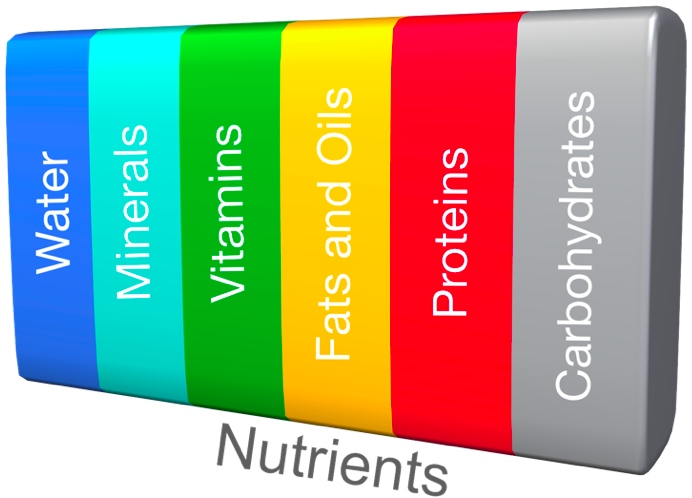
Nutrition is a collective term that refers to all the mechanical and chemical actions used by the body to obtain, process, and use the chemicals it needs for maintenance, growth, and activity. Nutrition also refers to the movement of these chemicals to the cells and the removal of waste products resulting from metabolism.  These chemicals are called nutrients. Nutrients can be divided into six classes: water, proteins, carbohydrates, fats and oils, vitamins, and minerals.
Water
The human body contains a significant amount of water, and virtually all chemical reactions in the body require water to proceed. In fact, a human body contains about 65% water by weight!
Water also helps regulate body temperature, provide structure to cells, eliminate waste products, and plays major roles in vision and hearing. The inside of the eyeball is filled with a fluid that consists of 98% water, for example.
Macronutrients
As we will soon see, minerals and vitamins are needed by the body in extremely small amounts. On the other hand, proteins, charbohydrates, and fats and oils (also called lipids) are required in our diet in much larger amounts and are sometimes called macronutrients. Proteins are found in bone, muscle, enzymes, hormones, and soft tissues. Carbohydrates are used for producing and storing energy, and are components of organs and other body structures. Fats and oils are major components of cell membranes. They are also used for storing energy and making certain hormones.
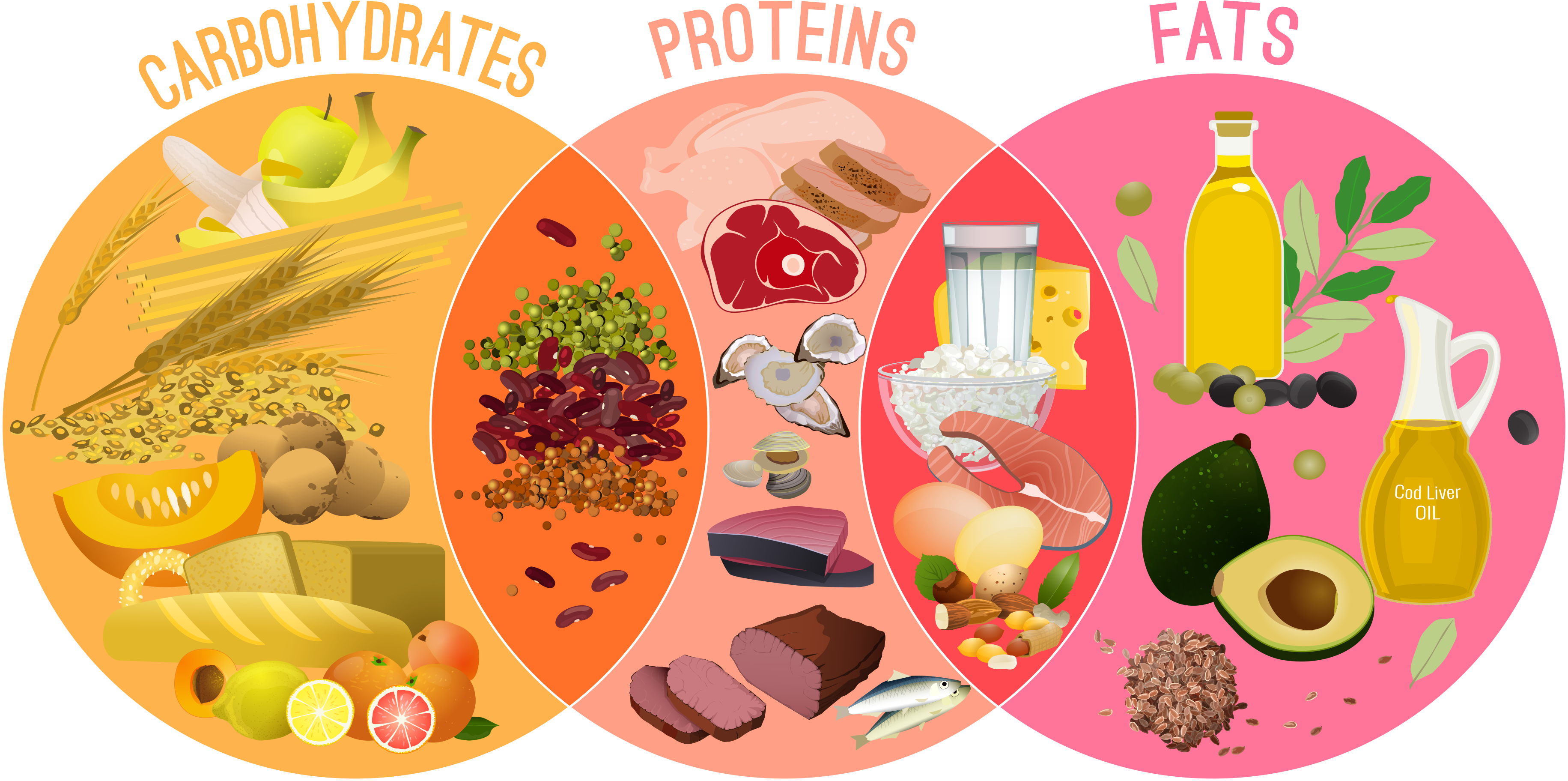
The macronutrients are shown in the graphic above. Notice the overlap between the three groups. For example, you can see that a number of beans are found between the carbohydrate and protein groups. This is because they are a great source for both of these nutrients. There is an overlap shown between proteins and fats as well. Dairy products (eggs, milk, cheese, yogurt, etc.), for example contain both proteins and fats. Furthermore, various vitamins and minerals are also found in all of the macronutrient groups.
Vitamins and Minerials
Vitamins and minerals are needed in very small amounts by the body but are critical for health. Vitamins play active roles in metabolism, protection of other body chemicals, and even in vision. Minerals also are important structural components of the body, and are involved in nerve activity, muscle contraction, and metabolism.
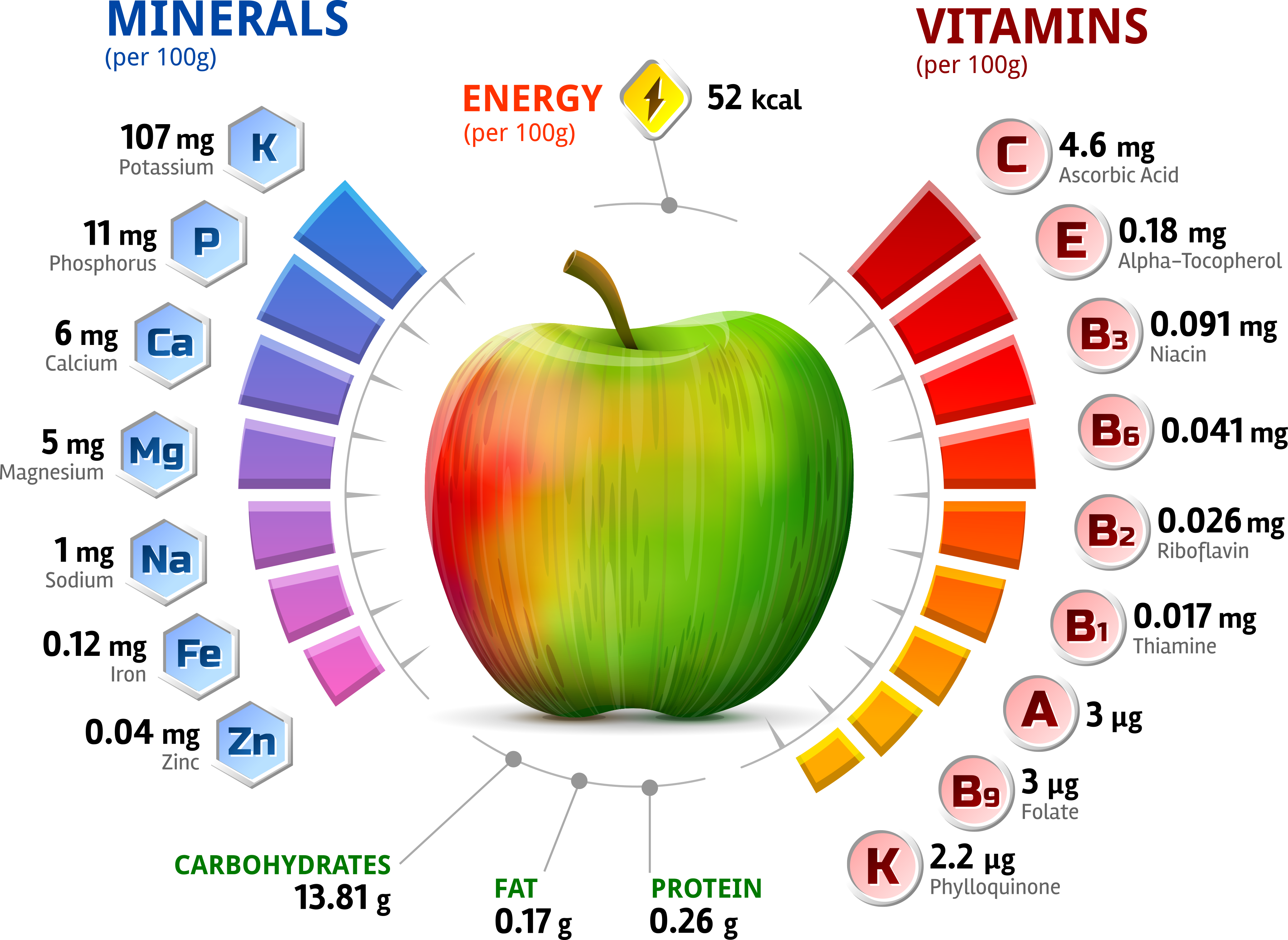
In the graphic below, the minerals and vitamins found in a small apple are listed. Notice that all of the minerials and vitamins amounts are given in milligrams (mg) or micrograms (ug), whereas the protein, fat, and carbohydrates (the macronutrients) are given in grams (g). As you may recall, there are 1,000 milligrams and 1,000,000 micrograms in a single gram! Nonetheless, dispite their extreemly small amounts, the minerials and vitamins are absolutely essential for health.
The Digestive System
The digestive system is responsible for obtaining and digesting food for the purpose of supplying nutrients and energy to the remainder of the body. The process of digestion is both mechanical and chemical, and both forms of digestion begin in the mouth. Food that enters the mouth is broken down into smaller particles and mixed with saliva as it is chewed. Saliva serves as a lubricant and a source of starch-digesting enzymes. Enzymes are special proteins that speed up chemical reactions. Once swallowed, food enters the esophagus and then the stomach, a highly acidic environment where enzymes begin digesting other nutrients.
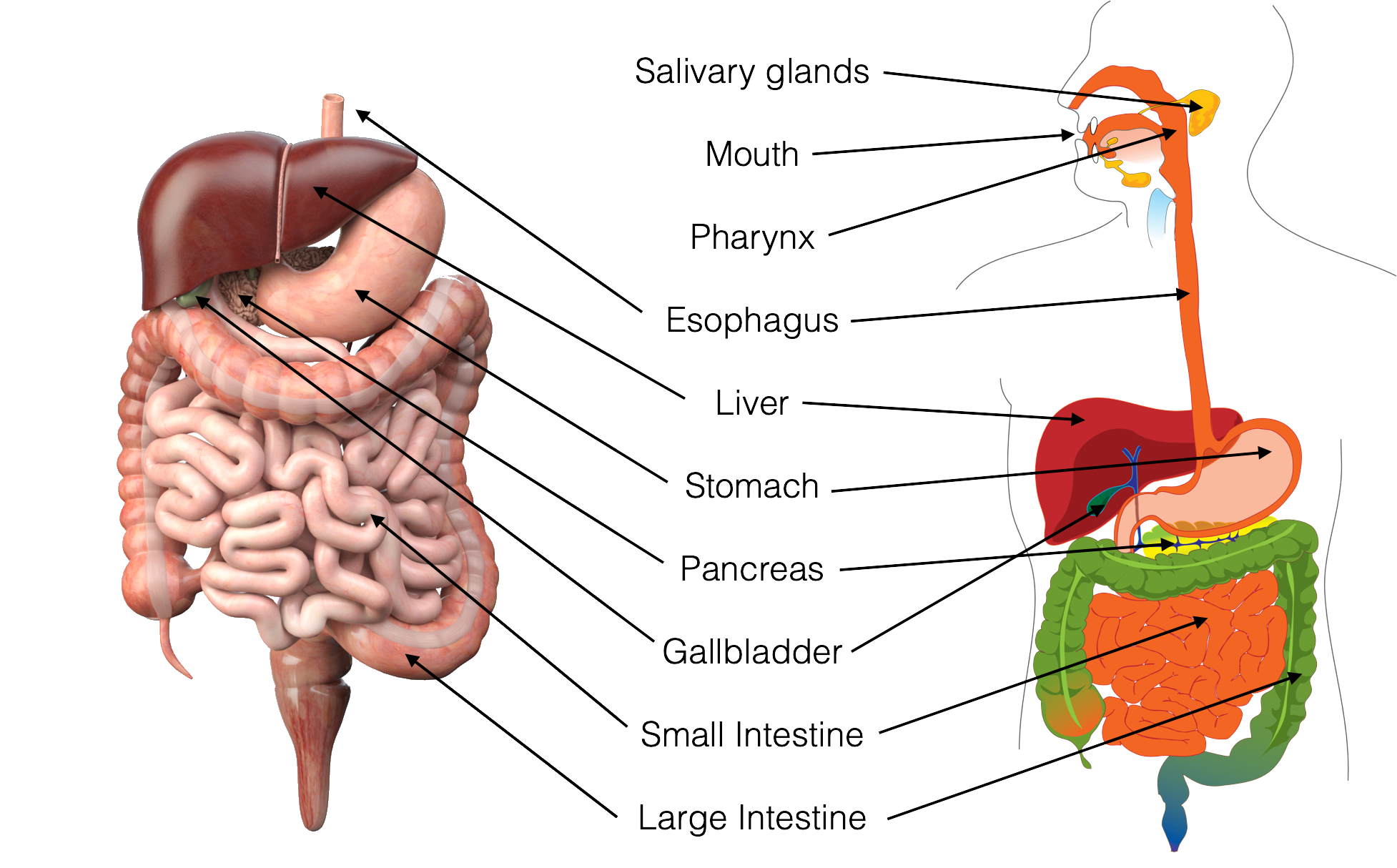
From there food moves into the small intestine, which is the major site of both digestion and absorption. The small intestine is lined with tiny finger-like projections called villi that greatly increase the amount of intestinal surface that comes in contact with nutrients, allowing more nutrients to be absorbed than a smooth surface would allow. Any undigested food and unabsorbed nutrients pass through the large intestine for a last chance at absorption before being expelled as waste. Most water is absorbed here, along with B vitamins and vitamin C.
Energy
Although all nutrients are important, a significant role of digestion is to provide chemical energy for the body. Carbohydrates are the primary source of chemical energy for the body, with fats serving as energy storage. Fats are used as energy after muscles and other tissues use the body’s carbohydrate supply. The body is also capable of breaking down proteins for energy when needed. Thus food is considered energy input. Notice that the amount of carbohydrates, fats, and proteins in the apple nutrient example above are 13.81 g, 0.17 g, and 0.26 g, respectively per 100 g of apple and that combined, these nutrients provide a total of 50 ckal (kilocalorie) of energy. This amount of energy per 100 g of nutrients for an apple is compared to other examples of food in the chart below:
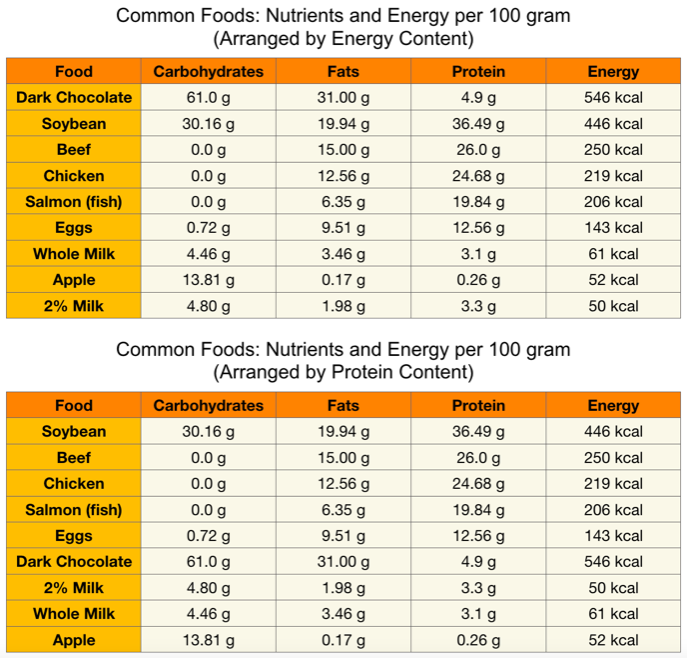
In this graphic, the example foods are arranged in two different ways. On the top, the foods are arranged in the highest to lowest amount of energy contained in 100 grams of the product. The bottom chart contain exactly the same information but is arranged in the highest to lowest amount of protein per 00 grams of product. Thus, while chocolate may provide a lot of energy, it contain relatively less protein. Therefore, while the energy may be immediately used in exertion and exercise, it is of much less use in building muscle. It is the differences in food nutrient content that must be taken into account when designing a balanced and healthy diet.
Uses of Energy by the Body
The energy released by the breakdown (digestion) of these three types of nutrients (carbohydrates, fats, and protein) is used for survival and for activity. The energy devoted to the involuntary actions involved in the body’s day-to-day survival is called the energy of maintenance or basal metabolism. The rate at which these maintenance functions use energy is called basal metabolic rate.
Maintenance functions include brain and nerve activity, contraction of smooth and cardiac muscle, the energy needed for building and repairing cells and tissues, and other activities of the body which are not under a person’s conscious control. Energy used for voluntary activity is that energy expended beyond what is needed for maintenance. This energy is mostly used by skeletal muscle during physical activity, but also is used for active thinking!
The total energy needed for maintenance and activity together is called energy output. Ideally, the body should be in a state of energy balance—energy input should be equal to energy output. This can be stated as “energy input minus energy output equals energy balance”. Therefore, when the units of energy input equal the units of energy output, energy balance mathematically equals “0”.

Energy balance is achieved through a combination of healthy food choices and adequate amounts of physical activity. When energy input exceeds energy output, the body is in positive energy balance and excess energy is stored as fat. When energy input is less than energy output, fat stores are used and the body is in negative energy balance. A physically fit person maintains energy balance in their body by making healthy food choices and engaging in physical activities that actively use energy.

In Investigation Four, students will review the role of the digestive system in nutrient absorption and perform experiments to examine how food choices and level of physical activity determine a person’s energy balance.
Examining Exercise: Investigation 4 - Mathematics Concepts
Prelab
- Calculate rate
- Counting
- Time in seconds and minutes
- Multiplication
- Data table
Lab
- Data table
- Mass in grams
- Greater than, Less than, Equal to
- Compare (non)measurable characteristics
- Addition
- Subtraction
- Time in minutes
Postlab
- Calculate rate
- Counting
- Time in seconds and minutes
- Multiplication
- Data table
- Compare (non)measurable characteristics
- Greater than, Less than, Equal to
- Bar graph
Examining Exercise: Investigation 4 - Procedural Tools

Examining Exercise: Investigation 4 - Cognitive Tools

Examining Exercise:
Investigation 4 Quiz

