
Teacher Portal:
Examining Exercise
Investigation 2
Investigation Two:
Exercise and Fitness
Investigation One introduced students to the cardiovascular and respiratory systems, demonstrated how heart rate is measured, and emphasized the interdependence of the systems in providing oxygen to the body during times of rest and activity. Investigation Two expands on the concepts of cardiovascular and respiratory interdependence by introducing the use of heart rate, breathing rate, and cardiac output as measures of cardiovascular and respiratory fitness.
Exercise
When a person exercises, muscles have to work harder and faster. As a result, their demand for oxygen and nutrients for energy increases. To meet this demand, the cardiovascular system has to make adjustments to increase the flow of blood to the muscles. Several factors are involved in this process. The heart rate increases, increasing the rate of blood flow. Increases in muscle metabolism cause blood vessels in the muscle to dilate, increasing the amount of blood reaching the muscle. Blood flow also increases dramatically in the lungs. During the resting state, many capillaries experience very little flow, or even lie 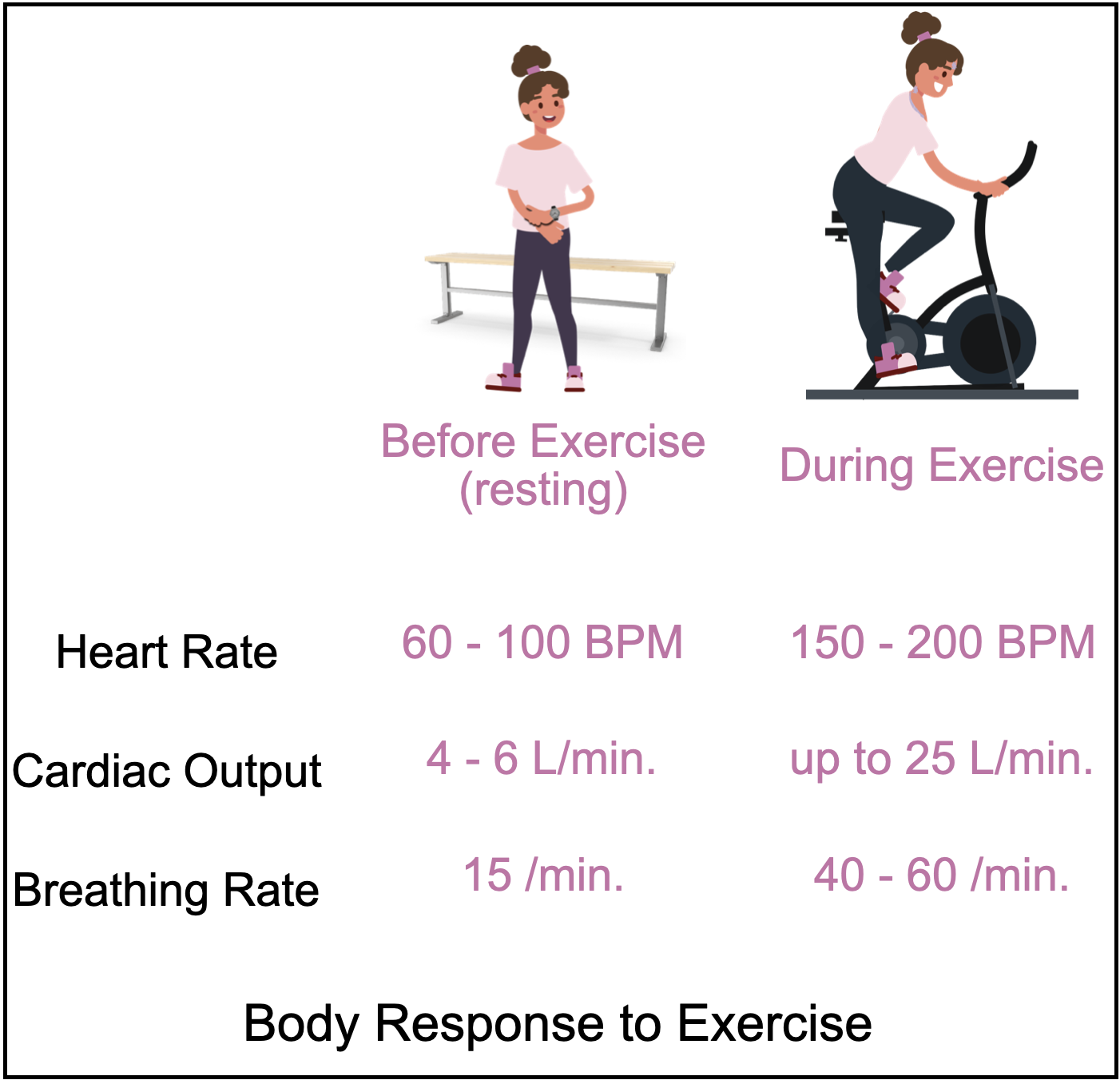 dormant. As the changes in blood flow and pressure occur in response to exercise, flow in these pulmonary capillaries reaches maximum level. In other words, more blood travels into the capillaries of the lungs. This increases the amount of blood that can be exposed to the oxygen diffusing from the lung alveoli and results in increases in the oxygen that moves from the lungs into the blood.
Exercise also produces changes in the respiratory system. In addition to the increase in blood flow through the pulmonary vessels, the respiratory rate and volume also change. During exercise breathing becomes deeper and respiratory rate increases, increasing the amount of oxygenated air that reaches the lungs.
Athletes
Over time, athletes who use endurance training techniques experience an increase in the size of the left ventricle of the heart and an accompanying increase in the volume of the left ventricle, so that the heart can 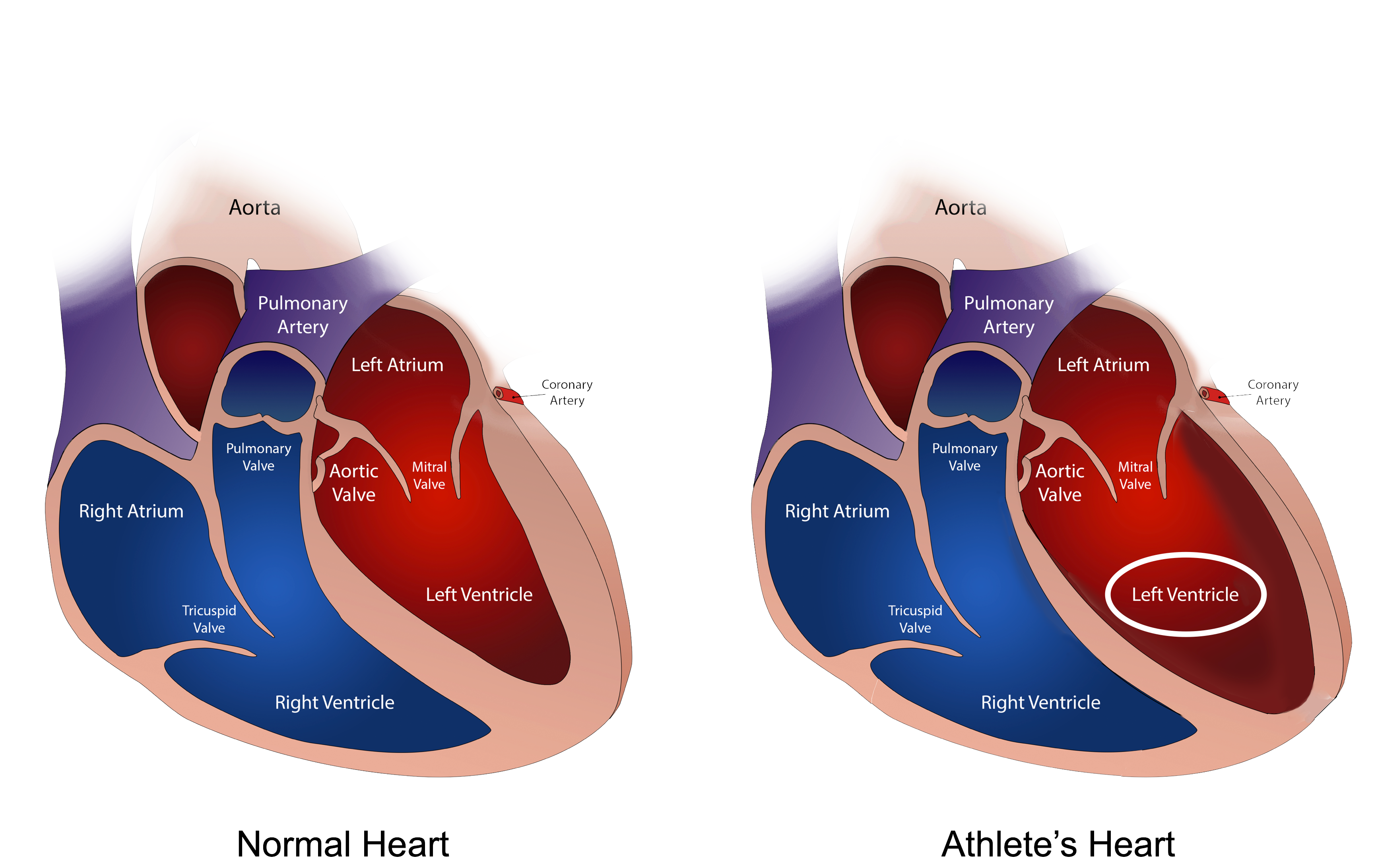 pump more blood per beat. This translates to an increase in the heart’s efficiency and a decrease in resting heart rate because the heart is able to pump the same volume of blood per minute with fewer beats. Marathon runners show the greatest increase in heart size and volume because of the length and intensity of their workouts. In other words, the heart muscle responds to exercise in ways similar to other muscles by getting stronger and larger.
Scientists describe the total volume of what the heart pumps during a one-minute period as cardiac output. When at rest, trained athletes and people who do not regularly participate in cardiovascular exercise have approximately the same cardiac output, about 5,000 ml (5 L) of blood per minute. However, the heart rate of the trained athlete may be as low as 55 beats per minute because his/her heart may pump as much as 90 ml of blood with each beat (about 5 L/min.) as a result of the increased size and volume of the left ventricle produced by training. In comparison, the person who does not exercise regularly would still have the same cardiac output but may have a heart rate of approximately 72 beats per minute because his/her heart would only pump as little as 69 ml of blood with each beat, again about 5 L/min.
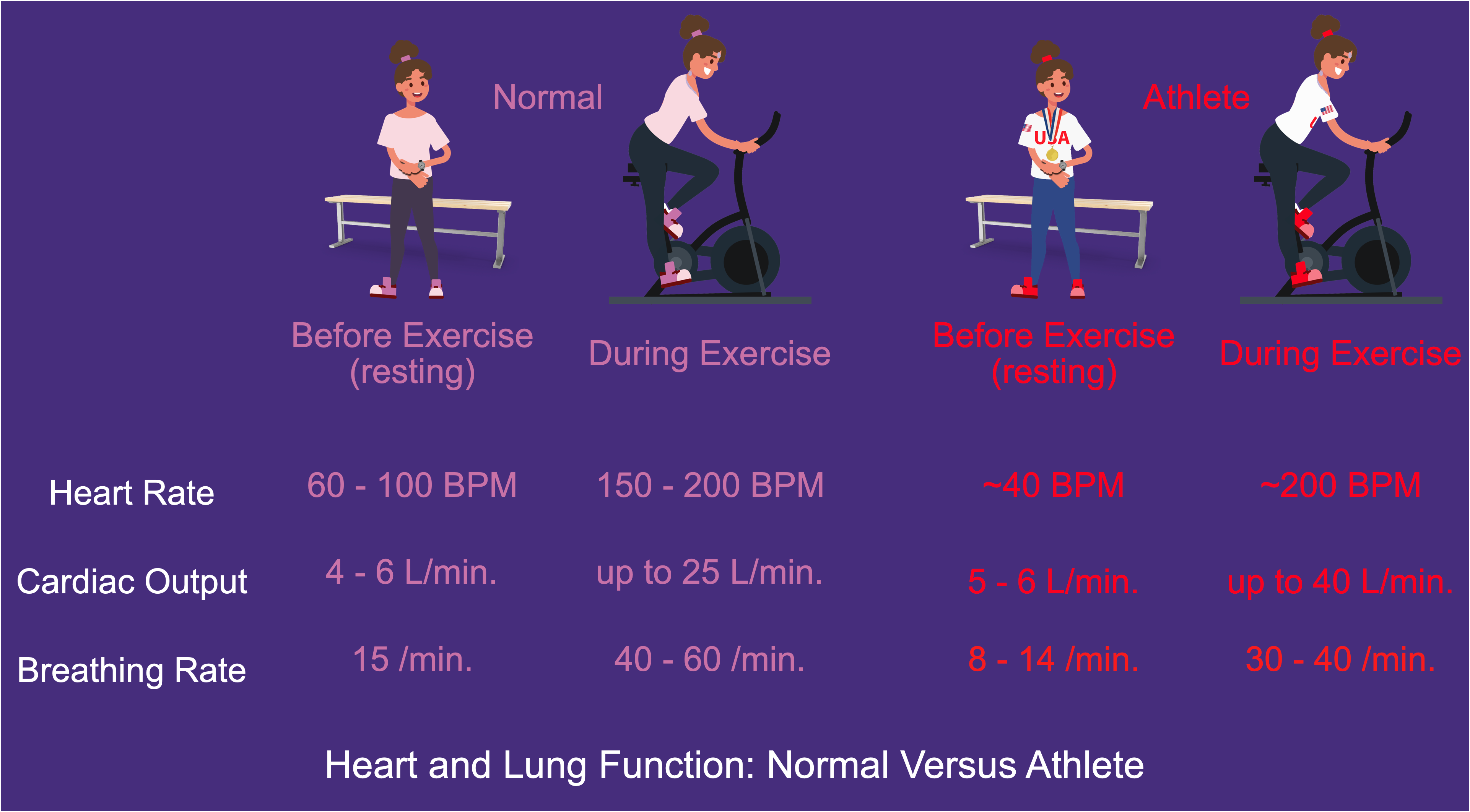
Over a lifetime, the decrease in resting heart rate for the trained athlete translates into significantly less work and less stress for the heart. In addition to the benefits during rest, the increase in the size of the left ventricle also offers advantages during any type of light, moderate, or vigorous activity. When the cardiac output of trained athletes and people who do not regularly exercise are compared, the cardiac output of the trained athlete is greater than that of the untrained individual when their heart rates are the same. For example, if both the trained and untrained athletes exercise so that their heart rate reaches 100 beats per minute, the trained athlete will be able to pump as much as 9L/min. while the untrained athlete may only pump 6 to 7 L/min. This occurs because the heart of the trained athlete may pump as much as 90 ml with each beat, but the heart of the untrained athlete pumps as little as 69 ml with each beat.
 Added to the other adjustments of the cardiovascular system, such as an increase in heart rate and dilation of blood vessels in muscles, the amount of blood flowing through the muscles is about 25 times greater in a trained athlete during exercise than during rest. Training, however, need not be thought of only in terms of Olympic athletes. The changes in left ventricular volume and resting heart rate can be seen after five to six weeks of regular cardiovascular exercise (30 minutes of exercise, three to five days per week)!
The experiments in Investigation Two are designed to demonstrate to students the changes that occur in heart rate and respiration during exercise, to illustrate the long-term changes in the heart and cardiovascular system as a result of regular cardiovascular exercise, and to promote exercise as a method of improving cardiovascular and respiratory fitness and endurance throughout life.
Examining Exercise: Investigation 2 - Mathematics Concepts
Prelab
- Counting
- Time in seconds and minutes
- Calculate rate
- Data table
- Compare (non)measurable characteristics
- Greater than, Less than, Equal to
- Calculate averages/mean
- Multiplication
- Division
- Addition
- Money
Lab
- Counting
- Time in seconds and minutes
- Calculate rate
- Multiplication
- Compare (non)measurable characteristics
- Greater than, Less than, Equal to
- Volume in mL
- Metric unit conversion
Postlab
- Data table
- Time in seconds and minutes
- Calculate rate
- Line graph
- Compare (non)measurable characteristics
- Greater than, Less than, Equal to
- (In)direct relationships
- Volume in mL
- Division
Examining Exercise: Investigation 2 - Procedural Tools

Examining Exercise: Investigation 2 - Cognitive Tools

Examining Exercise:
Investigation 2 Quiz

